Quick answer
The best Codex GEO skill in 2026 is not a one-line prompt that asks an agent to "make this article rank in AI search." It is a repeatable workflow skill that makes Codex gather current sources, turn a brand's claims into citable answer blocks, check crawl and citation readiness, create publish-ready assets, and measure whether AI answer engines mention the brand afterward.
That matters because GEO work has moved from content advice into operations. A team does not need another vague checklist. It needs a skill that Codex can run the same way every time, with enough guardrails to avoid fake sources, stale claims, missing images, weak metadata, and unmeasured outcomes.
For an Auspia-style growth team, the winning pattern is simple: research first, structure for extraction, publish with evidence, then measure AI visibility. Codex skills are a good fit because OpenAI's documentation describes them as reusable workflow packages with instructions, resources, and optional scripts that Codex loads when the task matches the skill. In other words, a good GEO skill becomes a small operating system for AI search work.
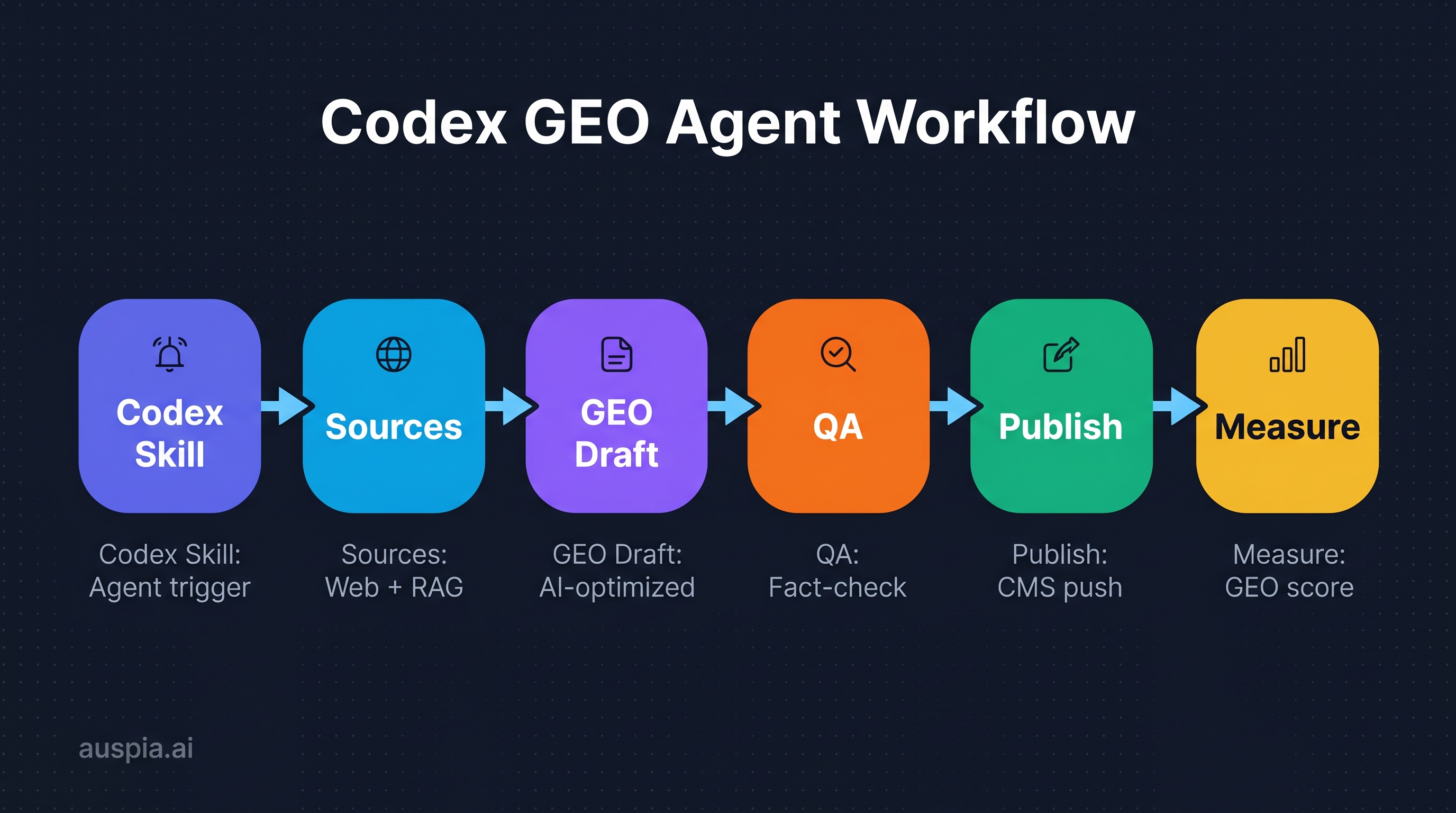
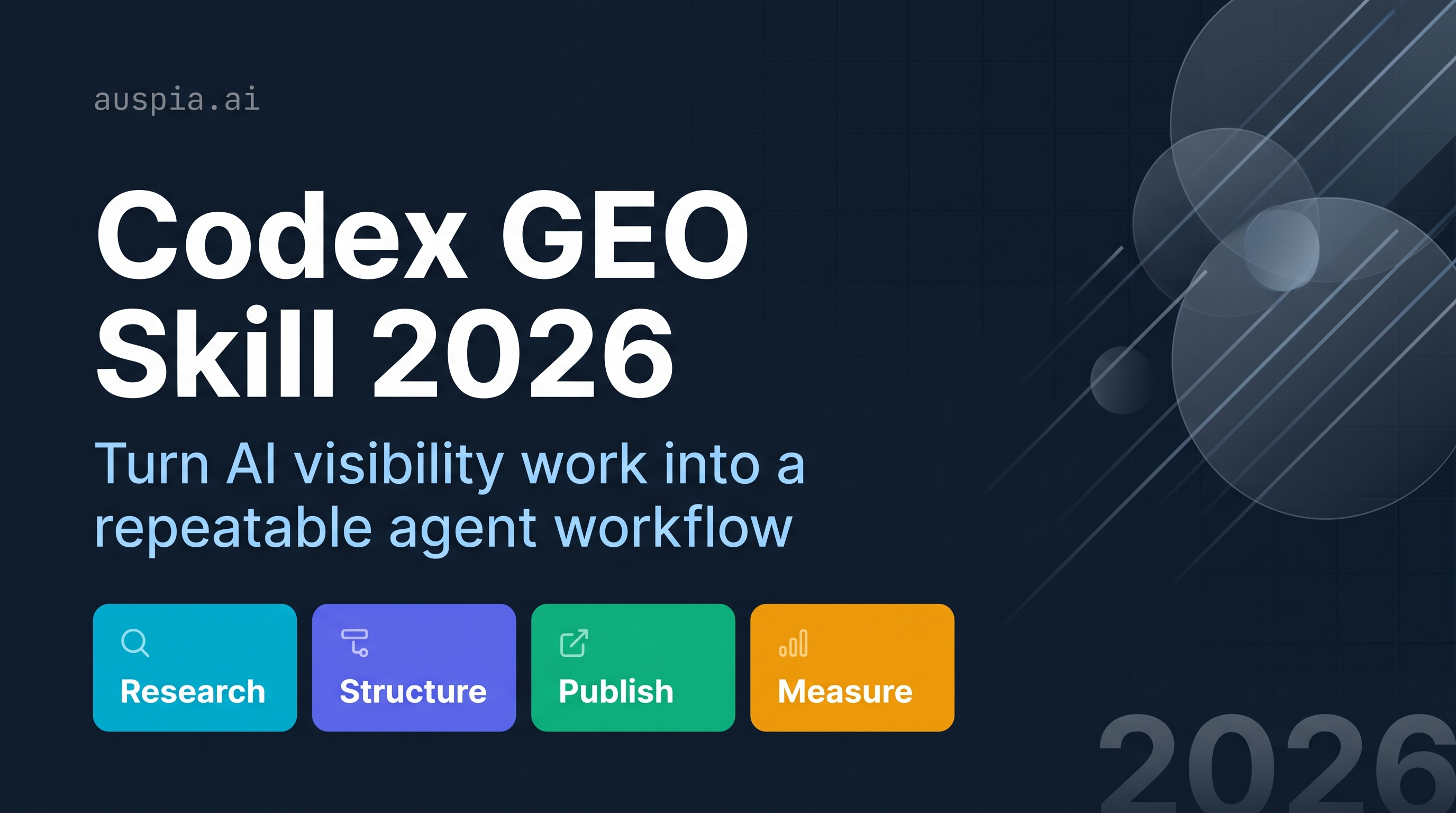
The practical Codex GEO workflow: source gathering, answer design, QA, publishing, and measurement in one repeatable loop.
Why Codex skills fit GEO work
OpenAI's Codex documentation describes skills as task-specific packages that include instructions, resources, and optional scripts. Codex starts with only the skill name, description, and path, then reads the full SKILL.md when it decides the skill is relevant. This is useful for GEO because the workflow is too detailed to keep in every prompt, but too important to leave to memory.
A GEO workflow usually needs several steps:
- Find current sources and cite them accurately.
- Identify the buyer questions that AI answer engines are likely to answer.
- Rewrite pages into short, extractable answer blocks.
- Add entity facts, tables, FAQs, schema notes, and internal links.
- Produce images or diagrams that help humans understand the argument.
- Publish with metadata, category, tags, and social image fields.
- Measure brand mentions, citation frequency, sentiment, and prompt coverage.
A normal prompt can forget one of those steps. A Codex skill can make them mandatory.
This is the difference between using Codex as a fast writer and using Codex as an operator. The writer produces copy. The operator checks the sources, looks for missing evidence, prepares the post for the CMS, and leaves a measurement trail.
The best Codex GEO skill should do five jobs
A useful Codex GEO skill should not try to "optimize everything." The better design is narrower: make Codex execute the work that a growth team repeats every week.
Job | What the skill should force Codex to do | Why it matters for GEO |
|---|---|---|
Research | Search current sources, official docs, SERPs, competitor pages, and internal material | AI search moves quickly, and stale claims weaken trust |
Extract | Turn the topic into direct answers, entity facts, comparison tables, and FAQs | AI systems need clear units they can quote or summarize |
Validate | Check crawlability, robots rules, source attribution, metadata, and unsupported claims | GEO fails when content cannot be reached or trusted |
Publish | Prepare the article, images, taxonomy, OG image, and internal links | A good draft still fails if publishing fields are incomplete |
Measure | Build a prompt set and record AI visibility over time | GEO without measurement is just content production |
The "best" skill is the one that closes this loop. It may use other tools, but it should own the workflow.
What to put inside the skill
A strong Codex GEO skill starts with a focused SKILL.md. The description should say exactly when the skill should trigger, because Codex uses descriptions to decide when to load full instructions. Avoid a description like "helps with SEO." Use something closer to this:
---
name: codex-geo-operator
description: Use when creating, refreshing, auditing, or publishing content for GEO, AI search visibility, AI citations, ChatGPT visibility, Perplexity visibility, Google AI Overviews, or answer-engine optimization.
---
Then the body should define the workflow. A practical structure looks like this:
1. Confirm the page goal, audience, brand, and target AI answer surfaces.
2. Research current facts and official sources before drafting.
3. Build a prompt library of buyer questions and comparison prompts.
4. Rewrite content into citable answer blocks, tables, and FAQ sections.
5. Add entity facts, internal links, schema notes, and image requirements.
6. Run a QA checklist for claims, citations, crawlability, and metadata.
7. Publish or prepare a CMS-ready package.
8. Create a measurement plan for brand mentions and citation tracking.
The skill can also include reference files. For example:
references/geo-checklist.mdfor the page-level QA checklist.references/prompt-library.mdfor reusable AI visibility prompts.references/source-policy.mdfor citation and evidence rules.references/publishing.mdfor CMS fields, taxonomy, and image requirements.scripts/for deterministic checks such as metadata validation or link audits.
This is where Codex skills become more reliable than copy-pasted prompts. You can keep the instructions small in the main file, then let Codex read the deeper reference only when the task needs it.
AGENTS.md, Skills, and MCP: use the right layer
A common mistake is putting everything into one surface. Codex has several layers, and each one should carry a different kind of instruction.
AGENTS.md is best for repository-level rules. The OpenAI Codex manual says Codex reads AGENTS.md before doing work and layers global and project-specific guidance. Use it for conventions that should apply to every task in a repo, such as build commands, style rules, file locations, or publishing safety rules.
Skills are best for reusable workflows. Put the GEO operating procedure in a skill because it should trigger only when Codex is doing GEO, AEO, AI search visibility, citation analysis, or content publishing work.
MCP is best for live tools and private data. OpenAI's documentation frames MCP as a way to connect models to third-party documentation, browsers, Figma, Sentry, GitHub, and similar tools. If the GEO skill needs live browser testing, Figma assets, an SEO database, or a CMS API, MCP or a script can provide that tool access.
The clean setup is:
Layer | Best use | GEO example |
|---|---|---|
| Durable repo rules | "Use this CMS route, do not hardcode tokens, run link checks before publishing" |
Codex skill | Repeatable workflow | "Research, draft, optimize, publish, and measure a GEO article" |
MCP/tool script | Live capability | "Fetch docs, inspect pages, upload images, query SEO metrics" |
Prompt | One-off intent | "Write this article for SaaS founders in English" |
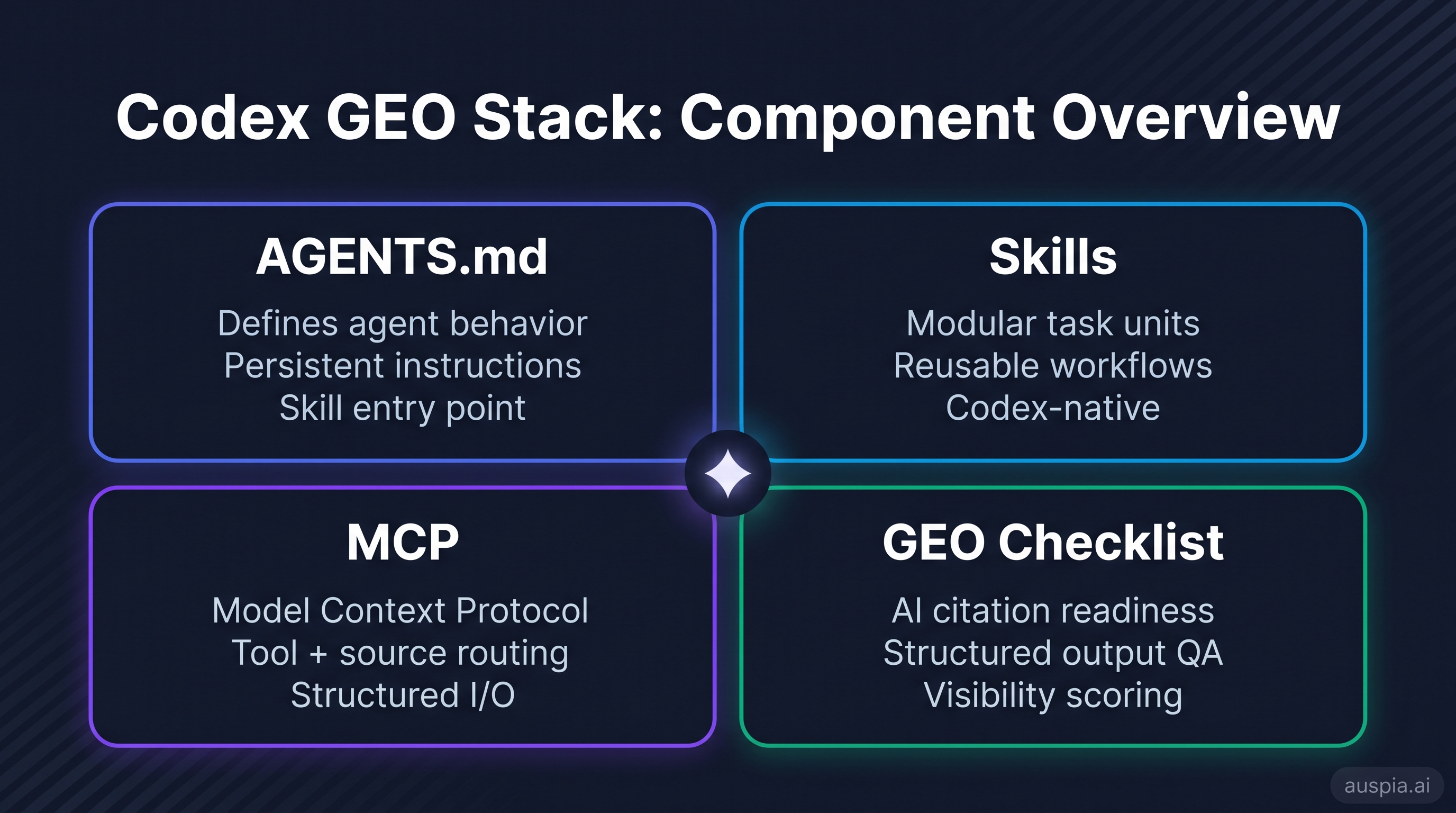
The stack works best when each layer has a narrow job instead of one giant prompt trying to control everything.
A Codex GEO skill template teams can adapt
Here is the practical version I would start from.
---
name: codex-geo-operator
description: Use for GEO, AEO, AI search visibility, AI citations, ChatGPT SEO, Perplexity SEO, Google AI Overviews, and publish-ready content optimization.
---

# Codex GEO Operator

## Goal
Create or improve pages so AI answer engines can understand, quote, cite, and recommend the brand accurately.

## Required workflow
1. Identify the target audience, page type, market, language, and conversion goal.
2. Research current sources. Prefer official docs, first-party data, live SERPs, and credible third-party sources.
3. Build a prompt set: informational prompts, comparison prompts, buying prompts, objection prompts, and local/vertical prompts.
4. Draft the page with a direct answer near the top, clear entity facts, comparison tables, and concise FAQ answers.
5. Add evidence. Every claim about rankings, market size, product capability, pricing, or current behavior needs a source or a clear label as an assumption.
6. Run GEO QA: crawlability, robots rules, schema notes, internal links, citation clarity, brand entity clarity, and image alt text.
7. Prepare publishing fields: title, slug, excerpt, meta description, category, tags, featured image, OG image, and inline visuals.
8. Prepare measurement: prompt list, baseline answers, citation screenshots, brand mention notes, and follow-up date.

## Refuse or pause when
- The task asks for fake citations.
- The source is outdated and no browsing or verification is allowed.
- The article needs images for publishing but no image generation or upload path is available.
- The CMS token or required taxonomy is missing.
This template is intentionally opinionated. It pushes Codex away from generic writing and toward an auditable publishing workflow.
How the skill improves AI search visibility
GEO is not magic formatting. The original GEO research paper, "GEO: Generative Engine Optimization," argued that optimization methods can improve visibility in generative engines. The practical lesson for 2026 is less academic but more urgent: AI answer systems reward pages that are easy to retrieve, understand, compare, and cite.
That usually means the page needs:
- A short answer at the top that can stand alone.
- Consistent entity language for the brand, product, category, and audience.
- Evidence-backed claims instead of marketing adjectives.
- Tables that compare alternatives or summarize decisions.
- FAQs that answer real buyer questions.
- Fresh dates when the behavior of a tool, platform, or search surface may change.
- Crawlable HTML and metadata that do not block bots or AI features.
A Codex GEO skill turns those requirements into repeatable checks. It also reduces the common failure where a team publishes a polished article but forgets measurement. If the skill ends by creating a prompt library and baseline report, the team can compare AI answers next week, not just hope the post worked.
How Auspia would use this in a real workflow
For an Auspia-style AI traffic growth workflow, the Codex GEO skill should connect content production with visibility checks.
A practical weekly cycle could look like this:
- Use a prompt library to identify buyer questions where the brand is absent or misdescribed.
- Run the Codex GEO skill to create or refresh the most relevant page.
- Use the AI Search Visibility Checker to inspect how the brand appears across target prompts.
- Use the GEO Score Checker to diagnose page-level readiness.
- Publish the updated article with clear metadata, images, and internal links.
- Re-run the same prompts after indexing and record citation changes.
The important part is not one article. It is the loop. AI visibility grows when the team keeps improving the pages that answer buying questions, comparison questions, and trust questions.
What most teams get wrong
The first mistake is treating GEO as a writing style. They add a FAQ, mention ChatGPT, and call the page optimized. That is thin work.
The second mistake is using Codex without a source policy. Agents can draft quickly, but current platform behavior, product features, and AI search surfaces change. A GEO skill should force source gathering before drafting, especially for articles about tools, APIs, search features, pricing, or regulations.
The third mistake is skipping images and structured assets. A good diagram or matrix helps humans understand the article and gives the page more useful context. It also helps the article become a stronger asset for social sharing, internal enablement, and sales conversations.
The fourth mistake is publishing without measurement. A GEO project should have a prompt set, baseline answers, tracked competitors, and notes on citation quality. Otherwise, the team is optimizing in the dark.
Selection checklist: is this really a good Codex GEO skill?
Use this checklist before adopting or writing one:
- Does the skill have a narrow trigger description, or is it a vague "SEO helper"?
- Does it require current research before claims are written?
- Does it separate source gathering, drafting, QA, publishing, and measurement?
- Does it include rules for evidence, citations, and unsupported claims?
- Does it produce answer blocks, tables, FAQs, and image briefs, not only paragraphs?
- Does it know where CMS taxonomy, image upload, and OG image fields live?
- Does it create a prompt library for measuring AI visibility later?
- Does it know when to pause instead of publishing incomplete content?
If the answer is no to several of these, it is probably a content prompt wearing a skill costume.
Final take
The best Codex GEO skill in 2026 is an operator skill, not a writer skill. It should make Codex behave like a careful growth teammate: verify sources, build citable content, prepare assets, publish cleanly, and measure whether AI answer engines actually pick up the brand.
That is where skills have an edge. They keep the workflow close to the work, while AGENTS.md holds repo rules and MCP connects live tools. Used together, they give growth teams a practical way to turn GEO from a fuzzy recommendation into a repeatable system.
FAQ
What is a Codex GEO skill?
A Codex GEO skill is a reusable SKILL.md workflow that guides Codex through generative engine optimization tasks such as research, answer-block writing, citation checks, publishing, and AI visibility measurement.
Is a Codex skill better than AGENTS.md for GEO?
Use both. AGENTS.md is better for repository-wide rules. A Codex skill is better for a specific GEO workflow that should run only when the task involves AI search visibility, citations, AEO, or content optimization.
Does GEO replace SEO?
No. GEO builds on SEO. A page still needs crawlability, useful content, internal links, authority, and technical hygiene. GEO adds answer extraction, citation readiness, entity clarity, and AI visibility measurement.
What should a GEO skill measure?
It should measure brand mentions, citation frequency, citation quality, answer sentiment, competitor presence, and prompt coverage across target AI answer surfaces. Clicks are still useful, but they are not enough.
Can Codex publish GEO articles automatically?
Yes, if the workflow has safe access to the CMS, valid taxonomy, image upload paths, and source verification rules. The skill should pause when required fields, images, or credentials are missing.
Codex SEO/GEO learning path
This article is part of the Codex SEO/GEO operator series. If you are building the workflow from scratch, follow the sequence:
1. How to Use Codex for Automated GEO in 2026
2. How to Use Codex for Automated SEO
3. How to Set Up a Codex SEO Workspace with AGENTS.md
4. How to Connect Codex to SEO Data with MCP
5. The Best Codex GEO Skill in 2026
6. How to Build a Codex Skill for Keyword Clustering
7. How to Use Codex Subagents for SERP, Content, and Technical SEO
8. How to Use Codex for Technical SEO Fixes Without Breaking Production
9. How to Run Daily SEO/GEO Monitoring with Codex Automations
10. Codex SEO/GEO Quality Gates: Diff, Evidence, Tests, and Human Approval
11. How to Use Codex to Build and Deploy an SEO/GEO-Ready Website
Where to go next
Previous: How to Connect Codex to SEO Data with MCP
Next: How to Build a Codex Skill for Keyword Clustering
Sources
- OpenAI Codex documentation: Agent Skills
- OpenAI Codex documentation: Custom instructions with AGENTS.md
- OpenAI Codex documentation: Model Context Protocol
- Research paper: GEO: Generative Engine Optimization
- Google Search documentation: AI features and your website