Quick answer: the best GEO OpenClaw Agent Skill in 2026 is not a one-click writer
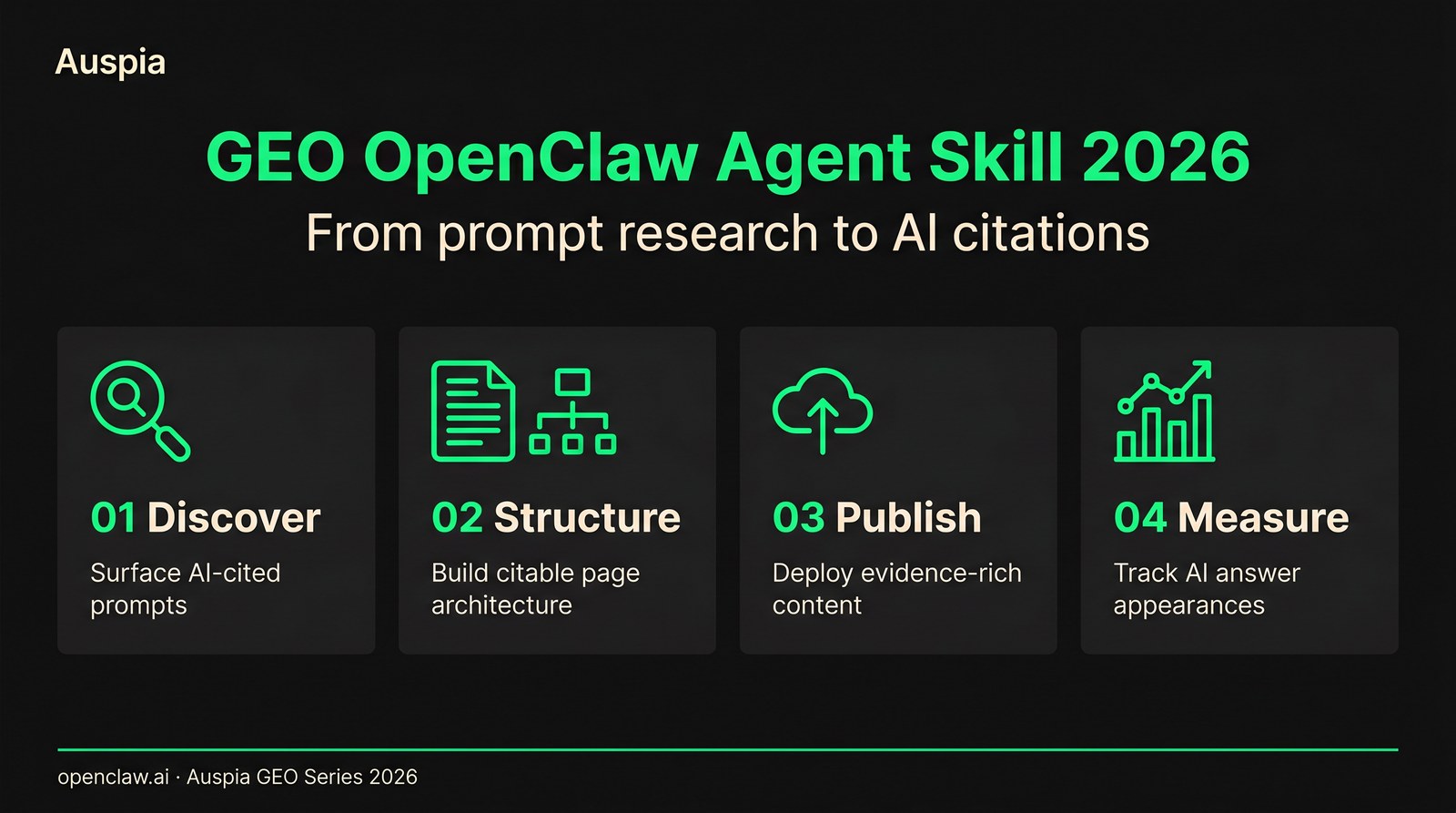
The best GEO OpenClaw Agent Skill for 2026 is a repeatable research-and-publishing workflow: it searches real buyer prompts, maps the sources AI systems already trust, turns that evidence into citeable pages, and measures whether the brand appears in AI answers afterward.
That sounds less glamorous than "press a button and rank in ChatGPT." It is also more useful. GEO is now close enough to normal growth work that the winning skill is not the one that writes the most content. It is the one that keeps a team honest about evidence, freshness, source quality, and measurement.
OpenClaw-style skills are useful here because they can package a repeatable operating procedure into an agent-readable instruction file. Felo's OpenClaw skills page describes the same idea in practical terms: giving an agent repeatable capabilities for research, monitoring, extraction, reporting, slides, and workflows. OpenClaw docs describe skills as a way to teach an agent how to use tools and follow task-specific behavior. For GEO, that matters because the work is too repetitive to run manually every week, but too risky to leave to a generic content prompt.
If you are building or choosing one GEO skill for OpenClaw, start with this standard:
Requirement | Why it matters for GEO | What the skill should produce |
|---|---|---|
Prompt research | AI search visibility starts from conversational questions, not only keywords | A grouped buyer-prompt library |
Source mapping | AI answers tend to cite sources that are specific, fresh, and easy to verify | A list of pages, reports, docs, and competitor mentions already appearing in AI/search results |
Citeable content structure | LLMs need clean facts, entities, summaries, and evidence blocks | A page brief with answer-first sections, source notes, schema ideas, and FAQ |
Technical checks | If crawlers cannot access the page, the content cannot become a reliable source | Crawl, robots, llms.txt, indexability, and internal-link checks |
Measurement loop | GEO is not done when the page is published | Prompt tests, citation tracking, and refresh actions |
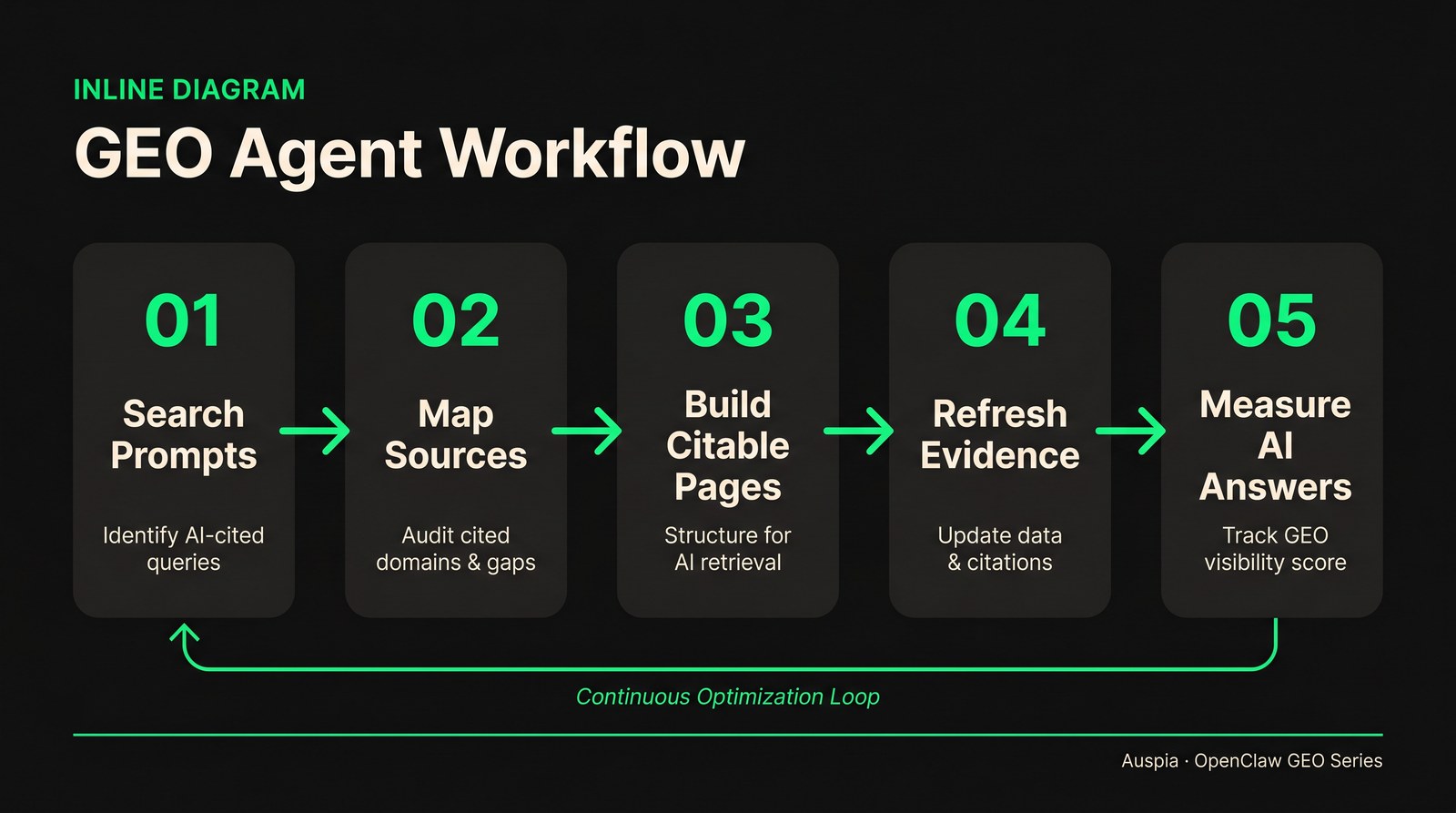
Figure: A practical GEO agent skill should work as a loop, not as a one-time content generator.
What a GEO OpenClaw Agent Skill should actually do
A useful GEO skill has one job: reduce the distance between what customers ask AI systems and what your website can prove.
In practice, that means the skill should run five tasks.
- Collect buyer prompts. Start with real question patterns: "best tool for...", "compare X vs Y", "how do I...", "is X worth it", "alternative to...", "what should I use for...". Traditional keywords still help, but GEO prompts are often longer, more comparative, and closer to decision-making.
- Check the current answer surface. The skill should search ChatGPT-style answer pages where possible, Google AI Overviews, Perplexity, Bing/Copilot surfaces, Google organic results, Reddit, YouTube, documentation, and niche directories. The goal is not to scrape everything. The goal is to find which sources are already being treated as answer material.
- Build an evidence map. A weak GEO article says the brand is great. A strong GEO asset shows product facts, pricing logic, use cases, examples, limitations, screenshots, third-party mentions, dates, and responsible claims. The skill should force the writer to gather those facts before drafting.
- Generate a citeable page brief. The output should not be a finished article by default. It should be a structured brief: direct answer, entity facts, comparison table, evidence blocks, internal links, FAQ, schema notes, and update schedule.
- Measure and refresh. After publishing, the skill should retest the prompt set and record whether the brand is mentioned, cited, misdescribed, or ignored. That feedback should create the next refresh brief.
This is where many "AI SEO" workflows fail. They stop at text generation. A GEO skill has to care about what happens after the text goes live.
Why OpenClaw is a good fit for this workflow
OpenClaw skills are useful for GEO because the work is procedural. A good analyst will run the same checks again and again: prompt expansion, source review, evidence collection, page structure, technical validation, and measurement.
A skill turns that process into a reusable standard. It can tell the agent which tools to use, what not to skip, what output format to return, and when to stop because evidence is missing.
That last part matters. A generic agent will often produce a confident article even when the source base is thin. A well-written GEO skill should do the opposite. It should say: "There is not enough evidence to publish this yet. Add product screenshots, third-party references, or comparison data first."
For growth teams, that is the difference between content automation and content debt.
The best skill pattern: Research -> Evidence -> Page -> Measurement
If we had to name the best GEO OpenClaw Agent Skill for 2026, it would be a "GEO Evidence Builder" skill. Not a writer. Not a keyword tool. Not a citation checker by itself.
The core workflow should look like this:
Stage | Agent action | Human decision |
|---|---|---|
Research | Expand the topic into buyer prompts, pain points, and comparison questions | Approve the prompt set that matches the target audience |
Evidence | Search the web, collect trusted sources, identify weak claims, and gather product facts | Decide which claims the brand can honestly support |
Page | Create an answer-first page brief with tables, examples, FAQ, internal links, and metadata | Edit the brief into a publishable asset |
Technical | Check crawl access, indexing basics, structured data opportunities, and AI crawler access | Fix blockers before promotion |
Measurement | Retest prompts and record brand mention, citation, sentiment, and competitor position | Choose the next refresh action |
The human is still in the loop. That is a feature, not a weakness. GEO touches claims, comparisons, and market positioning. Letting an agent invent those details is how brands end up with pages that look polished but cannot be trusted.
Skill selection matrix: how to choose the right OpenClaw GEO skill
Most teams do not need 20 skills. They need one strong skill for the workflow and a few smaller helpers around it.
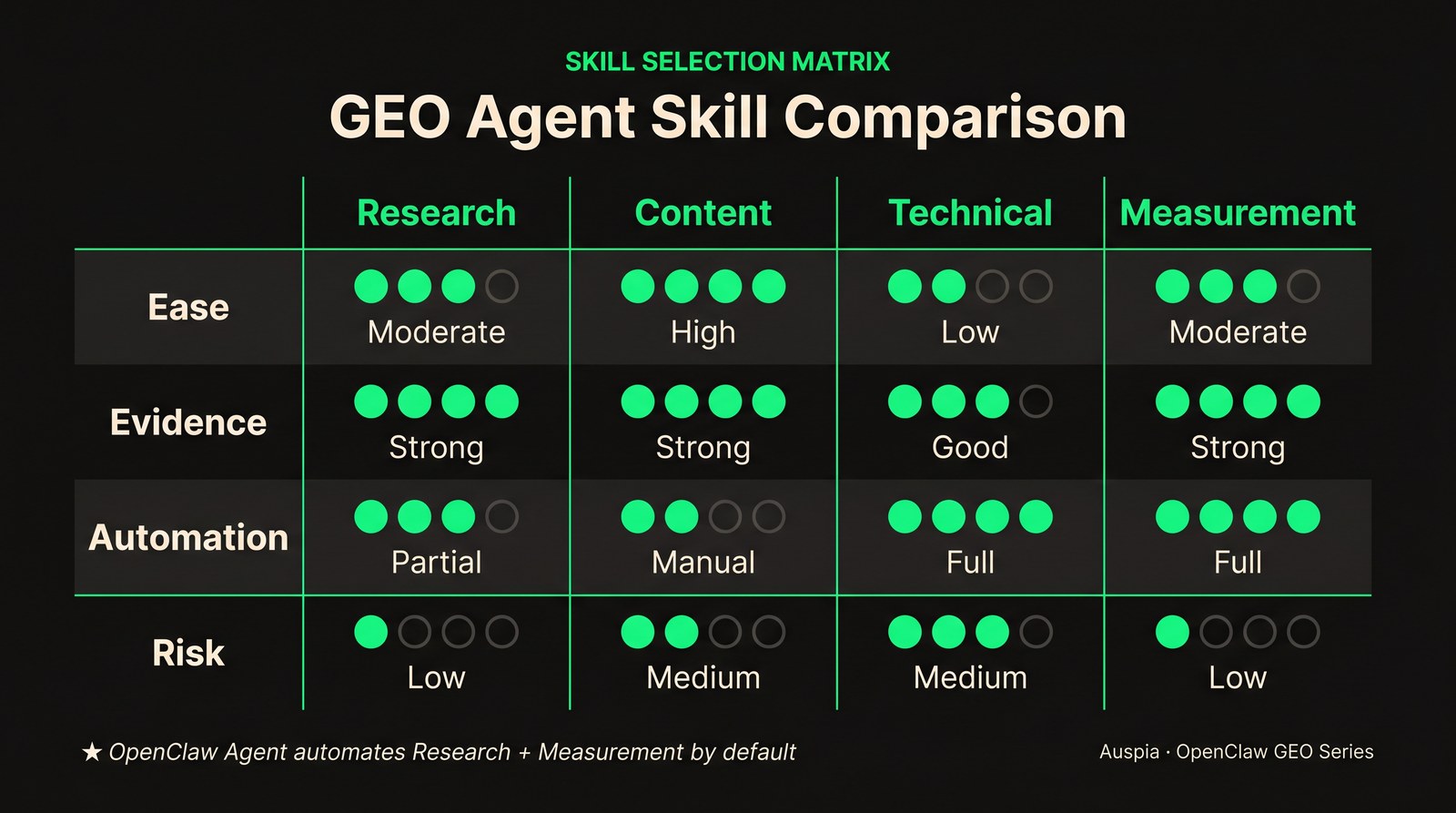
Figure: Research and measurement skills are usually more valuable than standalone AI writing skills for GEO.
Use this matrix when evaluating a GEO skill:
Skill type | Good for | Weakness | Priority |
|---|---|---|---|
Research skill | Prompt discovery, competitor source mapping, market language | Can collect noise if prompts are not constrained | High |
Content brief skill | Turning evidence into structured, citeable pages | Dangerous if it writes claims without sources | High |
Technical SEO skill | Robots, crawlability, schema, internal links, page hygiene | Does not create authority by itself | Medium |
Measurement skill | Tracking AI answer visibility and citation changes | Prompt samples can be biased | High |
Pure writing skill | Drafting sections from an approved brief | Often creates generic content if used too early | Low to medium |
The ranking may surprise content teams. Writing is not the bottleneck anymore. Trust is.
A practical OpenClaw GEO skill spec
A strong skill file should be boring in the best way. It should remove ambiguity.
Here is the spec I would use.
Inputs
- Target brand, product, or page
- Primary audience and market
- Topic or keyword seed
- Competitors to compare against
- Approved claims and proof points
- Source rules, including which sites are allowed or forbidden
- Publishing target, such as blog post, tool page, comparison page, or documentation page
Required tools
- Web search for current sources
- Website fetch or extraction for page review
- X/Twitter or community search when practitioner examples matter
- On-page SEO checker
- Robots.txt and AI crawler access checker
- Optional: LLM prompt testing or AI search visibility checker
For Auspia workflows, the natural next step is to pair this with an AI Search Visibility Checker and the broader Auspia SEO/GEO/AEO tools. The skill should not only create assets. It should help a team see whether those assets are becoming visible.
Output format
The output should be structured, not chatty:
- Executive answer
- Prompt library grouped by intent
- Source map with URLs, dates, and source type
- Competitor answer patterns
- Evidence gaps
- Page brief
- Recommended tables and visuals
- FAQ candidates
- Internal-link suggestions
- Technical blockers
- Measurement prompts
- Refresh schedule
If the skill cannot fill the evidence map, it should not proceed to a draft. That one rule will save teams from most bad AI content.
What to avoid
A GEO OpenClaw Agent Skill is not useful just because it is autonomous.
Avoid skills that:
- Generate long articles before checking current sources
- Treat GEO as keyword stuffing for ChatGPT
- Use unsupported statistics or vague "industry reports" claims
- Ignore crawlability, robots.txt, or AI crawler access
- Do not separate brand facts from agent assumptions
- Report "visibility" without showing the prompt sample
- Optimize only for one AI surface and call it a complete GEO strategy
- Skip refresh logic after publishing
Security also deserves attention. Skills are instructions that can influence what an agent does with files, network calls, credentials, and external tools. Use trusted sources, inspect the skill file, avoid hidden installation steps, and keep credentials out of prompts and markdown instructions.
How to build the skill in one week
Here is a realistic build plan.
Day 1: define the workflow
Write the skill around a fixed output contract. Do not start with tool calls. Start with the decisions the team needs to make: which prompts matter, which claims are supported, which pages should be created, and how success will be measured.
Day 2: add source rules
Define source quality tiers. For example: official docs, original research, product pages, analyst reports, customer reviews, community discussions, competitor pages, and low-quality reposts. Tell the agent which tiers can support claims and which can only provide context.
Day 3: add page templates
Create templates for comparison pages, answer pages, tool pages, category explainers, and case-style posts. GEO pages should start with direct answers and then prove the answer with examples.
Day 4: add technical checks
Add checks for indexability, robots.txt, sitemap presence, canonical tags, schema opportunities, and AI crawler access. The goal is not to make the agent a full technical SEO auditor. The goal is to stop obvious blockers before publishing.
Day 5: add measurement
Create a small prompt set for each page. Track four outcomes: mentioned, cited, ranked in the answer, and accurately described. If the brand is misdescribed, the next action may be an entity-fact page rather than another blog post.
Day 6: run a pilot
Pick one page type and one product. Run the skill, publish one asset, and test the prompt set. Do not scale until the feedback loop works.
Day 7: turn it into an operating cadence
Set a weekly refresh routine. GEO does not stay fixed. Competitors publish, AI answers shift, and source freshness changes. The skill should create a refresh queue, not a one-time report.
Auspia take: the best skill is the one that refuses weak content
A lot of teams want the agent to move faster. That is understandable. But the best GEO skill in 2026 is the one that slows the agent down at the right moments.
It should ask for proof before claims. It should show which prompts it tested. It should separate what the brand wants to say from what the market already believes. It should make content easier for AI systems to parse, but it should also make the company easier for humans to trust.
That is the real advantage of an OpenClaw Agent Skill for GEO. It can turn a messy growth habit into a repeatable operating system.
Checklist: before you publish with a GEO OpenClaw skill
- The article answers a real buyer prompt in the first section.
- Every comparison claim has a source, screenshot, product fact, or clear limitation.
- The page includes a short answer, table, examples, FAQ, and update date.
- The page is crawlable and internally linked from a relevant hub.
- The brand entity is consistent across title, description, about copy, schema, and author information.
- The skill records the prompt set used for measurement.
- A refresh date is scheduled before publication.
If you cannot check these boxes, the problem is not that your agent is too weak. The problem is that your workflow is asking the agent to write before the evidence exists.
FAQ
What is a GEO OpenClaw Agent Skill?
It is an agent-readable workflow that helps OpenClaw perform GEO tasks such as prompt research, source mapping, citeable content planning, technical checks, and AI answer measurement.
Is the best GEO skill just an AI article writer?
No. A writing skill can help after the research is done, but the most valuable GEO skill handles evidence, structure, and measurement. AI systems are more likely to trust pages that are specific, current, and verifiable.
Should I optimize for ChatGPT, Perplexity, Gemini, or Google AI Overviews first?
Start with the surfaces your buyers actually use. For most B2B teams, test several: Google AI Overviews for broad discovery, Perplexity for research-heavy queries, ChatGPT for decision support, and Gemini/Copilot where your audience already works.
How often should a GEO skill refresh content?
For competitive commercial topics, review prompt results monthly. For fast-moving software, pricing, or AI-tool topics, review every two to four weeks. Evergreen explainers can usually follow a quarterly refresh cadence.
Can OpenClaw skills replace a GEO strategist?
No. They can make the workflow repeatable and reduce manual research, but humans still need to approve claims, positioning, source quality, and publishing decisions.