Your page sits at #3 for a keyword that matters. You open the AI Overview for that same query, and Google cites a blog that is not even on page one. If that feels like a bug in your SEO, it is not. It is the normal state of AI Overviews in 2026, and it is the exact scenario the new AI Overview Citation Checker was built to read.
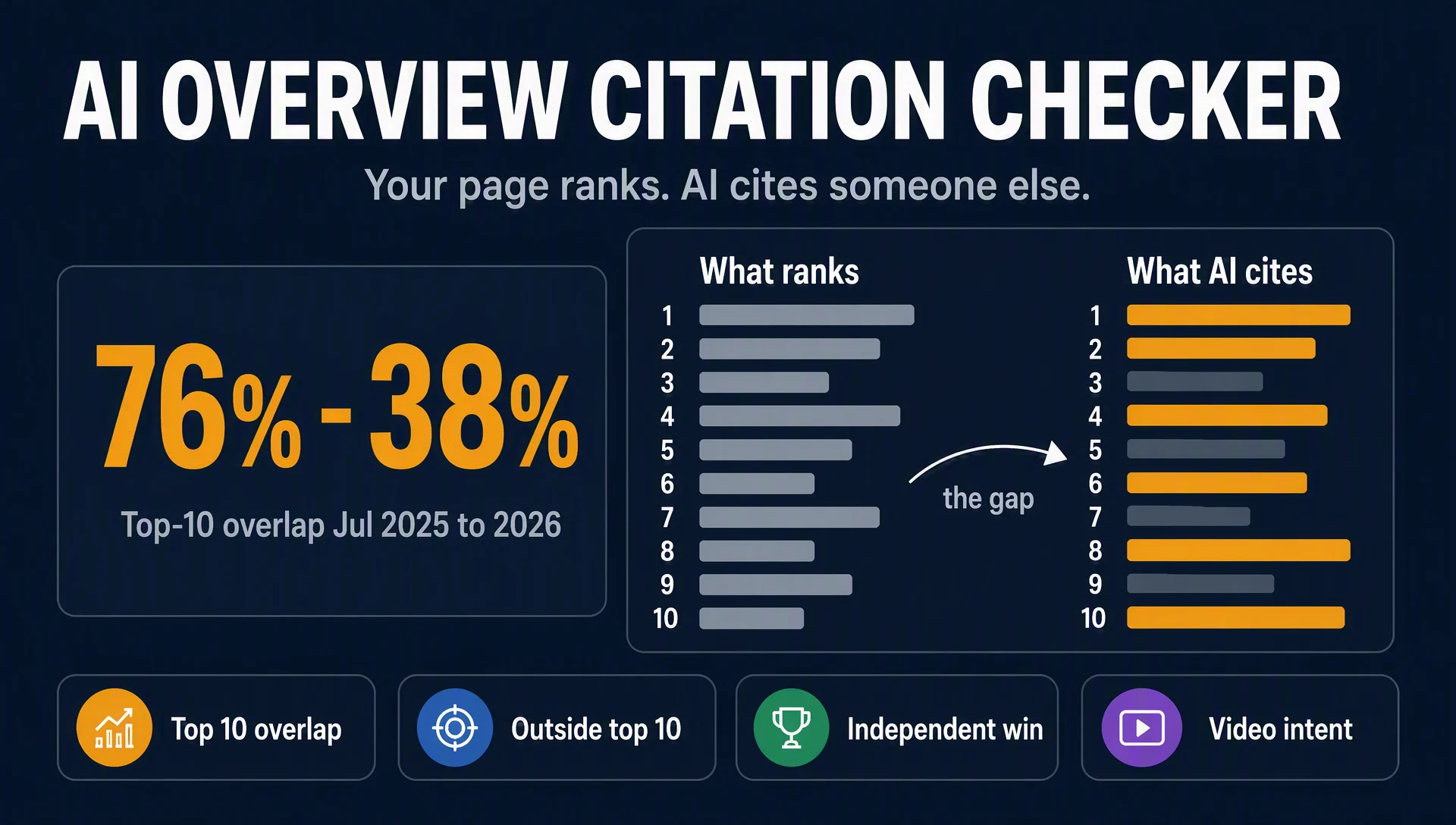
The short version: AI Overview selection has stopped tracking organic rankings. Ahrefs tracked the share of cited domains that also rank in the organic top 10 across 863,000 keywords and 4 million AI Overview URLs. It fell from 76% in July 2025 to 38% by early 2026. BrightEdge's February 2026 measurement put the overlap even lower, near 17%. That means a page sitting at position 47 can now out-cite the #1 result for the same query.
Below: what the gap is, what the checker shows you, and what each of its four verdicts should make you do next.
What the "citation gap" actually is
Two different systems now decide two different kinds of visibility for the same keyword. Google's organic ranking system ranks pages by relevance, authority, and links. Google's AI Overview selects sources by a different logic: can a page's content be extracted, reformulated, and combined into a synthesized answer, and does it add something the other candidates don't.
Those two selections overlap, but far less than most teams assume. Three 2026 findings explain the mechanics:
- Query fan-out. Google decomposes a query into related sub-queries, retrieves results for each, and cites pages that appear most often across those sub-results. CXL research found that ranking for a fan-out sub-query boosts citation probability by 161%. A page can be cited for a question it never ranks for, because it ranks for a question the search engine actually asked.
- Quotability is a different task from rankability. Sources are chosen for answer shape: direct answers in the first 100-150 words, headings that survive an "island test" (a heading plus its first two sentences reads as a complete unit), FAQ and HowTo schema, comparison tables, and balanced multi-perspective language. Answer-first pages earn roughly 67% more citations, and 55% of citations come from the top 30% of a page.
- Freshness acts as a premium, not a tiebreaker. Cited pages run about 25.7% fresher than organic top-10 results on average, and content under three months old earns a reported 182% citation premium over content older than a year.
One more number keeps people from over-reading the others: seoClarity found that 90% of AI Overviews contain at least one top-10 URL, while only 17-38% of individual citations come from the top 10. Both are true at once. A top-10 page is still the single best predictor of being cited; it is just no longer a gate.
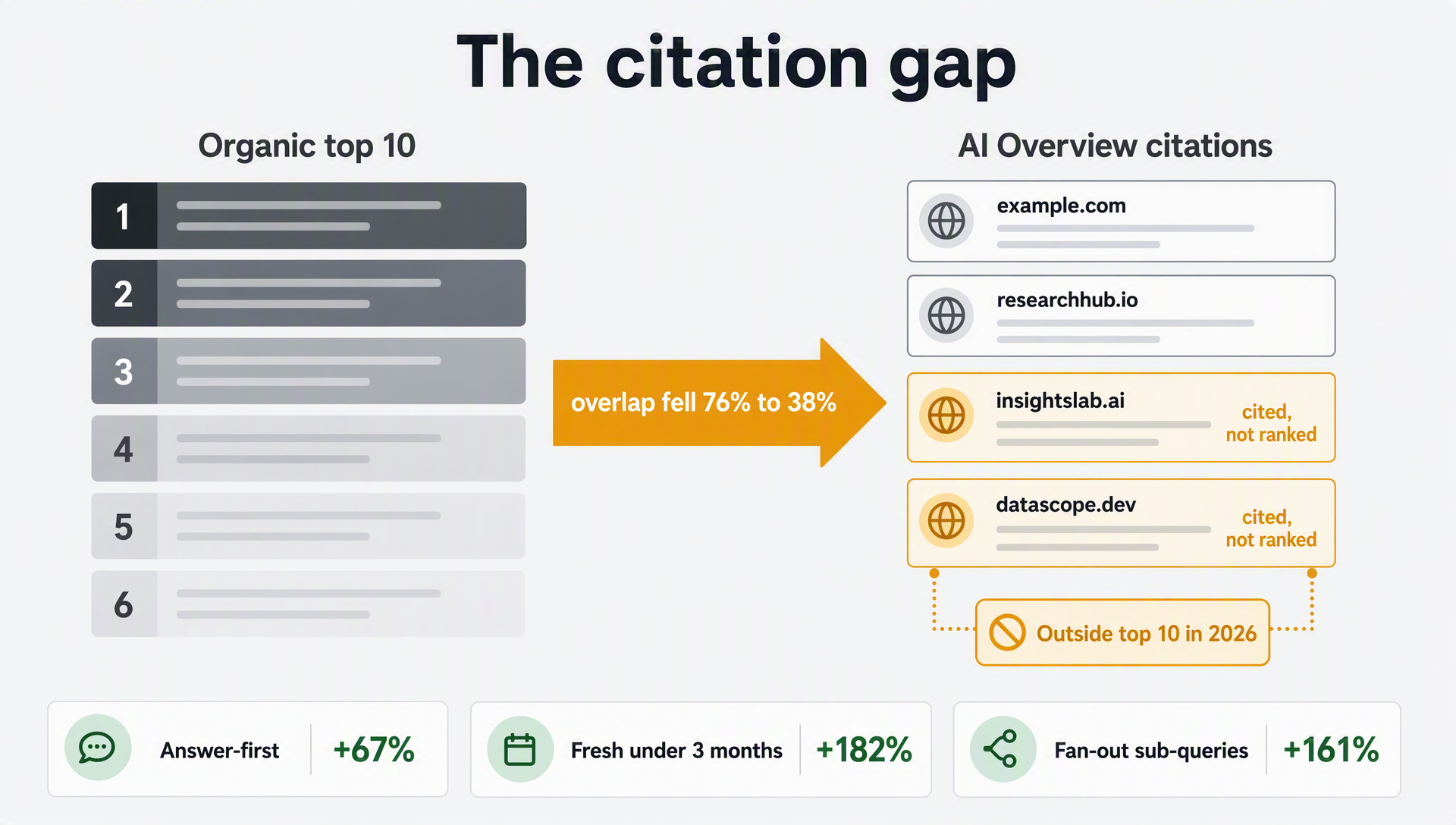
The citation gap: most AI Overview references now come from outside the organic first page.
What the checker does (and refuses to do)
The AI Overview Citation Checker deliberately stays narrow. You enter one English keyword, it runs a live US Google search as an audience would see it, maps every domain cited in the resulting AI Overview, and compares that citation map against the organic top 10 for the same result.
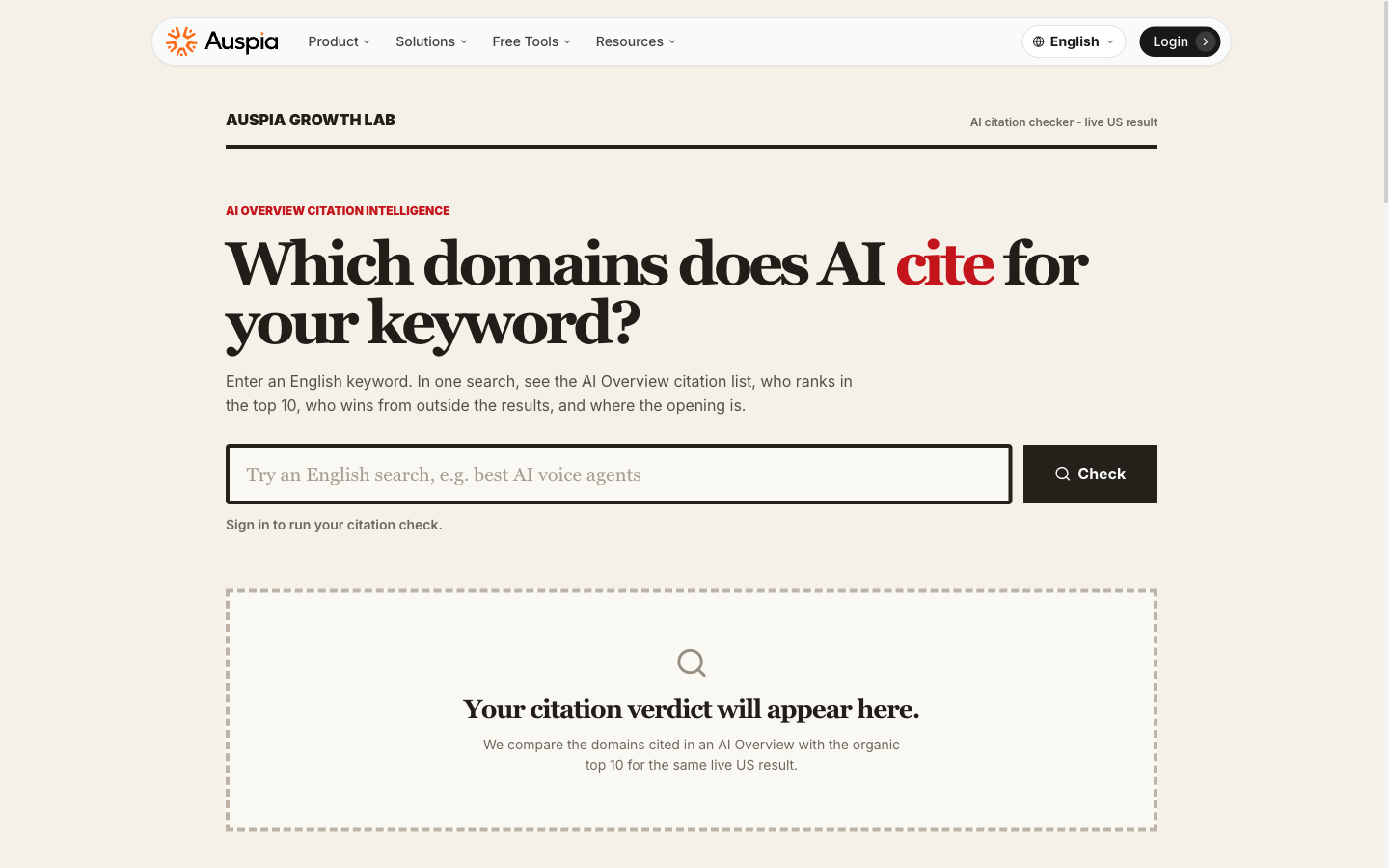
The full check is one keyword, one live result, and one citation map.
It does not score your website. It does not crawl your pages. It does not pretend to tell you how many citations you will get next month. The page itself states the contract: "This checker does not score your website. It reads one live result, maps its citations, and makes the gap between organic rank and answer selection visible."
The output is a citation verdict with up to four signals:
Signal | What it means | Why it matters |
|---|---|---|
Top 10 - #N | The cited domain also ranks organically, shown with its position | For this keyword, organic ranking still predicts citation |
Outside top 10 | AI cited a domain that does not appear in the organic first page | The selection logic has diverged from rankings |
Independent win | An outside citation that is not a major platform, government, or institution | A niche publisher won a slot against the giants |
Video intent | Google showed both an AI Overview and a video module | A second content format is active for this query |
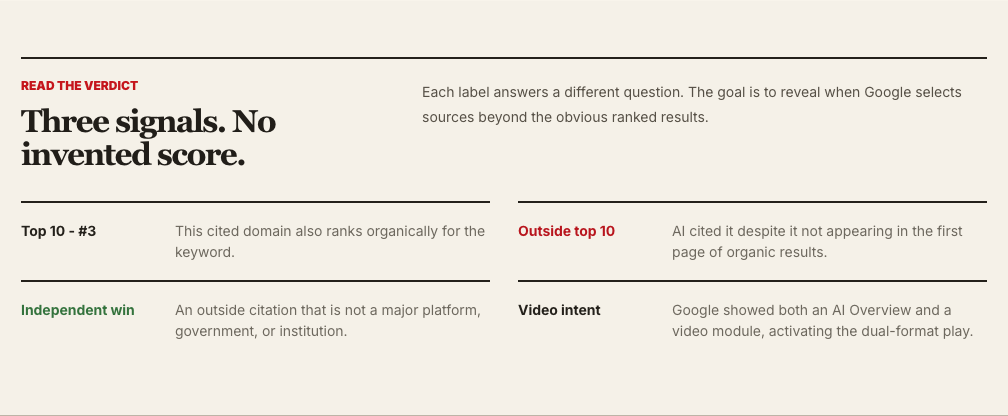
Each label answers a different question about the same live result.
Each signal is a scenario. The rest of this article reads them one by one.
Scenario 1: everything overlaps. Read it as stability, then watch it.
If most citations sit inside your organic top 10, the AI Overview for this keyword is still tied to classical rankings. That is the case for many transactional and high-commerce queries: research on 8,500 AI-generated answers puts their top-10 overlap at 52-61%, versus 38-47% for informational queries.
The play: treat SEO work as GEO work for this keyword. Fix the page that ranks and does not get cited first, because that is a convertible gap. Then set a reminder to re-check in a month. Overlap is not a permanent property of a keyword. Ahrefs' own methodology note is a warning here: part of the 76% to 38% drop reflects better detection of previously missed citations. Divergence can appear faster than your quarterly review expects.
Scenario 2: an outside-top-10 domain got cited. That is your blueprint.
This is the most common verdict of 2026, and the most useful. When a domain outside the first page appears in the AI Overview, you are looking at a page that beat your ranking system's judgment with quotability. Go read that page, and read it as a specification, not an enemy:
- Does it open with a direct answer inside the first 100-150 words?
- Do its H2s pass the island test, complete answer units under each heading?
- Does it carry FAQ or HowTo schema, comparison tables, or data visuals?
- How fresh is it? If it is under three months old, that is the freshness premium working.
- What entities and numbers does it name that your page omits?
Then rebuild your page as the better version of that specification, with your own facts and examples. Do not copy the page's wording or assets. Steal its structure, not its prose.
Scenario 3: an independent win. That is the signal most teams ignore.
The independent win is the most instructive verdict on the list: a citation that is not a major platform, government, or institution. In aggregate these are rare by volume, because citations are concentrated, with the top 1% of domains capturing 47% of AI Overview citations. But when a smaller domain wins a slot against Wikipedia, Reddit, or Forbes, the AI Overview is telling you the source selection had a specific reason.
The independent win usually means one of three things: extreme freshness, a direct answer nobody else formatted cleanly, or a named fact (a number, a comparison, a study) that the majors did not include. Your play is the same as scenario 2, but sharper: identify which of the three reasons applies to this keyword, then beat that one dimension. The other pattern in independent wins is entity presence: brand mention signals correlate roughly 3x more strongly with AI visibility than backlinks. If your brand is not findable as an entity across your site and your ecosystem, add that to the same sprint.
Scenario 4: video intent. There is a second lane, and it may be wider.
When Google shows both an AI Overview and a video module for the same query, the checker reports video intent. This is the signal I would bet most teams read and skip. The data says video is not a side channel: YouTube is the most-cited domain in AI Overviews at a 20.9% citation share, and 18.2% of citations that did not rank in the top 100 were YouTube URLs.
If the verdict is video intent, the question to ask is not "should we do video," it is "which video can we make that the current module does not already answer." A 60-90 second answer-to-camera that mirrors your best H2, or a screen recording of your product answering the question, are both cheap first attempts. Then re-check the keyword in a few weeks and see whether the video module's lineup changed.
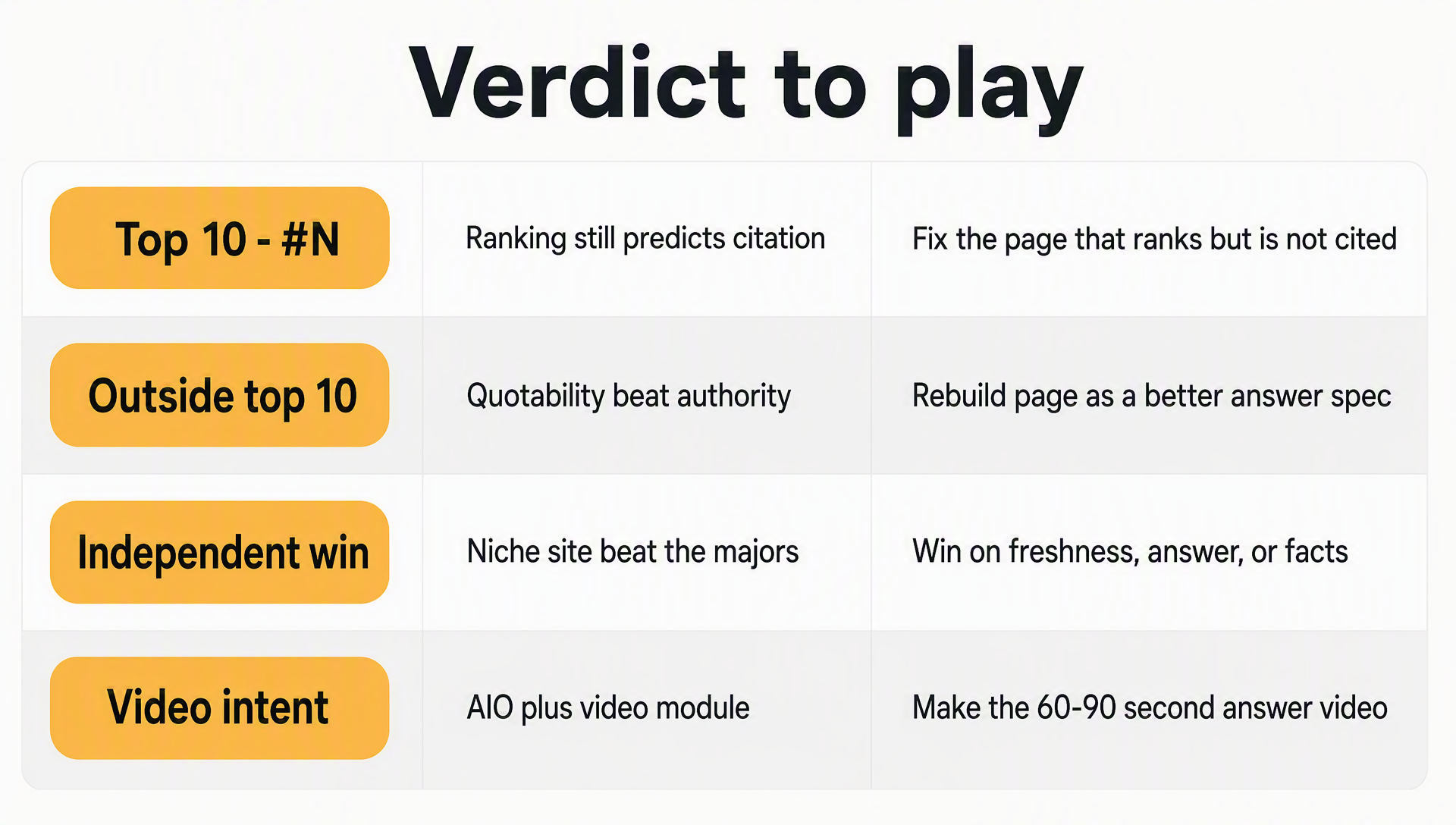
Four verdicts, four plays. Pick one per keyword, not all four.
When to run this check
The tool is one shot at a time, so it pays to use it at decision points, not as a monitoring dashboard:
- Before you brief content. Run the target keyword first. If the verdict shows an outside-top-10 winner, your brief changes: model that page's answer structure, do not just compete for rankings.
- On your branded keywords. A brand query is the cheapest visibility you will ever buy. If your own domain is outside the top 10 in the citation map or absent entirely, that is the first thing to fix.
- On a competitor teardown. Check the keywords where a competitor outranks you. Their cited pages tell you what their AI search presence is actually built on, which is often different from what their rankings are built on.
- After you publish or refresh. Publish the play, then re-run the same keyword in a few weeks. The citation map is the feedback loop; rankings alone will not tell you whether the AI-visible version of the page exists.
- Before an AI visibility audit. One keyword at a time is the wrong granularity for a full audit. Use this check to identify candidate keywords first, then go deep with tools that read your own site, like the AI Search Visibility Checker for crawl, discovery, and citation blockers.
A 10-minute citation-gap workflow
Five steps, roughly ten minutes for the first keyword:
- Pick one keyword with actual business meaning. The tool is US/English by design, so choose a keyword as an American buyer would type it.
- Run the check. Sign in to your Auspia account and enter the keyword. If no AI Overview appears for that query, the tool reports the absence directly. That is information too: it means the AI Overview is not active for this keyword yet, and watching it is a strategy, not an error.
- Classify the verdict. Which of the four signals dominate? Write down the outside-top-10 domains and any independent win.
- Pick one play. One verdict, one action: rebuild answer structure, add the missing fresh fact, create the video, or fix the branded gap. Do not act on all four at once.
- Follow through. If Google loads the references asynchronously and the checker shows an incomplete capture, re-run once before you conclude. Then re-check the keyword after you publish, with a fixed date on the calendar.
Where the checker stops
The tool is honest about its boundaries, and you should plan around them:
- One keyword, one market. US English only, so that every result is comparable. A keyword checked in another market can show a different citation map entirely.
- No scoring, no history. It reads one live result and does not track trends. Longitudinal measurement still belongs in Search Console's AI report, your own prompt logs, or a dedicated visibility tracker.
- Sign-in required. The check needs an Auspia account so each result is tied to a real user. That is the one friction point; the FAQ covers it directly.
- Top-10 rank is never a guarantee. The checker can show you a #3-ranked domain absent from the citations, and an absent domain present in them. That is the entire point of the tool.
FAQ
Do I need to sign in to use the AI Overview Citation Checker? Yes. The check requires a signed-in Auspia account.
Why does every keyword not show an AI Overview? Google does not generate an AI Overview for every query. When none appears, the checker reports the absence instead of inventing a verdict.
Why must the keyword be in English? The tool checks one fixed market, US English, so the results are comparable. A non-English keyword would pull a different SERP with different citation behavior.
Does a top-10 rank guarantee an AI citation? No. Studies put the overlap between organic top-10 rankings and AI Overview citations at roughly 17-38% in 2026. Ranking is a strong predictor, not a guarantee.
Why do I sometimes need to try again? Google loads AI Overview references asynchronously. When the capture is incomplete, the checker reports what it saw rather than guessing, and a re-run usually completes the map.
What if my keyword shows an outside-top-10 citation? Does that mean page two is the new page one? For AI visibility, yes, partially. The cited page likely won on quotability or freshness, not authority. Read it as a specification and rebuild your page as a better version.
Author: Adrian Cole, Analyst of 1,000+ AI Search Results at Auspia. Adrian writes about how brands actually appear in Google AI Overviews, ChatGPT, Perplexity, and other answer surfaces.