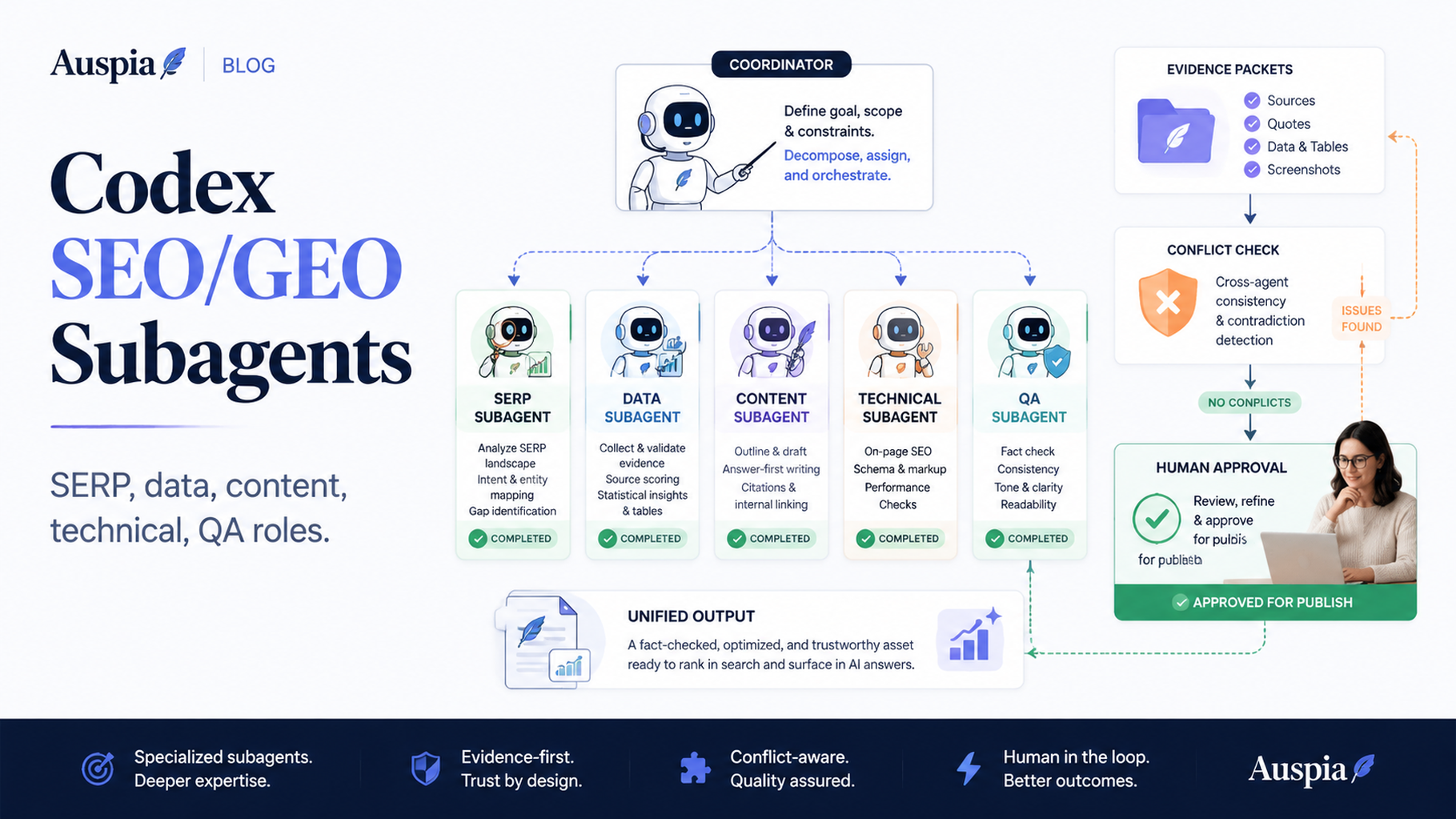

Codex subagents for SEO/GEO: specialized roles, evidence packets, conflict checks, and human approval.
Use subagents when the work really needs separation
Do not create five subagents that all "do SEO." Codex subagents are useful when different parts of the job need different context, different tools, or separate reasoning. For SEO/GEO, the best split is usually research, data, content, technical, and QA.
If the task is simple, keep it in one Codex session. If the task involves competing evidence, technical risk, and content decisions, split it.
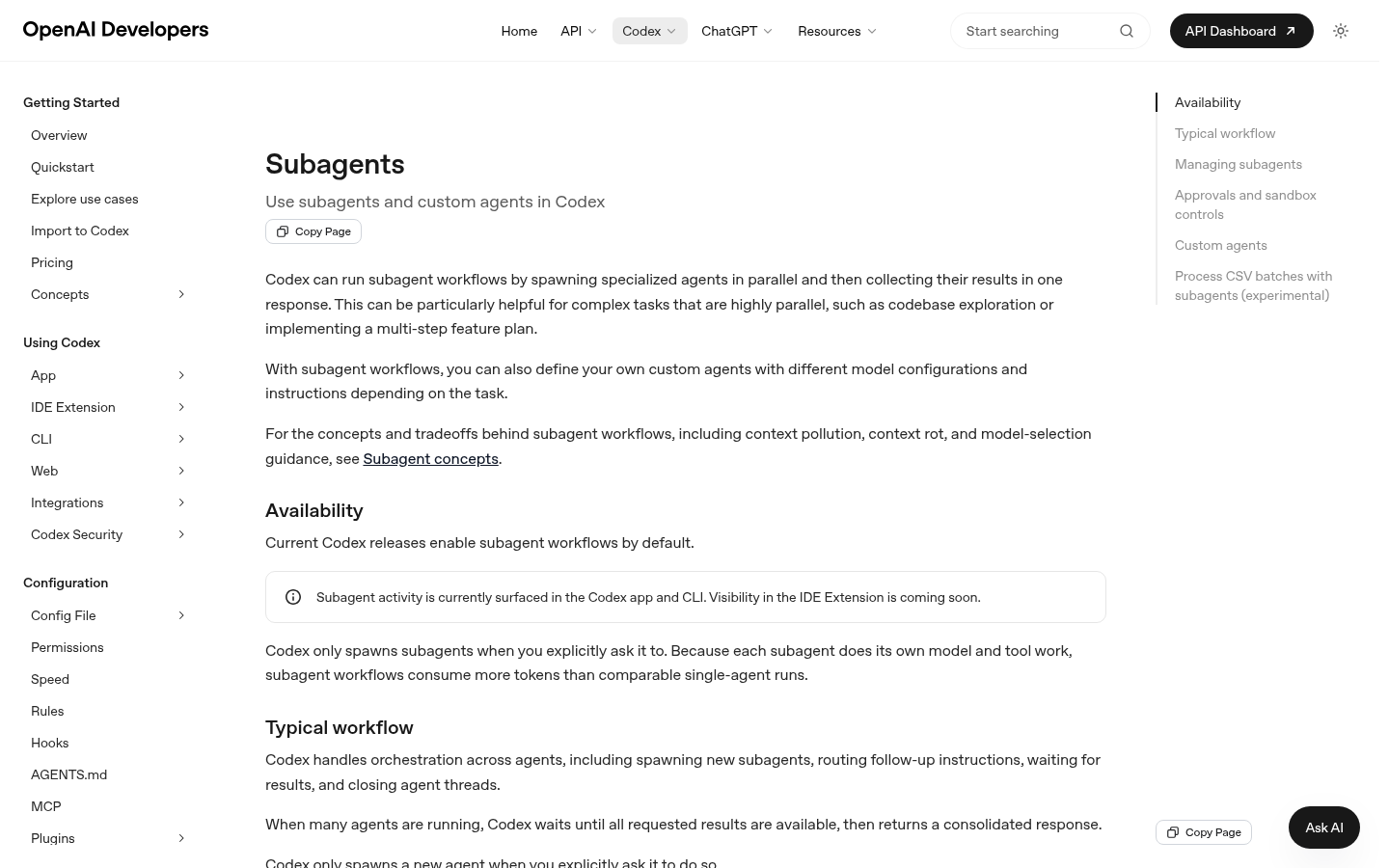
Codex subagents are useful when SEO/GEO work needs separate roles and evidence streams.
The five-role model
Subagent | Job | Output | Must not do |
|---|---|---|---|
SERP researcher | Inspect SERP and competitor patterns | evidence packet | write final copy |
Data analyst | Read GSC, Bing, GA4, keyword exports | priority table | decide brand positioning |
Content strategist | Convert evidence into briefs | page brief | publish |
Technical reviewer | Check crawl, render, schema, redirects | risk queue | deploy fixes |
QA reviewer | Test usefulness, claims, and safety | approval memo | override humans |
Coordinator prompt
Coordinate Codex SEO/GEO subagents for this page set.
Assign separate research, data, content, technical, and QA tasks.
Each subagent must return:
- evidence
- decision
- confidence
- blocked questions
- recommended next owner
Do not merge outputs until evidence is present.
Resolve conflicts by asking for human review, not guessing.
Handoff format
## Subagent handoff

Role:
Task:
Sources used:
Evidence:
Decision:
Confidence:
Risks:
Blocked questions:
Recommended next step:
Approval needed:
This handoff format matters because SEO/GEO work often fails at the boundary between teams. A content recommendation may be good for readers but unsafe technically. A technical fix may solve crawlability but not answer the buyer question. Subagents make these conflicts visible.
Conflict examples
Conflict | What Codex should do |
|---|---|
Data says refresh, technical reviewer finds noindex | Fix technical issue before rewriting |
SERP researcher says competitors make bold claims, QA finds no proof | Do not copy the claim; add verifiable evidence |
Content strategist wants a new page, internal-link map shows overlap | Consolidate or reposition before creating |
GEO prompts show citation loss, API log shows failed provider | Mark data quality issue, do not rewrite |
Beginner version
Start with only two subagents:
- Data analyst: reads exports and proposes priorities.
- QA reviewer: checks whether recommendations have evidence and safe next steps.
Add research and technical subagents only when the workflow becomes complex enough to justify the coordination cost.
FAQ
Are subagents required for Codex SEO work?
No. They are for complex work. Use them when separate evidence streams need independent review.
Can a subagent publish content?
It should not. Subagents should produce artifacts and recommendations. Publishing requires explicit human approval.
What is the biggest failure mode?
Coordination overhead. If each subagent produces long generic summaries, the workflow becomes slower without becoming safer.
Codex SEO/GEO learning path
This article is part of the Codex SEO/GEO operator series. If you are building the workflow from scratch, follow the sequence:
1. How to Use Codex for Automated GEO in 2026
2. How to Use Codex for Automated SEO
3. How to Set Up a Codex SEO Workspace with AGENTS.md
4. How to Connect Codex to SEO Data with MCP
5. The Best Codex GEO Skill in 2026
6. How to Build a Codex Skill for Keyword Clustering
7. How to Use Codex Subagents for SERP, Content, and Technical SEO
8. How to Use Codex for Technical SEO Fixes Without Breaking Production
9. How to Run Daily SEO/GEO Monitoring with Codex Automations
10. Codex SEO/GEO Quality Gates: Diff, Evidence, Tests, and Human Approval
11. How to Use Codex to Build and Deploy an SEO/GEO-Ready Website
Where to go next
Previous: How to Build a Codex Skill for Keyword Clustering
Next: How to Use Codex for Technical SEO Fixes Without Breaking Production
Sources and notes
Use OpenAI's official Codex documentation as the source of truth for current syntax and product behavior:
- Codex CLI: https://developers.openai.com/codex/cli
- AGENTS.md: https://developers.openai.com/codex/guides/agents-md
- Codex Skills: https://developers.openai.com/codex/skills
- Codex MCP: https://developers.openai.com/codex/mcp
- Codex subagents: https://developers.openai.com/codex/subagents
- Codex configuration: https://developers.openai.com/codex/config-reference
Author: Camille Rhodes, Architect of 300+ AI Content Workflows at Auspia. Camille writes about AI-assisted content systems, automation, and editorial quality control for growth teams.