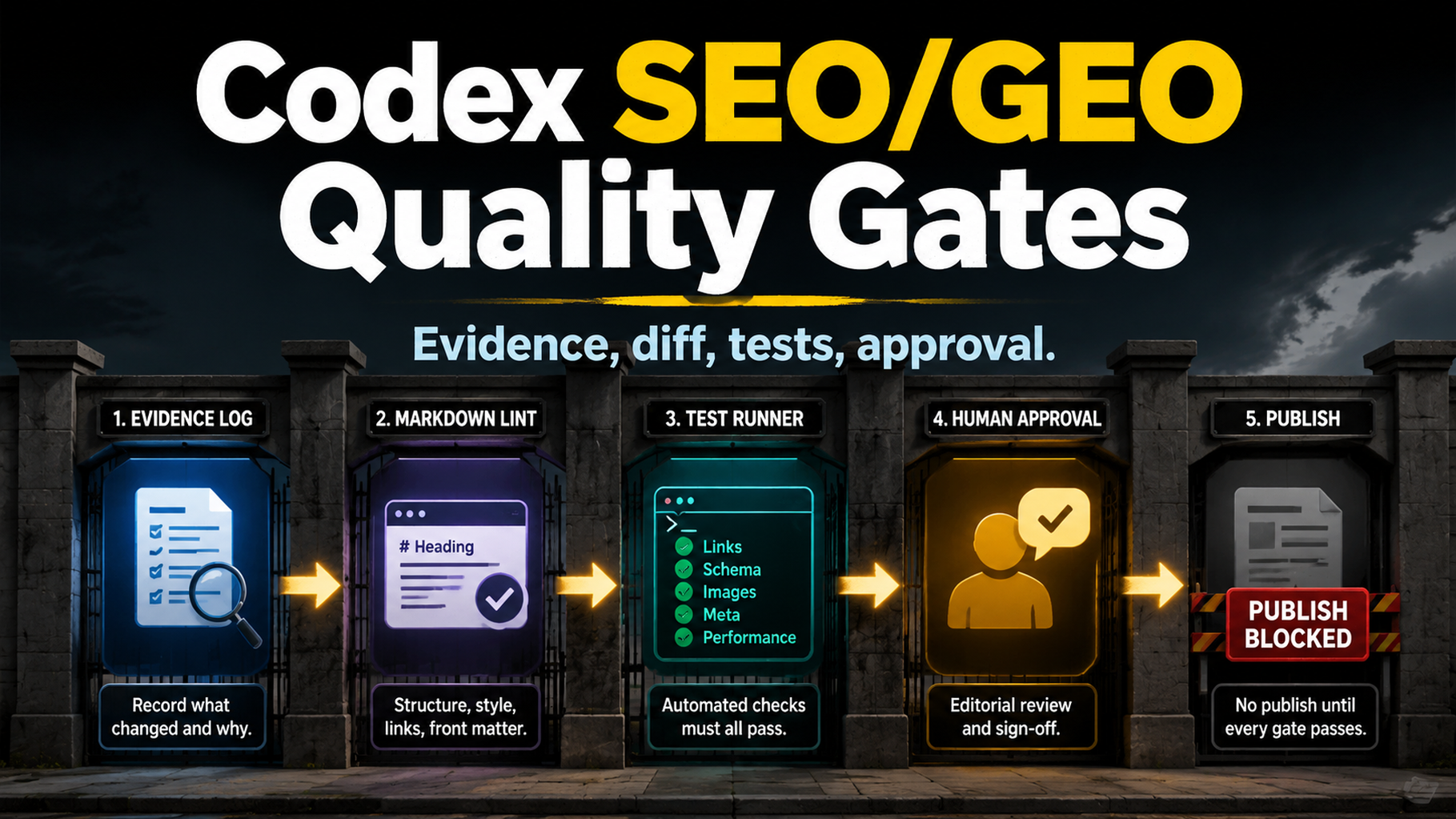

Codex quality gates: evidence, diff, tests, risk classification, and human approval before publishing.
Quality gates are what make Codex safe for SEO
Codex can read files, edit code, run commands, and prepare diffs. That is exactly why SEO/GEO workflows need gates. A polished recommendation is not enough. Every proposed change should pass evidence, usefulness, technical, diff, test, and approval checks.
This article is the safety layer for the Codex SEO/GEO series.
The six gates
Gate | Question | Blocks |
|---|---|---|
Evidence gate | Can the claim point to a source or file? | invented facts |
Usefulness gate | Does it help the reader or buyer complete a task? | thin SEO copy |
GEO extraction gate | Is the answer clear enough for AI systems to summarize or cite? | vague sections |
Technical gate | Could this affect crawl, index, rendering, schema, or redirects? | unsafe edits |
Diff/test gate | Is the change small and validated? | unreviewed code changes |
Publishing gate | Has a human approved final copy and risk? | autopublishing |
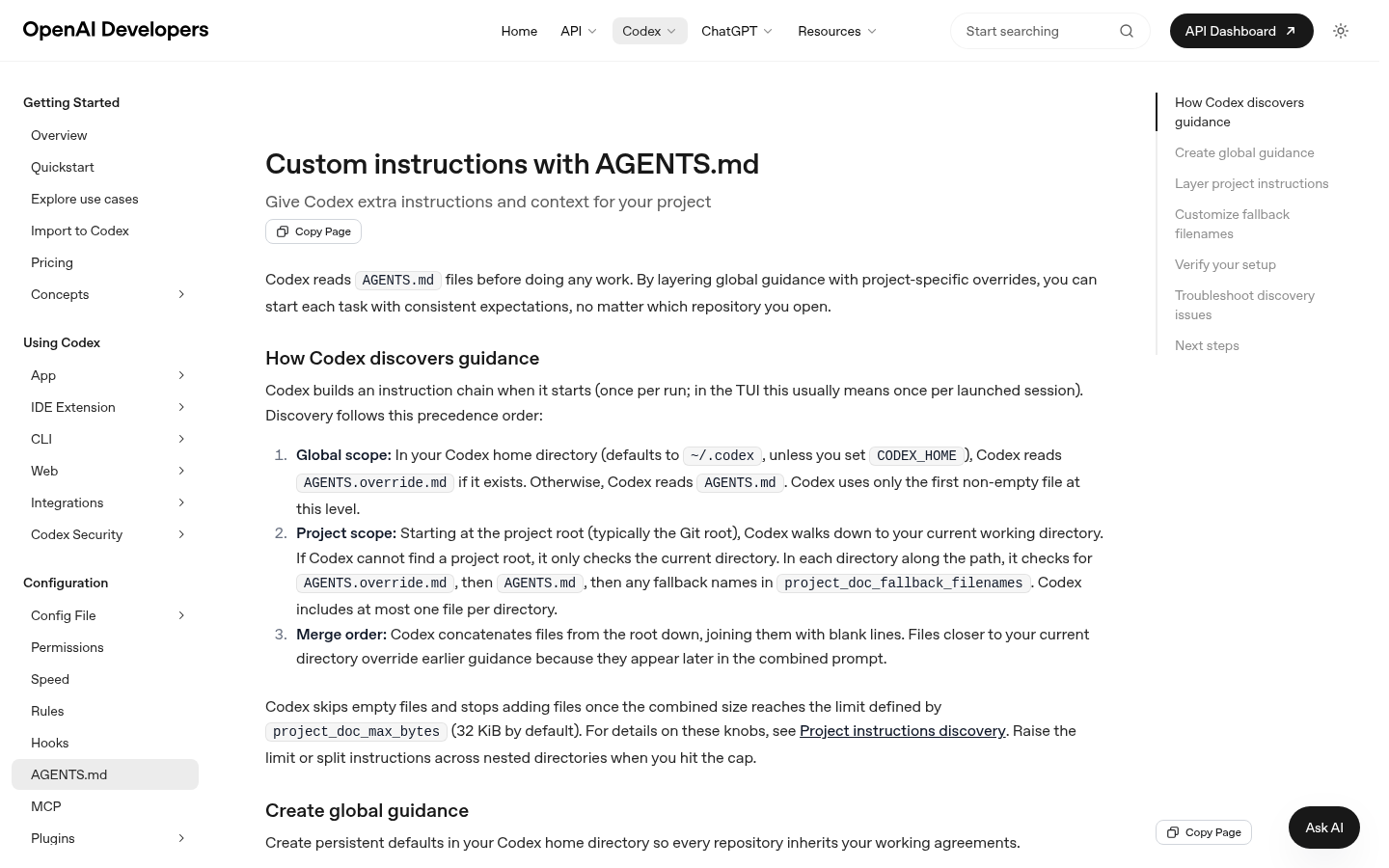
Put durable quality rules where Codex can read them before it proposes SEO/GEO edits.
Put the policy in AGENTS.md
## SEO/GEO quality gates

Before recommending any change, include evidence and risk.
Before editing files, present a plan.
Before publishing or submitting URLs, require explicit human approval.
Before changing technical SEO files, create a ticket and validation steps.
After edits, run available tests and summarize the diff.
Review prompt
Review this Codex SEO/GEO output against the quality gates.
For each failed gate:
- quote the risky recommendation
- explain the risk
- rewrite it as a safer next step
- state what evidence is missing
Do not approve publishing.
Approval matrix
Action | Approval needed |
|---|---|
Add evidence to a brief | editorial |
Update title/meta draft | SEO/editorial |
Add internal links in a draft | SEO/editorial |
Edit schema, canonical, noindex, robots, redirects, sitemap | engineering + SEO |
Submit URL or change account settings | explicit human approval |
Publish CMS content | explicit human approval |
Diff gate for technical work
When Codex edits files, require this memo:
## Diff review memo

Files changed:
Why changed:
Evidence:
Commands run:
Test result:
SEO/GEO risk:
Rollback plan:
Approval needed:
If Codex cannot fill this out, the change is not ready.
Evidence gate for content work
Claim type | Required evidence |
|---|---|
Traffic decline | GSC/Bing/GA4 export |
Competitor outranks us | SERP snapshot or API result |
AI answer cites competitor | dated AI answer observation |
Technical issue | file, rendered output, or request result |
Product claim | official docs or product page |
Common failure modes
- Letting Codex rewrite pages from one weak signal.
- Treating AI citation observations as stable rankings.
- Skipping tests because the patch "looks small."
- Allowing SEO tasks to change account settings.
- Having the same agent draft and approve the work.
FAQ
Are quality gates overkill for small sites?
No. Small sites have fewer pages, so one bad canonical, noindex, or thin content batch can hurt more.
Should Codex block itself?
Codex can follow gates, but humans should own approval. For technical enforcement, use tests, scripts, CI, and review rules.
What is the minimum viable gate setup?
Evidence, technical risk, and human approval. Add diff/test gates as soon as Codex starts editing files.
Codex SEO/GEO learning path
This article is part of the Codex SEO/GEO operator series. If you are building the workflow from scratch, follow the sequence:
1. How to Use Codex for Automated GEO in 2026
2. How to Use Codex for Automated SEO
3. How to Set Up a Codex SEO Workspace with AGENTS.md
4. How to Connect Codex to SEO Data with MCP
5. The Best Codex GEO Skill in 2026
6. How to Build a Codex Skill for Keyword Clustering
7. How to Use Codex Subagents for SERP, Content, and Technical SEO
8. How to Use Codex for Technical SEO Fixes Without Breaking Production
9. How to Run Daily SEO/GEO Monitoring with Codex Automations
10. Codex SEO/GEO Quality Gates: Diff, Evidence, Tests, and Human Approval
11. How to Use Codex to Build and Deploy an SEO/GEO-Ready Website
Where to go next
Previous: How to Run Daily SEO/GEO Monitoring with Codex Automations
Next: How to Use Codex to Build and Deploy an SEO/GEO-Ready Website
Sources and notes
Use OpenAI's official Codex documentation as the source of truth for current syntax and product behavior:
- Codex CLI: https://developers.openai.com/codex/cli
- AGENTS.md: https://developers.openai.com/codex/guides/agents-md
- Codex Skills: https://developers.openai.com/codex/skills
- Codex MCP: https://developers.openai.com/codex/mcp
- Codex subagents: https://developers.openai.com/codex/subagents
- Codex configuration: https://developers.openai.com/codex/config-reference
Author: Camille Rhodes, Architect of 300+ AI Content Workflows at Auspia. Camille writes about AI-assisted content systems, automation, and editorial quality control for growth teams.