GEO Rank Checker: How to Measure Your Generative Engine Ranking (2026 Guide)
A GEO rank checker measures how often your brand is cited, mentioned, and recommended inside AI-generated answers across engines like ChatGPT, Perplexity, Gemini, Google AI Overviews, and Copilot. Unlike traditional SEO, there is no single "position #1" to track — generative engine ranking is a blend of citation rate, share of citation, and prompt coverage, and it has to be measured per engine because citation behavior is stochastic and wildly inconsistent across platforms.
If you have been exporting a keywords-and-positions report and assuming it predicts your AI visibility, the data says otherwise: roughly 83% of AI Overview citations come from pages that sit outside the organic top 10, and about 88% of businesses are effectively invisible in AI search. This guide shows you how to actually check your GEO ranking, interpret the numbers, and turn a low score into a concrete fix plan using a free GEO checker and leaderboard.
Why Traditional SERP Rank Tracking Fails for GEO
Traditional rank trackers answer one question: where does my URL sit on the results page for this keyword? That model breaks down in generative search for three reasons.
First, AI answers are synthesized, not ranked. The same prompt can return different sources, wording, and citations across sessions, geographies, and time of day. A "rank" that changes every refresh is not a rank you can optimize against the way you optimize a title tag.
Second, most AI search is zero-click. Users get the answer (and the cited sources) without ever visiting your site, so traffic and CTR stop being reliable proxies for visibility. Pew Research found that when an AI summary appears, users click links inside it only about 1% of the time.
Third, being retrieved is not the same as being cited. Generative engines pull far more content into context than they surface in the answer — only about 15% of retrieved content actually gets cited. A rank tracker that counts "appeared somewhere in the process" will massively overstate your real visibility.
The fix is to stop tracking positions and start tracking citations, mentions, and recommendation share across a defined set of buyer prompts.
The Three Metrics That Actually Define GEO Ranking
A useful GEO rank checker reports three layered metrics. Each answers a different question, and you need all three to know where you stand.
1. Citation rate — your longitudinal signal
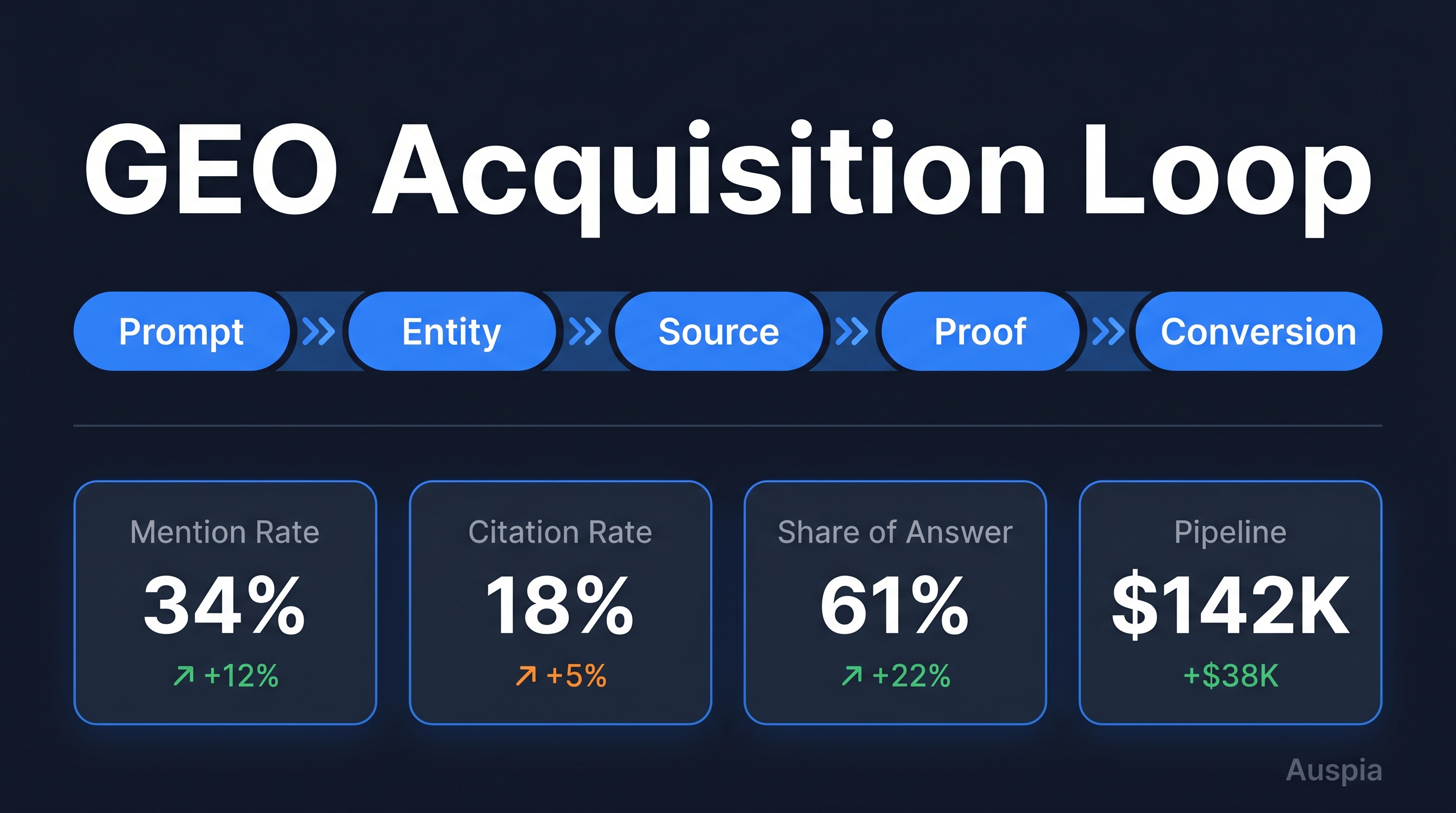
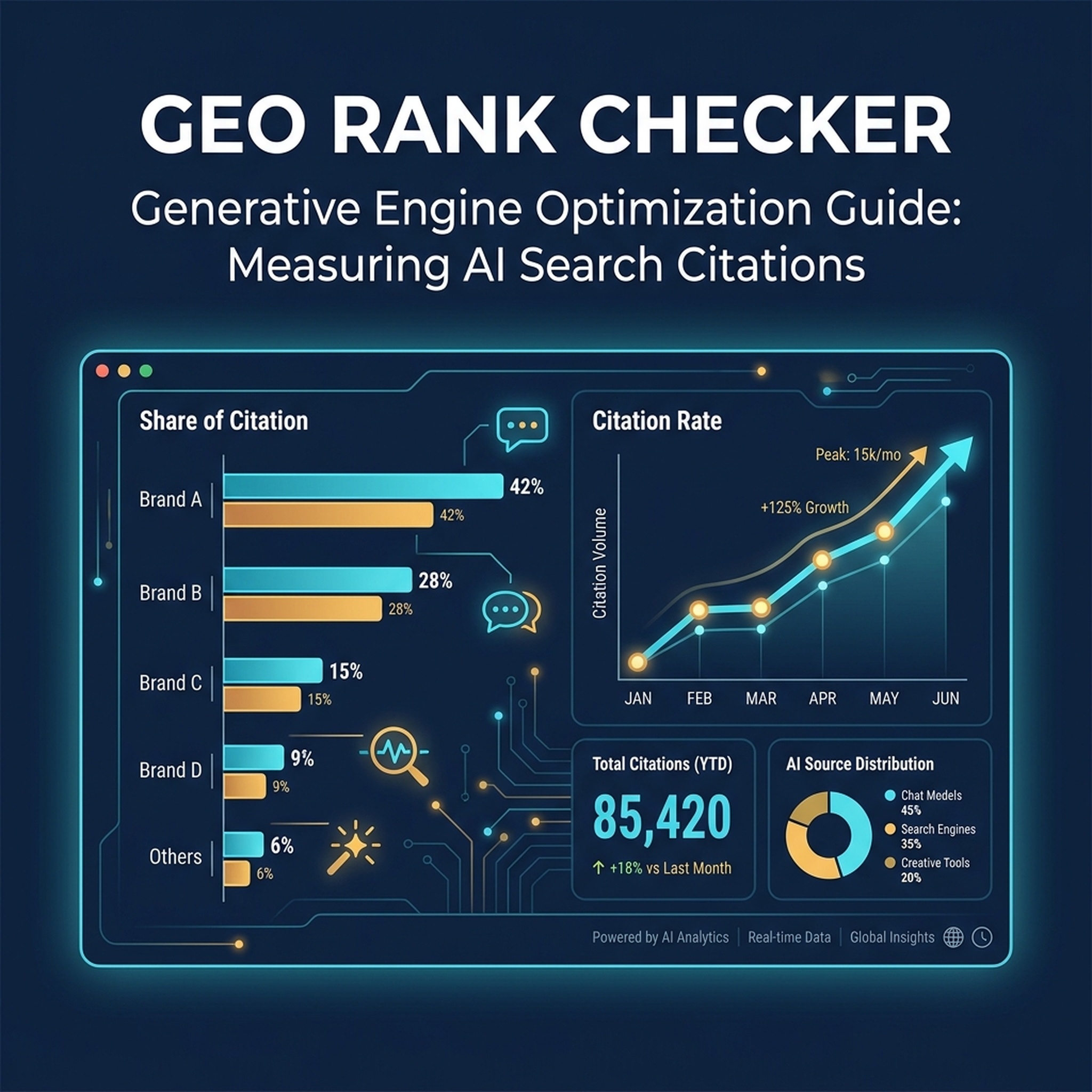
Citation rate is the percentage of your tracked prompts in which your brand (or content) is cited as a source. It is a self-focused metric: it tells you whether your visibility is trending up or down over time, but it tells you nothing about competitors. Use it as your week-over-week and month-over-month trajectory indicator.
2. Share of citation — the competitive dimension
Share of citation (sometimes called citation share) adds the competitive context that citation rate lacks. The formula is simple:
Share of citation = (Your brand citations ÷ Total citations in the query set) × 100
For example, if a 100-prompt audit returns 320 total citations across 18 brands and your brand is cited 45 times, your share of citation is 14.1%. If a competitor is cited 92 times, their share is 28.8% — roughly double yours — and that gap is the query territory you need to reclaim.
There is no universal "good" number. Context is everything:
| Category maturity | Typical leadership share of citation |
|---|---|
| Emerging category (under 10 credible brands) | 20–30% |
| Mid-competitive category (10–50 brands) | 10–20% |
| Mature category (50+ brands) | 5–10% can be strong |
The absolute percentage matters less than the trend. If your share is climbing quarter over quarter while competitors stay flat or decline, you are winning — even if your raw number looks modest.
3. Prompt coverage — the breadth signal
Prompt coverage measures how many different prompts your brand appears in, not how often. A brand cited in 8 of 10 prompts is healthier than one cited 8 times but only in 2 prompts, because the first brand is relevant across more of the buyer journey. Coverage tells you whether you are a niche source or a category-wide authority.
How to Read GEO-Ranking Data Without Fooling Yourself
The single biggest mistake teams make with GEO-ranking data is treating a one-shot snapshot as the truth. Citation behavior is stochastic: the same prompt run on Monday and Friday can return different sources. Research suggests only about 30% of brands maintain consistent visibility across AI answers from one session to the next.
Three interpretation rules keep you honest:
- Sample across a 7–9 day window, minimum. Never report GEO ranking from a single run. Aggregate citations across multiple days and ideally multiple sessions per day, then report share of citation as a range with a confidence interval, not a single decimal.
- Track the trend, not the absolute. A move from 6% to 9% share of citation over a quarter is a more meaningful signal than whether you "rank #3" on any given prompt.
- Measure per engine, then aggregate. Copilot is one of the top-citing engines, while Google AI Overviews has among the lowest citation rates. A strategy that wins on Perplexity can be invisible on Gemini. Roll the engines up into one headline number for the executive summary, but keep the per-engine breakdown for diagnosis.
The 5-Step GEO Rank Checking Workflow
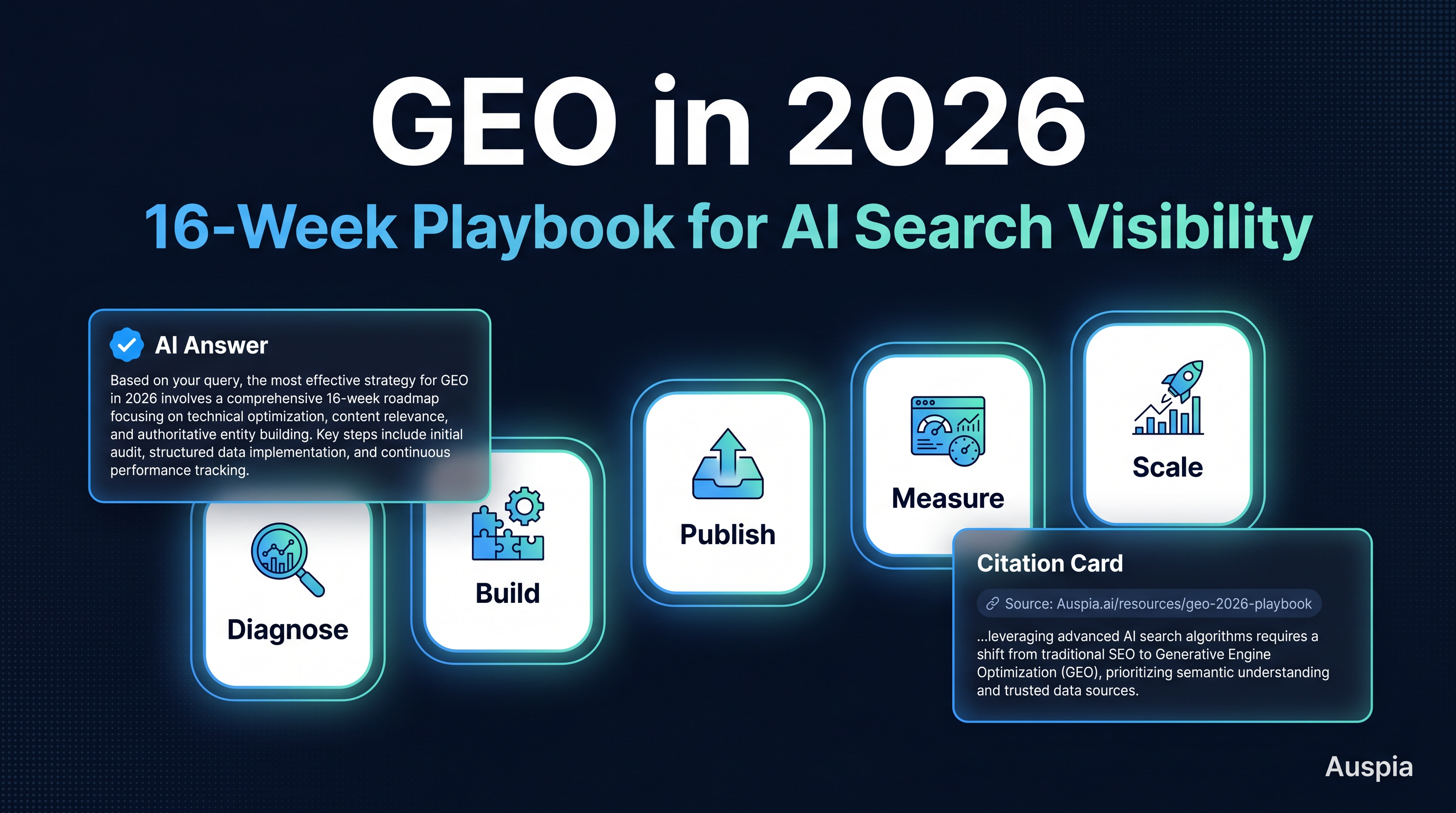
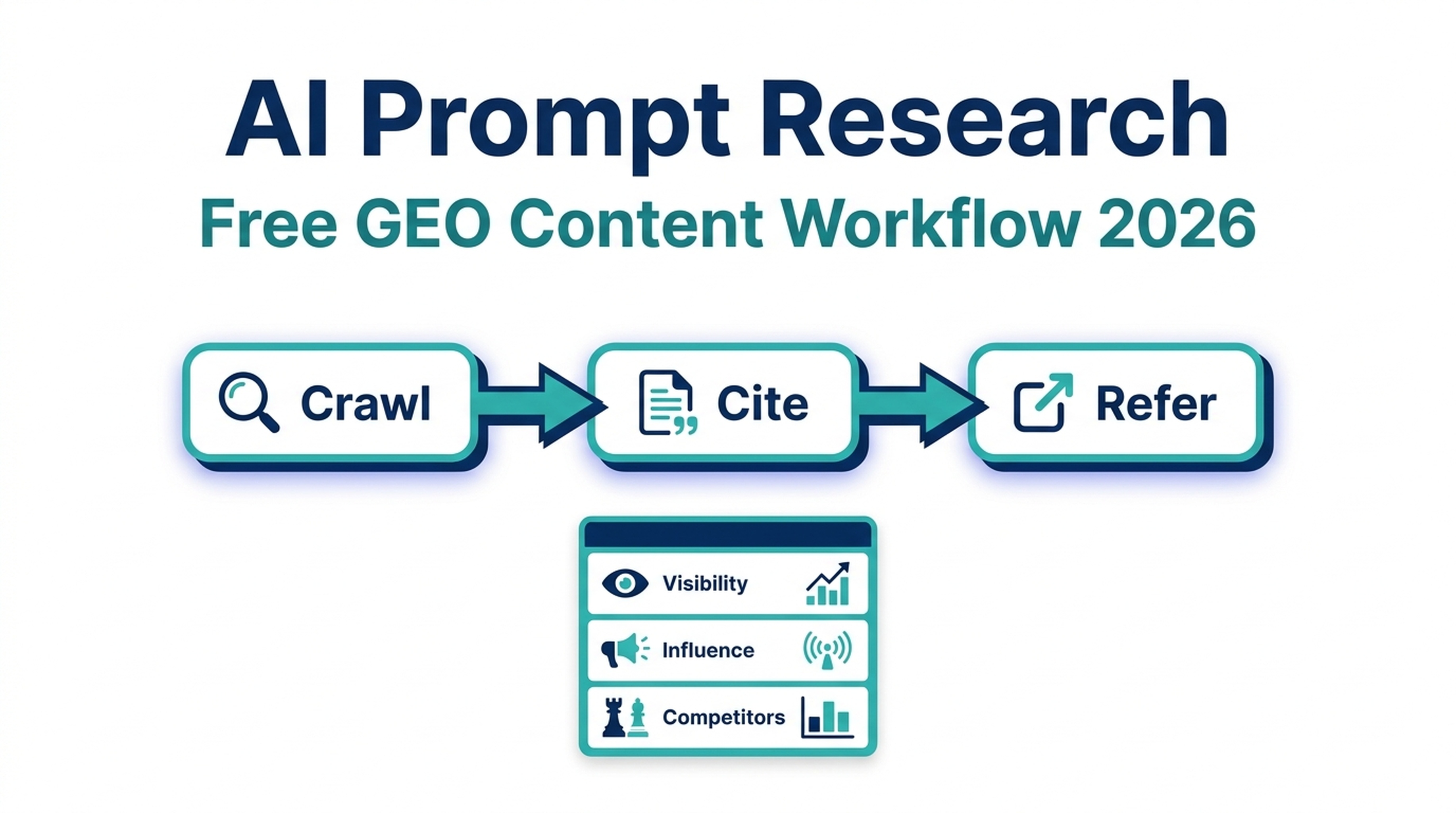
Here is a repeatable workflow you can run every month. It uses a free GEO checker and a public leaderboard so you are not dependent on expensive seat-based tools.
Step 1: Build your prompt set
Start with 30–100 buyer-intent prompts — the real questions your customers ask an AI before they ever reach your site. Mix three types: category prompts ("what is the best [your category]"), comparison prompts ("[your brand] vs [competitor]"), and problem prompts ("how do I solve [pain point]"). Anchor the set to your actual funnel, not to your existing keyword list, because AI prompts are longer and more conversational than search queries.
Step 2: Run a free GEO checker audit
Run the prompt set through a free GEO checker that reports which engines cite you, how often, and alongside which competitors. A good checker returns citation rate, share of citation, and prompt coverage broken down by engine (ChatGPT, Perplexity, Gemini, Google AI Overviews, Copilot) so you can see per-platform gaps instead of a single blended score.
Step 3: Benchmark against the leaderboard
Before you interpret your own number, check where the category ceiling sits. A GEO leaderboard ranks the top sites for AI search visibility by share of citation across engines. Compare your share against the leaders in your category to see whether you are chasing a 10% gap or a 40% gap — the size of the gap changes the strategy.
Step 4: Diagnose the gap per engine
For each engine, classify your result into one of four states:
| Pattern | What it means | First move |
|---|---|---|
| High citations, high coverage | You are a cited authority | Defend with freshness and new prompts |
| High citations, low coverage | You are a niche source | Expand topical breadth |
| Low citations, high coverage | You are retrieved but not cited | Fix source quality and extractability |
| Low citations, low coverage | You are invisible | Start with entity clarity and foundational GEO |
The "retrieved but not cited" state is the most frustrating and the most common: the engine knows you exist but does not trust you enough to surface you in the answer. That points to source-quality and answer-extractability problems, not reach problems.
Step 5: Convert the data into a fix plan
When your GEO ranking is low, work through this five-step fix in order — each step removes one reason an engine might skip you:
- Confirm crawlability for AI crawlers. Check your robots.txt and make sure retrieval crawlers (GPTBot, PerplexityBot, Google-Extended, ClaudeBot) are allowed while training crawlers are handled deliberately. A blocked crawler is the silent killer of GEO ranking.
- Strengthen brand entity clarity. Make sure your site, schema, and off-site profiles consistently state who you are, what you do, and for whom. Inconsistent entity signals are a top cause of "retrieved but not cited."
- Make content answer-extractable. Lead each page with a concise direct answer, use clear headings, and add FAQ and HowTo schema. Generative engines lift the most extractable sentence — make sure it is the right one.
- Earn citations on authoritative external sources. One in-depth piece on a high-authority outlet beats 100 low-weight placements. AI engines weight source quality, not publishing volume.
- Re-run the audit on the same prompt set after 2–3 weeks. Because citation is stochastic, give changes time to propagate before judging whether they moved your share of citation.
GEO Rank Checking vs Traditional SEO Rank Tracking
| Dimension | Traditional SEO rank tracking | GEO rank checking |
|---|---|---|
| Core unit | URL position on a SERP | Citation / mention inside an AI answer |
| Stability | Relatively stable day to day | Stochastic; changes session to session |
| Measurement window | Single snapshot acceptable | 7–9 day window with confidence intervals |
| Competitive lens | Position vs other URLs | Share of citation vs other brands |
| Click relationship | Position → CTR → traffic | Mostly zero-click; traffic is a weak proxy |
| Per-engine need | One Google SERP | Each AI engine measured separately |
The two disciplines are complementary, not interchangeable. Keep your SEO rank tracker for organic search health, and run a GEO rank checker for AI visibility — but do not let either report pretend to be the other.
Common Mistakes When Checking GEO Ranking
- Treating GEO as "AI version of SEO ranking." Anyone who promises to make your brand "rank #3 in AI search" is misunderstanding the medium. Legitimate GEO work improves citation rate by a measurable percentage over a window, not a fixed position.
- Reporting single-run snapshots. One audit is a data point, not a trend. Always sample repeatedly and report a range.
- Blending all engines into one number for diagnosis. A blended headline is fine for the executive summary, but it hides the engine where you are actually losing. Always keep the per-engine breakdown for the fix plan.
- Optimizing for publishing volume over source quality. AI engines reward authoritative, cross-validated sources, not mass-produced content. Bulk AI content is increasingly filtered out.
- Ignoring the retrieved-vs-cited gap. If you are retrieved but not cited, more reach will not help. Diagnose source quality and extractability first.
FAQ
Is there a free GEO rank checker? Yes. Auspia's GEO checker runs a free audit that reports citation rate, share of citation, and prompt coverage across the major AI engines, and the public leaderboard lets you benchmark against the top sites for AI search visibility.
How often should I check my GEO ranking? Run a full audit on a fixed prompt set every 2–4 weeks, sampling across at least a 7-day window each time. Weekly micro-checks on a 10-prompt subset are useful for catching sudden drops, but never base a decision on a single run.
What is a good share of citation? It depends on category maturity. In emerging categories with under 10 credible brands, 20–30% is leadership territory. In mature categories with 50+ brands, 5–10% can be strong. The trend direction matters more than the absolute number.
Why does my GEO ranking change every time I check? Generative answers are stochastic — the same prompt can return different sources across sessions, geography, and time. This is expected, not a bug. That is exactly why you measure over a multi-day window with confidence intervals instead of trusting a single snapshot.
Do I still need traditional SEO rank tracking? Yes. SEO rank tracking measures organic search health; GEO rank checking measures AI visibility. They are complementary. Just do not use one to predict the other — 83% of AI Overview citations come from pages outside the organic top 10.
Author: Ethan Marlowe, GEO Measurement Lead Across 500+ Prompts at Auspia. Ethan writes about citation tracking, share-of-citation dashboards, and how growth teams turn AI visibility data into a weekly operating rhythm.