If the brief says "improve AI visibility," it is not ready yet
Large companies rarely struggle to find a vendor, dashboard, or list of AI platforms to monitor. They struggle to agree on what the work is supposed to change.
"Improve AI visibility" sounds sensible until someone asks the questions that determine whether a program can be managed: Which audience? Which business line? Which buyer decision? Which information gap? Which risk owner? What signal would justify expanding the work?
An enterprise GEO strategy should begin with one business decision that is being shaped by AI-assisted research. It might be a high-consideration product comparison, a market-entry question, a complex service evaluation, a trust concern that delays conversion, or an implementation question that blocks a sales cycle. The goal is not to make a brand visible everywhere. The goal is to make the right information available when that decision is made.
This approach makes GEO easier to govern, more honest to measure, and less likely to become a disconnected content project.
Choose the business scenario before you choose a platform or metric
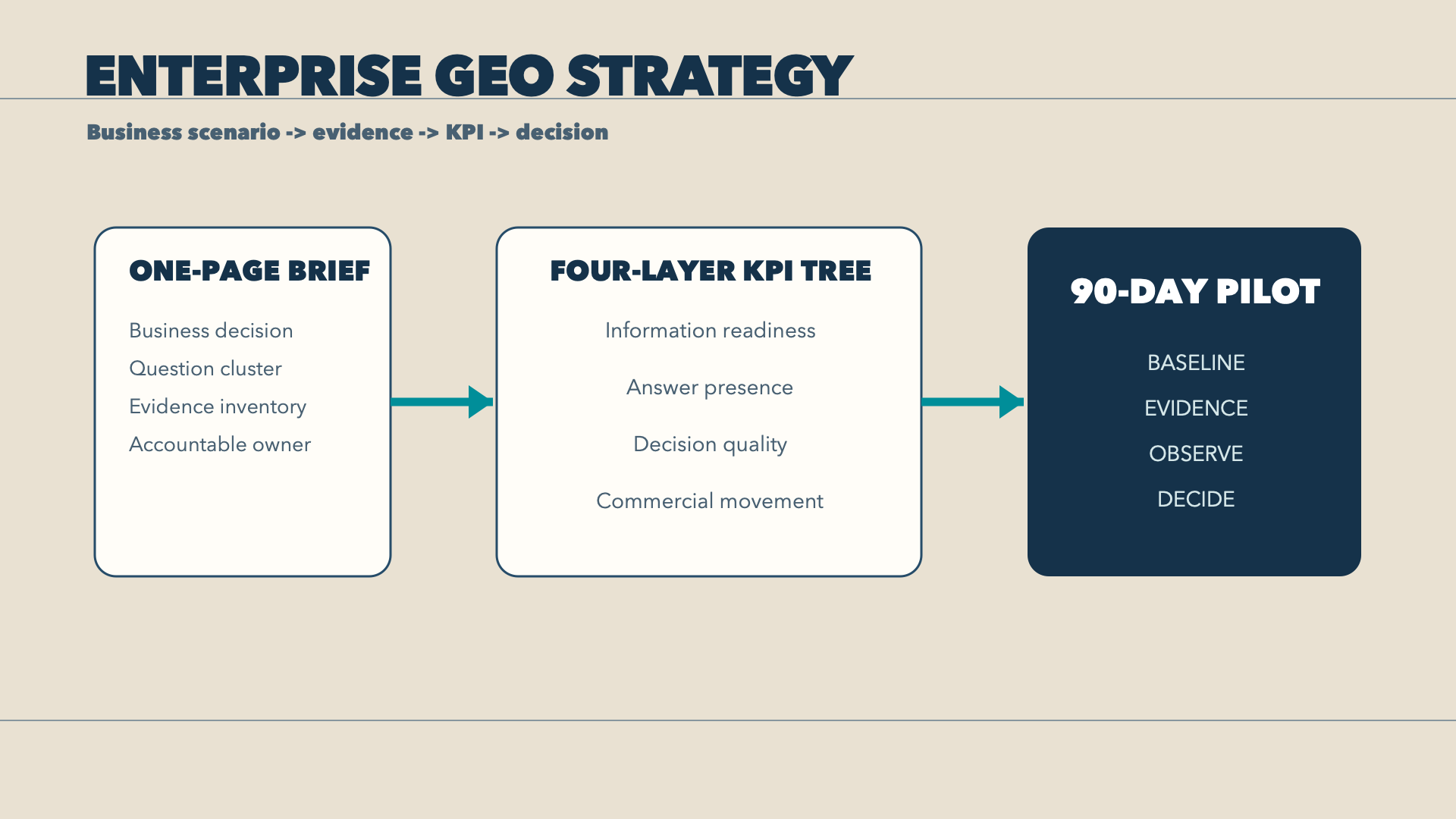
Start by listing decisions that matter commercially, then score them for suitability. A strong first scenario has a defined audience, recurring questions, owned information that can be improved, and a business owner who cares about the outcome.
Scenario | Why it can suit a GEO pilot | What to watch |
|---|---|---|
Complex B2B category comparison | Buyers often research alternatives before talking to sales | Keep claims factual and involve product marketing early |
Regulated or high-trust evaluation | Public proof and accurate boundaries strongly affect confidence | Legal, security, and compliance review may lengthen approvals |
New market or product launch | The company needs a coherent explanation of fit and local availability | Do not confuse early awareness with commercial validation |
Service-line differentiation | Buyers need to understand which team, capability, or delivery model fits | Avoid generic location or industry pages with no real substance |
Recurring implementation concern | Documentation can reduce uncertainty after a shortlist | Separate support content from contractual or legal advice |
For a first pilot, choose one scenario rather than a corporate-wide category. A global company may have dozens of brands, markets, languages, and product lines. Treating all of them as a single visibility score hides the decisions that matter and makes ownership impossible.
Write a one-page GEO decision brief
Before commissioning monitoring, content, or an audit, fill in this brief with the business sponsor and the teams who own the facts.
Brief field | What a useful answer looks like |
|---|---|
Business decision | "Help mid-market IT leaders decide whether our managed detection service fits their existing security team." |
Target audience and market | Specific role, company context, country or language, and decision stage |
Priority question cluster | 15 to 30 real questions from discovery, comparison, trust, and implementation stages |
Evidence inventory | Existing product pages, documentation, research, case material, policies, and known gaps |
Commercial outcome | A qualified evaluation, a technical-review start, a better-fit pipeline, or another agreed signal |
Program guardrails | Approved claims, excluded claims, legal-review needs, customer-data limits, and escalation route |
Accountable owner | A named business owner, not only the agency or SEO team |
Decision gate | The date and evidence required to continue, expand, redesign, or stop the pilot |
The brief forces an important conversation: is the company solving an information problem, a product-positioning problem, a technical discoverability problem, or all three? GEO cannot repair a value proposition that nobody can agree on. It can make that disagreement visible early.
Measure the chain, not one abstract score
Enterprise reporting needs a layered scorecard. A single mention rate is too easily gamed and too far removed from commercial results. At the same time, revenue is too slow and too influenced by other work to be the only near-term measure.
Use four connected layers.
Layer | What it asks | Examples of useful measures | What it should not be used to claim |
|---|---|---|---|
Information readiness | Can systems and buyers find the evidence? | Crawlable pages, current facts, complete documentation, clear entity and product context | That readiness automatically creates demand |
Answer presence | Does the brand appear in the relevant question set? | Presence rate, cited-source rate, recommendation context, competitor comparison | That every mention reflects a positive recommendation |
Decision quality | Does the answer give a useful and accurate reason to consider the brand? | Accuracy review, message-fit score, correction rate, coverage of key objections | That a favorable answer caused a deal |
Commercial movement | Is the scenario connected to better buyer behavior? | Qualified evaluations, technical-review starts, assisted conversions, sales feedback, branded demand trend | Direct causal attribution from one AI answer |
This is not a license to report every metric. Pick one or two per layer for the pilot, define them before the baseline, and state how each will be collected. The measurement question should always be, "What decision will this number help us make?"
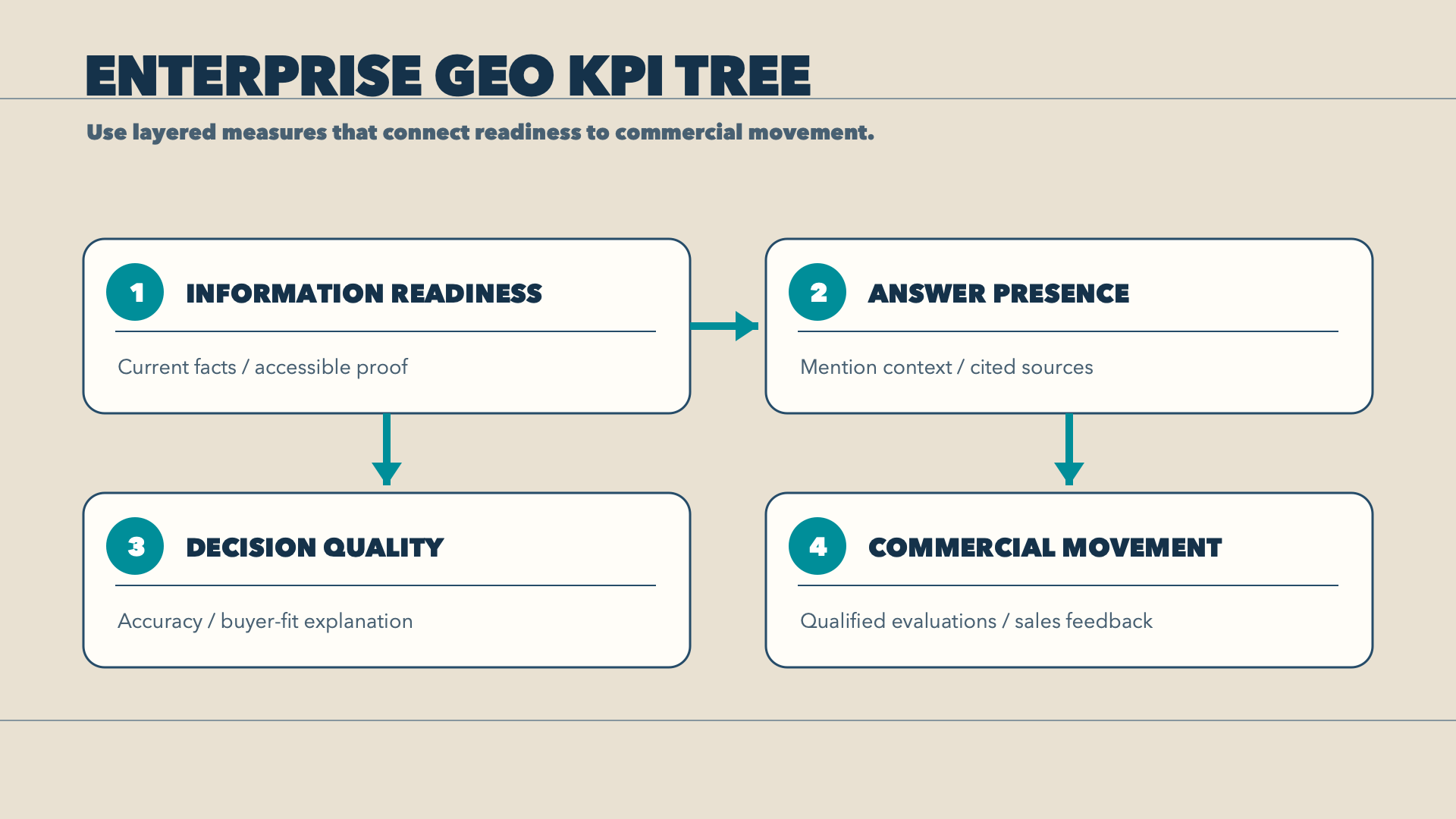
A useful enterprise scorecard connects readiness, answer presence, decision quality, and commercial movement.
Give each team a job it can actually own
GEO sits across departments, which is precisely why it can stall. Marketing may own the editorial calendar but not product claims. Product may own documentation but not buyer language. Legal may approve evidence but not review prompt results. Sales hears real objections but may never see the content backlog.
Use a simple operating model instead of a vague request for collaboration.
Workstream | Accountable | Contributors | Output |
|---|---|---|---|
Business scenario and priority questions | Business-line sponsor | Sales, product marketing, customer success | Approved decision brief and question set |
Fact and evidence review | Product or service owner | Legal, security, documentation, subject experts | Approved fact inventory and claim boundaries |
Content and page improvements | Content or web owner | SEO, product marketing, design | Prioritized page and documentation backlog |
AI-answer observation | GEO or search lead | Analytics, regional teams | Reproducible observation log with context |
Commercial interpretation | Revenue operations or business sponsor | Sales, analytics, marketing | Monthly pilot review and decision recommendation |
An external partner can support several lanes. It cannot substitute for an internal owner of the decision, the facts, or the risk boundary.
Run a 90-day pilot with decision gates
Ninety days is long enough to establish a baseline, improve a focused evidence set, and learn whether the operating model can produce useful decisions. It is not long enough to promise a finished enterprise transformation.
Days 1-15: establish the baseline and the boundaries
Confirm the question set, check conditions, markets, languages, and platforms. Record the initial answer context, competitor presence, visible citations, incorrect claims, and the pages currently supporting each priority question. Assemble the fact inventory and identify claims that need legal, security, or product approval.
The quality gate: every tracked question has a business rationale and an owner. If a prompt cannot be linked to an audience or decision, remove it from the pilot.
Days 16-45: repair the evidence that blocks a clear answer
Focus on the smallest set of pages that can improve clarity: a use-case page, an implementation guide, a comparison framework, a documentation page, a canonical fact correction, or technical access to an already useful source. Keep a record of what changed and why.
The quality gate: each page has a factual owner, a defined buyer question, and a review path. Do not publish speculative claims just to make the language sound more "AI-friendly."
Days 46-75: observe, compare, and qualify the results
Repeat the defined answer checks. Compare patterns, not isolated screenshots. Did the priority question set show clearer brand context? Did incorrect claims decrease? Did more pages become appropriate sources? What changed in sales feedback or the quality of incoming evaluations?
The quality gate: separate observed changes from explanations. A movement in answer presence may coincide with a content update, but it does not prove the update caused it.
Days 76-90: make a continuation decision
Bring the scorecard, evidence log, content changes, commercial signals, and unresolved risks to the business sponsor. The decision should be one of four things: expand the scenario, refine the question set, fix an operating blocker, or stop the work because the case is not strong enough.
The quality gate: write down why. An enterprise program needs a learning record, not a success-only presentation.
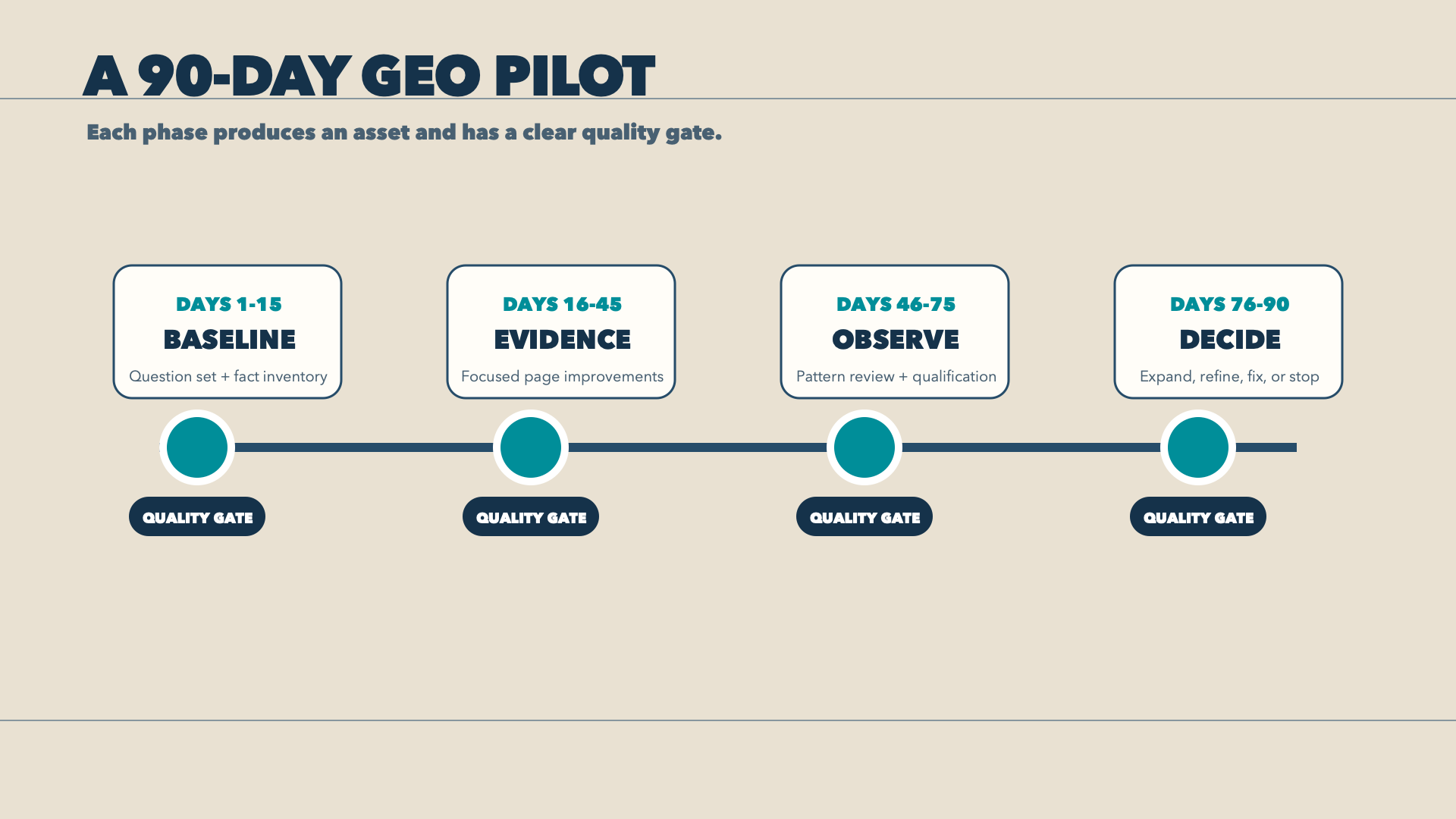
A pilot needs concrete outputs and a quality gate in every phase.
Questions to ask before approving a GEO vendor or internal program
These questions reveal whether a proposal is tied to a real operating model:
- Which business decisions and audience scenarios will the work cover first?
- How will prompts, locations, languages, platforms, and answer conditions be documented?
- What makes a citation or mention a positive, neutral, or problematic result?
- Which sources and pages will be inspected before a claim is made about performance?
- How will the provider handle answer volatility and uncertain attribution?
- Who reviews product, legal, security, and regional claims before content changes go live?
- What information is retained, and how are customer or confidential inputs excluded from testing?
- Which near-term measures are leading indicators, and which commercial measure will keep the pilot honest?
- What would make the team change course or stop after 90 days?
- Which deliverables leave the enterprise with reusable evidence, documentation, and operating knowledge?
Be cautious with claims that promise a fixed number of citations, guaranteed model output, or direct revenue attribution from a volatile answer surface. A serious program can define the work, the evidence, the review cadence, and the decision gates. It should not invent certainty where the platform does not provide it.
The Auspia view: enterprise GEO is a governed learning loop
The worthwhile outcome of an enterprise GEO pilot is not a brighter dashboard. It is a repeatable way to connect buyer questions, public evidence, answer observations, and business decisions.
That loop becomes valuable beyond AI search. It exposes stale facts, missing documentation, unclear market positioning, and the gaps between what sales hears and what the website proves. Teams that need a starting point can use Auspia's AI Search Visibility Checker to identify a focused set of questions and current answer contexts. The real work begins when the business owner decides which of those questions deserves an evidence-backed response.
FAQ
How large should an enterprise GEO pilot be?
Start with one business scenario, 15 to 30 priority questions, and a manageable evidence backlog. A pilot that spans every market and product line usually produces a generic score and no accountable action.
Should enterprise GEO sit in SEO, brand, or product marketing?
The operating lead can sit in different teams, but business sponsorship and fact ownership need to be explicit. Search, content, product marketing, analytics, legal, and sales usually have distinct roles in a viable program.
Can a 90-day pilot prove revenue impact?
It can show leading indicators and commercial signals such as better-qualified evaluations or improved sales feedback. It should not claim precise revenue causality from individual AI answers without strong supporting evidence.
Author: Maya Ellison, 12-Year GEO Strategy Researcher at Auspia. Maya writes about AI-search visibility, brand entity clarity, and practical GEO operating systems for growth teams.