Quick answer
The best GEO Claude Code skill in 2026 is not a single downloadable prompt. It is a small operating stack: one custom skill for the repeatable GEO workflow, one hook for quality gates, one MCP connection for trusted data, one subagent for review, and one slash command for the moments when a human wants control.
If I had to build only one, I would build a geo-content-auditor skill. It should inspect whether a page is easy for AI answer systems to understand, quote, and cite. It should check entity clarity, source quality, answer-ready passages, crawl access, internal links, schema, and measurement prompts. But the skill becomes much more useful when it sits inside a controlled Claude Code workflow rather than acting like a loose writing assistant.
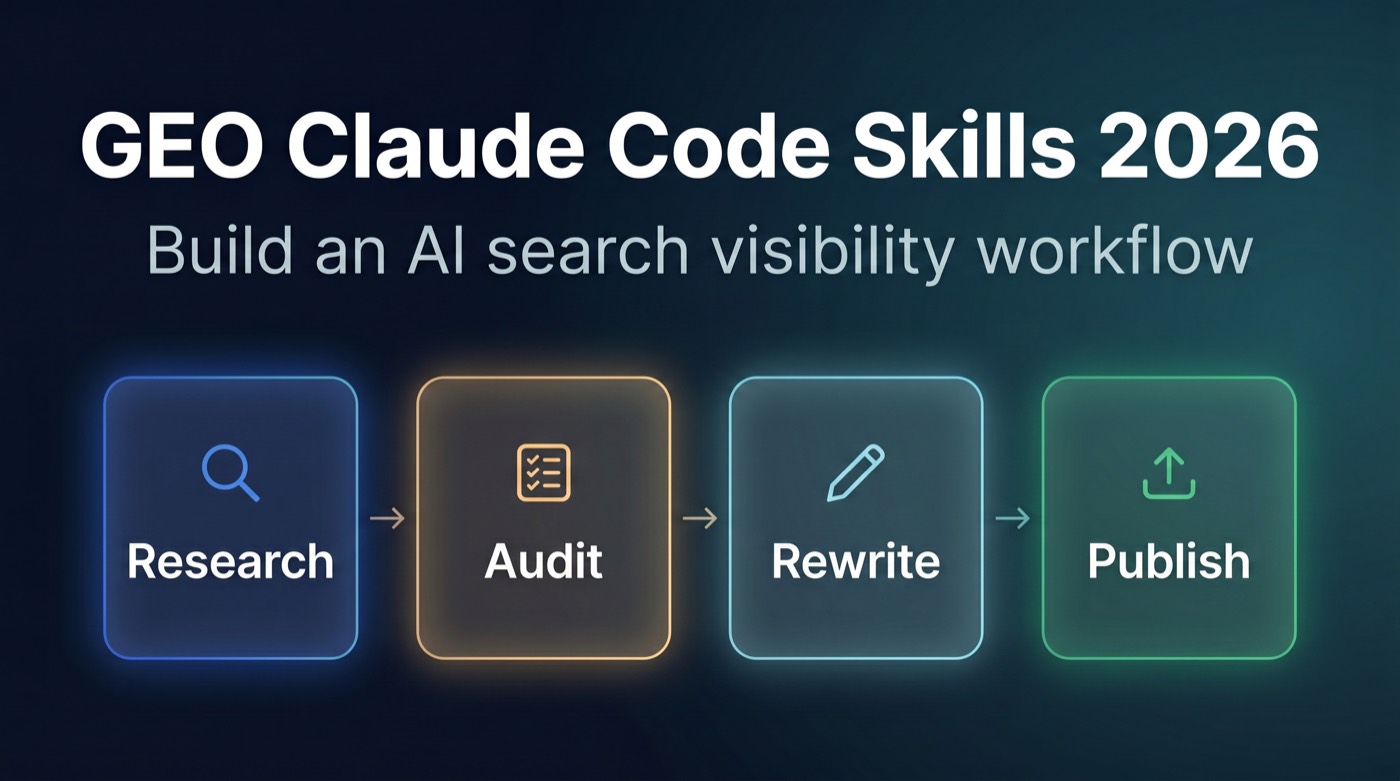
That distinction matters. GEO work fails when teams treat it as a content rewrite task. It works better when they build a repeatable evidence loop: research the query, audit the page, rewrite the source, publish with structure, then measure whether AI search surfaces can use it.
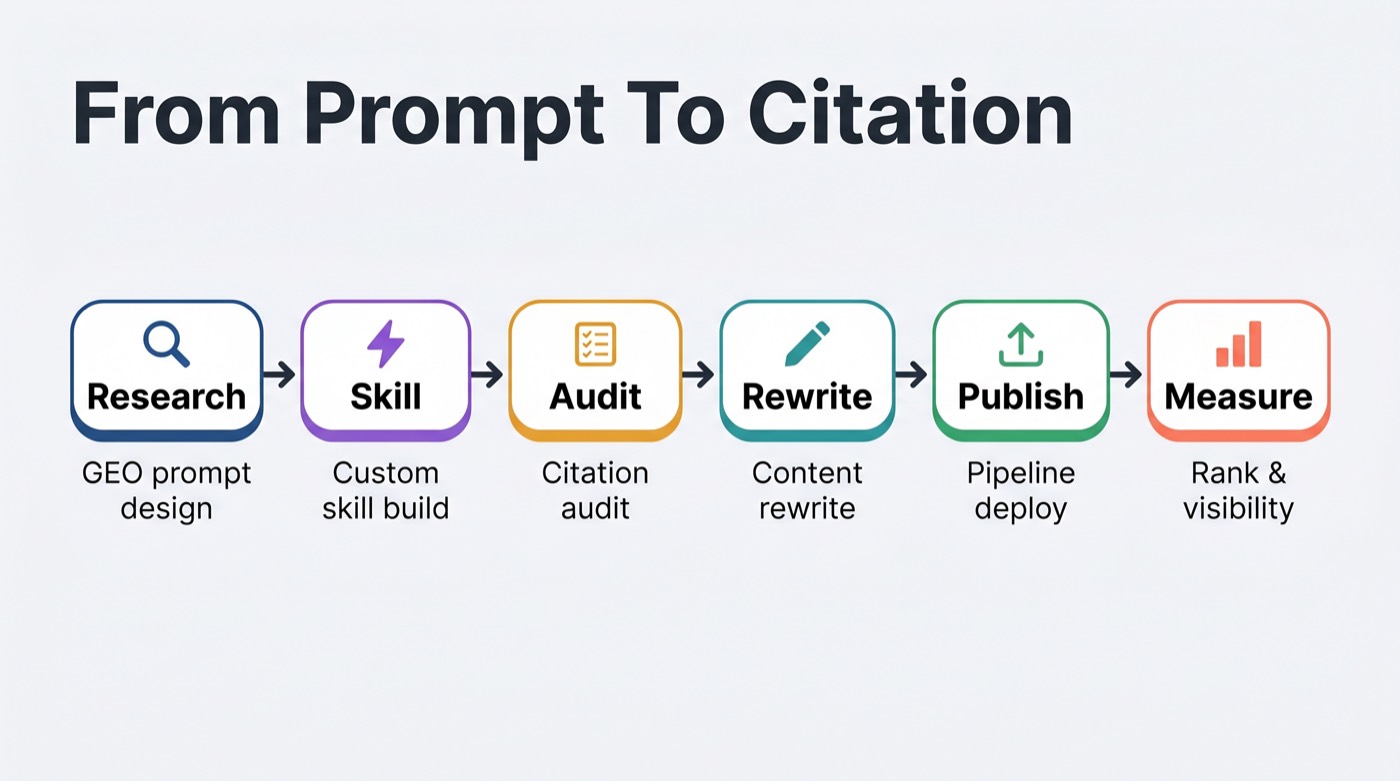
Caption: A practical Claude Code GEO workflow moves from prompt research to skill-guided auditing, rewriting, publishing, and visibility measurement.
What changed in 2026
Claude Code is no longer just a coding assistant for editing files. It has become a useful operating layer for repeatable growth work because it can combine filesystem context, project rules, external tools, and step-by-step workflows.
For GEO teams, that is a big deal. Generative Engine Optimization is not only about adding FAQs or stuffing pages with statistics. The real work is making a brand easier for answer engines to verify. That usually means:
- Clear entity facts about the company, product, category, and audience
- Pages that answer real buyer questions without hiding the answer
- Source-backed claims that can be quoted safely
- Technical access for crawlers and AI retrieval systems
- Internal links that connect definitions, comparison pages, tools, and proof assets
- A measurement loop across prompts, AI answers, citations, and competitor mentions
Claude Code's building blocks map surprisingly well to this work. Anthropic's Claude Code documentation describes skills as reusable ways to extend Claude with task-specific instructions, hooks as automated actions at lifecycle events, slash commands as explicit session controls, MCP as a way to connect tools and data, and subagents as a pattern for delegated work. Used carefully, these pieces turn GEO from "write some AI search content" into a repeatable publishing system.
The catch: Claude Code can now edit a site. The goal is to teach it to edit the right things, for the right reason, with a stop condition.
What a GEO Claude Code skill should actually do
A good GEO skill should not start by writing. It should start by diagnosing why an answer engine would trust the page.
Here is the practical scope I would expect from a strong 2026 GEO skill:
Capability | What the skill checks | Why it matters for GEO |
|---|---|---|
Prompt intent mapping | Buyer prompts, comparison prompts, problem prompts, local prompts | AI answers are generated from user questions, not from keyword lists alone |
Entity audit | Brand name, product category, audience, competitors, authors, locations | LLMs need clear entities before they can mention or compare a brand |
Citation readiness | Quotable passages, cited claims, dated data, author/source clarity | AI answer systems prefer pages that can be summarized without guesswork |
Technical access | Robots rules, sitemap, rendering, schema, canonical tags | A great page is useless if retrieval systems cannot access or parse it |
Internal evidence map | Links to category pages, tools, case pages, glossary pages, docs | Strong internal context helps machines and humans understand the brand's domain |
Measurement prompts | A fixed prompt set for ChatGPT, Perplexity, Gemini, AI Overviews, and other surfaces | GEO needs recurring measurement, not one-time publishing |
A useful skill also has boundaries. It should flag unsupported claims rather than inventing proof. It should separate "missing evidence" from "weak writing." It should create a changelog of what it changed. And it should make human review easy, especially on pages that affect pricing, medical, legal, financial, or enterprise buying decisions.
The best skill stack for GEO work
The strongest setup is usually not one giant skill. It is a small stack where each Claude Code feature does one job.
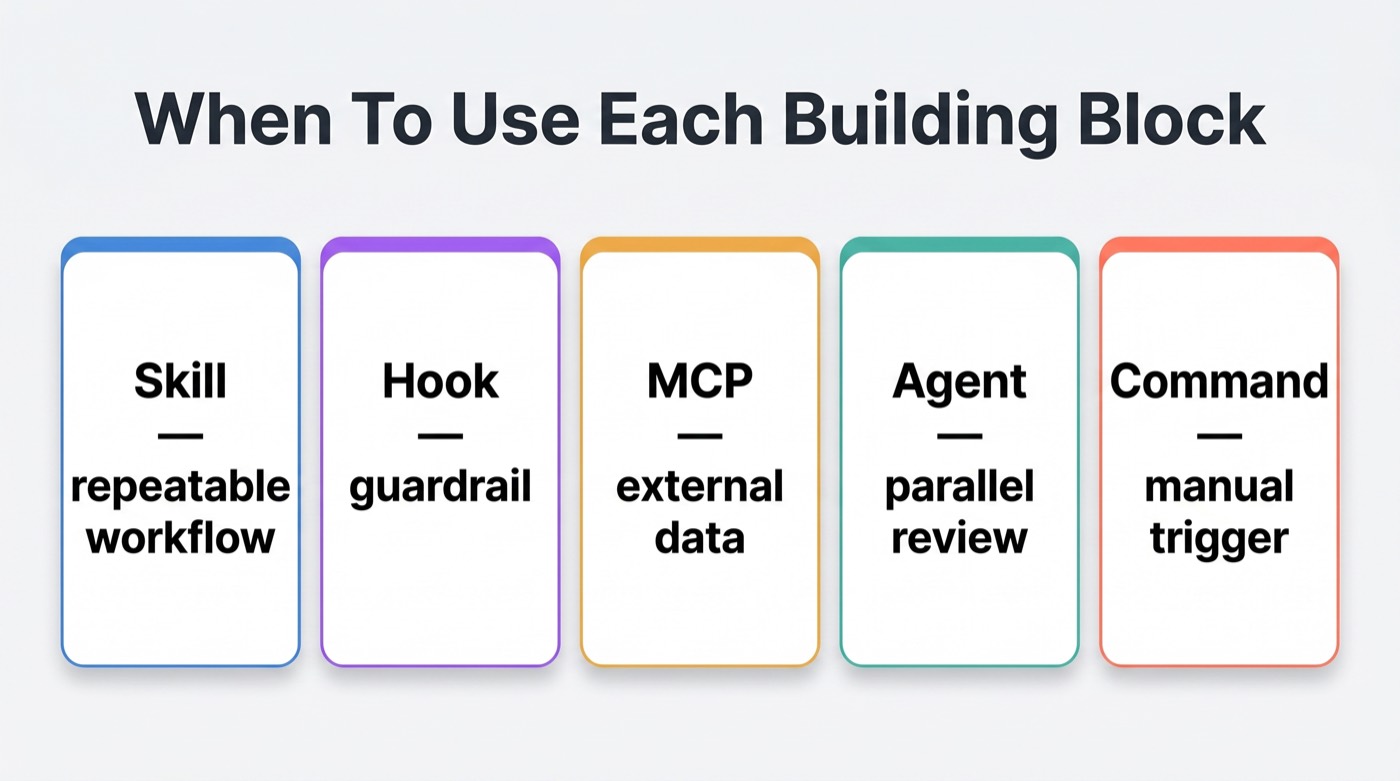
Caption: Use skills for repeatable workflows, hooks for guardrails, MCP for external data, agents for parallel review, and commands for manual triggers.
1. Custom skill: the repeatable GEO workflow
The custom skill is the center of the system. This is where you put the instructions that should be loaded automatically when the task is about GEO, AEO, AI search visibility, citation readiness, or content optimization.
A good SKILL.md should include:
- When to trigger the workflow
- Inputs the agent must inspect before editing
- The exact audit sequence
- What counts as a blocker
- Required output format
- Examples of strong and weak citation-ready content
- A final checklist before publishing
For example, the skill can tell Claude Code to inspect a page, identify the target AI-search prompts, evaluate whether the opening answer is extractable, check source claims, improve headings, add FAQs only when useful, then return a diff and a scorecard.
This is the piece I would call the "best" GEO Claude Code skill because it carries the operating knowledge. Without it, the rest of the stack has nothing to enforce.
2. Hook: the guardrail that stops bad GEO edits
Hooks are useful because they run at specific moments in the Claude Code lifecycle. For GEO, that makes them ideal for checks that should not depend on the model remembering a rule.
Useful GEO hooks include:
- Block publishing if a page has no clear answer in the first section
- Warn when a page adds claims without sources
- Run a local linter after content edits
- Check whether generated Markdown images have descriptive alt text
- Stop changes to
robots.txt, sitemap, schema, or canonical rules unless the task explicitly asks for technical SEO edits
A hook should not replace editorial judgment. It should catch the boring mistakes that ruin AI citation potential: missing titles, broken internal links, empty alt text, unreviewed generated claims, or accidental crawler blocks.
3. MCP server: trusted data without copy-paste chaos
MCP is valuable when the GEO workflow needs external or structured data: analytics, Search Console exports, keyword databases, CMS entries, docs, internal product facts, or a citation-tracking database.
The rule is simple: connect only what the workflow needs. A GEO skill does not need unlimited access to every system in the company. It needs scoped, trusted inputs.
Good MCP-backed GEO tasks include:
- Pulling a list of pages with declining organic traffic
- Reading a product fact sheet before rewriting a comparison page
- Checking whether a claim exists in internal documentation
- Fetching prompt visibility measurements from a database
- Comparing competitor mentions across a fixed prompt set
Security matters here. Claude Code best-practice discussions consistently warn against giving agentic coding tools broad access by default. For GEO work, that means MCP should be allowlisted, scoped, and documented.
4. Subagent: parallel review before publishing
Subagents are most useful when the main workflow needs a second opinion. GEO content often benefits from separate passes because one agent can miss what another catches.
For example:
- A "citation reviewer" checks whether the page has quote-worthy passages and evidence
- A "technical reviewer" checks crawlability, schema, and rendering assumptions
- A "conversion reviewer" checks whether the page still helps a human buyer take the next step
- A "competitor reviewer" checks whether the page answers the comparison prompts that matter
This is where Claude Code feels less like a writing tool and more like a small editorial desk. The main agent edits. The review agent pushes back.
5. Slash command: the human-controlled trigger
Slash commands are useful when the team wants an explicit workflow, not an automatic one. For example:
/geo-audit-page/geo-refresh-cluster/ai-citation-check/rewrite-for-answer-engines/measure-ai-visibility
I would not put every GEO action behind a command. The best repeatable logic belongs in a skill. But commands are helpful for risky or high-cost operations, such as rewriting a money page, refreshing a full topic cluster, or generating a measurement report.
A practical geo-content-auditor blueprint
Here is a lean blueprint for the skill I would build first.
Trigger
Use this skill when the user asks to improve a page, article, landing page, comparison page, glossary page, or tool page for GEO, AI search visibility, AI citations, AEO, answer extraction, or LLM optimization.
Inputs
The skill should ask Claude Code to inspect:
- The target file or CMS content
- The page URL, if available
- Target audience and conversion goal
- Primary prompt set or search intent
- Existing internal links
- Product facts and source constraints
- Any local SEO, schema, or crawler rules that affect the page
Audit sequence
- Identify the main question the page should answer.
- Check whether the answer appears near the top in plain language.
- Extract named entities and verify they are clear.
- Identify claims that need sources or removal.
- Check whether headings match real prompts.
- Add answer-ready passages that are useful to humans first.
- Improve internal links to relevant tools, category pages, and proof assets.
- Add structured FAQ only when the questions are real.
- Review technical access signals.
- Return a scorecard and diff summary.
Stop conditions
The skill should stop instead of publishing when:
- It cannot verify important claims
- The page's product positioning is unclear
- The task requires changing legal, medical, financial, or regulated statements
- The page needs source data that is not available
- The technical change could affect crawl access sitewide
This is unglamorous. It is also exactly why it works.
Example GEO scorecard
Area | Pass condition | Example fix |
|---|---|---|
Opening answer | The page gives a direct answer in the first 150 words | Add a short conclusion before the background section |
Entity clarity | Brand, product, audience, and category are explicit | Replace vague "our platform" language with the product name and category |
Citation passages | The page has compact, quotable explanations | Add a 2-3 sentence definition or comparison block |
Evidence | Claims are sourced, qualified, or removed | Link to docs, studies, pricing pages, or customer proof where appropriate |
Crawl access | Important pages are accessible and renderable | Review robots rules, canonical tags, sitemap, and server-rendered content |
Internal context | The page links to related tools or supporting pages | Link to relevant GEO, AEO, AI visibility, or audit resources |
Measurement | The page has a prompt set to test after publishing | Create 10-20 prompts across buyer, comparison, and problem intents |
Auspia teams can pair this workflow with tools such as the AI Search Visibility Checker or the GEO Score Checker when they need a fast outside-in read before deeper content work.
Common mistakes
The most common mistake is treating GEO as a tone change. Teams ask the agent to "make this more GEO-friendly," then get a page with extra headings, more FAQs, and a few generic sentences about AI search. That rarely changes whether the page is cited.
The second mistake is giving Claude Code too much freedom. A GEO skill should not freely rewrite product claims, invent use cases, or adjust technical SEO files without constraints. Agentic workflows need boundaries.
The third mistake is skipping measurement. A page is not GEO-ready just because it looks structured. Test it against real prompts. Check whether the brand is mentioned, whether competitors are preferred, whether citations point to your page, and whether the answer accurately reflects your positioning.
Auspia take
The best GEO Claude Code skill is boring in the right places. It does not promise magic citations. It turns a messy content operation into a controlled loop.
For 2026, I would judge any GEO skill by five questions:
- Does it start with prompts and entities before rewriting?
- Does it separate evidence problems from copy problems?
- Does it use hooks or checks to stop risky edits?
- Does it connect to trusted data instead of guessing?
- Does it produce a measurement plan after publishing?
If the answer is yes, you have something worth using. If the skill only writes a prettier article, keep it out of your publishing workflow.
FAQ
What is a Claude Code skill?
A Claude Code skill is a reusable instruction package that tells Claude how to handle a specific type of task. For GEO work, a skill can define the audit steps, output format, editing rules, and quality checks Claude should follow when improving pages for AI search visibility.
What is the best GEO Claude Code skill in 2026?
The best starting point is a geo-content-auditor skill that checks prompt intent, entity clarity, citation-ready passages, evidence, crawl access, internal links, and measurement prompts. It should be paired with hooks, MCP, subagents, and slash commands for safer execution.
Are Claude Code skills better than SEO tools?
They solve a different problem. SEO tools collect data, audit pages, and show opportunities. Claude Code skills turn that context into repeatable edits inside a codebase or content repository. The strongest workflow uses both.
Can Claude Code improve AI citations automatically?
It can improve the conditions that make citation more likely: clear answers, trustworthy claims, crawlable pages, structured entities, and relevant internal context. It cannot guarantee that ChatGPT, Perplexity, Gemini, or Google AI features will cite a page.
Should every GEO team use hooks?
Yes, if Claude Code can edit files that affect publishing, schema, robots rules, or claims. Hooks are useful guardrails because they can run checks automatically instead of relying on the agent to remember every rule.
Claude Code SEO/GEO learning path
This article is part of the Claude Code SEO/GEO operator series. If you are building the workflow from scratch, follow the sequence:
1. How to Use Claude Code for SEO Automation
2. How to Build a Claude Code SEO/GEO Workflow Cockpit
3. How to Use CLAUDE.md and Memory for SEO/GEO Workflows
4. How to Refresh SEO Pages with the Claude Code VS Code Extension
5. Best GEO Claude Code Skills in 2026
6. How to Use Claude Code Subagents for GEO Research
7. How to Use Claude Code Hooks as SEO/GEO Quality Gates
8. How to Connect Claude Code to SEO Data with MCP
9. How to Use Claude Code GitHub Actions for SEO/GEO Reviews
10. How to Run Daily SEO/GEO Monitoring in Claude Code
Where to go next
Previous: How to Refresh SEO Pages with the Claude Code VS Code Extension