The short version
Search is no longer only a list of blue links. In 2026, Google Search, AI Overviews, AI Mode, ChatGPT, Perplexity, Gemini, and other answer systems are all pushing users toward a different behavior: ask one rich question, compare options, and sometimes let an AI agent do part of the work.
That does not mean SEO is dead. It means the job has widened.
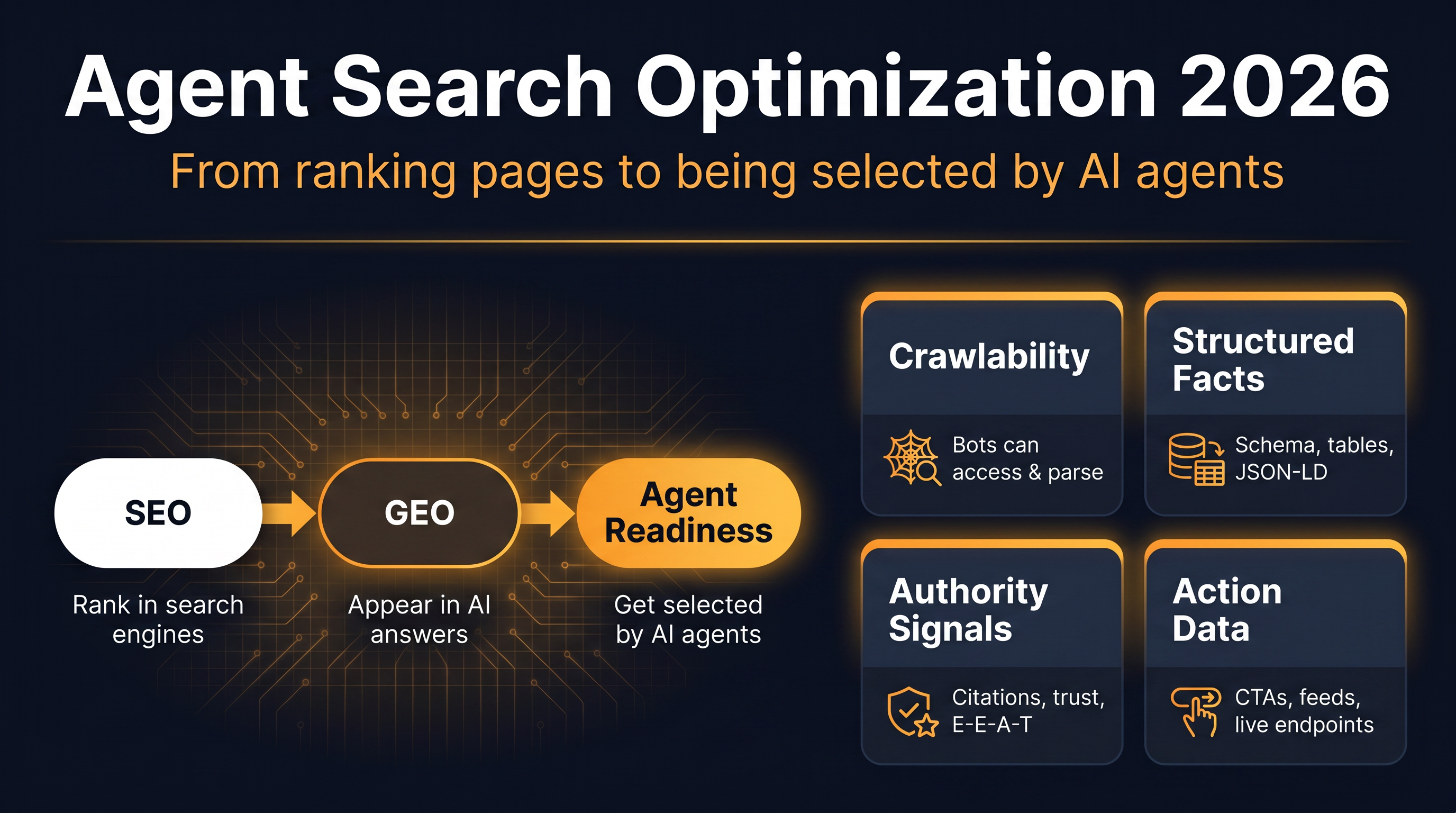
Classic SEO still makes pages crawlable, indexable, understandable, and trusted. GEO, or Generative Engine Optimization, makes the same pages easier for AI answer systems to quote, summarize, and cite. Agent optimization goes one step further: it makes your site useful when an AI system is trying to complete a task, not just answer a question.
The 2026 playbook is simple to say and harder to execute:
Layer | What it optimizes for | What the page must provide |
|---|---|---|
SEO | Ranking and discovery | Crawlable pages, search intent match, internal links, technical health |
GEO | AI answers and citations | Clear claims, source-worthy evidence, entity clarity, extractable summaries |
Agent optimization | Task completion | Structured facts, comparison data, availability, pricing, policies, integrations, action paths |
A page that only says "we are the best platform for growing teams" will struggle. A page that says who it is for, what it costs, what it integrates with, what constraints apply, what evidence supports the claim, and how to take the next step has a much better chance of being used by both humans and AI systems.
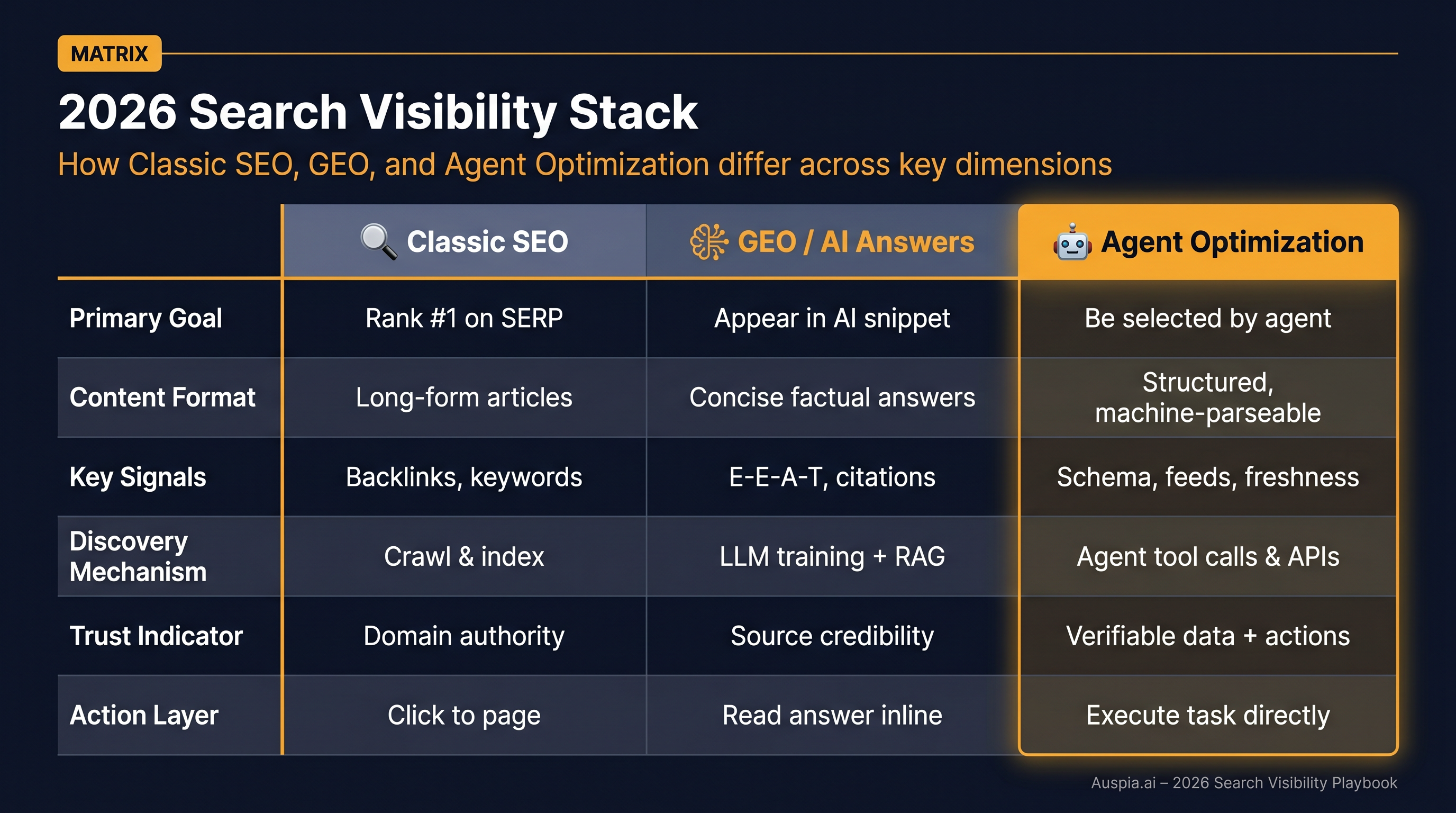
Caption: The 2026 visibility stack is not SEO versus GEO versus agents. It is SEO as the base layer, GEO as the answer layer, and agent readiness as the task layer.
What changed in search
The source article that inspired this piece framed the shift well: search is moving from "returning links" toward "helping complete tasks." That is the right mental model.
Google has been explicit about this direction. Its Search documentation says AI Overviews and AI Mode can use query fan-out, where Search issues multiple related searches across subtopics and data sources before generating a response. Google's May 2025 AI Mode announcement also described agentic capabilities for tasks like event tickets, restaurant reservations, and local appointments. The important detail is not the specific feature list. Product details will keep changing. The important detail is the pattern.
The user is no longer always typing a short keyword such as:
best CRM software
They are asking something closer to:
Find a CRM for a 20-person B2B team, under $500 per month, with Slack integration, easy migration from spreadsheets, and good support for outbound sales.
That query contains intent, constraints, comparison criteria, budget, integrations, and risk. A traditional ranking page may still get discovered. But an AI system trying to answer or act on that query needs much more than a keyword-optimized title.
It needs decision information.
Why this matters for traffic teams
For years, SEO teams could separate traffic work from conversion work. One team ranked pages. Another team handled product detail, sales enablement, pricing, proof, and onboarding.
AI search collapses that separation.
If an AI answer system needs to recommend a source, it will prefer pages that make facts easy to verify. If an AI agent needs to compare vendors, it will prefer pages with clear product attributes, pricing, integrations, limitations, and proof. If a user asks for a buying shortlist, vague marketing pages are not very useful.
This is why SEO, content, product marketing, analytics, and web engineering now need to work from the same asset map. Your website is not just a brochure. It is a structured evidence base.
Auspia's view: the winners in 2026 will not be the teams that abandon SEO for a new acronym. They will be the teams that keep SEO fundamentals strong while rebuilding their content around answer extraction, entity trust, and task completion. If you want a quick baseline, start with an AI Search Visibility Checker or a technical crawl before rewriting everything.
Strategy 1: optimize for decisions, not just keywords
Keyword intent still matters. But for complex queries, the AI layer is trying to make a decision tree.
A weak product page says:
Our platform helps modern teams create better content faster with powerful AI workflows.
That sentence is smooth, but it does not help an AI system compare anything.
A stronger page says:
Pricing starts at $39 per seat per month. The platform supports WordPress, Webflow, Shopify, and custom CMS export. It is best for teams publishing 20 or more SEO pages per month. It is not a fit for teams that need legal or medical content approval without human review. Customers usually use it for content refreshes, programmatic landing pages, GEO audits, and AI-search monitoring.
That paragraph gives the system useful fields: price, integrations, fit, non-fit, use cases, and constraints.
The practical move is to rewrite important pages as decision assets. For each product, service, or comparison page, add:
Decision field | Example content |
|---|---|
Best-fit customer | "B2B SaaS teams publishing 10-100 pages per month" |
Non-fit customer | "Not for teams that need fully automated legal advice" |
Pricing or budget range | "Starts at $X" or "Typical project range is $X-$Y" |
Integrations | CMS, analytics, CRM, commerce, support, data warehouse |
Evidence | Case study, benchmark, screenshot, methodology, customer quote |
Freshness | Last updated date, current feature scope, 2026 assumptions |
Action path | Demo, audit, calculator, checklist, contact, trial |
This may feel too direct for traditional brand copy. Good. Direct is easier to cite, compare, and use.
Strategy 2: build an authority network outside your own site
Your own website is necessary, but it is not enough.
AI answer systems often triangulate. They look for signals across the open web: review sites, community discussions, documentation, third-party comparisons, news coverage, GitHub repositories, partner pages, podcasts, YouTube transcripts, and expert posts. A brand that only talks about itself on its own domain can look thin.
This is where many teams misunderstand GEO. They publish more blog posts and call it AI visibility. That is only one piece.
You need a source network:
Signal source | What to earn or maintain |
|---|---|
Third-party profiles | Accurate product categories, descriptions, pricing notes, screenshots |
Community mentions | Real answers in Reddit, Quora, LinkedIn, niche forums, and Slack communities where appropriate |
Expert references | Practitioner reviews, teardown posts, conference talks, podcast mentions |
Partner pages | Integration pages, marketplace listings, app directory entries |
Documentation | Clear public docs that explain setup, limitations, APIs, and use cases |
Case evidence | Specific before/after examples with dates and methodology |
Do not fake this. Thin PR distribution and low-quality guest posts are easy to ignore. A useful third-party footprint answers the questions real buyers ask: Does this work? For whom? Compared with what? What breaks? What proof exists?
For AI visibility, honest limitations are not a weakness. They help a model place you in the right context.
Strategy 3: feed agents structured facts
Google's Search Central documentation for AI features says the same foundational SEO practices still apply: allow crawling, make content easy to find through internal links, provide a good page experience, keep important content in text, and make structured data match visible page content.
That last part matters. Structured data is not magic. It is only useful when it reflects what humans can also see.
For 2026, every important commercial page should have three layers:
- Visible human-readable facts on the page.
- Structured markup where it is appropriate and accurate.
- Machine-friendly supporting files and feeds when the business model needs them.
Examples:
Page type | Useful structured information |
|---|---|
SaaS product page | SoftwareApplication schema, pricing notes, features, integrations, FAQ |
Local service page | LocalBusiness details, service area, hours, booking path, reviews policy |
Ecommerce category | Product data, availability, price, return policy, shipping, Merchant Center feed |
Comparison page | Compared entities, criteria, dates, methodology, limitations |
Help documentation | HowTo or FAQ where valid, version notes, update date, related docs |
The risk is over-marking. Do not add schema that your page does not support. Do not hide claims in JSON-LD that users cannot verify. AI systems and search engines both prefer consistency.
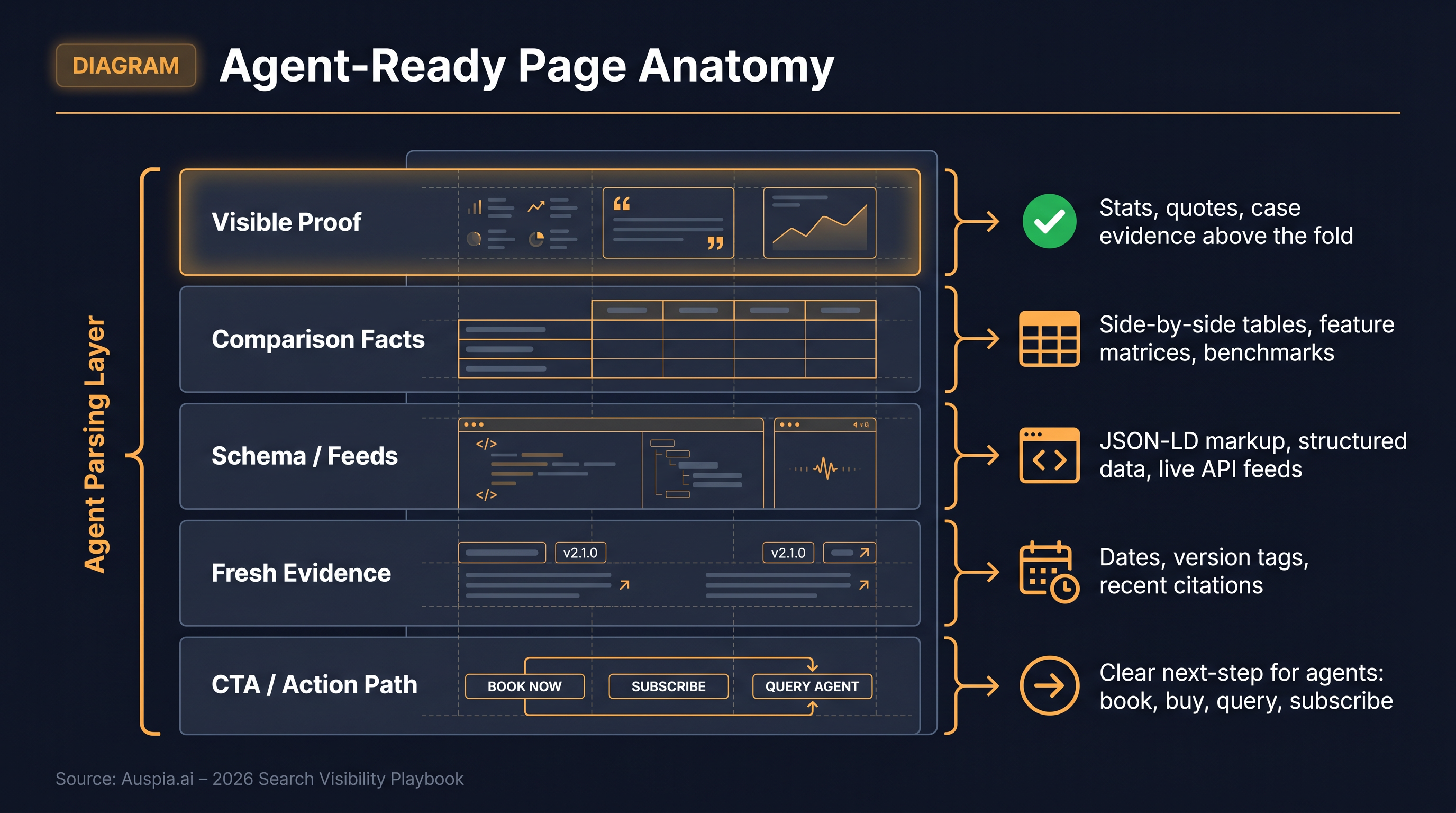
Caption: An agent-ready page makes decision facts visible, structured, and actionable. The markup should confirm the page, not replace it.
Strategy 4: design pages as living assets
The source article ended with a useful idea: future business websites will feel more alive. I agree with that, but I would make it more operational.
A living website is not a site that randomly rewrites itself with AI every day. That would be risky. A living website has a feedback loop.
The loop looks like this:
Input | What to review | What to update |
|---|---|---|
Search Console | Queries, pages, click changes, indexing issues | Titles, internal links, coverage gaps, technical fixes |
AI answer tracking | Where the brand appears or disappears | Answer-ready summaries, missing proof, entity descriptions |
Sales calls | Repeated buyer questions | FAQ, comparison pages, objection sections |
Support tickets | Confusing setup or feature limits | Docs, feature pages, integration notes |
Competitor changes | New positioning or pricing claims | Comparison criteria, proof, alternatives |
Product changes | New features or removed limits | Structured data, changelog, screenshots, use cases |
The point is not to produce more content. The point is to keep the pages that matter current enough to be trusted.
A stale page with a 2023 feature list is a bad signal in 2026. So is a pricing page that hides every practical detail. So is an integration page that says "connects with your stack" but never names the tools.
A 2026 audit checklist for agent-ready visibility
Use this checklist on your top 20 commercial and educational pages.
Question | Pass/fail |
|---|---|
Can Google crawl and index the page? | |
Is the main content available as text, not trapped in images or scripts? | |
Does the page answer a specific buyer or researcher question in the first screen? | |
Are price, fit, use cases, limitations, and integrations clear where relevant? | |
Does the page include evidence a third party could verify? | |
Does structured data match visible content? | |
Are there internal links from related topic pages and tools? | |
Does the page have a real update date or version context? | |
Is there a clear next action for humans and agents? | |
Can the same facts be found in credible external sources? |
If a page fails the first three checks, fix SEO basics before worrying about GEO. If it passes SEO basics but fails evidence and structure, it is probably underperforming in AI answers. If it passes both but has no clear action path, it may get cited without converting.
For a deeper technical pass, use Auspia's SEO/GEO/AEO tools to combine site health, AI search visibility, and agent readiness checks.
What most teams will get wrong
The common mistake is treating "agent optimization" as a new metadata trick.
It is not. It is content architecture.
Another mistake is assuming that AI systems only want short summaries. Short summaries help, but complex tasks need detail. A good agent-ready page often has a concise answer at the top and rich specifics below: tables, examples, limitations, screenshots, schema, FAQs, and a clear action path.
The third mistake is ignoring off-site proof. If every claim about your brand appears only on your own site, it is harder for an answer system to trust the claim. You do not need to be everywhere. You do need enough credible corroboration in the places your buyers and category peers already use.
FAQ
Is SEO still useful in 2026?
Yes. SEO is still the base layer. Pages need to be crawlable, indexable, fast enough, internally linked, and useful to searchers. GEO and agent optimization build on that base; they do not replace it.
What is the difference between GEO and agent optimization?
GEO focuses on being understood, summarized, and cited by generative answer systems. Agent optimization focuses on being usable when an AI system is comparing options or helping a user complete a task. GEO asks, "Can the system cite this?" Agent optimization asks, "Can the system act on this?"
Do I need schema for AI search visibility?
Schema helps when it accurately reflects visible content, but it is not a shortcut. Google's guidance for AI features still points back to foundational SEO and helpful content. Use structured data to clarify facts, not to hide claims.
Should every page include pricing and limitations?
Not every page. But commercial pages, comparison pages, and product pages should give enough decision detail for a buyer or agent to know whether the offer fits. If exact pricing is impossible, provide ranges, plan logic, or buying criteria.
How often should agent-ready pages be updated?
Review priority pages monthly or quarterly, depending on how fast your product and market change. Update immediately when pricing, integrations, availability, policies, or core claims change.
Final take
The search team of 2026 has a broader job than the SEO team of 2016.
It still protects crawlability, rankings, and intent coverage. It also builds evidence that AI answer systems can trust. And now it has to prepare pages for agents that compare, filter, book, buy, recommend, and route users toward action.
The practical question for every important page is no longer only "Can this rank?"
It is also: "Can an AI system understand it, verify it, compare it, and use it to help someone decide?"
If the answer is no, the page is not ready for the next version of search.