Direct answer
Yes, a company can do GEO in-house in 2026. The harder question is whether it should.
If your team already knows SEO, can write structured expert content, can build a prompt library, and can track AI answer visibility every month, you can start with a lean internal GEO program. If you are missing two or more of those pieces, doing it yourself usually becomes slower and more expensive than expected.
GEO is not "SEO with a new name." Traditional SEO is mostly about earning rankings and clicks from search results. GEO, or generative engine optimization, is about making your brand, pages, facts, and external evidence easy for AI answer systems to understand, verify, and cite.
That shift changes the work. You are no longer optimizing only for a blue-link ranking page. You are building the source material an AI system may use when someone asks, "Which vendor should I consider?", "What is the best approach for this problem?", or "Is this brand credible?"
This guide is written for founders, marketing leads, SEO teams, and content operators who are asking a practical question: can we run GEO ourselves in 2026, or do we need help?
Why this question matters in 2026
Search behavior has already split into two habits.
People still use Google for navigation, shopping, local intent, and many research tasks. But they also use ChatGPT, Perplexity, Gemini, Claude, Google AI Overviews, and other answer interfaces when they want a synthesized recommendation instead of ten links.
That matters because many commercial queries are no longer just "find me pages." They are closer to:
- "Which project management tools are good for a 30-person agency?"
- "What are the safest payroll providers for a remote startup?"
- "Which SEO software should I use if I care about AI visibility?"
- "What are the risks of switching from agency SEO to an in-house team?"
In those answers, visibility depends on more than your own website. AI systems look for clean explanations, consistent brand facts, third-party mentions, current evidence, reviews, comparisons, and pages that are easy to quote.
That is why GEO feels familiar to SEO teams, but it is not the same job.
GEO vs SEO: the simplest useful difference
Traditional SEO asks, "Can search engines crawl, understand, rank, and send traffic to this page?"
GEO asks, "Can an AI answer system understand this brand or page well enough to use it as evidence in a generated answer?"
Dimension | Traditional SEO | GEO in 2026 |
|---|---|---|
Main target | Search rankings and clicks | AI answers, citations, mentions, recommendations |
Core asset | Rankable pages | Verifiable source material and external evidence |
Optimization unit | Keyword, URL, SERP | Prompt, answer pattern, entity, citation path |
Measurement | Ranking, impressions, clicks, conversions | Brand mentions, citation share, prompt coverage, answer quality |
Main risk | No rankings or low CTR | The AI answer ignores you, misdescribes you, or cites competitors |
SEO is still useful. In fact, good technical SEO and strong content architecture usually make GEO easier. But ranking well is not a guarantee that an AI answer will cite you. A page can rank and still be too vague, too promotional, too outdated, or too hard to verify.
The reverse can also happen. A smaller brand with a clean comparison page, detailed documentation, credible third-party mentions, and fresh evidence can become useful input for AI answers even before it dominates classic SERPs.
The five capabilities you need before doing GEO yourself
Use this section as a self-assessment. If your team cannot cover these five areas, DIY GEO will probably stall after the first few blog posts.
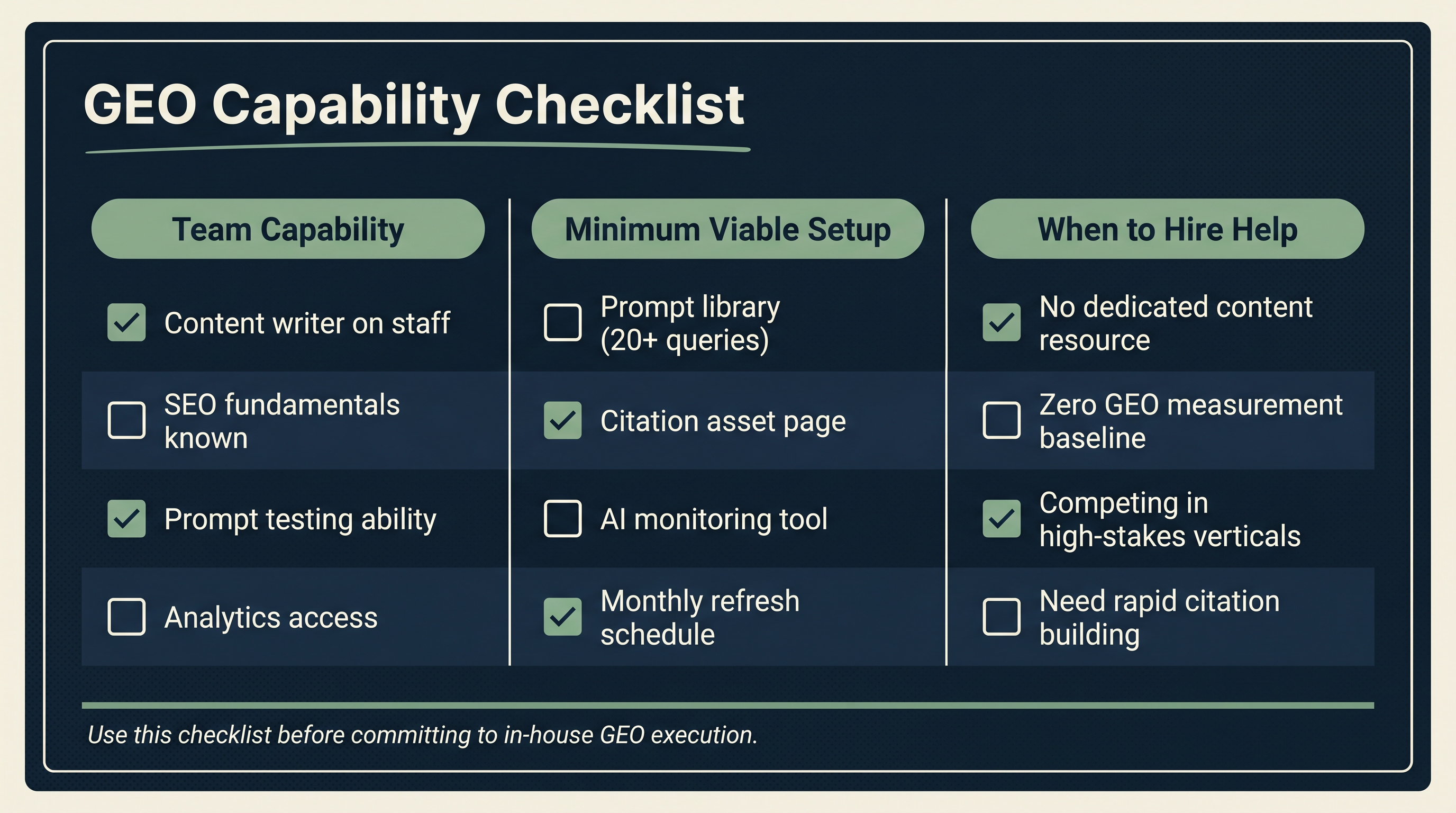
Use this checklist before committing to in-house GEO execution.
1. You need prompt and intent research, not only keyword research
Keyword research still helps, but it is too narrow for GEO.
A buyer may search Google for "best CRM for startups." In an AI tool, that same buyer might ask:
- "Which CRM should a 12-person B2B SaaS team use if we hate admin work?"
- "Compare HubSpot, Pipedrive, and Attio for a founder-led sales team."
- "What CRM is easiest to migrate away from Salesforce?"
Those prompts contain context, constraints, and comparison intent. A GEO team needs to collect them, group them, and test how AI systems answer them.
Minimum setup:
- 30 to 80 buyer prompts grouped by funnel stage
- competitor prompts, comparison prompts, and "recommend a vendor" prompts
- repeated testing across at least two answer platforms
- a way to record whether your brand appears, how it appears, and which sources are cited
If your team only has a keyword list, you are not ready yet. Start by building a prompt library.
2. You need structured expert content
GEO content should be easy for humans to read and easy for machines to extract.
That means your pages need direct answers, definitions, comparison tables, decision criteria, current dates, source links, examples, and clear claims. A long essay with vague advice is not enough.
Good GEO source pages often include:
- a short answer near the top
- a definition that can be quoted without the rest of the article
- comparison tables with real decision criteria
- named use cases and audience segments
- evidence for claims, not just opinions
- an update date when freshness matters
- author or company context that explains why the source is credible
This is where many DIY attempts fail. The team writes "thought leadership" when the channel needs source material.
3. You need entity and evidence work
AI answers are more likely to use brands they can understand consistently.
For GEO, your brand entity should be boringly clear. What do you do? Who is it for? What category are you in? What proof exists outside your own site? Which pages should an answer system trust when it describes you?
At minimum, maintain:
- a clear About page with product category, audience, location, and company facts
- product or service pages that avoid vague positioning
- customer evidence, case studies, reviews, or third-party references
- author bios or expert pages for high-trust content
- schema where it genuinely clarifies entities and content types
- consistent names, descriptions, and claims across major profiles
This work is less glamorous than publishing new posts. It is also where a lot of AI visibility is won.
4. You need measurement that accepts uncertainty
GEO measurement is messier than SEO measurement. There is no universal "rank 1" equivalent for every AI answer surface.
A practical in-house dashboard should track:
Metric | What it tells you |
|---|---|
Prompt coverage | How many priority prompts mention your brand |
Citation share | How often your URLs or third-party references appear as sources |
Answer position | Whether you appear as a recommendation, example, alternative, or footnote |
Competitor frequency | Which competitors appear more often and why |
Source type | Whether citations come from your site, review sites, media, docs, forums, or directories |
Answer accuracy | Whether AI systems describe your brand correctly |
Do not expect perfect attribution in the first month. The goal is to build a repeatable visibility baseline, then improve it.
If you want a quick starting point, use Auspia's AI Search Visibility Checker to see how your brand appears in AI-style answer contexts, then turn those findings into a recurring prompt test set.
5. You need an operating loop
GEO is not a one-time publishing sprint.
AI answers change as new sources appear, competitors publish, models update, review pages change, and fresh evidence enters the web. If your team cannot revisit content and prompts every month, your early wins may decay.
A minimum GEO operating loop includes:
- baseline prompt testing
- source page rewrites
- citation and evidence building
- answer monitoring
- monthly content refreshes
That loop is the difference between "we wrote some GEO articles" and "we run a GEO program."
The real cost of DIY GEO
The obvious costs are writing, tools, and maybe a consultant. The hidden costs are usually larger.
Learning cost
Someone has to learn how AI answer systems select and synthesize sources. They do not need to become a machine learning researcher, but they should understand retrieval, citations, hallucination risk, entity consistency, and source verification.
For a capable SEO or content lead, expect 30 to 60 hours of learning before the work becomes practical. That number goes up if the industry is technical, regulated, or highly competitive.
Strategy cost
DIY GEO creates many hard choices:
- Which prompts matter first?
- Which pages should be rewritten before new pages are created?
- Which claims need third-party evidence?
- Which competitors are being cited and why?
- Which answer platforms are worth monitoring?
Bad choices here waste months. The danger is not that your team does nothing. The danger is that your team works hard on the wrong assets.
Coordination cost
GEO often touches content, SEO, PR, product marketing, sales, support, legal, and analytics.
A content editor may need product proof. A PR lead may need quotable research. A sales team may know the real buyer questions but not have time to document them. Legal may need to review comparison claims. Analytics may need to help build monitoring.
If no one owns that coordination, the program becomes a scattered content calendar.
Evidence cost
AI answers tend to reward corroboration. Your own site matters, but it is not the whole picture.
You may need:
- review platform cleanup
- partner mentions
- expert quotes
- survey or benchmark data
- original research
- credible guest contributions
- directory profile updates
- public documentation
This is where "we will just write blogs" breaks down. GEO is partly content, partly reputation infrastructure.
Maintenance cost
A GEO article published in January 2026 can be stale by June if the market changes, competitors launch, or an AI answer starts citing a newer source.
At minimum, budget for monthly prompt checks and quarterly content refreshes. If your category changes quickly, check more often.
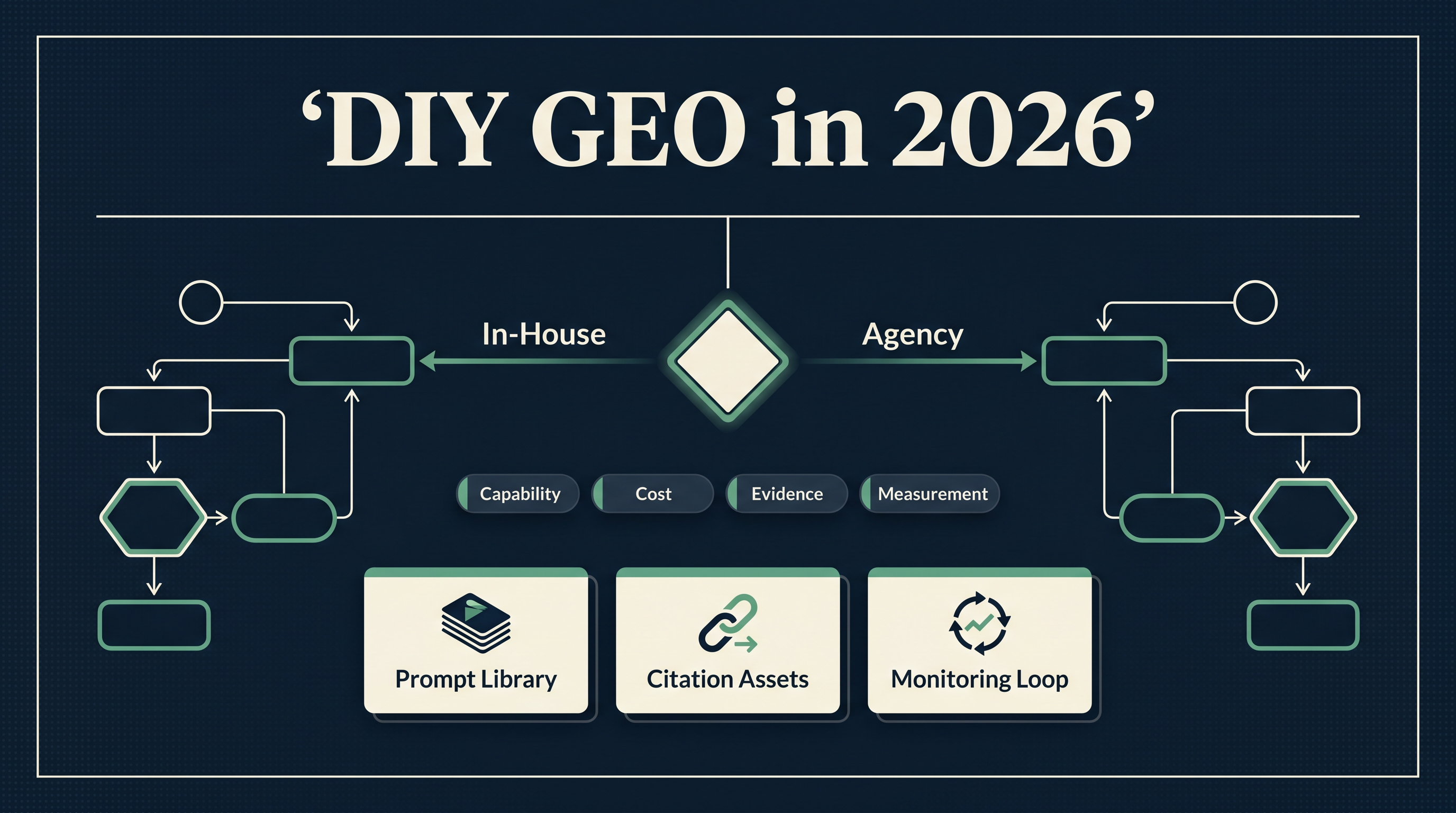
DIY vs hiring help: a practical decision table
There is no universal answer. The right model depends on your team, category, urgency, and risk tolerance.
Situation | Better path | Why |
|---|---|---|
You have strong SEO and editorial teams, but little AI visibility measurement | Hybrid | External strategy plus internal execution works well |
You have no content owner | Hire help | DIY will stall after planning |
You operate in legal, finance, health, cybersecurity, or enterprise software | Usually hire help | Claims, evidence, and accuracy matter more |
You have a niche product and deep founder expertise | DIY or hybrid | Internal knowledge may be your strongest asset |
Competitors already appear in AI answers and you do not | Hire help | Speed matters |
Budget is limited but time is available | DIY pilot | Start with a narrow prompt set and a few source pages |
You want to build long-term internal capability | Hybrid | Learn the system while reducing early mistakes |
A good rule: if you need results fast, hire help. If you need capability forever, build inside. If both are true, use a hybrid model.
A lean 90-day DIY GEO plan
If you decide to run GEO yourself, do not begin with 50 articles. Begin with a narrow operating loop.
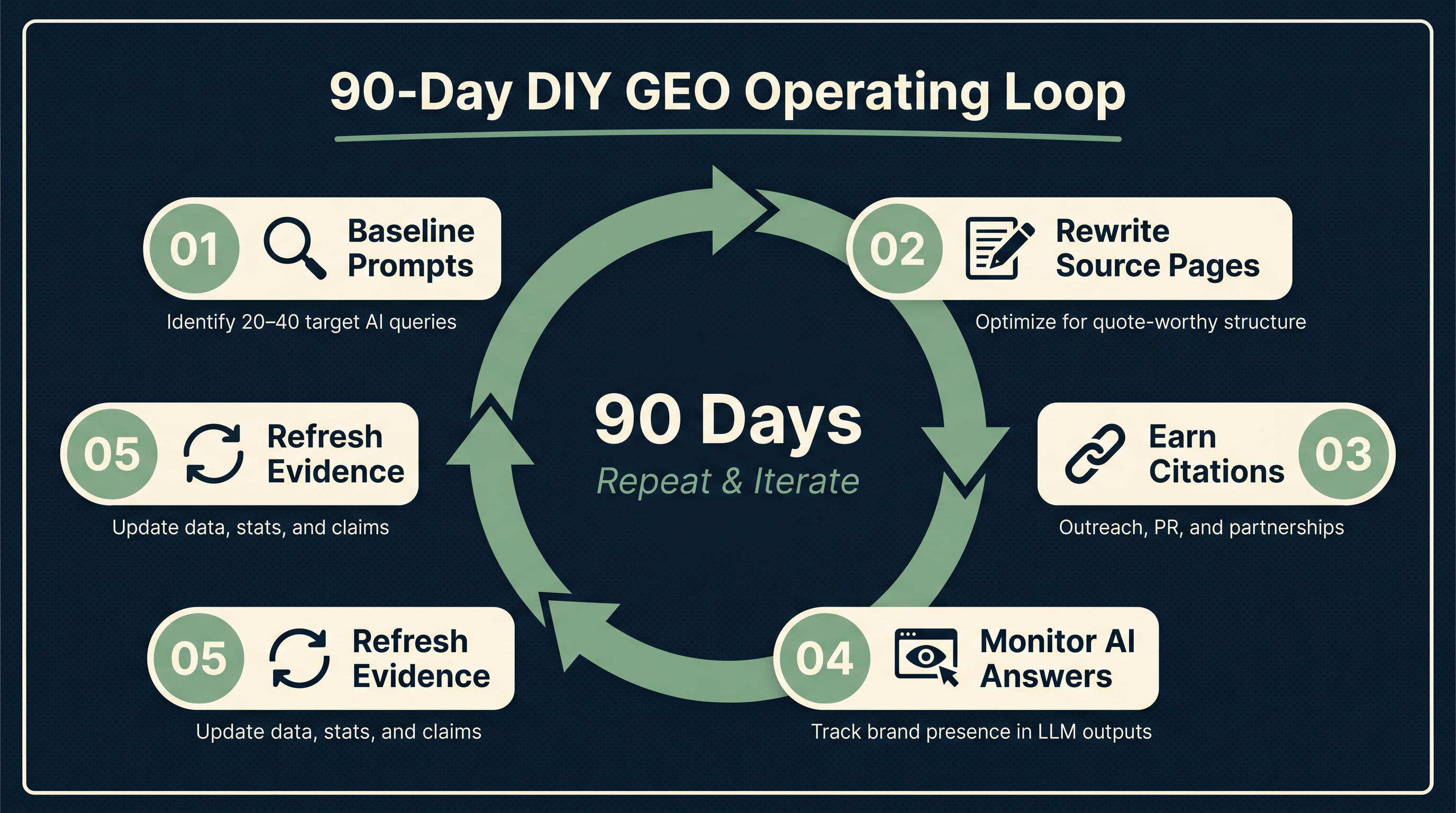
A 90-day GEO loop is enough to test whether your team can execute before scaling the program.
Days 1-15: build the baseline
Create a prompt library of 30 to 50 questions your buyers might ask AI tools.
Include:
- category prompts: "What are the best tools for..."
- comparison prompts: "Compare X vs Y for..."
- pain prompts: "How should a team solve..."
- risk prompts: "What should I avoid when..."
- vendor prompts: "Which companies provide..."
Run those prompts across two or three AI answer surfaces. Record brand mentions, competitor mentions, citations, and answer accuracy.
Days 16-40: rewrite source pages
Pick the pages most likely to support AI answers:
- homepage positioning
- product or service pages
- comparison pages
- category explainers
- customer proof pages
- FAQ or documentation pages
Rewrite them for extractability. Add direct answers, tables, definitions, evidence, and specific use cases. Remove vague sales language that says nothing an AI system can verify.
For an audit-style starting point, Auspia's GEO Score Checker can help identify pages that are too thin, too generic, or not structured for AI answer extraction.
Days 41-65: build citation assets
Create or improve assets other sites can cite:
- benchmark pages
- checklists
- original survey summaries
- glossaries
- comparison frameworks
- transparent methodology pages
- customer evidence pages
Then distribute them. Pitch partners, contribute to industry newsletters, update directories, and make sure your public profiles describe the company consistently.
Days 66-90: monitor, refresh, and decide
Re-run the prompt library. Compare results against the baseline.
Look for:
- more brand mentions
- better answer accuracy
- new citations from your pages
- competitor movement
- prompts where you still do not appear
- prompts where AI mentions you but gets details wrong
At the end of 90 days, make a sober decision. If the team shipped source pages, earned evidence, and improved visibility, keep building internally. If the work slowed down or the measurement is still unclear, bring in help before more time disappears.
Common DIY GEO mistakes
Mistake 1: treating GEO as keyword stuffing
Generative systems do not need you to repeat a keyword 37 times. They need clear, verifiable information that answers a prompt well.
Mistake 2: only optimizing your homepage
AI answers usually need specific evidence. A homepage rarely provides enough detail for comparisons, use cases, risks, or decision criteria.
Mistake 3: publishing without external proof
Your site can explain your claims. Other sources help validate them. If no one else mentions your brand, product, research, or expertise, AI systems have less to work with.
Mistake 4: ignoring negative or outdated information
AI answers may surface old reviews, outdated profiles, or competitor-written comparisons. GEO includes reputation cleanup and evidence refresh, not just new content.
Mistake 5: measuring once
One prompt test is a screenshot, not a measurement system. Track the same prompt set over time so you can see direction, not noise.
Mistake 6: expecting SEO timelines to map perfectly
Some GEO changes may show up quickly in answer quality. Others require crawls, fresh citations, or external corroboration. Plan in months, not days.
Who should do GEO in-house?
DIY GEO makes sense when:
- your team has a strong subject-matter expert available every week
- you already publish high-quality SEO or product content
- you can assign one owner to prompt testing and reporting
- you can tolerate 90 days of learning before clear patterns emerge
- your category is niche enough that internal expertise beats generic agency playbooks
- you want to build a durable internal growth capability
In-house GEO is not a bad idea. It is often the right long-term move. The mistake is pretending it is free because the people are already on payroll.
Who should hire a GEO partner?
Hiring help makes sense when:
- you need a baseline and roadmap quickly
- your competitors already appear in AI answers
- your internal content team is busy or junior
- your industry has high trust requirements
- you lack measurement infrastructure
- you need third-party perspective on what AI answers currently reward
The best partner should not only "write GEO content." They should help you build prompt libraries, source-page templates, evidence plans, monitoring reports, and a handoff process your internal team can eventually run.
Auspia take
The smartest 2026 approach is rarely "all DIY" or "all outsourced."
For most growth teams, the better model is phased:
- Run a fast audit to see where your brand appears in AI answers today.
- Build a prompt library around real buyer questions.
- Rewrite the highest-value source pages.
- Create citation-worthy assets.
- Monitor for 90 days.
- Decide whether to scale in-house, use a partner, or keep a hybrid model.
GEO will reward teams that treat it as an evidence system, not a content trend. If your brand facts are clear, your pages answer real prompts, and the wider web supports your claims, you have a chance to be included in AI answers. If your content is thin and your evidence is invisible, publishing more articles will not fix the problem.
FAQ
Can I do GEO myself in 2026?
Yes. You can do GEO yourself if you have SEO fundamentals, expert content, a prompt library, entity cleanup, and recurring measurement. If you lack content ownership or measurement, start with a small pilot or hire help.
How long does DIY GEO take to show results?
A practical pilot should run for 90 days. Some answer improvements may appear sooner, but reliable patterns usually need repeated prompt testing, source-page updates, and new evidence.
Is GEO replacing SEO?
No. SEO still matters for crawlability, content architecture, authority, and demand capture. GEO builds on some SEO foundations but optimizes for AI-generated answers, citations, and brand mentions.
What is the minimum viable GEO setup?
Start with a 30-to-50-prompt library, five priority source pages, one citation asset, a simple monitoring sheet, and a monthly refresh schedule.
Do I need technical skills for GEO?
You do not need to train models. You do need enough technical understanding to monitor prompts, structure content, manage crawlability, use schema carefully, and analyze answer patterns.
When should I hire a GEO agency or consultant?
Hire help when speed matters, competitors already appear in AI answers, your industry has high trust requirements, or your team cannot maintain a monthly prompt and content refresh loop.