The likely problem
If ChatGPT does not recommend your brand, the problem is usually not one missing trick.
It is usually a visibility gap.
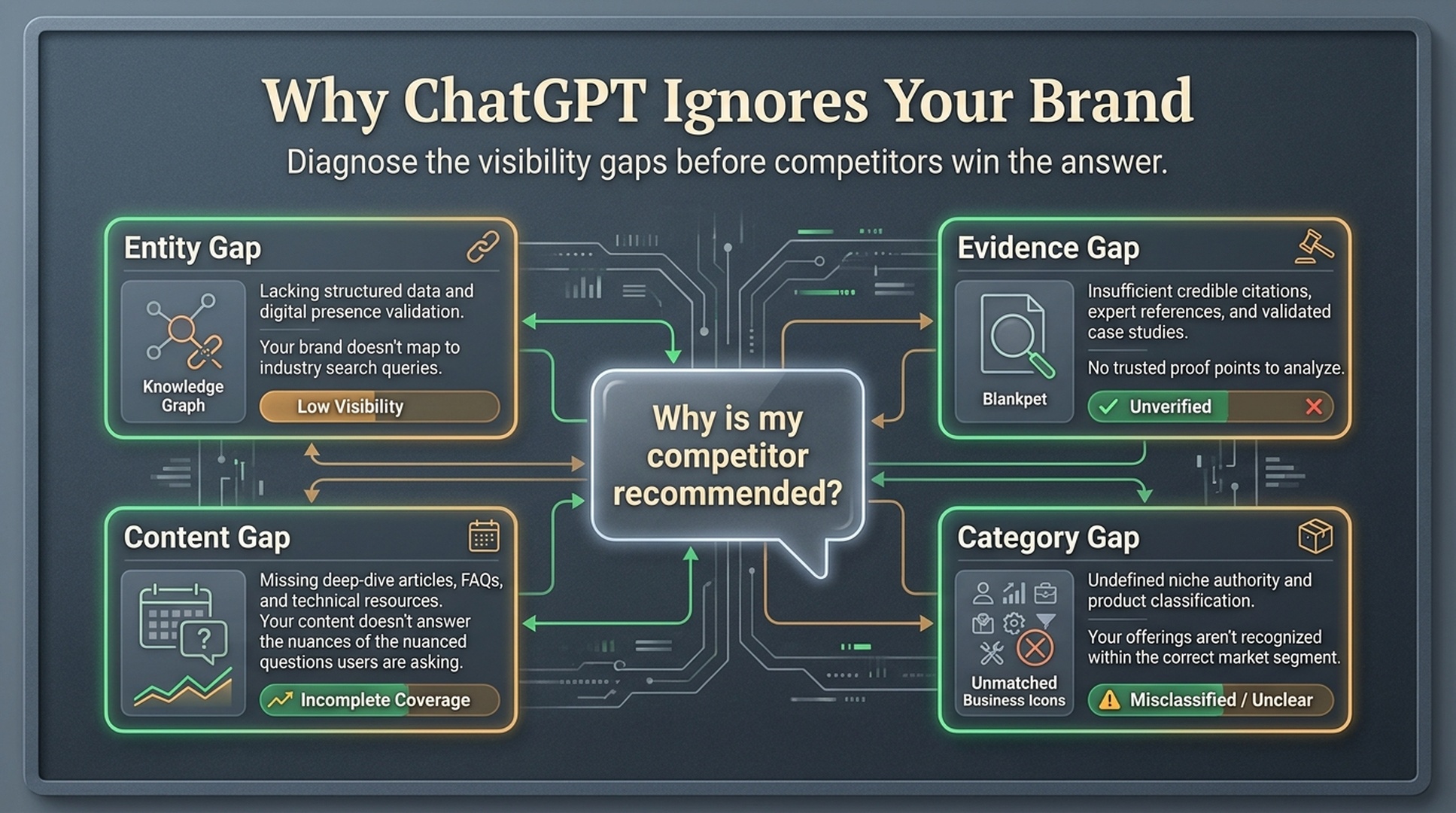
The model may not understand what your company does. It may not see enough trusted evidence. It may know your brand but associate competitors more strongly with the category. Or your website may answer search keywords without answering the questions people actually ask AI assistants.
Here is the fast diagnosis:
Symptom | Most likely reason |
|---|---|
ChatGPT does not mention your brand at all | Weak entity footprint or low category association |
ChatGPT recommends competitors instead | Competitors have stronger evidence, clearer pages, or more third-party mentions |
ChatGPT describes your brand incorrectly | Inconsistent brand facts across your website and the wider web |
ChatGPT only mentions you when asked by name | Your brand is known, but not connected to category or buyer prompts |
ChatGPT cites other sites, not yours | Your pages are hard to extract, thin, or less trusted as sources |
The fix is not to ask ChatGPT harder. The fix is to make your brand easier to understand, verify, compare, and cite.
First, test the problem correctly
Many teams test ChatGPT visibility with one lazy prompt:
"What is [our brand]?"
That prompt is useful, but it is not enough.
A buyer rarely starts there. They ask for options, comparisons, recommendations, risks, alternatives, and category advice.
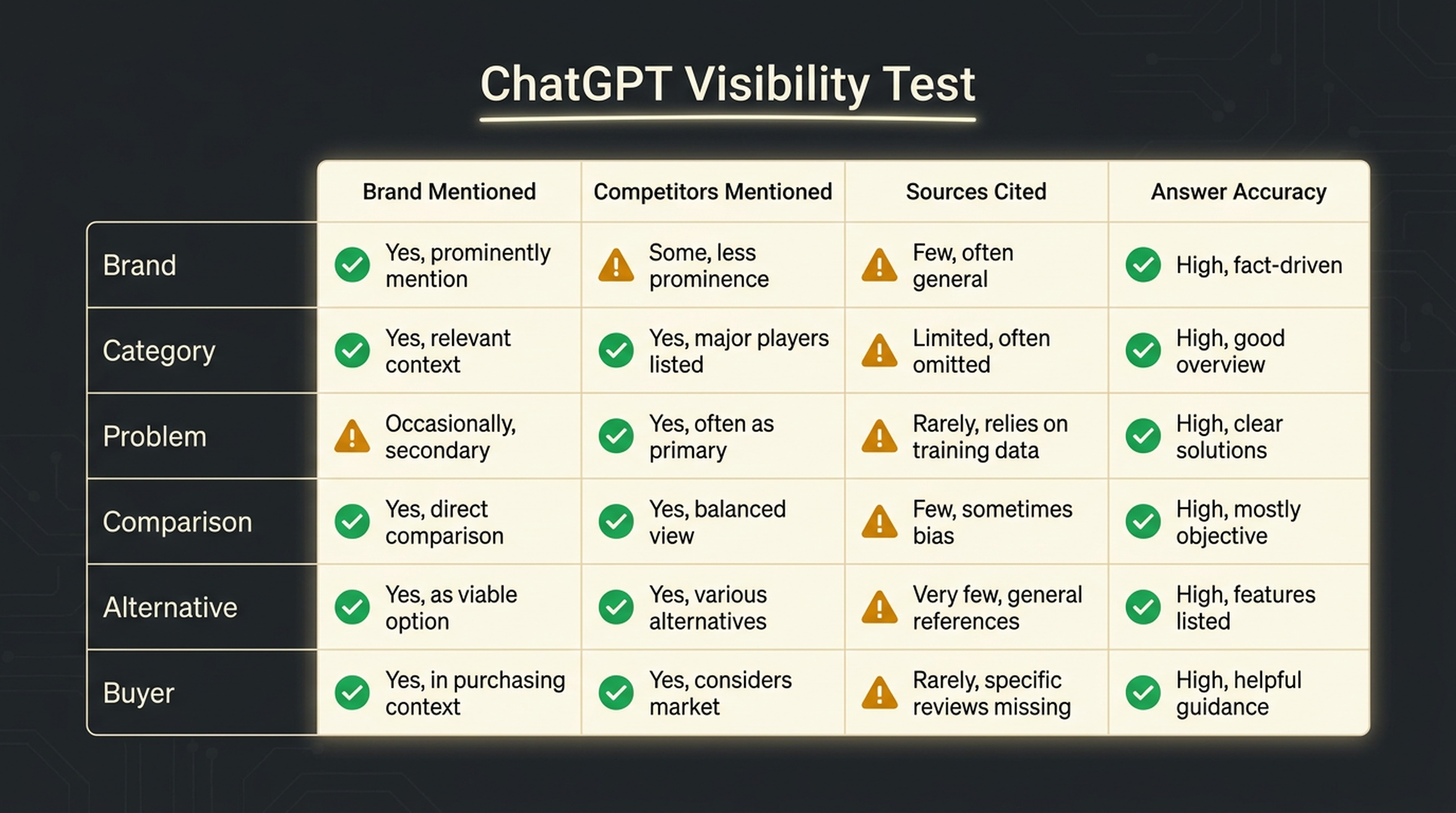
Use this small prompt set before changing anything:
Prompt type | Example |
|---|---|
Brand prompt | "What is [brand]?" |
Category prompt | "What are the best tools for [category]?" |
Problem prompt | "How can I solve [specific problem]?" |
Comparison prompt | "[Brand] vs [competitor], which is better for [use case]?" |
Alternative prompt | "What are the best alternatives to [competitor]?" |
Buyer prompt | "Which [category] tool should a [specific team] choose?" |
Run 20 to 30 prompts. Save the answers. Record which brands appear, which sources are cited, and how your brand is described.
That baseline matters. Without it, you are just guessing.
Symptom 1: ChatGPT does not know what category you belong to
This is the most common problem for early-stage brands, repositioned brands, and companies with vague homepage copy.
The website says:
We help teams unlock smarter growth with AI-powered workflows.
That might sound fine in a sales deck. It is weak machine-readable positioning.
A clearer version says:
Acme Workflow is project management software for remote creative agencies that need client approvals, deadline tracking, and reusable campaign templates in one workspace.
The second version gives AI systems category, audience, use case, and differentiator.
Check these pages first:
Place | What should be clear |
|---|---|
Homepage | Category, audience, core use case |
About page | Brand definition, history, market, proof points |
Product page | What the product does and when to use it |
Use-case pages | Specific problems and user types |
Organization schema | Name, URL, sameAs profiles, description |
Social profiles | Same category language and description |
Directories | Correct category and product description |
If those sources disagree, ChatGPT may not be able to place you confidently.
Fix: write a brand entity block
Create one short, factual block and reuse it across your owned profiles.
Template:
[Brand] is a [category] for [audience] that helps teams [primary job]. Teams use it to [use case 1], [use case 2], and [use case 3]. It is often compared with [competitors or alternatives] when buyers need [decision context].
Example:
Auspia is an AI search visibility platform for SEO and growth teams that need to measure how their brand appears in ChatGPT, Perplexity, Gemini, and Google AI Overviews. Teams use it to track prompts, compare competitor visibility, find citation gaps, and prioritize GEO fixes.
Do not make this poetic. Make it reusable.
Symptom 2: competitors are recommended, but you are missing
This is more frustrating because it means the category exists in ChatGPT's answer. You are just not part of the shortlist.
There are usually four reasons:
Reason | What it means |
|---|---|
Competitors have clearer category pages | Their sites explain the use case better |
Competitors have more trusted mentions | Review sites, directories, comparisons, and partner pages support them |
Competitors answer buyer prompts | They have pages for alternatives, comparisons, use cases, and decision criteria |
Competitors are easier to cite | Their pages include clear facts, tables, FAQs, and named examples |
This is not only a content problem. It is a market evidence problem.
A brand that appears on review sites, partner pages, comparison articles, customer stories, and category lists is easier to recommend than a brand that only exists on its own homepage.
Fix: map the competitor evidence gap
Pick three competitors that ChatGPT recommends.
For each one, check:
Evidence type | Competitor A | Competitor B | Your brand |
|---|---|---|---|
Clear category page | |||
Comparison pages | |||
Review profiles | |||
Directory listings | |||
Partner pages | |||
Case studies | |||
Documentation | |||
Third-party articles | |||
Branded search demand |
You are looking for patterns, not perfection.
If every competitor has review profiles and you do not, fix that. If competitors have use-case pages and you only have a homepage, fix that. If competitors are cited through comparison articles, you need better category evidence outside your site.
Symptom 3: ChatGPT describes your brand incorrectly
This is a brand facts problem.
It happens when old positioning, old product descriptions, outdated profiles, or inconsistent third-party listings are still visible.
Common examples:
Wrong answer | Likely source of confusion |
|---|---|
It calls you an agency when you are now software | Old website copy or directory listings |
It lists discontinued features | Old docs, cached pages, or reviews |
It puts you in the wrong category | Vague positioning or mismatched profiles |
It recommends you for the wrong audience | Unclear use-case pages |
It says little beyond generic claims | Thin About and product pages |
The fix starts with source cleanup.
Fix: create a brand facts inventory
Make a simple inventory of the facts AI systems should get right.
Fact | Correct version | Where to update |
|---|---|---|
Brand name | Website, schema, profiles | |
Category | Homepage, About, directories | |
Primary audience | Product and use-case pages | |
Core product | Product page, docs, review sites | |
Main use cases | Use-case pages, FAQs, case studies | |
Competitors | Comparison and alternatives pages | |
Pricing model | Pricing page and profiles | |
Supported markets | Site footer, schema, local pages |
Then update your owned sources first. After that, correct the most visible external profiles.
You will not fix every old mention. You do not need to. Start with the sources most likely to be retrieved or cited.
Symptom 4: your content ranks in Google but is not cited by AI answers
This happens more often than SEO teams expect.
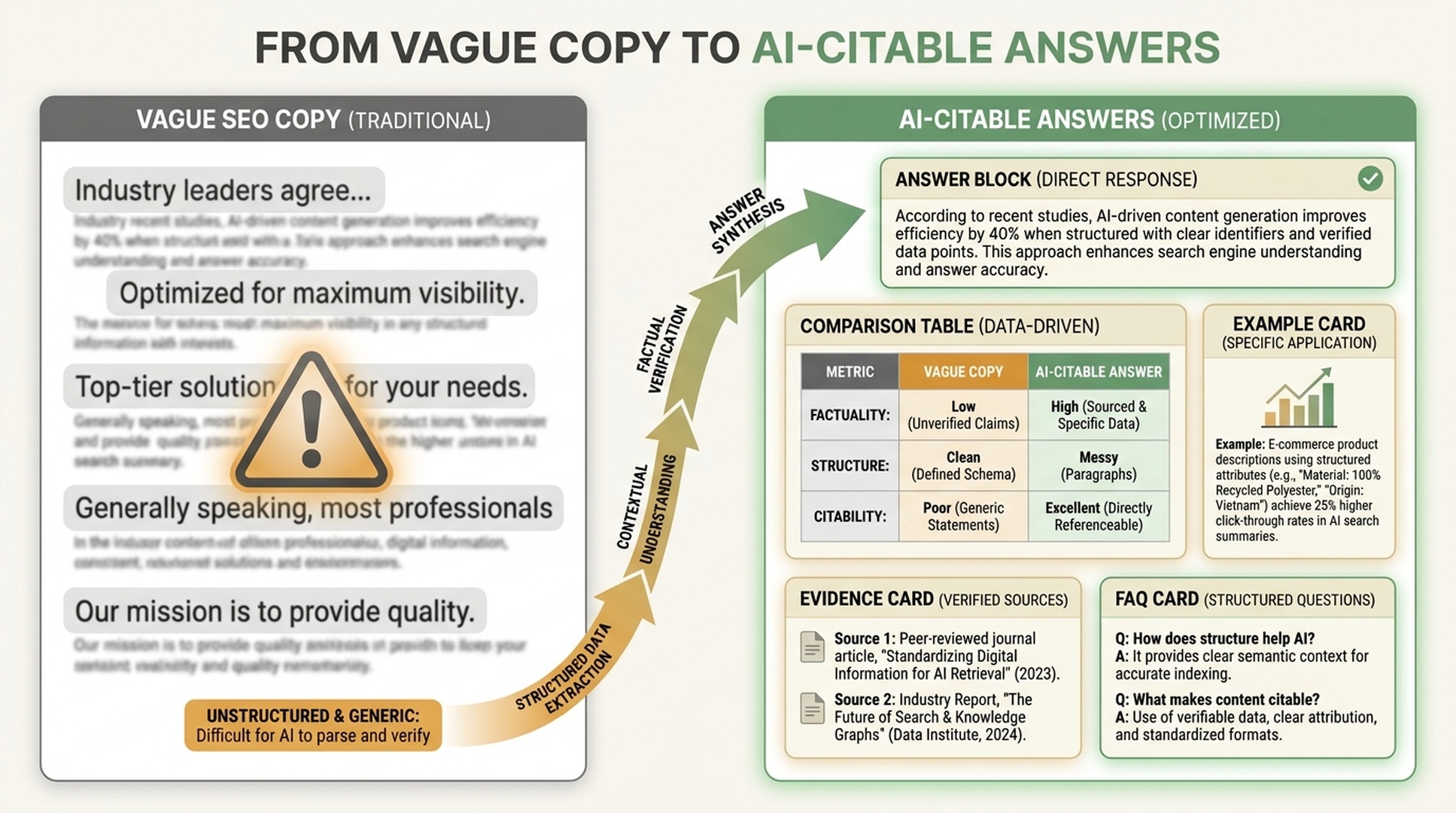
A page can rank because it matches a keyword, has links, and satisfies search intent. That does not mean it is the best source for a generated answer.
AI systems often prefer pages with:
- Clear definitions
- Direct answers
- Tables
- Named examples
- Specific facts
- Original data or evidence
- FAQ sections
- Strong internal context
- Recent updates when freshness matters
A long article with vague sections is harder to cite than a shorter page with clean answer blocks.
Fix: rebuild one high-value page for extraction
Pick one page that should be cited but is not.
Add these elements:
Section | Purpose |
|---|---|
Short answer | Gives AI systems a clean summary |
Definition or scope | Reduces ambiguity |
Comparison table | Helps answer buyer prompts |
Example | Makes the concept concrete |
Evidence | Supports claims |
Common mistakes | Captures related questions |
FAQ | Adds extractable answers |
Related pages | Improves internal discovery |
Do not turn the page into a keyword dump. Make it easier to quote.
Symptom 5: ChatGPT only mentions you when asked by name
This is a category association problem.
If ChatGPT answers "What is [brand]?" correctly but does not include you in "best tools for [category]," your brand entity exists, but the category connection is weak.
You need pages and evidence that connect your brand to buyer prompts.
Publish assets like:
Asset | Prompt it supports |
|---|---|
Category guide | "What is [category]?" |
Use-case page | "How do I solve [problem]?" |
Comparison page | "[Brand] vs [competitor]" |
Alternatives page | "Best alternatives to [competitor]" |
Buyer guide | "Which [category] tool should I choose?" |
Case study | "Has this worked for a team like mine?" |
FAQ page | "What should I know before choosing?" |
This is where GEO content planning differs from a standard blog calendar. You are not just publishing information. You are building answer eligibility.
A 30-day repair plan
If ChatGPT is ignoring your brand, use a focused sprint.
Week | Work | Output |
|---|---|---|
Week 1 | Prompt baseline and competitor gap | 25 prompts, competitor list, source notes |
Week 2 | Brand entity cleanup | Updated About page, schema, profiles, product description |
Week 3 | Answer asset rebuild | One category page, one use-case page, one FAQ or comparison page |
Week 4 | Evidence and measurement | Updated profiles, third-party sources, second prompt report |
The point is not to force a result in 30 days. The point is to stop guessing.
After four weeks, you should know:
- Which prompts exclude you
- Which competitors appear instead
- Which facts are wrong
- Which sources are cited
- Which pages need rebuilding
- Which external evidence gaps matter most
That is enough to make the next sprint much sharper.
What not to do
Do not try to manipulate ChatGPT with fake pages, fake reviews, or mass-produced content.
Bad GEO creates long-term cleanup work.
Avoid these moves:
Bad move | Why it fails |
|---|---|
Publishing dozens of thin AI pages | Creates weak, repetitive content with little evidence |
Stuffing "ChatGPT" into every heading | Does not improve category trust |
Buying generic mentions | Adds noise, not credible verification |
Creating fake comparisons | Weakens trust with readers and AI systems |
Relying only on llms.txt | A support file cannot replace clear pages and evidence |
Checking one prompt once | AI answers vary too much for one screenshot to mean much |
The better approach is slower but cleaner: clear facts, useful pages, credible sources, and repeated measurement.
Auspia take
When ChatGPT ignores a brand, most teams look for a shortcut.
The useful answer is less exciting: the brand is usually not easy enough to understand, verify, or recommend.
That is fixable.
Start with a prompt baseline. Clean up the entity. Rebuild the pages AI systems should use. Add evidence outside your site. Then measure again.
If you want the broader strategy behind this repair workflow, read the companion guide: GEO SEO: How Brands Show Up in AI Search Results.
FAQ
Why does ChatGPT recommend my competitors but not my brand?
Usually because competitors have clearer category signals, stronger third-party evidence, better comparison content, or more extractable pages. ChatGPT may know your brand but still choose better-supported options for recommendation prompts.
Can I submit my brand to ChatGPT?
Not like submitting a sitemap to Google. You can improve crawlability, entity clarity, content structure, and evidence so AI systems have better information to retrieve and use.
How do I know whether ChatGPT understands my brand?
Run brand, category, comparison, problem, and buyer prompts. Check whether your brand appears, how it is described, which competitors appear, and which sources are cited.
Why is ChatGPT describing my company incorrectly?
The most common causes are outdated website copy, old third-party profiles, inconsistent category descriptions, or weak product pages. Build a brand facts inventory and update the most visible sources first.
Do backlinks help ChatGPT recommend a brand?
Credible, relevant mentions can help indirectly because they strengthen evidence and discoverability. Random backlinks are less useful than review profiles, directories, partner pages, case studies, documentation, and trustworthy comparisons.
How long does it take to improve ChatGPT visibility?
A 30-day sprint can improve the assets and measurement system. Changes in AI answers may take longer and vary by platform, prompt, source freshness, and retrieval behavior.
Author: Naomi Ellis, Brand Mention Analyst Across 20k+ Visibility Signals at Auspia. Naomi writes about brand mentions, reputation signals, and visibility gaps across AI answer systems.