What is Claude GEO? A practical guide to earning visibility in Claude answers
Claude GEO is the work of making your brand, pages, and evidence easy for Claude to understand, retrieve, summarize, and cite.
Tag
22 posts
Start here
Claude GEO is the work of making your brand, pages, and evidence easy for Claude to understand, retrieve, summarize, and cite.
Tag
Learn how reviews, testimonials, directory profiles, case proof, and reputation pages support ChatGPT GEO by strengthening evidence, trust, and recommendation context.
Learn how to structure case study pages as ChatGPT GEO evidence assets with baselines, workflows, proof blocks, outcomes, caveats, and reusable source material.
Getting cited by Perplexity requires more than publishing another SEO article. This playbook shows how to make your pages accessible, source-ready, evidence-backed, and measurable so Perplexity has a clearer reason to cite your brand.
Learn how to make content more citation-ready for ChatGPT GEO with direct answers, entity clarity, evidence, structured anchors, crawlable pages, and source clusters.
Learn how to build a credible third-party evidence trail for ChatGPT GEO using reviews, directories, partner pages, comparison mentions, podcasts, case studies, and prompt-based measurement.
In 2026, GEO is becoming a trust system, not just a traffic tactic. Learn how to turn process proof, source evidence, and brand boundaries into AI-search citations.
A practical 2026 GEO playbook for turning vague website copy into citable evidence, structured answers, and measurable AI search visibility.
Most brand content still chases impressions. This 2026 GEO playbook shows how to turn pages, PR, and thought leadership into structured assets that AI answer engines can understand, reuse, and cite.
A practical 2026 GEO playbook for appliance brands, using laundry appliances as the example. Learn how to turn prompts, product facts, proof assets, and measurement loops into AI-search visibility.
GEO in 2026 is not keyword stuffing for chatbots. It is the work of making your pages crawlable, extractable, trustworthy, and easy for AI answer engines to cite.
Legal and government searches reward official, well-maintained, and clearly cited sources. GEO teams can learn how authority signals shape AI answers in sensitive topics.
Financial search is fast, sensitive, and citation-heavy. Publishers and brands need clear timestamps, risk boundaries, and source quality to appear responsibly in AI answers.
Data breach searches combine definitions, risk, and urgent next steps. AEO content must answer plainly while showing trustworthy evidence and boundaries.
Recall queries are high-risk searches where users need accurate, current, official information. Brands should prepare recall pages before a crisis, not during one.
Google AI Overviews reward pages that are easy to understand, corroborate, and extract. Use this checklist to make your pages more likely to support AI-generated answers.
GEO content planning in 2026 is not just about publishing more articles. It is about building verifiable, structured knowledge assets that AI search systems can extract, trust, and cite.
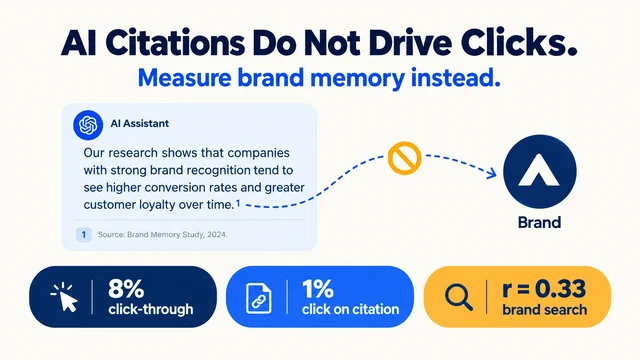
Zero-click search is not the end of organic growth. This guide shows how GEO helps brands earn AI citations, protect visibility, and measure influence when clicks decline.
In 2026, AI answer systems do not just read your page. They break it into answer-ready units. This guide shows how checklists, tables, and FAQs make content easier for AI systems to parse, verify, and cite.
Off-site GEO is the work of making your brand visible in credible third-party contexts, not just on your own website. This guide explains how to build external proof that helps AI systems understand, verify, and cite your brand with more confidence.
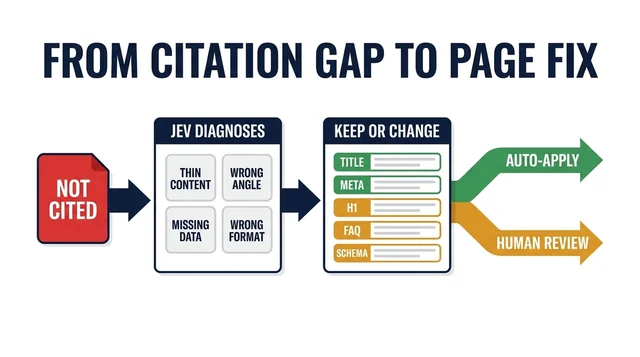
If AI systems still ignore your brand after GEO work, the issue is usually one of five missing signals: extractable content, trust, evidence volume, prompt match, or freshness. Here is how to diagnose and fix the gap in 2026.
GEO in 2026 is not a trick for wording pages. It is the work of making your pages survive retrieval, ranking, answer synthesis, and citation selection across AI search systems.