Direct answer
Generative engine optimization is the practice of making a brand, website, or content asset easier for AI answer systems to understand, retrieve, cite, and recommend.
It is often shortened to GEO. The term sounds technical, but the work is practical. You clarify the brand entity, publish pages that answer real prompts, make facts easy to extract, build credible evidence outside your own site, and measure whether AI systems actually mention or cite you.
The main difference from traditional SEO is the output you are optimizing for.
Practice | Main target | Success looks like |
|---|---|---|
SEO | Search result pages | Rankings, impressions, clicks, organic traffic |
AEO | Answer boxes and direct answers | Concise answers, featured snippets, voice/search answers |
GEO | AI-generated answers | Mentions, citations, recommendations, accurate summaries |
GEO does not replace SEO. It sits on top of it. If your site is technically weak, vague, thin, or unsupported by outside evidence, AI visibility will be harder to earn.
What generative engine optimization means in practice
A generative engine is any system that synthesizes an answer instead of only returning a list of links.
That can include ChatGPT, Perplexity, Gemini, Claude, Google AI Overviews, Bing Copilot, or industry-specific assistants. Each system works differently. Some cite sources. Some browse the web. Some rely more heavily on model memory. Some mix search, product data, structured sources, and user context.
For a marketing team, the practical question is the same:
When someone asks an AI system about our category, problem, product type, or competitors, are we included in the answer?
Generative engine optimization tries to improve the answer to that question.
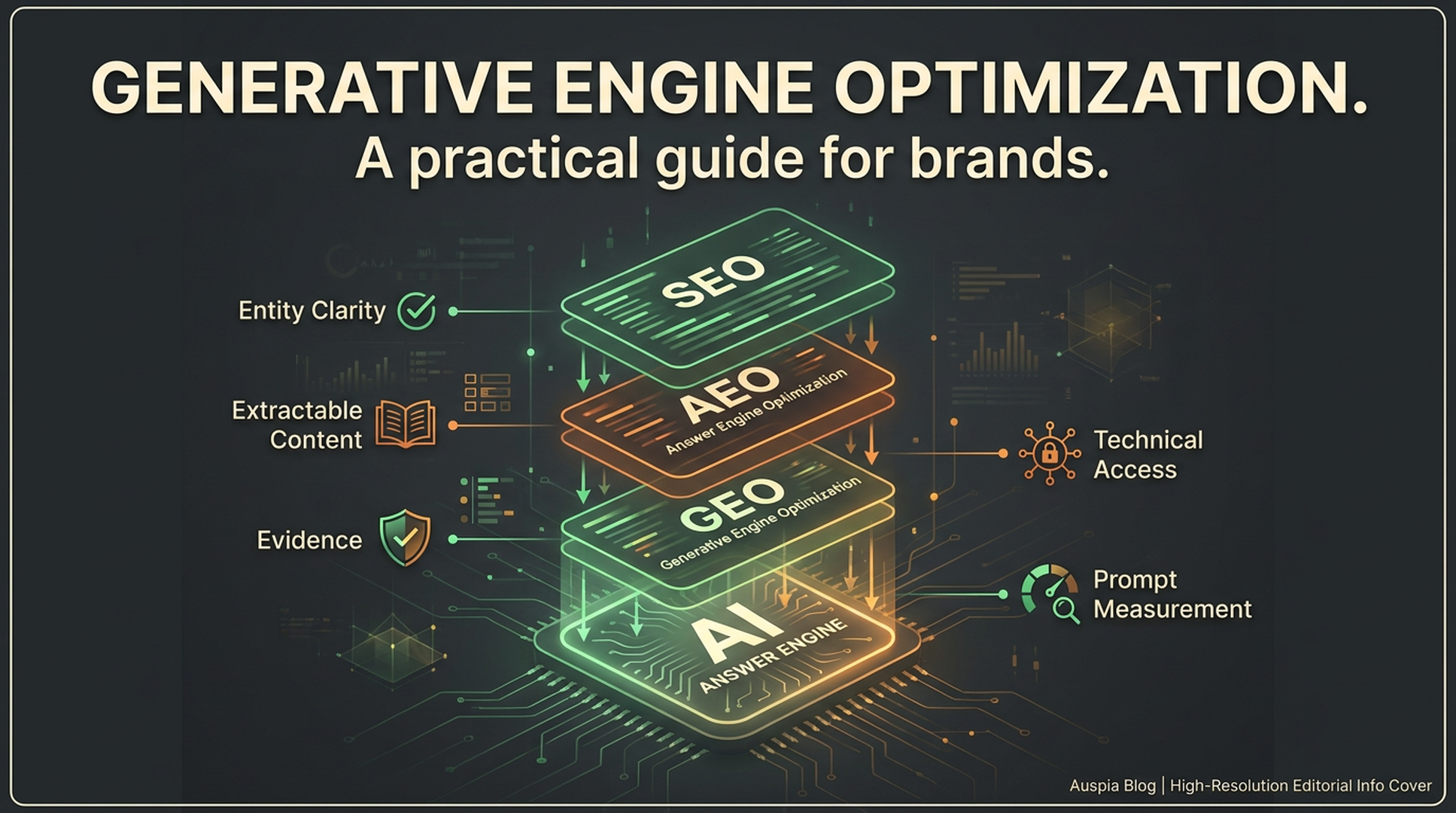
It usually touches five areas:
Area | GEO question |
|---|---|
Entity clarity | Does the AI system understand who we are and what category we belong to? |
Content structure | Can it extract useful answers from our pages? |
Evidence | Can outside sources verify our claims? |
Technical access | Can important pages be crawled, rendered, and parsed? |
Measurement | Are we tracking prompts, mentions, citations, and answer accuracy? |
If those areas are weak, a brand can have a beautiful website and still be invisible in AI answers.
A simple example
Imagine two companies sell compliance software.
Company A has a homepage that says:
We help modern teams simplify trust through intelligent workflows.
Company B has a page that says:
Northstar Compliance is SOC 2 compliance software for B2B SaaS startups. Teams use it to collect evidence, assign control owners, monitor vendor risk, and prepare for audits without building spreadsheets from scratch.
Company B is easier for a generative engine to use.
It names the category, audience, use case, and product functions. It can be summarized. It can be compared. It can be recommended for a specific prompt like:
"What SOC 2 software should an early-stage SaaS startup compare before its first audit?"
Company A may sound polished to humans, but it gives AI systems fewer handles.
This is the basic GEO problem. AI systems need clear, verifiable, extractable information. Brand poetry is usually not enough.
GEO vs SEO vs AEO
These terms overlap, which is why the market feels noisy.
Use this decision table:
If you want to... | Use this lens first | Why |
|---|---|---|
Rank a page in Google | SEO | You need crawlability, relevance, authority, and search intent fit |
Win a concise answer block | AEO | You need a short, extractable answer to a specific question |
Get mentioned in ChatGPT or Perplexity | GEO | You need entity clarity, evidence, and prompt-level relevance |
Improve brand descriptions in AI answers | GEO + entity SEO | You need consistent facts across your site and the wider web |
Turn existing search traffic into leads | SEO + conversion content | You need rankings, useful pages, and clear paths to action |
The mistake is treating these as separate departments. They are more like layers.
SEO gives your site a foundation. AEO makes answers easier to extract. GEO makes the brand and content easier to use inside generated answers.
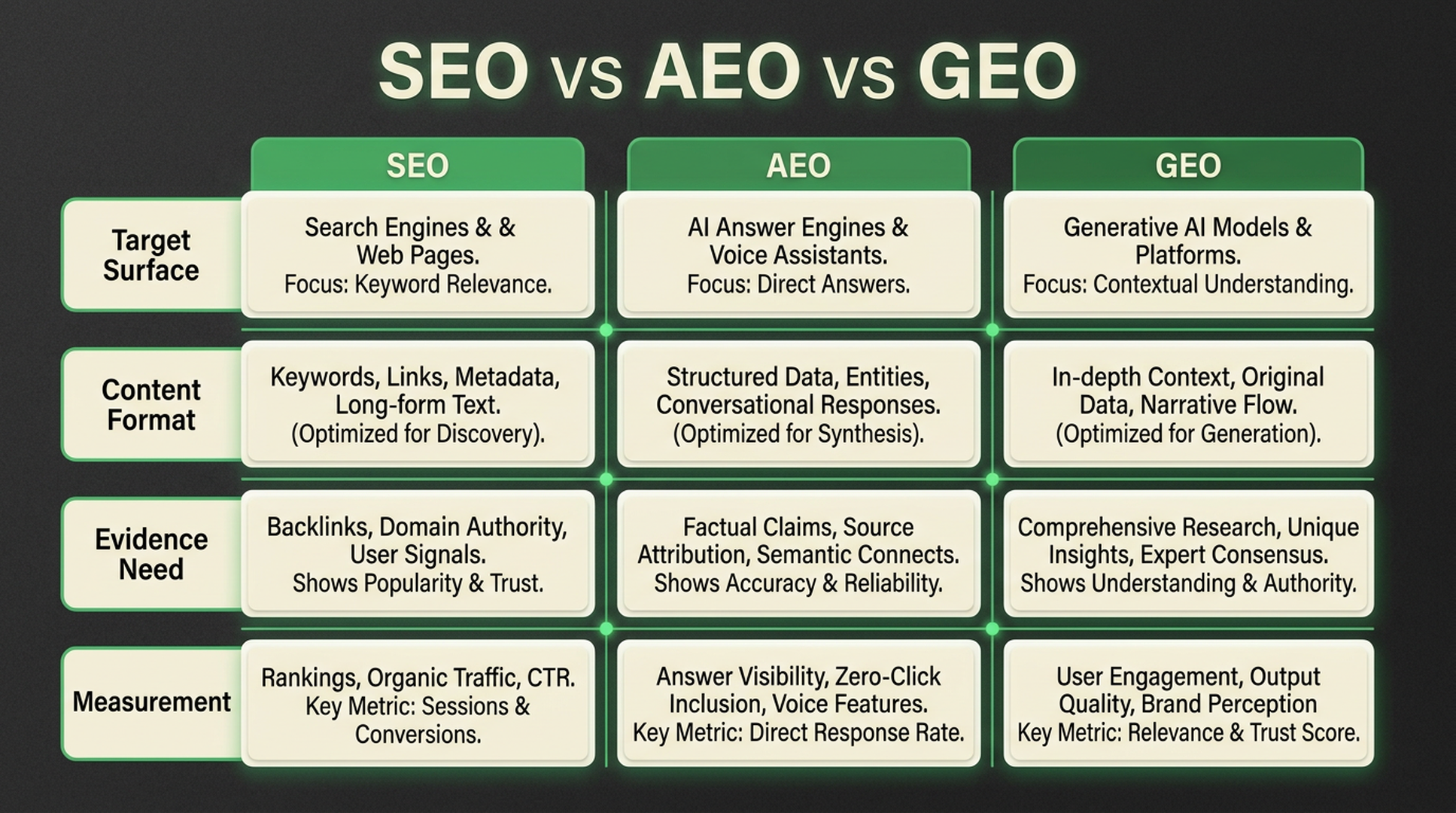
How generative engines choose what to include
No outside team can fully know how every AI system chooses every answer. The products change, retrieval settings vary, and models behave differently across prompts.
Still, the visible pattern is clear enough to act on.
Generative engines tend to favor information that is:
- Easy to classify
- Clear enough to summarize
- Supported by credible sources
- Relevant to the user's prompt
- Recent enough for the topic
- Structured enough to compare
- Accessible enough to retrieve
- Consistent across multiple sources
That last point matters. If your homepage says one thing, your LinkedIn profile says another, review sites put you in the wrong category, and comparison pages ignore you, AI systems get a weaker signal.
GEO is partly content optimization. It is also reputation cleanup, entity management, technical SEO, digital PR, and measurement.
The practical GEO workflow
A small team can start with a six-step workflow.
Step 1: build a prompt baseline
Do not start by rewriting pages. First find out how AI systems currently describe the market.
Create a prompt set with five groups:
Prompt group | Example |
|---|---|
Brand | "What is [brand]?" |
Category | "What are the best tools for [category]?" |
Problem | "How do I solve [specific problem]?" |
Comparison | "[Brand] vs [competitor]" |
Buyer decision | "Which [category] tool should a [specific team] choose?" |
Run the same prompt set across the AI surfaces that matter to your audience. Record whether your brand appears, which competitors appear, what sources are cited, and whether the answer is accurate.
This gives you a baseline. Without it, GEO work becomes guesswork.
Step 2: clean up the brand entity
Your brand entity is the machine-readable idea of who you are.
At minimum, make these facts consistent:
Fact | Example |
|---|---|
Brand name | Auspia |
Category | AI search visibility platform |
Audience | Growth teams, SEO teams, founders, and content teams |
Use case | Measuring and improving AI answer visibility |
Core surfaces | ChatGPT, Perplexity, Gemini, Google AI Overviews |
Differentiator | Prompt tracking, visibility audits, GEO content workflows, technical readiness checks |
Put this clarity on your About page, homepage, product pages, author bios, organization schema, social profiles, directories, and partner pages.
Small inconsistencies are normal. Large inconsistencies create confusion.
Step 3: make core pages extractable
Generative engines need content that can be lifted into an answer.
Improve your most important pages first:
Page | What to add |
|---|---|
About page | Clear brand definition, category, audience, and proof points |
Product page | What it does, who it is for, use cases, integrations, limitations |
Use-case page | Problem, context, workflow, examples, expected outcome |
Comparison page | Honest tradeoffs, criteria, buyer fit, alternatives |
FAQ page | Real questions with direct answers |
Case study | Specific context, actions, constraints, results, lessons |
Glossary page | Definitions that connect your category language |
Do not bury key facts in hero copy or images. Put important claims in readable HTML, with headings and tables where useful.
Step 4: build evidence outside your site
Your own pages tell AI systems what you claim. Other sources help them decide whether the claim is safe to use.
Evidence can come from:
- Review platforms
- Directories
- Partner listings
- Customer stories
- Integration pages
- Podcasts and interviews
- Guest articles
- Analyst lists
- Community discussions
- Product documentation
- Original data or benchmarks
Quality beats volume. A few credible category-relevant sources are worth more than dozens of generic mentions.
For a young brand, this is often the slowest layer. It is also one of the most defensible.
Step 5: fix technical access
Technical GEO is mostly practical SEO with an AI retrieval lens.
Check:
Technical area | Question |
|---|---|
Robots.txt | Are important pages blocked? |
Sitemap | Are entity, product, and content pages discoverable? |
Rendering | Is the main text available without fragile client-side rendering? |
Canonicals | Are source pages consolidated correctly? |
Schema | Does markup clarify Organization, Product, Article, FAQ, and Breadcrumb meaning? |
Internal links | Can crawlers reach the pages that explain the brand? |
Page health | Are important pages stable, fast, and not intermittently failing? |
A tool file like llms.txt can help document important AI-readable resources, but it is not a substitute for accessible pages, clear content, and credible evidence.
Step 6: measure again and compare sources
After updates, rerun the same prompt set.
Do not only ask, "Did we appear?" Ask better questions:
Metric | What to look for |
|---|---|
Mention rate | Are we appearing more often? |
Citation rate | Are our pages or trusted third-party sources cited? |
Description accuracy | Are answers describing us correctly? |
Competitor overlap | Which brands still appear instead of us? |
Source mix | Which pages or domains seem to shape the answer? |
Prompt gaps | Which use cases still exclude us? |
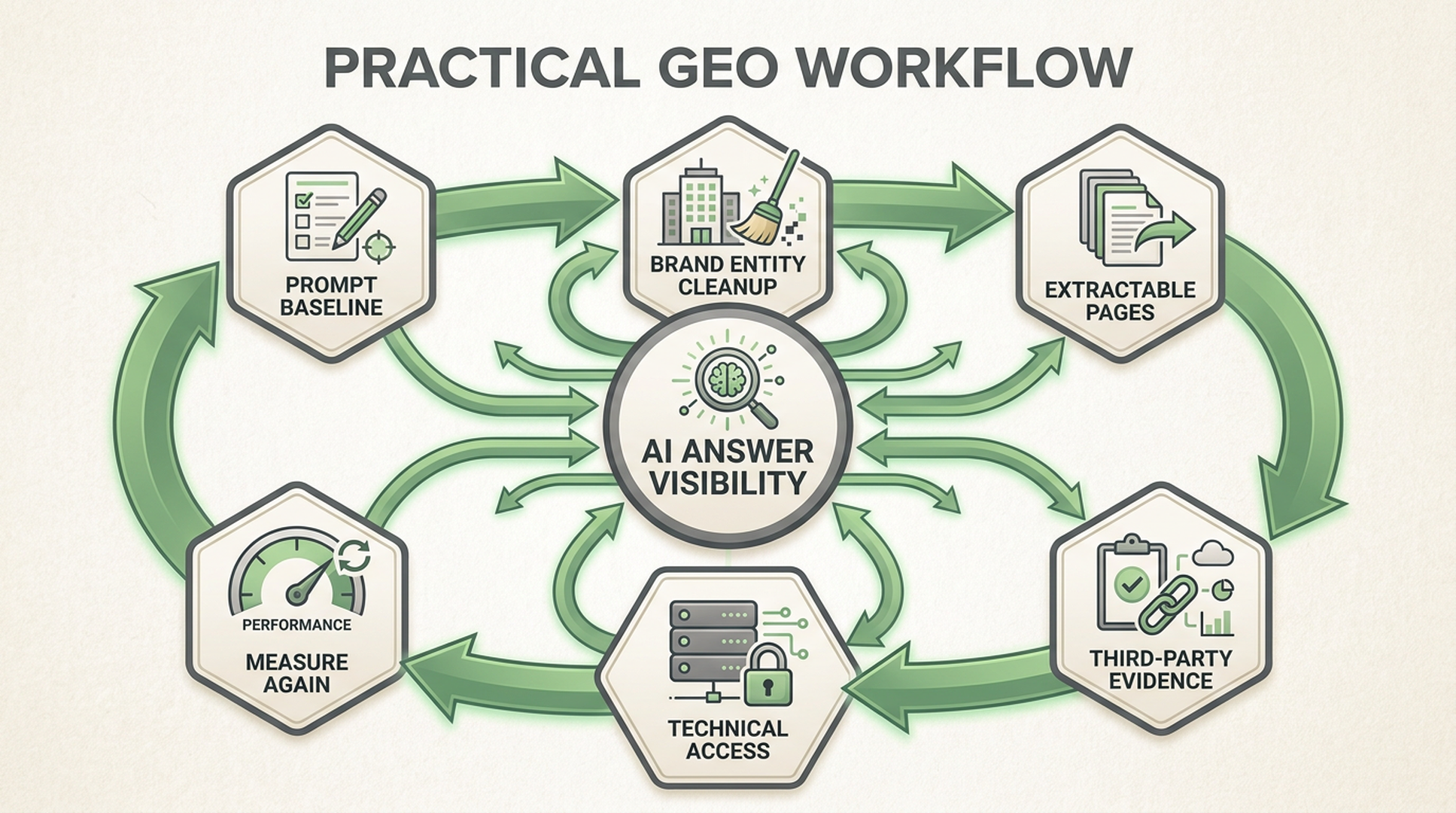
The measurement loop matters because GEO is not a one-time optimization. AI answers shift as sources, models, retrieval systems, and market language change.
What to publish for GEO
A good GEO content plan is not just a blog calendar.
It should include assets that help AI systems answer different kinds of prompts.
Prompt intent | Useful asset |
|---|---|
"What is this category?" | Glossary or category guide |
"Which tool should I choose?" | Comparison page or buyer guide |
"How do I solve this problem?" | Use-case guide or workflow article |
"Can I trust this brand?" | Case study, review profile, evidence page |
"How does this compare to alternatives?" | Alternatives page or decision memo |
"What does this brand do?" | About page, product page, organization schema |
If you are starting from scratch, publish in this order:
- Clean About page
- Category guide
- Use-case page
- Comparison or alternatives page
- FAQ/glossary page
- Case study or evidence page
- Measurement-focused update after you learn which prompts matter
For ChatGPT-specific visibility, the companion article goes deeper: ChatGPT SEO: How to Get Your Brand Mentioned by ChatGPT.
Common misconceptions
"GEO is just SEO with a new name"
Not quite. SEO and GEO share foundations, but they optimize for different outputs. SEO tries to win search visibility and clicks. GEO tries to win inclusion in generated answers, citations, summaries, and recommendations.
"If we add schema, AI systems will cite us"
Schema can clarify meaning. It does not create authority by itself. A weak page with schema is still a weak page.
"We need hundreds of AI-written pages"
Usually no. GEO rewards clarity, coverage, and evidence. Thin pages at scale can create noise, duplicate claims, and low-trust content.
"Third-party mentions are just backlinks"
Links can help, but GEO evidence is broader. Reviews, directories, partner pages, docs, data, interviews, and credible comparisons can all help AI systems verify a brand.
"One ChatGPT answer proves success"
One answer is a snapshot. Track a prompt set over time. Look at mention rate, citation rate, competitor overlap, and answer accuracy.
A 14-day starter plan
If you need a lightweight first sprint, use this plan.
Day | Task | Output |
|---|---|---|
1 | Choose 25 prompts | Brand, category, problem, comparison, buyer prompts |
2 | Run baseline checks | Mentions, competitors, citations, accuracy notes |
3-4 | Audit brand entity | About page, profiles, schema, category language |
5-7 | Rewrite one core page | Clear answer, tables, FAQs, proof points |
8-10 | Improve evidence | Directory profiles, review pages, partner listings, case links |
11 | Technical review | Robots, sitemap, rendering, schema, internal links |
12-13 | Publish one answer asset | Glossary, comparison, use-case, or FAQ page |
14 | Rerun prompts | Updated visibility report and next priorities |
This will not make every AI system recommend you overnight. It will give you a working baseline, cleaner assets, and a repeatable process.
That is enough to start.
Auspia take
Generative engine optimization is not a magic channel. It is a visibility discipline for a search environment where the answer may come before the click.
The brands that win will usually have three advantages:
- Clearer entity signals
- Better answer assets
- Stronger external evidence
The boring work matters. Precise About pages. Useful comparison pages. Accurate schema. Clean internal links. Credible third-party profiles. Prompt tracking. Content that says something specific.
That is not as flashy as "ranking in ChatGPT." It is more durable.
FAQ
What is generative engine optimization?
Generative engine optimization is the process of improving how a brand, website, product, or content asset appears in AI-generated answers. It focuses on entity clarity, extractable content, third-party evidence, technical access, and prompt-level measurement.
Is generative engine optimization the same as GEO?
Yes. GEO usually stands for generative engine optimization. Some teams also use it more narrowly to describe AI search visibility work across ChatGPT, Perplexity, Gemini, Google AI Overviews, and similar answer systems.
How is GEO different from SEO?
SEO focuses on ranking pages in search results and earning clicks. GEO focuses on being mentioned, cited, summarized, compared, or recommended in generated answers. The two overlap, but they are not identical.
Does GEO require new tools?
You can start manually with a prompt set, spreadsheet, crawl checks, and content audit. Tools become useful when you need repeatable prompt tracking, citation monitoring, competitor comparison, and reporting across many prompts or markets.
Can GEO guarantee that ChatGPT recommends my brand?
No. GEO can improve the conditions that make recommendations more likely, but no responsible team can guarantee a specific AI answer. Models, retrieval systems, sources, and prompts change.
What should I optimize first?
Start with a prompt baseline and brand entity audit. If AI systems cannot describe the brand correctly, fix entity clarity before publishing a large batch of new content.
Author: Isabel Grant, Researcher of 2,000+ AI Citation Patterns at Auspia. Isabel writes about citation earning, source quality, and how AI systems choose evidence for answers.