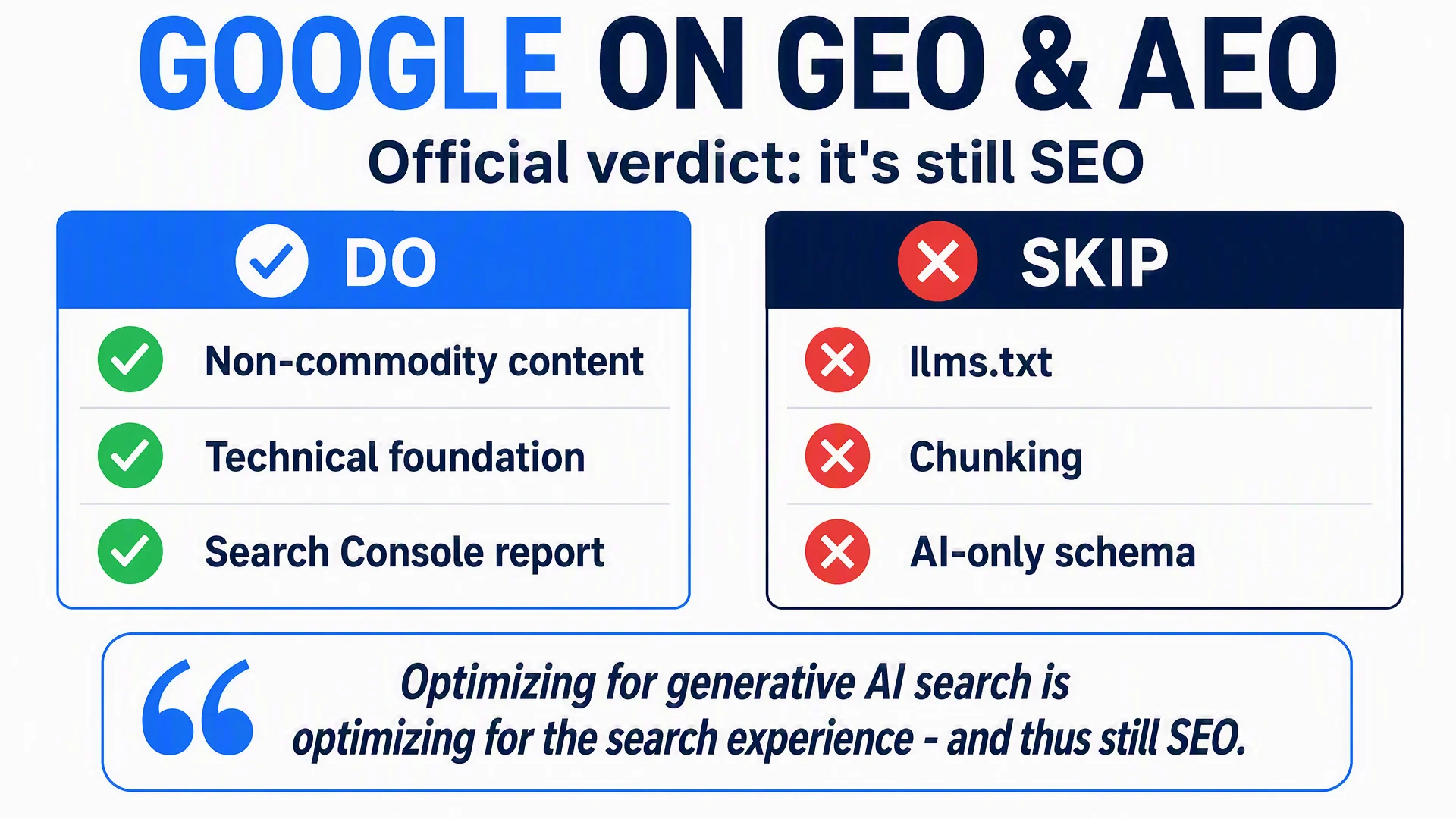
▶ Watch the video summary (83 seconds): Google settled the biggest argument in search marketing — GEO and AEO are still SEO. The official quote, how AI answers work, and the guide's full skip list in one short walkthrough.
The short answer: Google calls GEO and AEO "still SEO"
Google's official documentation now answers the question everyone in search has been arguing about. From the guide Optimizing your website for generative AI features on Google Search:
"Optimizing for generative AI search is optimizing for the search experience, and thus still SEO."
That sentence matters because it comes from Google's own documentation, not a conference quote or a podcast aside. Google defines "AEO" as answer engine optimization and "GEO" as generative engine optimization, treats both as marketing terms rather than Google concepts, and then tells you the practical consequence: the same core ranking systems, the same index, and the same quality standards that power normal search also power AI Overviews and AI Mode. Nothing about that changes because the answer is now generated.
This article walks through both official documents line by line: what Google says AI search is, what it says you do not need, what it says to focus on instead, and how to measure results. Beginners can start with the 10-point foundation checklist. Professionals can jump to the operating principles and the open questions Google's guide does not settle.
Where this guidance comes from, and why it is now official
Two Google documents carry this position:
Document | What it covers | Status |
|---|---|---|
Optimizing your website for generative AI features on Google Search | How AI Overviews and AI Mode retrieve and cite content, what to do, what to skip, how to measure | Expanded in 2026; the current reference |
Google Search's guidance on using generative AI content on your website | Google's stance on AI-written content, spam policy boundaries, disclosure | Last updated December 2025 |
The first document did not appear from nowhere. Search Engine Journal reported on May 15, 2026 that Google had consolidated a position its own engineers had been stating in public talks. At Search Central Live, Gary Illyes and Cherry Prommawin said GEO and AEO do not require separate frameworks. That stance was scattered across conference coverage for months. With the new guide, it is written down, citable, and explicit, including a mythbusting section aimed directly at the AEO/GEO service industry.
Why that shift matters for your planning: arguments over "should we do SEO or GEO?" can finally end. Google has published the reference. What remains is deciding how much of the surrounding hype deserves your budget, which is exactly what the guide's mythbusting section addresses.
How Google's AI search features actually work
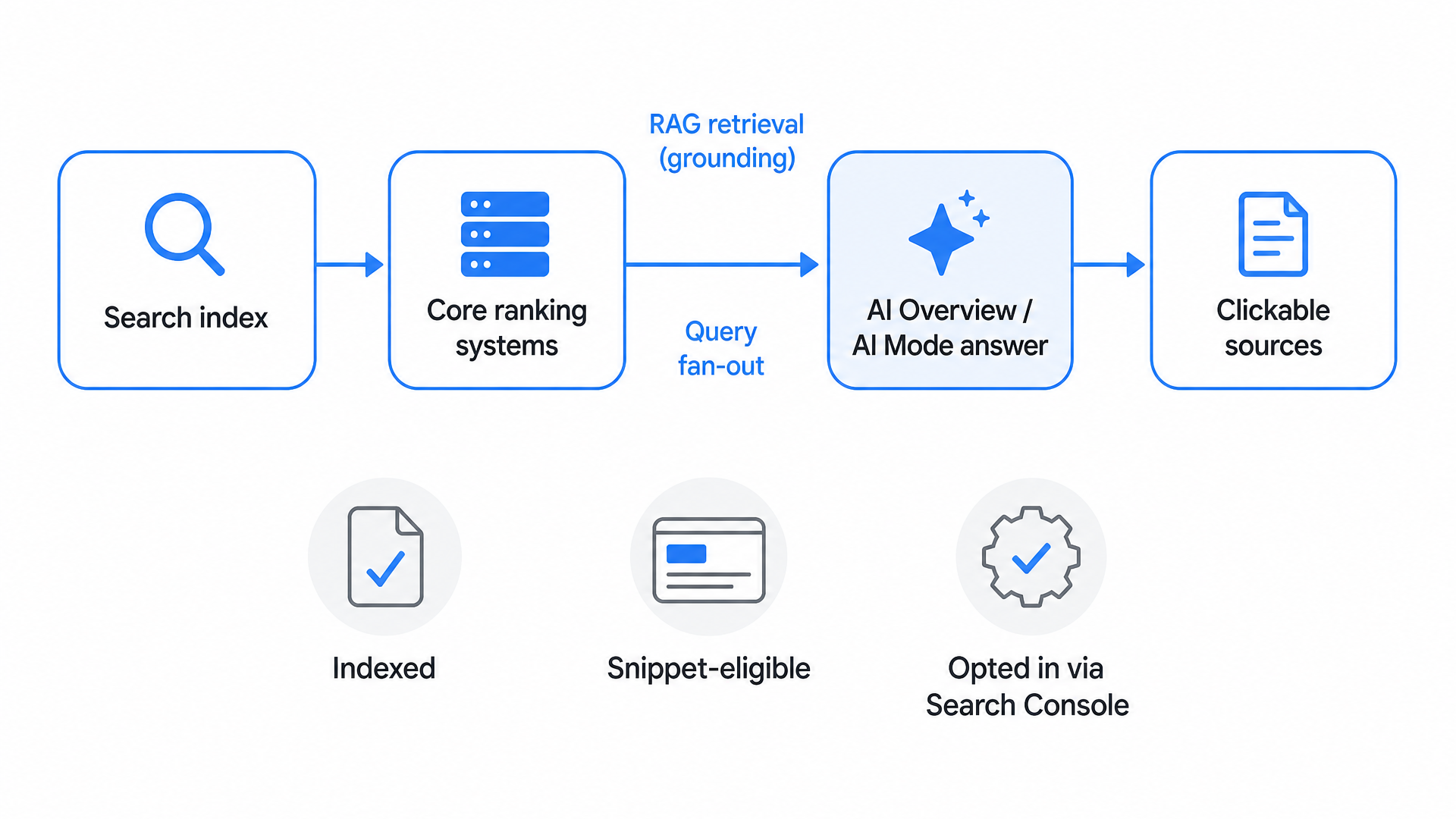
Before judging the advice, understand the mechanism the advice is built on. Google's generative AI features do not run a separate ranking system. They use two mechanisms on top of core search:
- Retrieval-augmented generation (RAG), which Google calls grounding. The system retrieves relevant, up-to-date pages from the Search index using core ranking systems, then generates a response from those pages, showing clickable supporting links. The pages are the source; the generated text is the summary.
- Query fan-out. The model simultaneously generates related queries to retrieve more context. Ask "how to fix a lawn full of weeds," and it may also fetch results for "best herbicides for lawns" and "remove weeds without chemicals" before composing an answer.
Two eligibility conditions apply before any of this can happen. Your page must be indexed and eligible to appear in Google Search with a snippet (no noindex, nothing blocking the crawler). And your site must be opted in to generative AI features through Search Console's settings. Google is explicit that indexing and serving are never guaranteed. As the guide puts it, the AI systems "use publicly accessible, crawlable content."
The practical consequence is simple: an AI answer can only cite pages that already pass normal search prerequisites. If your content never makes it into the index, no amount of AI-specific tweaking will make you citable.
The terminology verdict: what Google says about AEO and GEO
Google's guide defines both terms plainly: "AEO" stands for answer engine optimization, "GEO" for generative engine optimization. Then it delivers the verdict:
Term | What it claims to optimize | Google's position |
|---|---|---|
AEO (answer engine optimization) | Visibility in AI answer surfaces (AI Overviews, AI Mode, assistants) | A third-party marketing term. The work is search optimization, and the mechanics are core ranking systems. |
GEO (generative engine optimization) | Visibility and citations in generative AI engines | Same verdict: "optimizing for generative AI search is optimizing for the search experience, and thus still SEO." |
SEO | Visibility in Google Search | Still the umbrella. Foundational SEO practices are the prerequisite for AI features. |
The guide goes one step further: it warns readers to be careful with third-party AEO/GEO services and points to Google's guidance on evaluating third-party SEO advice. That is an unusually direct signal. Google is telling site owners that a whole category of vendors sells "AI search optimization" for techniques the guide lists as unnecessary.
Read this the right way, though. The verdict is not "GEO is a scam" or "ignore AI features." It is a claim about method: the job called GEO or AEO is performed with the same inputs as SEO: content quality, technical accessibility, and relevance. The surface is new. The discipline is not.
What Google says you do not need
The mythbusting section of the guide carries the most weight, and it is worth reading closely because it directly contradicts advice circulating in much of the AEO/GEO industry:
Tactic promoted by AEO/GEO services | What Google's guide says |
|---|---|
Add | "Google Search itself doesn't use them." They will neither harm nor help your visibility. |
Break content into tiny chunks for AI understanding | "There's no requirement to break your content into tiny pieces." Google's systems "are able to understand the nuance of multiple topics on a page." |
Rewrite content specifically for AI systems | Unnecessary. AI systems understand synonyms and general meaning, so "you don't need to write in a specific way just for generative AI search." |
Cover every possible query variation, including fan-out queries | Not needed, and it can backfire: pages created mainly to match query variations can violate the scaled content abuse spam policy. |
Chase inauthentic brand mentions | "Isn't as helpful as it might seem": core ranking systems focus on quality, and separate systems block spam. |
Add special structured data for AI | "There's no special schema.org markup you need to add." Standard structured data remains worth doing for rich results, not for AI features. |
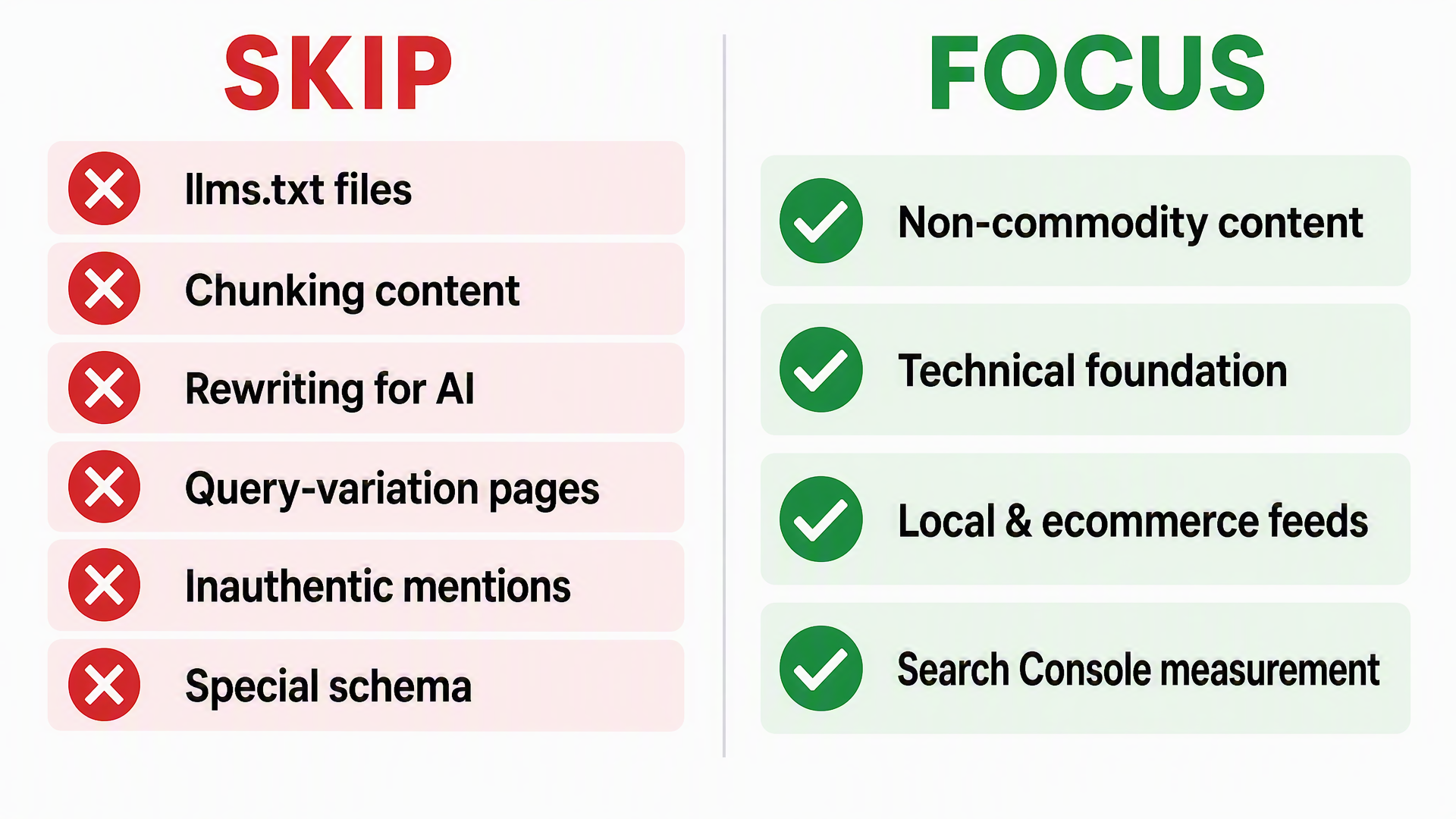
Add the guide's other throwaways and the picture gets clearer: there is no ideal page length, no requirement to write "for the AI," and no benefit from separating your content into an AI version and a human version. Google's own framing is blunt: "Focus on what your visitors would enjoy, find helpful, and feel satisfied with."
If you have been paying an agency for chunked, AI-reformatted, schema-heavy "AI optimization," the guide is the document to hold up in that conversation.
What Google says to focus on instead
The guide's positive recommendations are shorter than its skip list, and that is the point. Most of it is ordinary, well-executed SEO with an emphasis on original insight.
Content quality is the single biggest lever. The guide says your content's quality "will likely influence your website's presence in generative AI search in the long run more than any of the other suggestions." The standard it pushes is non-commodity content: content that carries information people cannot easily get elsewhere. Google's own contrast: commodity content is "7 Tips for First-Time Homebuyers," a list of common knowledge. Non-commodity content is "Why We Waived the Inspection & Saved Money," a first-hand account with a real point of view. First-hand reviews, original research, and experience-based advice are the category to aim for.
Technical foundation is the entry ticket. Pages must be crawlable, indexable, and snippet-eligible. Follow crawling best practices, use semantic HTML, apply JavaScript SEO best practices if your site relies on JS, deliver a good page experience (device compatibility, low latency, clear main content), and reduce duplicate content. Large, frequently updated sites should review crawl budget guidance.
Local and ecommerce visibility gets specific treatment. Product pages can appear in AI responses through Merchant Center feeds. Local businesses should maintain a Google Business Profile. Google also mentions Business Agent for conversational interactions. None of this replaces your website; it complements it.
One content system, not two. The guide repeatedly refuses the idea of separate treatment for AI queries. Your audience's underlying needs are the target; Google's systems understand relevance even without exact keyword matches, which is why covering "every variation of how someone might seek content" is unnecessary. Build pages for people, and the same pages serve AI features.
The rules for AI-generated content
The second document clears up the other frequent worry: Google does not ban AI-generated content. Its position, quoted directly: "Generative AI can be particularly useful when researching a topic, and to add structure to original content."
The line Google draws is not human-written versus machine-written. It is value versus volume. Using AI to mass-produce pages that add nothing for users can violate Google's spam policy on scaled content abuse. The standard is unchanged: content must meet Search Essentials and the spam policies, whatever tool produced it.
The guide's checklist for AI-assisted publishing:
- Prioritize accuracy, quality, and relevance, especially when output is automated.
- Keep metadata honest: titles, meta descriptions, structured data, and image alt text must accurately describe the page.
- Disclose how content was created where it helps readers, for example by explaining that automation was used or adding image metadata.
- In ecommerce, follow Merchant Center rules: AI-generated images must carry IPTC
DigitalSourceTypeTrainedAlgorithmicMediametadata, and AI-generated product data must be labeled as such.
The practical translation: AI as an accelerator for your own original work is fine. AI as a publishing engine is exactly what the spam policy targets. If you cannot say what the page adds beyond what already exists, the page is at risk regardless of who wrote it.
Measuring generative AI visibility in Search Console
Google's answer to "how do I know if AI features show my content?" is the Generative AI performance report in Search Console. It shows how people discover your content through generative AI features on Google Search, covering Search and Discover: impressions, queries, and pages, split the way you would expect from a Search Console report.
Two guardrails around that report matter more than the numbers themselves. First, the report only exists if you opt in to generative AI features and your pages are eligible, so set that up before measuring anything. Second, Google adds a warning that should shape every tool-buying decision you make: "No third-party tool has access to our internal ranking or AI systems." Any vendor claiming to show you Google's internal AI metrics is describing access Google says does not exist.
The report is authoritative for Google surfaces only. AI search spans more than Google: ChatGPT, Perplexity, and Gemini answer questions from their own retrieval stacks, which Google's documentation does not govern. For those surfaces you can run prompt-level checks directly: ask a set of questions in each product and record which sources get cited. A cross-platform checker like Auspia's AI Search Visibility Checker can systematize that routine, but the honest baseline is a spreadsheet and a repeating prompt set.
The 10-point foundation checklist
This is the beginner track. If you do nothing else after reading this article, work through these ten items:
- Confirm your pages are indexed. Use URL Inspection in Search Console (or a
site:search) on your five most important pages. - Verify snippet eligibility. No
noindex, no robots blocking, no canonical pointing elsewhere. - Opt in to generative AI features in Search Console's settings.
- Record a baseline from the Generative AI performance report: impressions and top queries for the last 28 days.
- Run the commodity test on your best content. Ask: could a reader get this exact value from ten other pages? If yes, add first-hand experience or a unique point of view.
- Strengthen your money pages with original evidence. Real usage, real numbers, named constraints, screenshots of your own.
- Fix crawlability basics. Clear internal links, an accurate sitemap, semantic headings, no duplicate title tags.
- Check page experience. The page should load fast on mobile and make its main content immediately identifiable.
- Cut thin or duplicated content rather than expanding it.
- Schedule a monthly review of the AI performance report, tied to the content changes you made.
For professionals: operating principles and open questions
If you run an SEO or content program, the guide is useful mainly as a budgeting and governance tool. These are the operating principles it implies:
- One content system, not two. Split "SEO content" and "GEO content" and you multiply cost for a surface Google says runs on the same foundation. Judge every page by one standard: does it earn its place for a human reader?
- Evidence over tactics. When a vendor sells a new "AI search hack," ask what the platform's own documentation says. Google's guide is the reference for Google surfaces; platform docs are the reference for everything else.
- Measure before you optimize. Opt in, baseline the report, then change things. Without a baseline, you cannot attribute movement to any change you made.
- Treat AI as capacity, not identity. AI-assisted research and structuring are explicitly sanctioned. AI-generated volume is the risk. The distinction is whether your page adds value that did not exist before.
And three open questions the guide does not settle, worth tracking honestly:
- Non-Google platforms may weight signals differently. Google's documentation governs Google's AI features. ChatGPT and Perplexity run their own retrieval and citation logic, and their behavior is not bound by anything in this guide.
- Third-party measurement claims stay unverifiable. Google says no outside tool sees its internal systems. Treat vendor screenshots of "Google AI rankings" as marketing until proven otherwise.
- The agentic frontier is deliberately underspecified. Google's guide mentions AI agents and the emerging Universal Commerce Protocol as worth exploring "if this is something that's relevant to your business and you have extra time." Forward-looking, not urgent, and the same is true of most agent-readiness advice on the market today.
One closing line from the guide is worth pinning somewhere visible: "plenty of content thrives in Google Search (including generative AI experiences) without any overt SEO at all." The system rewards substance, not technique. The best thing you can do for your AI visibility is to make your site the one place a reader would rather be than anywhere else.
FAQ
Is SEO still relevant now that Google has AI Overviews? Yes, Google says so explicitly. The guide's opening question is "Is SEO still relevant for generative AI search?" and its answer is "In short, yes!" AI features are rooted in the same core ranking and quality systems as regular search.
What exactly does Google say about GEO and AEO? It defines AEO as answer engine optimization and GEO as generative engine optimization, calls them third-party marketing terms, and says optimizing for generative AI search is still SEO. It also warns readers to be skeptical of third-party AEO/GEO services.
Do I need to add llms.txt for Google? No. Google says Search itself does not use llms.txt files and that they will neither harm nor help your site's visibility in Google Search. Standard content quality and technical accessibility are what matter.
Does Google penalize AI-generated content? Not by itself. Google's guidance says AI is useful for research and structure, and the test is whether content meets Search Essentials and the spam policies. Mass-producing pages without added value can violate the scaled content abuse policy.
Should I create separate content for AI search queries? No. Google's guide says there is no requirement to write differently for generative AI search, no ideal page length, and no need to cover every query variation. Pages built to manipulate fan-out queries can even trigger spam policies.
Is structured data required for appearing in AI Overviews? No special schema is needed for generative AI features. Standard structured data remains useful because it qualifies pages for rich results in normal search.
How do I check whether my site appears in Google's AI features? Opt in to generative AI features in Search Console, then open the Generative AI performance report, which shows how people discover your content through AI features across Search and Discover.
Does Google's position mean GEO for ChatGPT or Perplexity is pointless? No. Google's guide only governs Google's own AI features. ChatGPT, Perplexity, and other platforms have their own retrieval systems and may weight signals differently; test them directly rather than assuming they follow Google.
Author: Gabriel Finch, Search Retrieval Researcher, 1,200+ AI Answers Reviewed at Auspia. Gabriel writes about how search retrieval works, which surfaces AI answers draw from, and what makes a page the source a model actually cites.