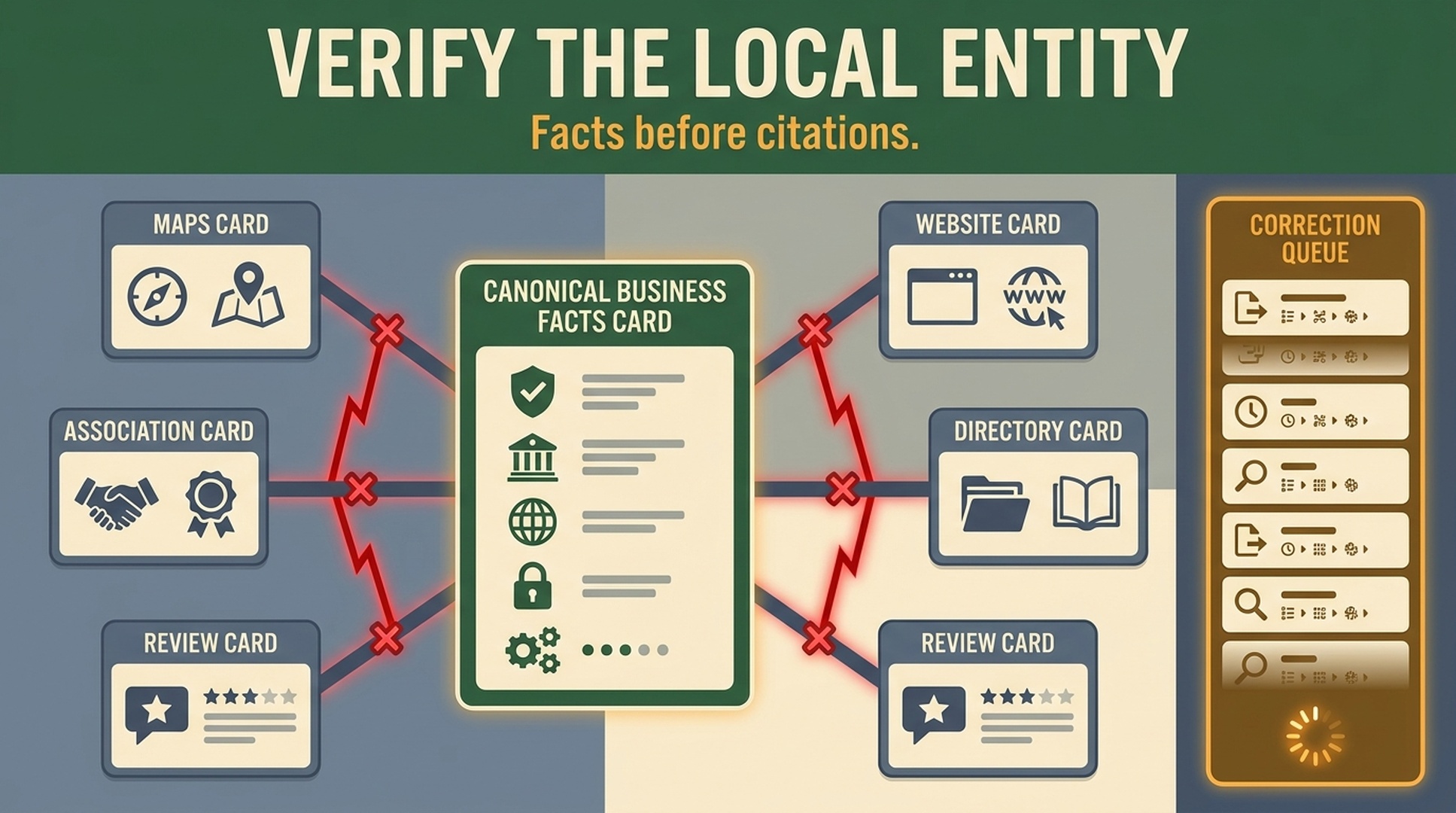
The useful question is not "Where can we submit our listing?"
The useful question is: when a customer, Google, a directory, or an AI answer system looks up this business, do they find the same verifiable company with the same location, service boundary, category, contact route, and proof?
That is the job of local citations in 2026. A citation is still a public mention of business facts, often including name, address or service area, phone number, website, category, or reviews. But the work has changed. The old version emphasized how many directories could hold a listing. The better version treats each public source as evidence in a business identity record.
For a US or Canadian business, the citation program should make it easier to answer five customer questions:
Customer question | The facts that must agree |
|---|---|
Is this the business I meant to find? | Public name, primary category, website, and local phone |
Can it serve or receive me here? | Address, map pin, storefront status, or service-area boundary |
Is it open and reachable now? | Regular and special hours, phone, booking, and emergency or appointment rules |
Does it provide this service? | Service list, categories, credentials, limitations, and relevant pages |
Why should I trust it? | Genuine reviews, licenses, association membership, local partnerships, project proof, and consistent third-party descriptions |
If these facts disagree, submitting the business to another low-quality directory does not solve the problem. It creates another copy that can become wrong later.
Why "NAP consistency" is necessary but not enough
NAP means name, address, and phone number. It remains useful shorthand because those fields are common points of failure. A business may have moved, changed a tracking number, rebranded, added a franchise location, or kept an old call center phone on a directory. Each mismatch makes it harder for a customer to know what is current.
But an accurate local entity record includes more than NAP:
Fact group | Examples | Why it matters |
|---|---|---|
Identity | Public name, legal name where needed, logo, website, primary category | Separates the business from similar names and outdated brands |
Location model | Storefront address, map pin, service area, hybrid model, delivery area | Prevents customers from visiting the wrong place or requesting unavailable service |
Contact and access | Local phone, booking URL, hours, accessibility, parking, appointment policy | Determines whether discovery can turn into a useful customer action |
Offer | Services, specialties, product availability, price or quote boundaries, exclusions | Helps customers and answer systems match the business to the right request |
Trust evidence | Licenses, association listings, review sources, partners, local projects, media | Gives a customer a reason to believe the description |
Freshness | Recent hours, moves, closures, ownership or name changes, active pages | Stops outdated sources from becoming the public version of the business |
Call this entity verification rather than citation building. It changes the question from "How many listings did we create?" to "Which sources would a reasonable customer use to verify this fact, and are those sources correct?"
Google treats complete facts as a local-search foundation
Google's local-ranking guidance says complete and accurate Business Profile information makes a business more likely to appear in local search results. It asks businesses to supply details such as address, phone number, category, and customer-useful attributes. Google also says that local results are mainly based on relevance, distance, and prominence.
That does not mean every directory is a Google ranking factor. Google does not publish such a list or a citation-count formula. It does mean that a business should not expect strong local relevance while the most important public records disagree about what it is, where it operates, or how a customer reaches it.
The same discipline supports Google's search AI features. Google says there are no special AI Overview or AI Mode requirements or special schema to add. Its published best practices include keeping Business Profile information current. For other answer engines, assume less, not more: public web sources may be retrieved or cited differently across platforms, so accurate facts and relevant third-party confirmation are safer investments than a platform-specific trick.
Start with a canonical facts sheet
Before claiming, correcting, or deleting listings, prepare a version-controlled facts sheet for each business or location. This is the source of truth that operations, marketing, agencies, franchise teams, and customer service use when updating public records.
Field | Record | Approval owner |
|---|---|---|
Public name | Exact real-world name used on signage, website, invoices, and customer communications | Business owner or brand lead |
Operating model | Storefront, service-area, hybrid, or multi-location | Operations lead |
Address and map pin | Customer-facing address and entrance details, or hidden-base status for a service-area business | Location manager |
Service boundary | Named cities, ZIP codes, regions, or delivery areas the team can support | Operations or dispatch lead |
Contact route | Local phone, booking page, website URL, and escalation contact | Customer-experience lead |
Hours | Standard, special, appointment, emergency, pickup, and seasonal hours | Location manager |
Category and services | Primary category, secondary categories, actual services, specialties, and exclusions | Operations and marketing |
Trust facts | Active licenses, associations, credentials, warranties, partner relationships, and review-platform presence | Compliance or business owner |
Change history | Effective date, prior value, new value, proof, and sources that need updates | Profile or marketing owner |
This sheet should distinguish facts that must be identical from descriptions that can vary. A phone number, address, business name, and operating hours need strict control. A 100-word business description can change its phrasing by source as long as it does not alter the core category, service boundary, or customer promise.
Audit sources by decision value, not domain count
Do not begin with a list of 300 directories. Start with the sources that a customer, a local partner, or a platform is most likely to use when deciding whether the business is real and relevant.
Tier | Source types | Audit goal | Typical action |
|---|---|---|---|
1: owned and Google | Business Profile, website, location pages, booking pages, social profiles the business actively maintains | Make the canonical facts visible and current | Correct, verify, document ownership, and link to the right local destination |
2: customer decision sources | Major review platforms, maps, marketplaces, vertical platforms, and local consumer directories used in the category | Make customer-facing discovery facts accurate | Claim or correct records, remove duplicates when possible, and monitor reviews |
3: authority and eligibility sources | Licensing boards, professional associations, chambers, franchise directories, insurer or manufacturer partner pages | Verify credentials, category, local presence, or relationship | Correct facts and retain proof of the real relationship |
4: local proof sources | Local media, nonprofits, schools, suppliers, event pages, local sponsorships, and project partners | Show genuine local participation and contextual relevance | Pursue or update only when the relationship is real and useful to the audience |
5: long-tail directories | Low-traffic or generic listing sites | Prevent obvious misinformation from spreading | Fix only material errors; do not pay for volume without a customer or evidence reason |
This hierarchy makes an agency's work easier to explain. Tier 1 errors can break customer actions. Tier 2 errors can send demand to the wrong location. Tier 3 errors can undermine trust. Tier 4 can add proof. Tier 5 rarely deserves to drive the whole program.
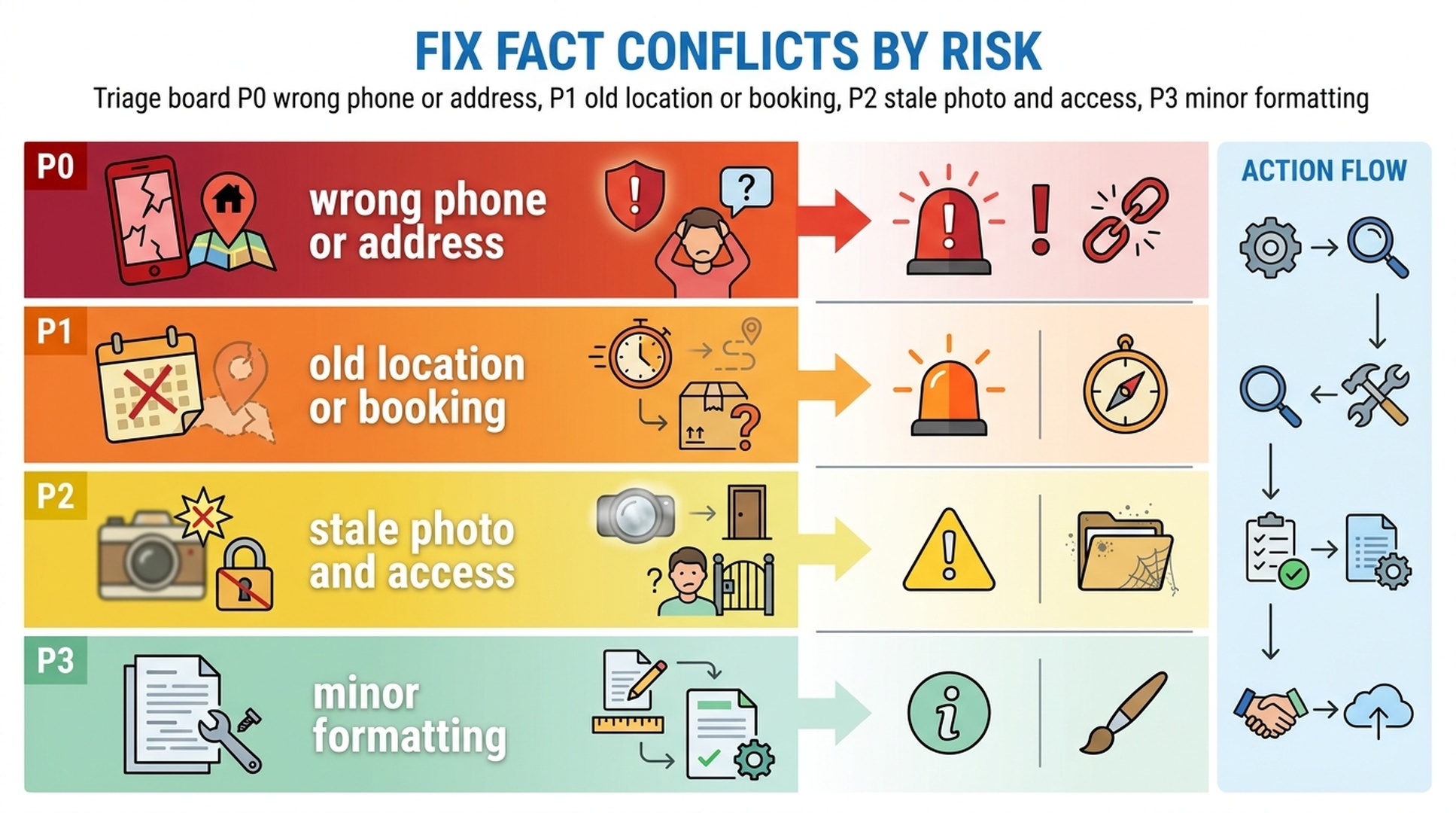
Resolve conflicts in the right order
When the same business appears differently across the web, trying to edit every source at once is inefficient. Resolve the source-of-truth problem first, then update dependent sources in a deliberate order.
Conflict | Root cause to investigate | Resolution order |
|---|---|---|
Old address remains in search and directories | Move, rebrand, missing closure notice, or duplicate location | Website and Business Profile -> major customer platforms -> licensing/association pages -> remaining sources |
Different phone numbers appear | Tracking system, franchise call center, old agency number, or a location-specific phone change | Confirm the customer-facing phone strategy -> website and Business Profile -> critical third parties |
Service area is inconsistent | Sales coverage expanded, dispatch boundary changed, or a residential base was displayed | Operations approval -> Business Profile/service pages -> booking and quote forms -> relevant directories |
Category differs across sources | Marketing language drift, merger, or an attempt to target adjacent demand | Decide the core category -> update owned facts -> correct high-trust sources -> retire misleading claims |
Duplicate profile or listing | Ownership dispute, old provider, move, department, or an unauthorized record | Confirm the real entity -> use each platform's duplicate or ownership process -> document the outcome |
Review profile points to an old brand or location | Rebrand, acquisition, mistaken merge, or customer confusion | Escalate with evidence; do not create a new fake history or ask for reviews to mask the problem |
For a move, rebrand, closure, or change in service model, treat the change as a small project. Record the effective date, retain proof, update the website and Business Profile, check the top decision sources, and monitor search results and customer contacts. A change with no owner turns into a long-running citation problem.
Service-area and multi-location businesses need different controls
The biggest citation mistakes often come from applying storefront rules to a business that travels to customers, or treating a multi-location company as one generic brand.
Service-area businesses
Google says a service-area business that does not serve customers at its address should hide the address and use a service area. It generally receives one profile for the area it serves. This needs to be reflected outside Google as well.
Do not let directories publish a home address or virtual office as a public storefront just because a form requires an address. Where an address is legally required for a record, distinguish that administrative purpose from customer-facing location information. Make the service boundary, booking route, and business phone clear on the website so customers do not have to infer where the team can go.
Multi-location brands
For each real location, maintain a location-specific facts sheet, phone or contact route where possible, regular and special hours, local landing page, local photos, categories, and evidence of staff or customer operations. Do not force every location to have the same description if the actual offer, accessibility, service scope, or customer experience differs.
Google's Business Profile guidelines allow one profile per location when service businesses have separate locations, separate service areas, and separate staff. That is an operating rule, not a content opportunity. A page or profile should exist because the location is real and independently useful to customers.
Citation work should start with facts customers can verify
Google advises businesses to keep Business Profile information complete and accurate. That is the right starting point for citation work: publish the same current facts on the website and correct the public sources customers actually use. A longer directory list is not a substitute for facts that agree.
For AI-search checks, record what appears for a defined prompt, date, and location, then investigate incorrect facts at their source. Do not convert a single observed answer into a claim about a universal ranking factor.
Do not confuse entity verification with local link building
Citations and links overlap when a local partner, association, or publication names the business and links to it. That can be valuable. But a citation campaign should not be judged only by backlink count.
Evidence opportunity | Citation value | Link value | Customer value |
|---|---|---|---|
A licensing-board record | Confirms eligibility and location | Often none | High for regulated decisions |
A local chamber membership page | Confirms local participation and category | Sometimes present | Useful if customers recognize the organization |
A supplier or manufacturer partner page | Confirms a real commercial relationship or specialization | Often present | High when the relationship informs buying confidence |
A generic directory profile | May confirm basic contact facts | Sometimes present | Low unless customers in the category use it |
A paid guest-post placement with a bare link | Usually weak identity confirmation | May pass a link | Low unless it contains accurate, relevant, useful information |
The best local reference usually gives a customer a reason to trust the business and a system enough context to identify it correctly. A bare link inside an irrelevant article rarely does either.
A 45-day entity verification sprint
This sprint is appropriate for one location, a service-area business, or a small group of priority locations. Large brands should run it in waves rather than trying to clean every listing at once.
Timeframe | Work | Owner | Deliverable |
|---|---|---|---|
Days 1-5 | Approve canonical facts, operating model, service boundary, and change owners | Business owner and operations lead | Signed facts sheet and change log |
Days 6-12 | Audit Tier 1 and Tier 2 sources; capture conflicting facts, duplicate records, ownership gaps, and broken customer paths | Agency or local marketing lead | Prioritized source inventory with screenshots and URLs |
Days 13-25 | Correct owned and highest-decision sources; update website, Business Profile, booking paths, and major review or vertical platforms | Profile owner with operations approval | Correction log with before/after evidence |
Days 26-35 | Correct authority sources; pursue real local proof where relationships already exist | Marketing lead and relationship owners | Updated credentials/partner records and proof backlog |
Days 36-45 | Recheck priority queries, local prompts, customer paths, and source conflicts; assign unresolved items | Owner and agency | Entity verification report and next-quarter maintenance list |
The result is not "500 citations built." It is a defensible public record with a clear list of what is verified, what needs evidence, and what should be retired.
How to measure citation work honestly
Citation counts are easy to report and easy to misunderstand. Use measures that reveal whether a business is becoming easier to verify.
Measure | Better question |
|---|---|
Tier 1 and Tier 2 fact-match rate | Do the sources customers use most reflect the approved facts? |
Duplicate and obsolete-record count | Are old locations, old phones, or false profiles still creating confusion? |
Verified authority records | Are licenses, memberships, and partner descriptions current and accurate? |
Customer-path success | Can a customer from each important source call, book, get directions, or reach the correct local page? |
Description accuracy in AI prompt checks | Is the business correctly identified by service, location, and customer fit? |
Qualified referral and lead quality | Are third-party sources sending useful local demand rather than misdirected traffic? |
Maintenance completion | Were changes, moves, seasonal hours, and rebrands propagated before they became customer problems? |
This is where citation work becomes a business-information discipline. It serves maps, organic search, local partners, customer service, and AI-answer accuracy at the same time.
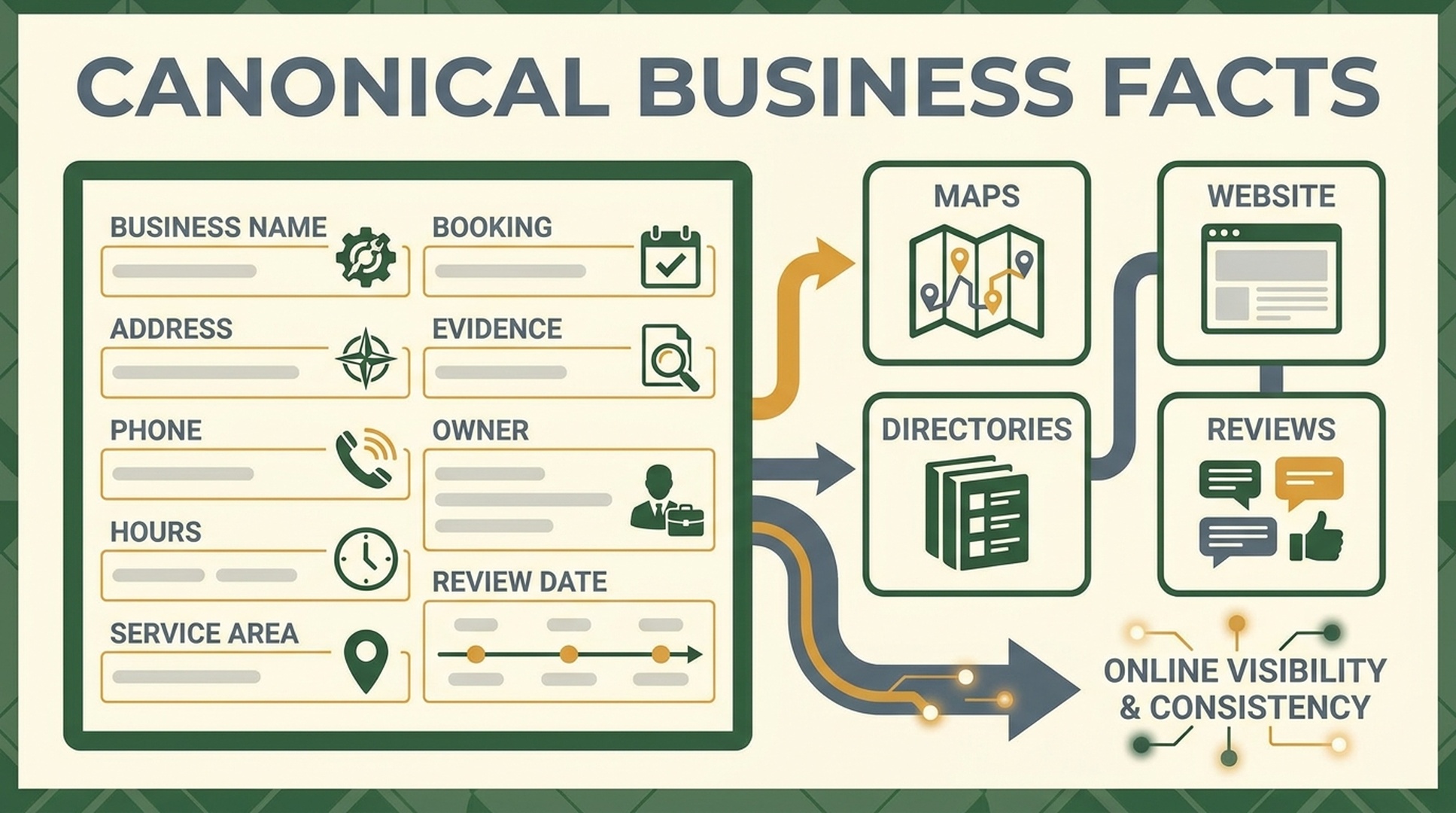
Use this framework to separate operational facts, customer trust, relevant evidence, and answer-quality checks.
Use the timeline as an operating sequence, not as a ranking guarantee.
FAQ
Are local citations still important in 2026?
Yes, but the priority is accurate, useful public business evidence rather than maximum directory volume. Google emphasizes complete and accurate Business Profile information. That does not support a "submit everywhere" approach.
What is the difference between a citation and a backlink?
A citation is a public mention of a business's identifying information. It may include a link, but it does not have to. A backlink is a hyperlink to a website. The best local references often provide both accurate context and a relevant link, but they serve different purposes.
Should a service-area business show its home address in directories?
Not as a customer-facing storefront if customers are not served there. Google advises service-area businesses to hide the address on the Business Profile when they do not serve customers at that address. Use a truthful service boundary and contact path; follow legal or regulatory requirements separately where an address must be disclosed.
How many directories should a local business use?
There is no universal number. Start with the Business Profile, website, major customer decision sources, relevant vertical platforms, licensing or association records, and real local partners. Add a directory only when it helps a customer, verifies a relevant fact, or is needed to correct material misinformation.
Do citations guarantee an AI mention or citation?
No. Different AI systems use different retrieval methods and sources. Accurate public records can reduce ambiguity and support verification, but no directory listing, schema type, or citation package can guarantee an AI answer or recommendation.
What should we do after a business move or rebrand?
Treat it as a managed facts-change project. Update the website and Business Profile first, retain proof, correct the major customer and authority sources, monitor duplicates and old phone numbers, and assign an owner to unresolved sources.
Continue the local search series
Use these related guides to move from diagnosis to an operating plan:
- Local search ranking factors in 2026
- Local link building and relevant mentions
- Local GEO for AI search
- How to measure local search and AI visibility
Sources
- Google Business Profile Help, Tips to improve your local ranking on Google. Source for complete business information and Google's relevance, distance, and prominence explanation.
- Google Business Profile Help, Guidelines for representing your business on Google. Source for accurate public name, address/service-area guidance, service-area and multi-location profile rules, local phone and location-specific website guidance, and one-profile principles.
- Google Search Central, AI features and your website. Source for the absence of special AI Overview or AI Mode requirements and Google's advice to keep Business Profile information current.
Author: Lydia Hart, Brand Entity Strategist for 200+ Entity Audits at Auspia. Lydia writes about brand facts, entity consistency, local proof, and the public records that make a business easier to verify.