The prioritization rule
Do not start ChatGPT GEO by rewriting every page. Start with the pages most likely to change how AI systems understand, recommend, compare, or cite your brand.
The practical priority order is usually:
- pages that define what your company is
- pages that explain your category
- pages that answer buyer use cases
- pages that compare options
- pages that prove the claims
- pages that fix known answer errors
- pages that measure visibility
This matters because most teams do not have unlimited editorial, design, engineering, and review capacity. GEO works better when the first updates clarify high-value entities and answer high-intent prompts instead of polishing low-impact archive pages.
Start with prompts, not URLs
A URL list is not a strategy. It only tells you what exists.
A prompt list tells you what the market asks.
Before choosing pages to update, group the prompts you care about:
Prompt group | Example question | Page that should answer it |
|---|---|---|
Category definition | What is GEO software? | Category or glossary page |
Brand fit | What does this company do? | Product or about page |
Use case | How can a SaaS team track ChatGPT mentions? | Use-case page |
Comparison | What are the alternatives to a competitor? | Comparison page |
Proof | Has this approach worked before? | Case study or evidence page |
Risk | Why is ChatGPT describing my brand wrong? | Troubleshooting guide |
Measurement | How do I know visibility improved? | Measurement guide |
When a prompt has business value and no strong page, that gap moves up the queue.
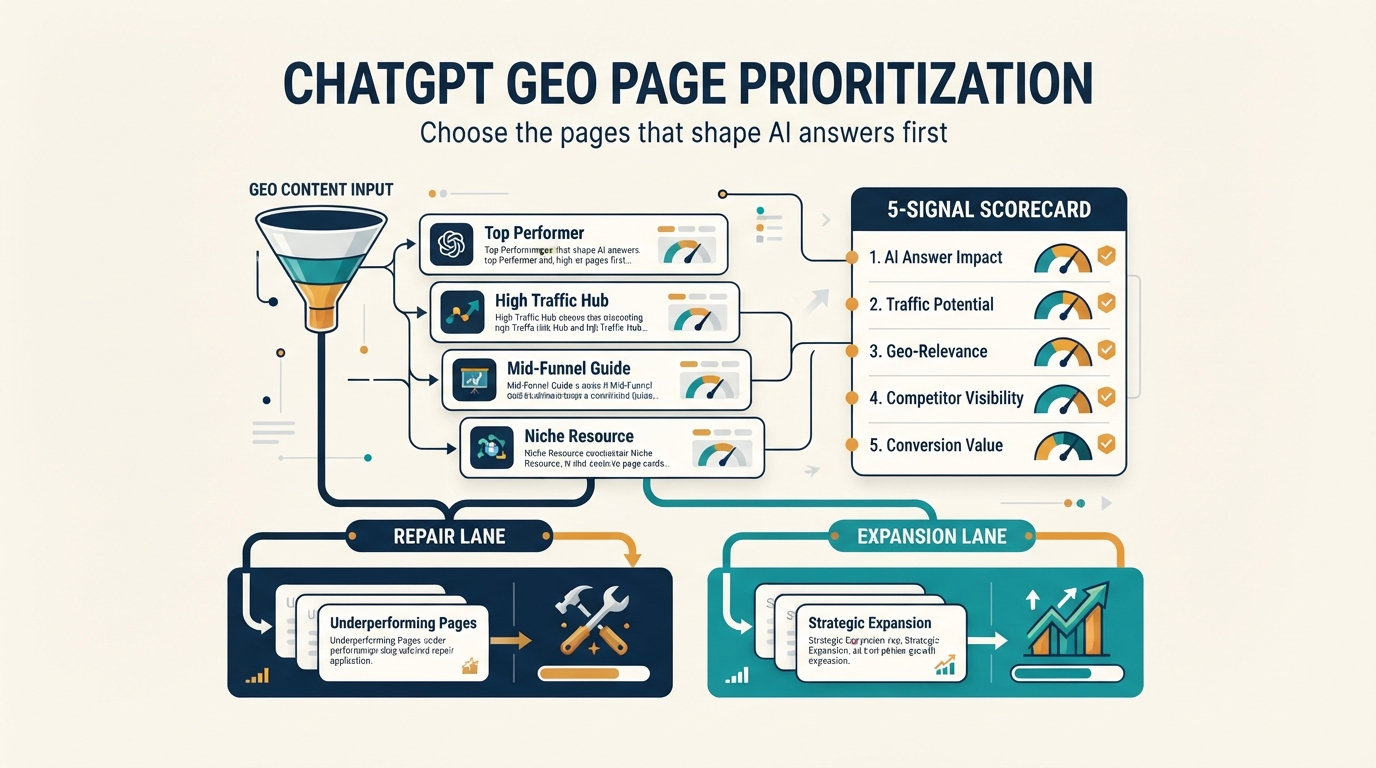
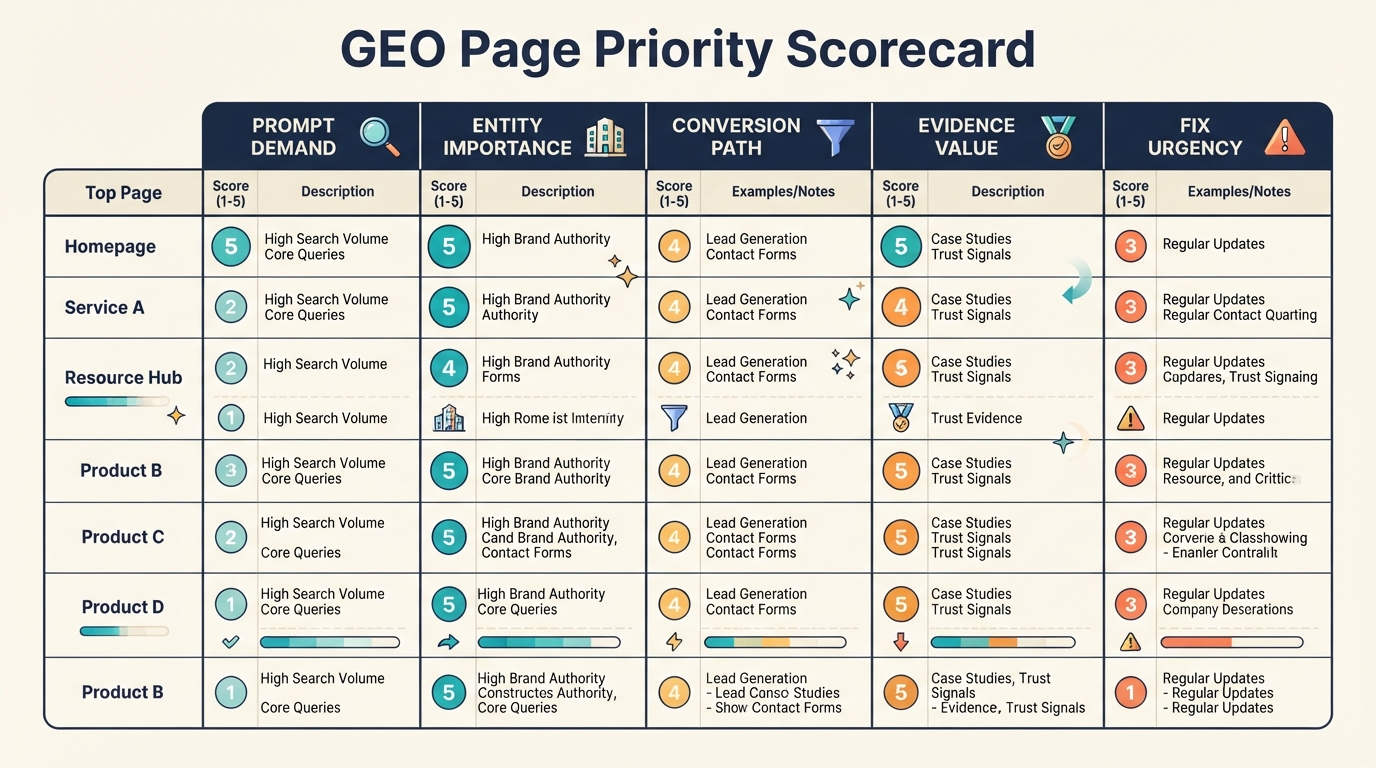
Score each page with five signals
Use a simple 1-5 score for each candidate page. You do not need a perfect model. You need a consistent decision process.
Signal | What to check | High score means |
|---|---|---|
Prompt demand | Does this page answer questions buyers actually ask? | Many valuable prompts depend on it |
Entity importance | Does it clarify the brand, product, category, or competitor set? | It shapes how AI understands the company |
Conversion path | Does the page influence trials, demos, sales calls, or product education? | It sits close to business outcomes |
Evidence value | Does it contain proof, examples, data, reviews, or citations? | AI answers can reuse or reference it |
Fix urgency | Is ChatGPT currently wrong, vague, or missing the brand on this topic? | Updating it could remove a visible problem |
Add the scores, then review the top ten manually. The manual review matters because a page can score high but still be blocked by product positioning, legal review, or missing evidence.
Prioritize the page types that shape AI understanding
For most B2B and SaaS sites, these page types should be reviewed before low-intent blog posts.
1. Product and homepage messaging
If AI systems cannot summarize what the product does, later GEO work becomes noisy. The homepage and product overview should make the brand entity easy to understand.
Check whether the page states:
- who the product is for
- what problem it solves
- which category it belongs to
- how it is different from adjacent tools
- what evidence supports the positioning
Avoid clever copy that sounds good to humans but leaves the entity vague.
2. Category and glossary pages
Category pages teach language. They help define terms like GEO, AEO, AI search visibility, ChatGPT SEO, and answer engine optimization.
A strong category page should include a short definition, practical examples, adjacent terms, who uses it, common mistakes, and links to deeper pages.
If your site does not define the category, AI systems may borrow definitions from competitors, marketplaces, review sites, or generic search results.
3. Use-case pages
Use-case pages match real prompts.
For example, a buyer may not ask for a platform name. They may ask:
- how to track brand mentions in ChatGPT
- how to audit AI search visibility
- how to compare GEO tools
- how to fix wrong brand descriptions in AI answers
Those prompts should map to pages that explain the workflow, buyer situation, expected output, proof, and next step.
4. Comparison and alternatives pages
Comparison pages are often high-value because AI answers frequently explain markets by comparing options.
A good comparison page should be balanced. It should explain who each option fits, where the differences matter, and what decision criteria buyers should use. Weak comparison pages that only attack competitors are less useful for humans and less credible for answer systems.
5. Proof pages
Proof pages include case studies, customer stories, benchmarks, review summaries, methodology pages, and third-party evidence hubs.
If a page makes a claim without proof, it may help marketing but not GEO. If a proof page exists but is buried, update the internal links and summaries so it supports the pages where claims are made.
Use a two-lane roadmap
A useful ChatGPT GEO roadmap has two lanes: repair and expansion.
Repair pages fix known weaknesses. Expansion pages create new answer assets for prompts you do not yet cover.
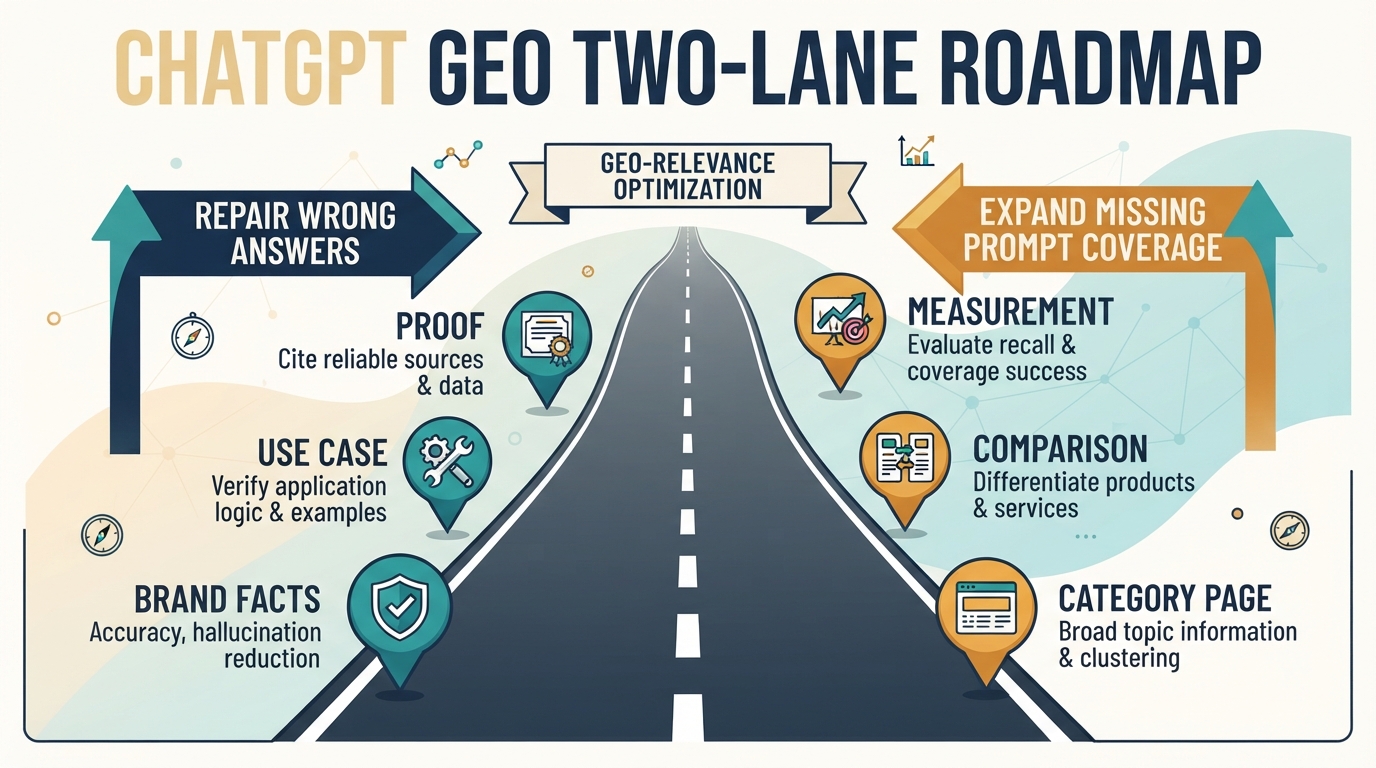
Lane | When to use it | Example work |
|---|---|---|
Repair | ChatGPT gives wrong, weak, or missing answers | Rewrite brand facts, add proof, improve definitions, fix thin pages |
Expansion | Valuable prompts have no good destination | Build use-case pages, comparison pages, FAQ hubs, measurement guides |
Do both, but do not mix them into one vague backlog. Repair work often needs stakeholder review. Expansion work often needs content production and internal links.
The 10-page starter set
If you need a practical starting point, choose ten pages:
- homepage or product overview
- about page or brand facts page
- main category page
- strongest use-case page
- highest-value comparison page
- best case study or proof page
- most important FAQ page
- measurement or audit guide
- technical crawlability page
- page that corrects the most common wrong answer
This starter set gives AI systems a clearer view of the brand, category, use cases, proof, and measurement method.
It also gives your team a manageable first sprint instead of an endless content audit.
What to change on prioritized pages
Once a page is selected, do not only add keywords. Improve the page as a source.
Use this update checklist:
- Put a direct summary near the top.
- State the brand, category, product, and audience clearly.
- Add examples that match buyer prompts.
- Include proof where the page makes a claim.
- Use descriptive headings that can be quoted or summarized.
- Add internal links to the hub, proof page, and next step.
- Remove vague language that could apply to any company.
- Add FAQ only when the questions are real.
- Make the page easy to crawl and render.
The goal is not longer content. The goal is cleaner evidence and clearer extraction.
A weekly prioritization workflow
Use this workflow every week during a GEO sprint.
Monday: review prompt results
Run a fixed prompt set and note where ChatGPT mentions the brand, omits the brand, gives a vague description, cites weak sources, or points users to competitors.
Tuesday: map problems to pages
For each weak answer, identify the page that should carry the answer. If no page exists, mark it as an expansion gap.
Wednesday: score the pages
Use the five-signal scorecard: prompt demand, entity importance, conversion path, evidence value, and fix urgency.
Thursday: update the top pages
Update only what can realistically be improved this week. For many teams, two to four page updates are enough.
Friday: check internal links and rerun prompts
Make sure the updated pages are connected to the relevant hub and proof pages. Then rerun the same prompts and record whether the answer quality changed.
Common prioritization mistakes
Mistake 1: refreshing blog posts before brand pages
Blog posts can matter, but brand, product, category, and proof pages often shape entity understanding more directly.
Mistake 2: choosing pages only by Google traffic
A page with modest Google traffic may be important for ChatGPT if it answers a high-value buyer prompt or fixes an entity problem.
Mistake 3: updating pages without proof
GEO updates become weaker when they add claims but no evidence. Improve proof at the same time as messaging.
Mistake 4: ignoring competitor prompts
If buyers ask about alternatives, categories, or comparisons, your site needs balanced comparison assets. Otherwise AI systems may rely on competitor pages and third-party lists.
Mistake 5: treating prioritization as a one-time audit
ChatGPT answers shift as content, citations, competitors, and crawl signals change. Prioritization should be reviewed weekly or monthly, not once per year.
FAQ
What pages should I optimize first for ChatGPT GEO?
Start with pages that clarify the brand, category, product, use cases, comparisons, proof, and known answer errors. These pages are more likely to shape how AI systems understand and recommend the company.
Should I update old blog posts for GEO?
Yes, but only after scoring them against prompt demand, entity importance, conversion value, evidence, and fix urgency. Some old blog posts are valuable; many are not the first priority.
How many pages should a first GEO sprint include?
A first sprint can start with five to ten pages. That is enough to clarify the main entity, category, use cases, and proof without overwhelming the team.
How do I know if a page is important for AI visibility?
A page is important when it answers valuable prompts, defines an important entity, supports conversion, contains proof, or fixes a current ChatGPT answer problem.
Do internal links affect prioritization?
Yes. A page that is important but poorly linked should be prioritized for both content improvement and internal linking. Important GEO pages should not be orphaned.
Author: Victor Lane, GEO Audit Specialist with 300+ Readiness Reviews at Auspia. Victor writes about GEO readiness audits, prioritization systems, and practical scorecards for AI search visibility.