Recommendation at a glance
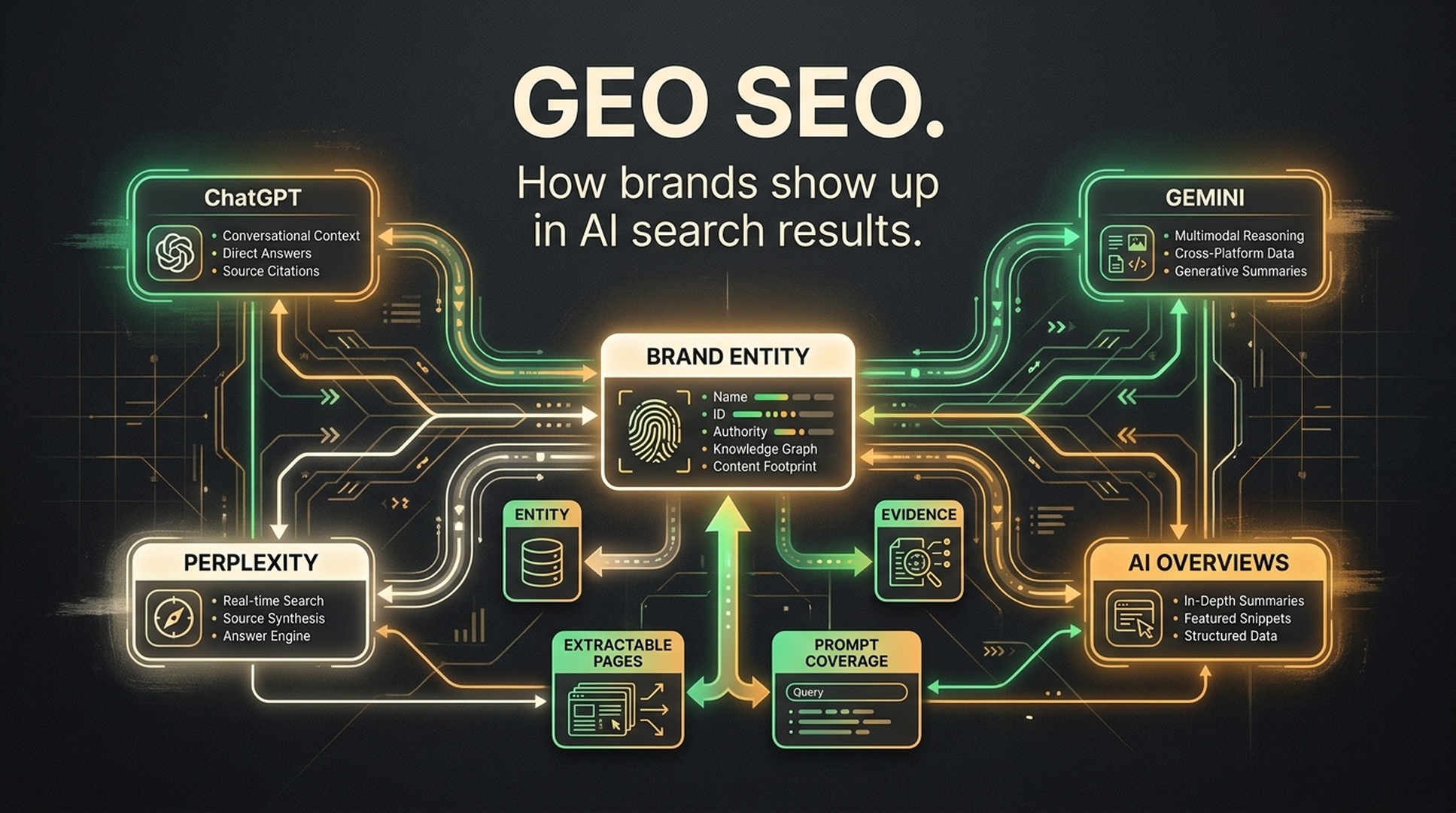
GEO SEO is the work of making a brand easier to find, understand, cite, and recommend inside AI-generated answers.
Traditional SEO still matters. Your pages still need to be crawlable, useful, and trustworthy. But GEO SEO adds a second goal: your brand has to become a clear answer candidate when people ask ChatGPT, Perplexity, Gemini, Google AI Overviews, or another AI search surface for advice.
The practical difference is simple:
If your goal is... | Traditional SEO asks | GEO SEO asks |
|---|---|---|
Discovery | Can Google find and rank this page? | Can AI systems retrieve and understand this entity? |
Authority | Does this page deserve to rank? | Is this brand supported by enough evidence to mention? |
Content | Does the article match the keyword? | Does the page answer the prompt clearly enough to extract? |
Measurement | Did rankings, clicks, and impressions move? | Did brand mentions, citations, and answer accuracy improve? |
For brands, the shift is uncomfortable. In classic SEO, a user sees ten blue links and chooses where to click. In AI search, the answer may summarize the market, name a few options, cite a handful of sources, and end the decision before the user ever visits a website.
That does not make SEO obsolete. It makes brand visibility harder to fake.
Where GEO SEO actually shows up
GEO SEO is not limited to one product called "AI search." It shows up wherever a user asks a system to synthesize an answer instead of returning a list of links.
The main surfaces include:
Surface | What visibility looks like |
|---|---|
ChatGPT | Your brand is mentioned, compared, described, or cited in an answer |
Perplexity | Your page or a third-party source is cited as evidence |
Gemini | Your brand appears in synthesized answers or product/service suggestions |
Google AI Overviews | Your content or brand is included in an AI-generated search summary |
Claude or other assistants | Your brand is recognized in category, comparison, or recommendation prompts |
Vertical AI assistants | Your product, service, or content appears in industry-specific recommendations |
That last row matters. GEO is not only a marketing problem. It affects SaaS discovery, ecommerce product selection, local service recommendations, B2B vendor shortlists, healthcare information, education content, and professional services.
A user might not search "best CRM software" anymore. They might ask:
"What CRM should a 12-person B2B SaaS team use if they need HubSpot integration, low setup cost, and decent reporting?"
That is a different battlefield. The winning brand is not always the page that used the keyword most efficiently. It is the brand that the AI system can confidently place into the answer.
GEO SEO is not a replacement for SEO
The worst way to explain GEO SEO is to say, "SEO is dead."
It is not. Search still sends traffic. Google still crawls and ranks pages. Technical SEO still matters. Content quality still matters. Links, internal architecture, brand trust, and user intent still matter.
The better framing is this:
Layer | What it does |
|---|---|
Technical SEO | Makes the site accessible and understandable |
Content SEO | Answers search intent with useful pages |
Entity SEO | Clarifies who the brand is and what it is connected to |
AEO | Makes answers concise and extractable |
GEO SEO | Makes the brand eligible to be mentioned, cited, and recommended by AI answers |
GEO sits on top of the older layers. If the foundation is weak, GEO work gets slower.
For example, if your site blocks important crawlers, hides content behind scripts, has thin product pages, or describes the company differently on every profile, AI systems have less reliable information to retrieve.
GEO SEO does not let you skip the basics. It makes the cost of skipping them more visible.
The five signals brands need for AI search visibility
A brand usually appears in AI answers when five signals line up.
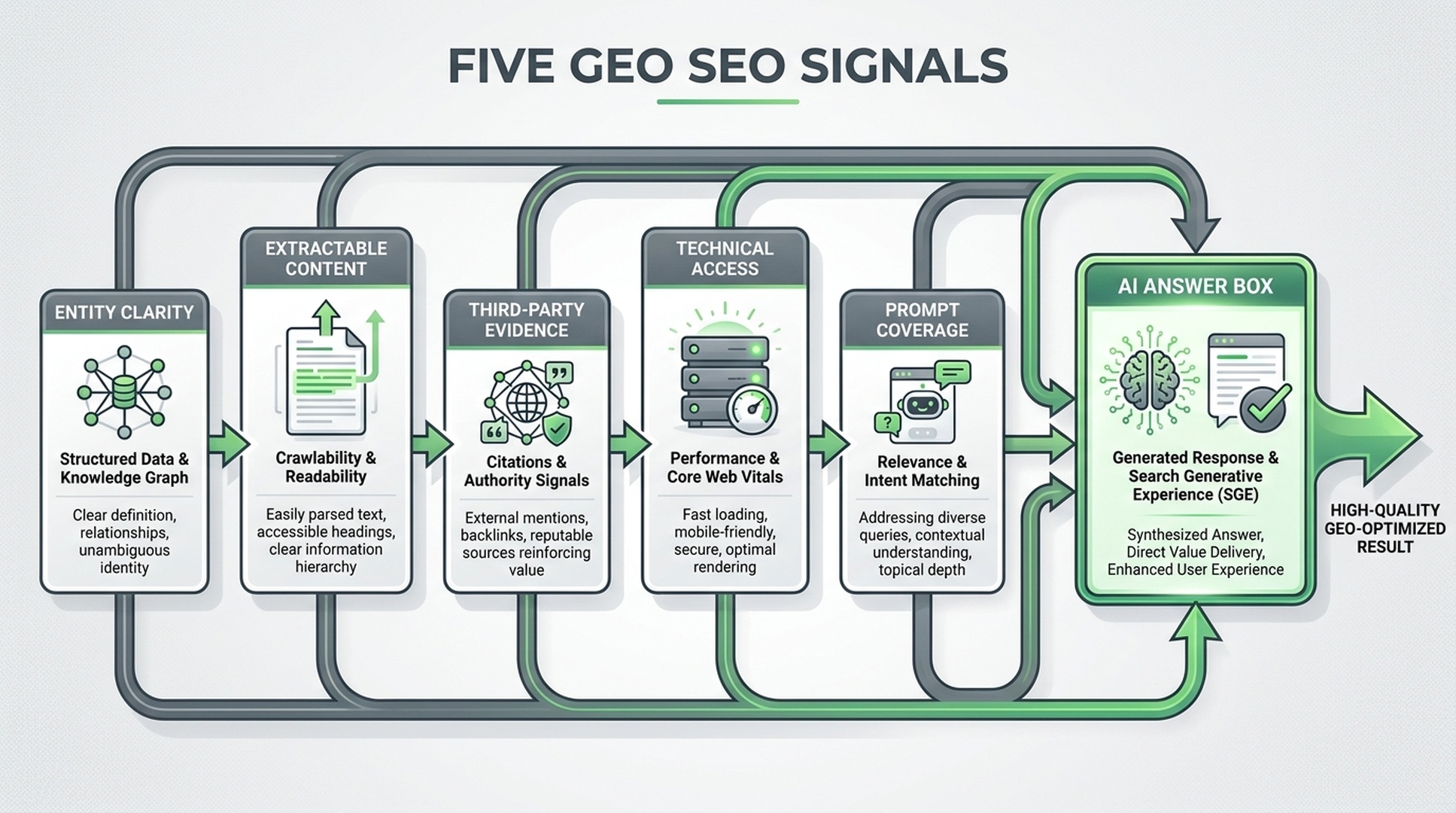
1. entity clarity
AI systems need to know what the brand is.
That sounds obvious, but many websites are vague. Their homepage says they "empower teams" or "unlock growth" without naming the category, audience, use case, or alternative.
A GEO-ready brand description is plain:
Auspia is an AI search visibility platform for teams that want to measure and improve how their brand appears in ChatGPT, Perplexity, Gemini, and Google AI Overviews.
That sentence gives AI systems several useful handles:
- Brand name: Auspia
- Category: AI search visibility platform
- Audience: teams working on AI visibility
- Use case: measure and improve brand appearance in AI answers
- Related surfaces: ChatGPT, Perplexity, Gemini, Google AI Overviews
A weak description creates ambiguity. A clear description creates retrievability.
2. extractable content
AI answer systems work better with content that can be summarized, compared, and quoted.
A beautiful page with vague copy is less useful than a plain page with clean answers.
Strong GEO content includes:
- A direct answer near the top
- Descriptive headings
- Tables for comparisons
- Short definitions
- Named examples
- Product facts
- FAQ sections based on real questions
- Clear internal links to related pages
- Schema when it clarifies the entity or page type
This is why old-school SEO copy often underperforms in AI answers. It may be optimized for a keyword, but not for extraction.
A page that says "the complete platform for the modern growth journey" gives an AI system very little. A page that says "our tool tracks brand mention rate, citation rate, competitor overlap, and answer accuracy across 100 buyer prompts" gives it something to work with.
3. third-party evidence
Your own website can define your brand. It cannot fully verify your brand.
AI recommendations need confidence, and confidence often comes from the wider web.
Useful evidence can include:
Evidence source | Why it helps |
|---|---|
Review platforms | Shows customer language and category fit |
Directories | Confirms basic brand/category facts |
Partner pages | Shows ecosystem relationships |
Case studies | Gives specific use cases and outcomes |
Independent comparisons | Places the brand in a decision set |
Documentation | Proves how the product works |
Interviews and podcasts | Adds named perspective and expertise |
Research or data | Gives AI systems facts worth citing |
This is not a license to spam mentions everywhere. Low-quality mentions can muddy the signal.
The useful question is: if an AI system wanted to verify this brand, what trustworthy sources would it find?
4. technical access
If a page is hard to crawl, render, or parse, it is harder to use as evidence.
Technical checks for GEO SEO include:
Check | Why it matters |
|---|---|
Robots.txt | Important pages should not be accidentally blocked |
Sitemap | Core pages should be discoverable |
Server-rendered content | Main text should exist in readable HTML |
Canonicals | Duplicate pages should not confuse source selection |
Schema | Organization, Product, Article, FAQ, and Breadcrumb markup can clarify meaning |
Internal links | Crawlers need paths to entity, product, and evidence pages |
Page reliability | Intermittent errors weaken retrieval and trust |
You do not need to react to every new crawler name. Start with the boring checks. They usually catch the real problems.
5. prompt coverage
Classic SEO starts with keywords. GEO SEO starts with prompts.
That does not mean you ignore keyword research. It means you translate search demand into the kinds of questions people now ask AI systems.
For example:
Keyword-style query | AI prompt version |
|---|---|
| "How do I get my brand mentioned by ChatGPT?" |
| "How do brands show up in AI search results?" |
| "What tools help track AI search visibility?" |
| "Which project management tool is best for a remote agency with 20 people?" |
| "What are the best HubSpot alternatives for a startup that needs cheaper onboarding?" |
Prompt coverage is the bridge between content strategy and AI visibility.
If your site has no pages answering the questions buyers ask, AI systems have little reason to include you in those answers.
A GEO SEO scorecard for brands
Use this scorecard before writing new content. It will prevent a lot of wasted work.
Area | 0 points | 1 point | 2 points |
|---|---|---|---|
Brand entity | Vague positioning | Category is stated but inconsistent | Clear category, audience, use case, and differentiator |
Core pages | Homepage only | Some product/use-case pages | About, product, use-case, comparison, FAQ, and evidence pages |
Extractability | Long generic copy | Some useful sections | Clear answers, tables, examples, and FAQs |
Third-party evidence | Few credible mentions | Some directories or reviews | Multiple trusted sources confirm category and claims |
Technical access | Crawl/rendering issues | Mostly accessible | Crawlable, linked, structured, and reliable |
Prompt tracking | No prompt set | Ad hoc checks | Tracked prompts, competitors, mentions, citations, and accuracy |
Score each area from 0 to 2.
- 0-4: Start with entity clarity and technical access.
- 5-8: Build answer assets and third-party evidence.
- 9-12: Start measuring prompt-level visibility and competitor overlap.
Most teams want to start with content. The scorecard often says otherwise. If the brand entity is unclear, more content just creates more unclear content.
What to publish first
A GEO SEO content plan should not start with 50 blog posts.
Start with pages that help AI systems classify, compare, and verify the brand.
Priority | Page or asset | Why it matters |
|---|---|---|
1 | About page | Defines the brand entity |
2 | Category page | Connects the brand to the market language |
3 | Use-case pages | Maps the brand to specific buyer problems |
4 | Comparison pages | Helps AI systems explain tradeoffs |
5 | FAQ or glossary pages | Makes definitions and answers extractable |
6 | Case studies | Adds evidence and specificity |
7 | Third-party profiles | Supports verification outside your own site |
If you are working on ChatGPT visibility specifically, read the companion guide: ChatGPT SEO: How to Get Your Brand Mentioned by ChatGPT.
How to measure GEO SEO
Rank tracking is not enough.
A GEO SEO dashboard needs to track whether AI systems actually include your brand when the prompt matches your category, use case, or buyer decision.
Measure these fields:
Metric | What it tells you |
|---|---|
Brand mention rate | How often your brand appears across a prompt set |
Citation rate | Whether your pages or third-party sources are cited |
Competitor overlap | Which brands appear instead of you |
Answer accuracy | Whether the system describes your brand correctly |
Source mix | Which sources AI answers rely on |
Prompt coverage | Which buyer questions include or exclude your brand |
Sentiment | Whether the answer frames your brand positively, neutrally, or negatively |
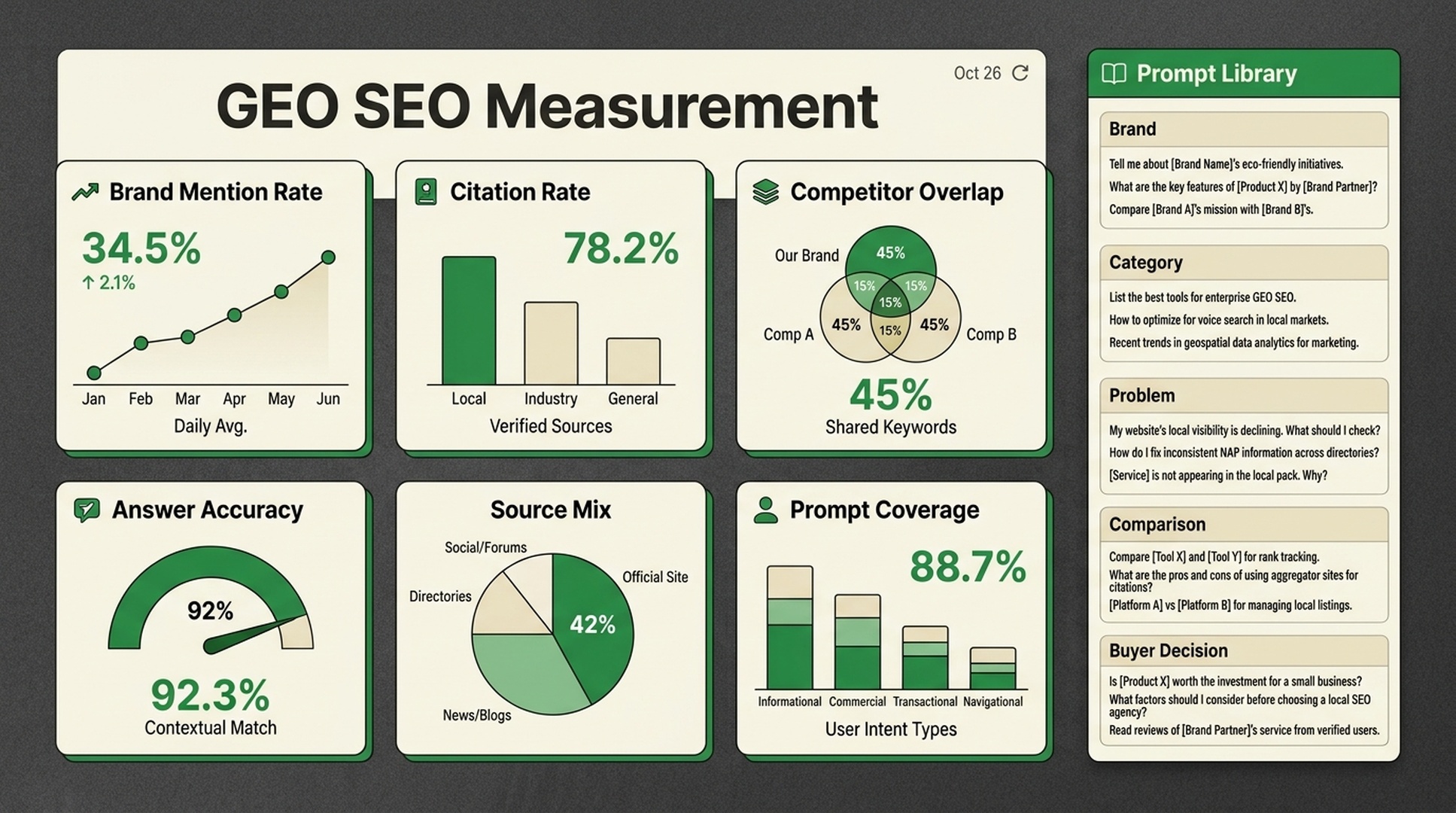
A single screenshot is not a measurement system. AI answers vary by model, date, location, login state, prompt wording, and retrieval mode.
Track a prompt library over time instead.
Start with 25 prompts:
- 5 brand prompts
- 5 category prompts
- 5 problem prompts
- 5 comparison prompts
- 5 buyer decision prompts
Then review changes every two to four weeks. That cadence is slow enough to avoid overreacting and fast enough to catch movement.
Common GEO SEO mistakes
GEO SEO is new enough that bad advice spreads quickly.
These are the mistakes worth avoiding:
Mistake | Better approach |
|---|---|
Treating GEO as keyword stuffing for AI | Write pages that answer real prompts clearly |
Publishing only blog posts | Fix entity, product, comparison, and evidence pages too |
Ignoring technical access | Make important content crawlable and extractable |
Assuming llms.txt is a magic fix | Treat it as a support file, not the strategy |
Measuring one prompt once | Track a prompt set over time |
Depending only on your own site | Build credible third-party evidence |
Hiding behind vague brand language | Say what the brand is, who it serves, and when to choose it |
The biggest mistake is expecting AI visibility to behave like a ranking position. It rarely does.
You may appear in one prompt and not another. You may be cited by Perplexity but not mentioned by ChatGPT. You may be described correctly in a brand prompt but ignored in a category prompt.
That is normal. GEO SEO is a visibility system, not a single ranking slot.
Auspia view
GEO SEO is best understood as answer eligibility.
Can an AI system identify the brand? Can it connect the brand to the right category? Can it verify the claim? Can it extract a useful answer from the page? Can it compare the brand against alternatives? Can it cite a source with confidence?
If the answer is yes across enough prompts and sources, the brand has a real chance of showing up.
If the answer is no, publishing more generic content will not fix the problem.
The practical path is clear:
- Define the brand entity.
- Make core pages extractable.
- Build third-party evidence.
- Remove technical barriers.
- Track prompt-level visibility.
- Improve the pages and sources AI systems actually use.
That is less glamorous than promising instant AI rankings. It is also more likely to work.
FAQ
What is GEO SEO?
GEO SEO is the process of improving how a brand, product, or content asset appears in AI-generated answers. It focuses on entity clarity, extractable content, third-party evidence, technical access, and prompt-level measurement.
Is GEO SEO the same as generative engine optimization?
They are closely related. Generative engine optimization is the broader practice of optimizing for AI answer systems. GEO SEO is a practical SEO-facing version of that work, especially for teams already managing organic search, content, and technical SEO.
How is GEO SEO different from AI SEO?
AI SEO is often used as a broad umbrella for adapting SEO to AI-driven search. GEO SEO is more specific: it focuses on being mentioned, cited, summarized, compared, or recommended in AI-generated answers.
Can GEO SEO help my brand appear in ChatGPT?
Yes, but it does not guarantee a specific answer. GEO SEO improves the conditions that make brand mentions more likely: clear entity signals, useful pages, credible evidence, accessible content, and prompt tracking.
Do I need new content for GEO SEO?
Sometimes. But many teams should first improve existing pages: About, product, category, use-case, comparison, FAQ, documentation, and evidence pages. New blog posts help only when the underlying brand and evidence signals are clear.
What is the first GEO SEO task for a small team?
Build a 25-prompt visibility baseline. Check whether your brand appears, which competitors appear, which sources are cited, and whether your brand is described accurately. Then fix the biggest entity, content, evidence, or technical gap.
Author: Maya Ellison, 12-Year GEO Strategy Researcher at Auspia. Maya writes about AI search visibility, brand entity clarity, and practical GEO operating systems for growth teams.