Recommendation at a glance
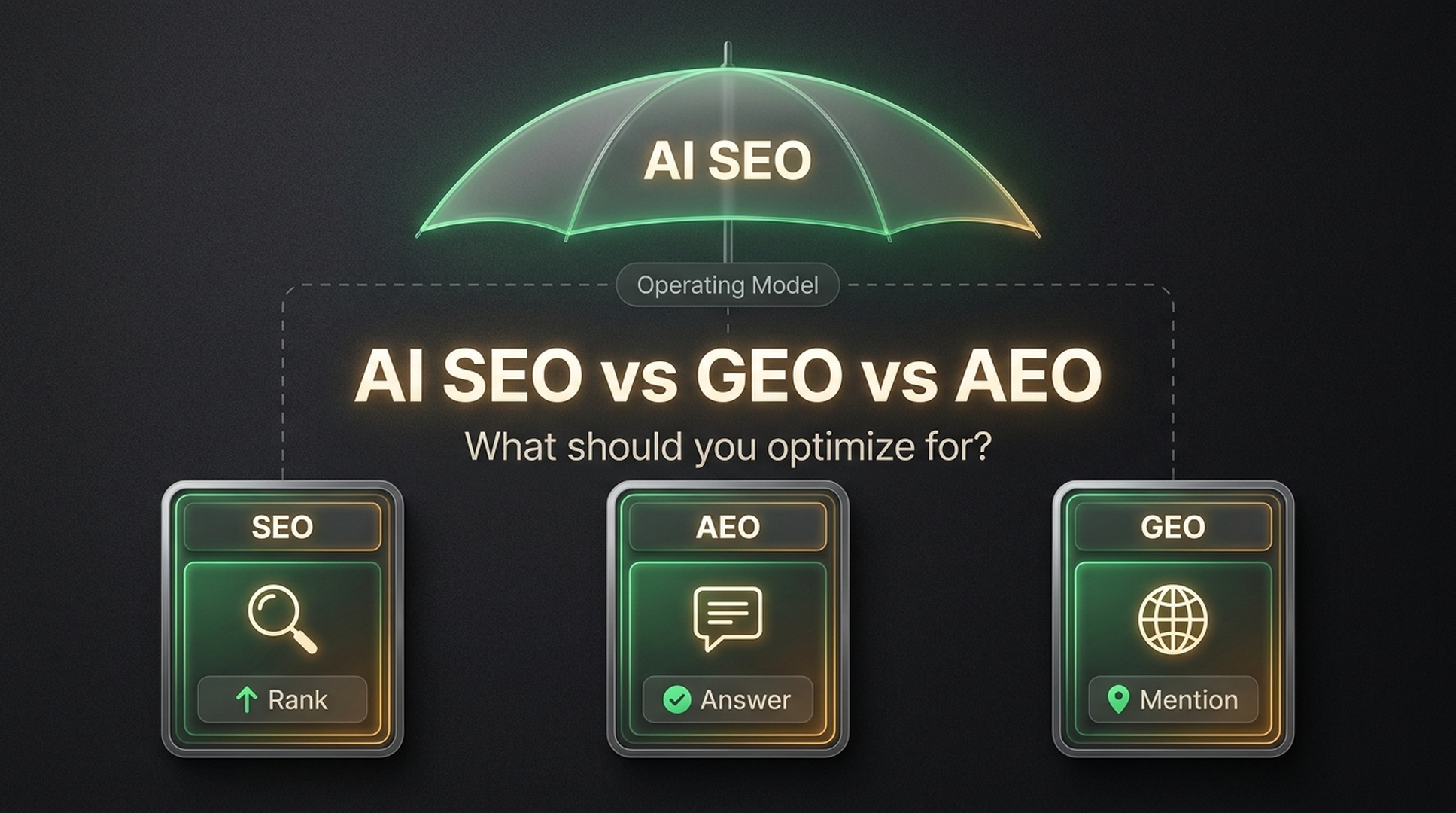
If you are choosing between AI SEO, GEO, and AEO, do not treat them as competing strategies.
Use them as layers.
- Use SEO when you need pages to rank in Google and earn organic traffic.
- Use AEO when you need content to answer questions clearly enough for snippets, answer boxes, and direct responses.
- Use GEO when you need your brand, product, or content to appear in AI-generated answers from systems like ChatGPT, Perplexity, Gemini, and Google AI Overviews.
- Use AI SEO as the umbrella term for adapting organic search work to an AI-assisted discovery environment.
The practical priority is usually this:
Team situation | Start with |
|---|---|
Your site has crawl, indexing, or thin content problems | SEO |
Your content ranks but does not answer questions cleanly | AEO |
Your competitors appear in ChatGPT or AI answers and you do not | GEO |
You need a cross-channel search strategy for 2026 | AI SEO |
Most teams need all four eventually. The mistake is trying to do all four at once without knowing which visibility problem they are solving.
The plain-English difference
These terms overlap because the search market changed faster than the vocabulary.
Here is the clean version.
Term | Plain-English meaning | Main job |
|---|---|---|
SEO | Search engine optimization | Help pages rank and earn clicks from search engines |
AEO | Answer engine optimization | Help content become a clear answer to specific questions |
GEO | Generative engine optimization | Help brands and pages appear in AI-generated answers |
AI SEO | AI-era search optimization | Broad umbrella for SEO, AEO, GEO, and AI-assisted search workflows |
AEO is about answer clarity. GEO is about AI answer inclusion. AI SEO is the broader operating system.
That distinction matters because the deliverables are different.
A blog post can be good SEO but weak AEO if it ranks but buries the answer. A product page can be good SEO but weak GEO if it gets traffic but does not make the brand easy to recommend. A brand can have good AEO snippets but poor GEO visibility if it lacks third-party evidence.
Choose SEO when the page still needs to be found
Traditional SEO is still the foundation.
If Google cannot crawl, index, understand, or trust your page, AI-era visibility becomes harder too.
SEO work includes:
- Technical crawlability
- Indexation
- Site architecture
- Internal links
- Search intent matching
- Content depth
- Topic coverage
- Page speed and stability
- Backlinks and authority
- Titles and meta descriptions
- Structured data where useful
SEO is the right starting point when:
Symptom | What it usually means |
|---|---|
Important pages are not indexed | Technical SEO or crawl/indexing issue |
Pages rank on page 3 or lower | Relevance, authority, or content quality issue |
Google chooses the wrong page | Internal linking, cannibalization, or intent mismatch |
Organic traffic is flat | Weak topic coverage or low authority |
Pages get impressions but few clicks | Title, snippet, positioning, or intent problem |
Do not skip this layer. GEO cannot rescue a site that search systems cannot read.
Choose AEO when the answer is buried
AEO is useful when your content exists but does not answer clearly.
This usually happens when a page has enough words but poor answer structure.
AEO work includes:
- Direct answers near the top
- Definition blocks
- FAQ sections
- How-to steps
- Comparison tables
- Short summaries
- Schema markup where appropriate
- Clear question-led headings
- Concise explanations before deeper detail
AEO is the right starting point when:
Symptom | What it usually means |
|---|---|
You rank but do not win snippets | The answer may be too buried or unclear |
Users ask support-like questions | You need better FAQs and answer pages |
Content is long but hard to scan | The page needs answer blocks, tables, and structure |
AI tools summarize competitors instead | Competitors may have more extractable answers |
Sales teams repeat the same explanations | Your site may not answer buyer questions directly |
AEO is not about making every paragraph short. It is about making the answer easy to extract before the reader gets lost.
Choose GEO when your brand is missing from AI answers
GEO is the right lens when the problem is not only page ranking, but brand inclusion.
You might need GEO if someone asks ChatGPT, Perplexity, or Gemini for recommendations in your category and your competitors appear but you do not.
GEO work includes:
- Brand entity clarity
- Category association
- AI-readable product and use-case pages
- Third-party evidence
- Comparison and alternatives pages
- Prompt tracking
- Citation monitoring
- Source cleanup
- Technical access for important pages
- Consistent facts across the web
GEO is the right starting point when:
Symptom | What it usually means |
|---|---|
ChatGPT recommends competitors but not you | Weak category association or evidence gap |
Perplexity cites third-party pages, not your site | Your pages may be less extractable or less trusted |
AI answers describe your brand incorrectly | Entity facts are inconsistent or outdated |
Your brand appears only when prompted by name | Category prompts do not connect you to the market |
Buyer prompts exclude your brand | You lack comparison, use-case, or evidence assets |
GEO is not a hack for forcing AI systems to mention you. It is a way to make your brand a better answer candidate.
Choose AI SEO when you need the whole operating model
AI SEO is the broadest term. Different teams use it differently, but it usually means search optimization in an environment shaped by AI-generated answers, AI Overviews, conversational search, automated content workflows, and LLM-assisted research.
AI SEO can include:
- Traditional SEO
- AEO
- GEO
- AI Overview optimization
- Prompt research
- Programmatic content workflows
- Content refresh automation
- AI-assisted technical audits
- AI search visibility reporting
- Entity and knowledge graph work
Use AI SEO when the question is strategic:
Strategic question | Why AI SEO fits |
|---|---|
How will AI search affect organic traffic? | It covers SEO, AEO, and GEO together |
Which content should we refresh first? | It can combine traffic, prompt, and citation data |
How do we measure search when clicks decline? | It adds mentions, citations, and answer visibility |
How should the SEO team use AI workflows? | It includes operations and automation |
What should our 2026 search roadmap include? | It connects rankings, answers, and AI discovery |
AI SEO is less useful when it becomes a vague label. It is useful when it gives the team a clear operating model.
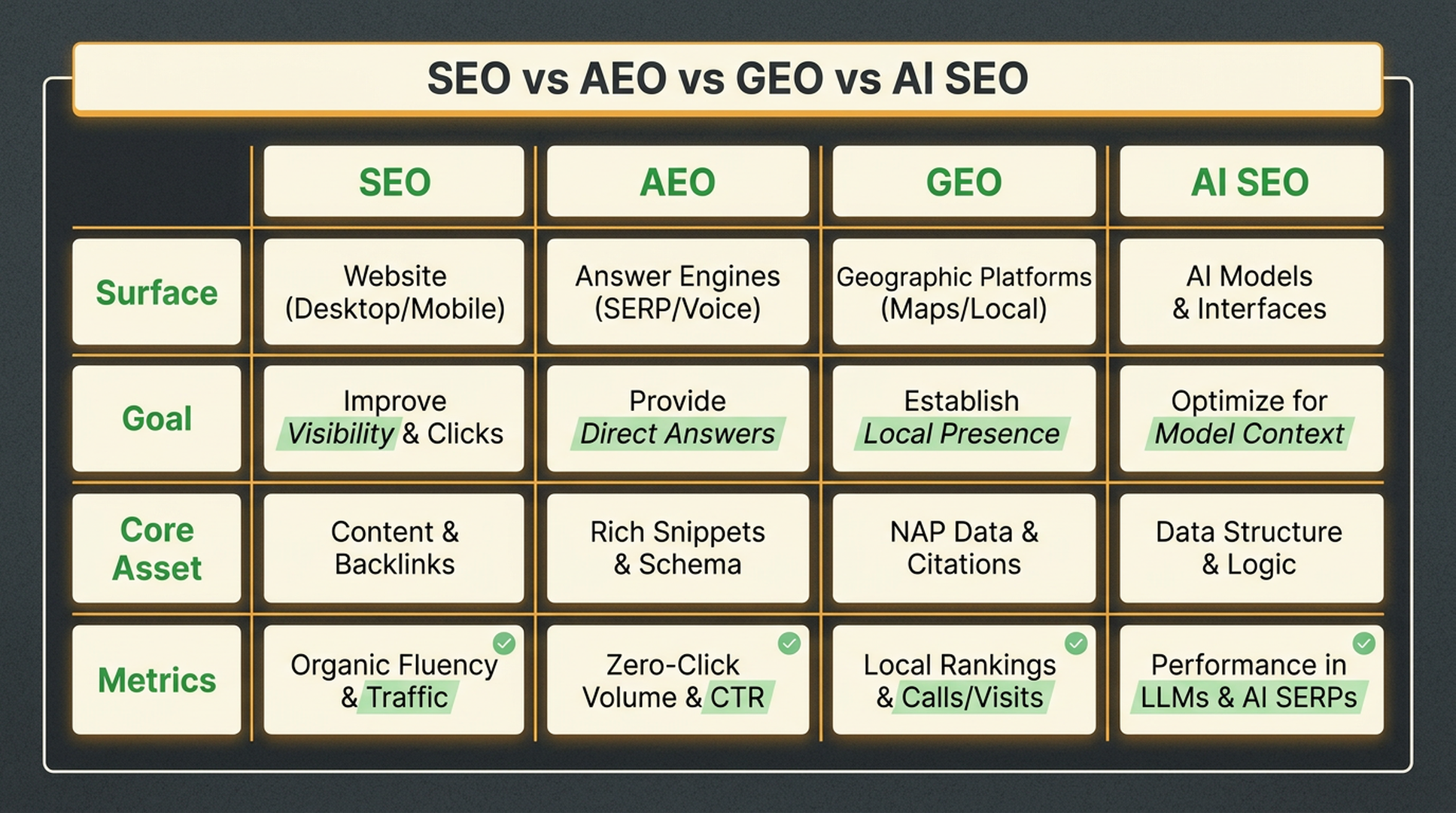
The side-by-side comparison
Use this table when planning content or explaining the difference to stakeholders.
Dimension | SEO | AEO | GEO | AI SEO |
|---|---|---|---|---|
Main surface | Google/Bing search results | Snippets, answer boxes, voice/direct answers | ChatGPT, Perplexity, Gemini, AI Overviews, AI assistants | All AI-influenced search and discovery surfaces |
Main goal | Rank and earn clicks | Be extracted as a clear answer | Be mentioned, cited, compared, or recommended | Build an AI-era organic growth system |
Core unit | Page | Answer | Brand/entity/source | Search program |
Key assets | Landing pages, articles, technical SEO, links | FAQs, definitions, summaries, tables | Entity pages, use-case pages, comparison pages, evidence sources | Workflows, prompt libraries, dashboards, content systems |
Measurement | Rankings, clicks, impressions, CTR | Snippet wins, answer coverage, FAQ performance | Mention rate, citation rate, answer accuracy, competitor overlap | Combined traffic, visibility, citation, and workflow metrics |
Biggest risk | Ranking without conversion | Answering without differentiation | Being invisible in AI recommendations | Using "AI" as a vague label without a plan |
The overlap is real. A strong GEO page often needs SEO fundamentals and AEO structure. A strong AI SEO program usually contains all three.
What to prioritize first
A good priority order depends on the current weakness.
Use this quick decision tree:
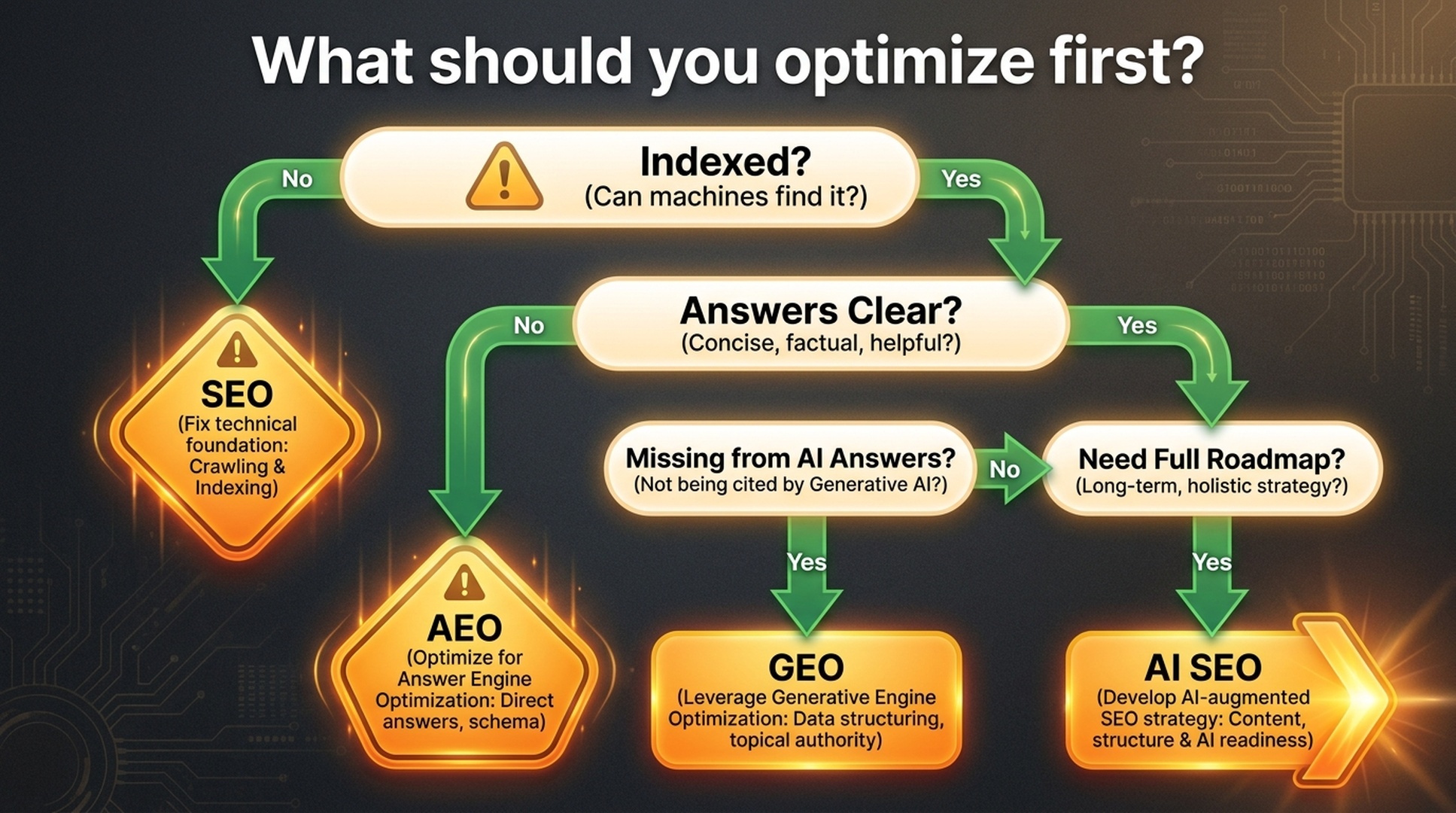
If your site is technically weak, start with SEO
Fix crawlability, indexation, internal links, page quality, and search intent before chasing AI visibility.
GEO depends on accessible pages. AEO depends on clear page structure. Both get harder when the SEO base is broken.
If your pages rank but answers are weak, start with AEO
Rewrite the pages so users and AI systems can find the answer quickly.
Add short answer blocks, tables, examples, FAQs, and schema when it clarifies the page.
If competitors appear in AI answers, start with GEO
Run a prompt baseline. Find which competitors appear, what sources are cited, and how your brand is described.
Then fix the category, evidence, and content gaps.
For a deeper diagnostic, use the companion guide: Why ChatGPT Does Not Recommend Your Brand.
If leadership asks for an AI search roadmap, use AI SEO
Build a roadmap that connects organic traffic, answer visibility, brand mentions, citations, content workflows, and reporting.
This is where AI SEO is useful. It gives executives one umbrella without forcing the team to pretend every tactic is the same.
Example roadmap for a B2B brand
Here is a practical 90-day roadmap.
Timeframe | Focus | Output |
|---|---|---|
Days 1-15 | SEO foundation | Crawl/index audit, internal link fixes, priority page list |
Days 16-30 | AEO cleanup | Rewrite top pages with answer blocks, tables, FAQs |
Days 31-50 | GEO baseline | Prompt library, competitor mentions, citation map |
Days 51-70 | Entity and evidence | About page, product facts, profiles, review/directories, case evidence |
Days 71-90 | AI SEO reporting | Dashboard combining rankings, traffic, mentions, citations, and answer accuracy |
This sequence avoids the common mistake of publishing dozens of AI-themed blog posts before fixing the pages and signals that actually matter.
What each team should own
AI-era search is cross-functional. If no one owns the pieces, the strategy becomes a deck.
Team | Ownership |
|---|---|
SEO | Crawlability, indexing, search intent, internal links, rankings |
Content | Answer structure, topical coverage, examples, FAQs, comparison assets |
Brand | Entity clarity, positioning, consistent language, third-party profiles |
PR or partnerships | Credible mentions, directories, interviews, partner pages, evidence |
Product marketing | Use cases, competitor comparisons, buyer criteria, product facts |
Analytics | Prompt tracking, citation reports, dashboards, traffic impact |
Small teams do not need six departments. But they still need these jobs covered.
Common mistakes
Mistake 1: calling everything AI SEO
The term is useful as an umbrella, but it becomes useless when every tactic gets shoved under it.
Name the specific problem: ranking, answer extraction, AI mention, citation gap, entity confusion, or content workflow.
Mistake 2: doing GEO before fixing entity clarity
If your brand description is vague or inconsistent, AI answer systems have a weak starting point.
Fix the entity first.
Mistake 3: treating AEO as FAQ stuffing
AEO is not adding ten generic FAQs to every page. It is structuring real answers around real user questions.
Mistake 4: measuring only rankings
Rankings still matter, but they do not show whether your brand appears in AI answers.
Add mention rate, citation rate, competitor overlap, and answer accuracy.
Mistake 5: ignoring third-party evidence
Your site can explain your brand. Outside sources help verify it.
GEO gets much harder when the wider web has little credible evidence about your company.
Auspia recommendation
Use this order if you are unsure:
- Fix SEO foundations so pages can be found.
- Add AEO structure so answers can be extracted.
- Build GEO signals so the brand can be mentioned and cited.
- Wrap the work into an AI SEO operating model so the team can measure and repeat it.
That order is not glamorous. It prevents wasted work.
If your brand is already being excluded from ChatGPT-style recommendation prompts, move GEO higher in the queue. If your pages are not indexed, do not start there. Fix the base first.
FAQ
Is AI SEO the same as GEO?
No. AI SEO is a broad umbrella for adapting search strategy to AI-driven discovery. GEO is more specific: it focuses on appearing in generated answers, recommendations, summaries, and citations.
Is AEO still relevant with ChatGPT and AI search?
Yes. AEO helps content become clear and extractable. That makes it useful for snippets, direct answers, and AI-generated answers. GEO often depends on AEO-style structure.
Should I prioritize SEO or GEO first?
If your site has crawl, indexing, or content quality problems, start with SEO. If your SEO base is solid but your brand is missing from AI recommendations, prioritize GEO.
What is the easiest way to start with GEO?
Create a prompt baseline. Test brand, category, problem, comparison, and buyer prompts. Record mentions, competitors, citations, and answer accuracy.
What metrics should AI SEO include?
Use rankings, clicks, impressions, CTR, snippet coverage, brand mention rate, citation rate, competitor overlap, answer accuracy, and prompt coverage.
Can one page support SEO, AEO, and GEO?
Yes. A strong page can rank in search, answer a question clearly, and provide AI systems with extractable facts. The page needs SEO fundamentals, answer-first structure, and credible evidence.
Author: Simon Vale, 11-Year Search Intent Researcher at Auspia. Simon writes about buyer queries, SERP patterns, query mapping, and content alignment across search and AI answer systems.