The practical answer
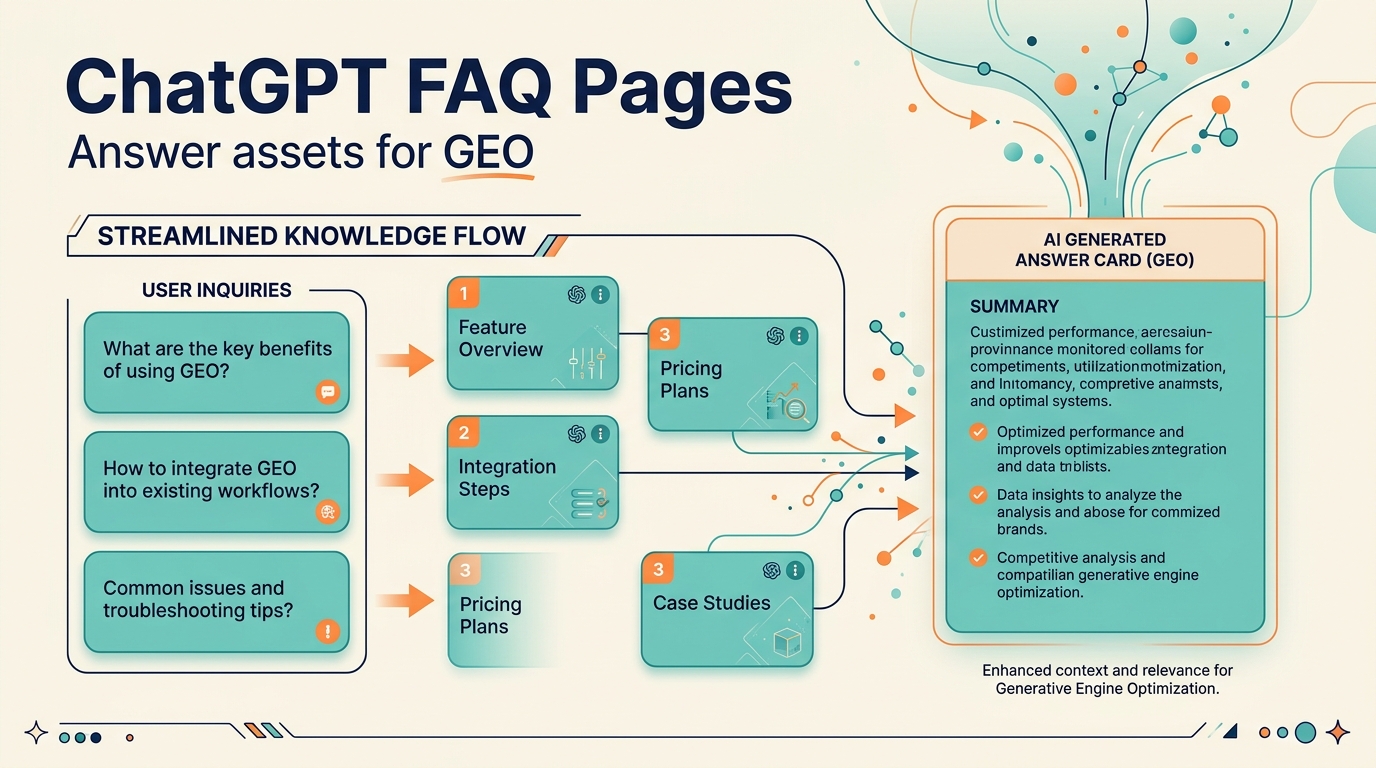
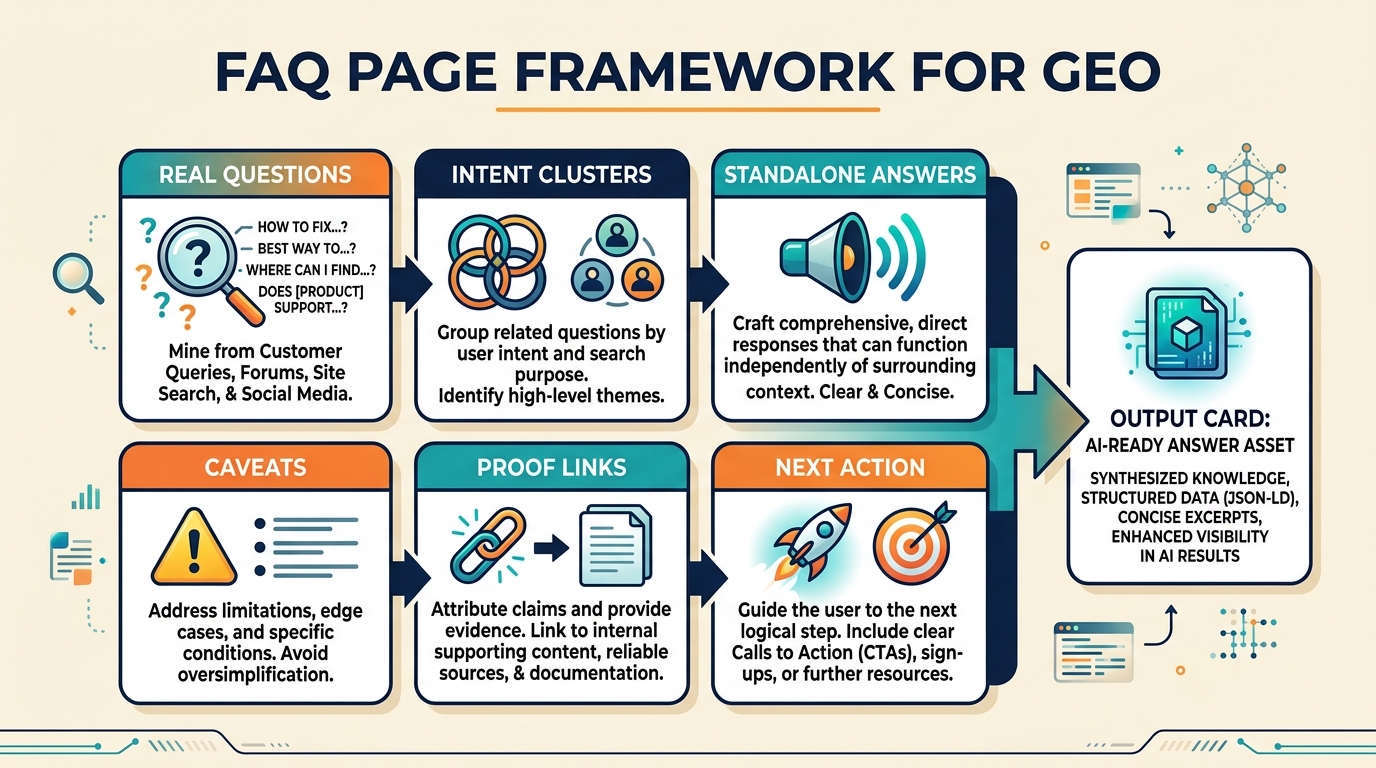
FAQ pages can help ChatGPT GEO when they answer real buyer questions clearly, but they fail when they become a dumping ground for thin, repetitive, keyword-stuffed answers. A strong FAQ page is an answer asset: it groups related questions by intent, gives concise direct answers, adds context where needed, links to deeper proof, and uses language that AI answer systems can extract accurately.
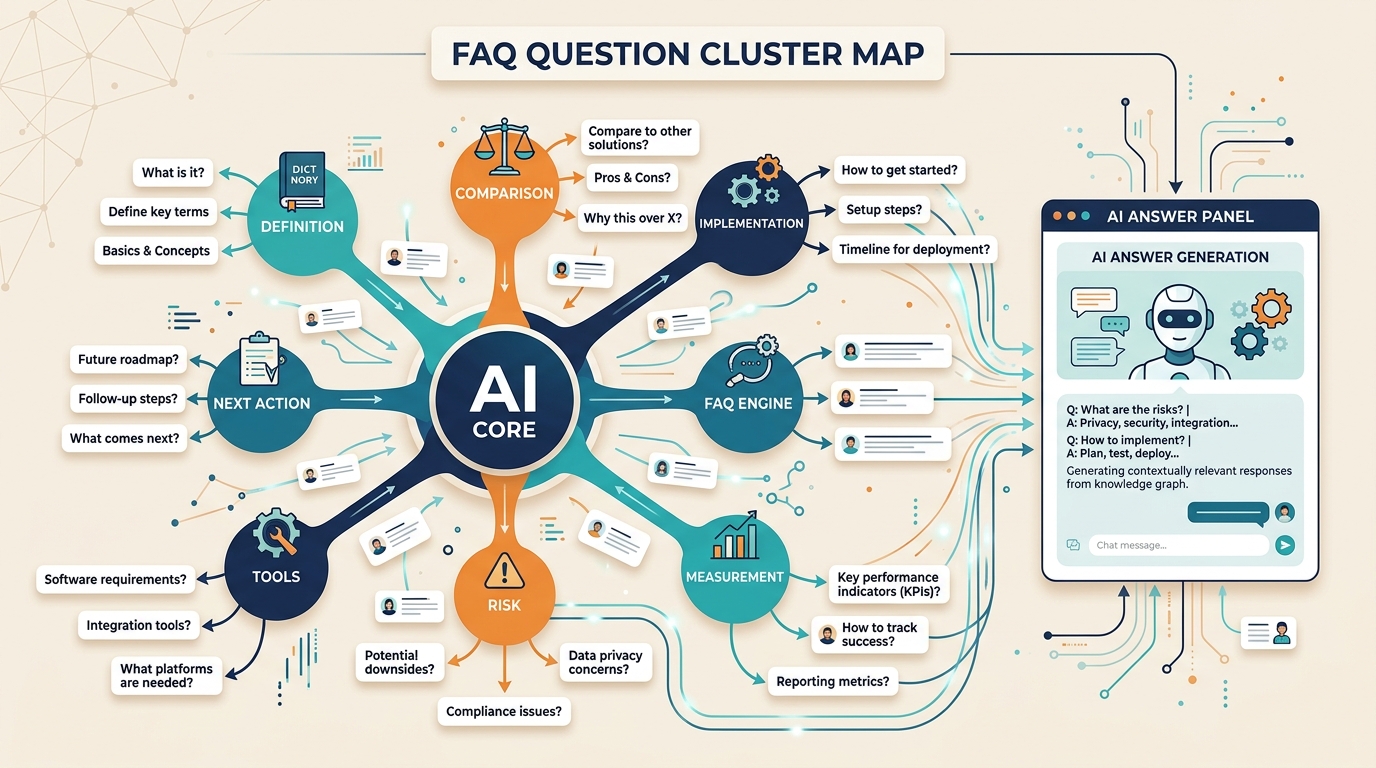
For ChatGPT visibility, FAQs are useful because many prompts are question-shaped. Buyers ask what something is, how it works, which option to choose, how to measure it, what risks exist, and what to do next. A good FAQ page gives AI systems clean source material for those answers.
The goal is not to add FAQs everywhere. The goal is to build question clusters that are useful enough for humans and structured enough for AI answers.
When FAQ pages help GEO
FAQ pages are useful when the questions are real, specific, and connected to a topic or buyer journey.
Good FAQ use cases:
- explaining a new category
- answering objections before a demo
- clarifying pricing or plans
- comparing adjacent solutions
- explaining technical setup
- answering implementation questions
- supporting a product or use-case page
- building an answer hub around a topic cluster
Weak FAQ use cases:
- adding generic questions just to make a page longer
- repeating the same answer with different wording
- targeting keywords without helping the reader
- hiding important content in collapsed sections that are hard to crawl
- using FAQ schema as a shortcut for low-quality content
A useful FAQ page should reduce confusion. If it does not, it probably does not help GEO.
Start with question intent
Group FAQ questions by intent instead of listing them randomly.
A GEO FAQ page might use clusters like:
Intent cluster | Example questions |
|---|---|
Definition | What is GEO? What is ChatGPT SEO? |
Comparison | How is GEO different from SEO? How is AEO different from GEO? |
Implementation | How do I run a GEO audit? How do I build a prompt library? |
Measurement | How do I measure ChatGPT visibility? What score should I track? |
Risk | Can I guarantee ChatGPT citations? What if AI describes my brand incorrectly? |
Tools | What tools help with AI search visibility? Do I need LLMs.txt? |
Next action | What should I fix first? How often should I test prompts? |
Intent clusters help humans scan and help AI systems understand the role of each answer.
Write answers that can stand alone
Each FAQ answer should be understandable without reading the whole page.
Weak:
Yes, it can help a lot depending on your needs.
Stronger:
A GEO audit helps you check whether AI answer systems understand, mention, compare, and recommend your brand for important buyer prompts. It usually includes brand prompts, category prompts, comparison prompts, and evidence checks.
The stronger answer names the topic and gives context. It can be reused more safely in AI answers.
Use the three-layer answer format
For important questions, use three layers:
- Direct answer: one or two sentences
- Context: why it matters or when it applies
- Next action: what the reader should do next
Example:
ChatGPT visibility should usually be measured with a recurring prompt library, not a single manual test. Track whether your brand is absent, described incorrectly, mentioned vaguely, accurately described, or recommended with evidence. Start with 15-25 prompts across brand, category, problem, comparison, and proof questions.
This answer is concise, but not shallow.
Build question clusters from prompts
FAQ strategy should come from real prompts.
Sources for FAQ questions:
- sales calls
- support tickets
- internal search logs
- Google Search Console queries
- People Also Ask results
- forum threads
- competitor pages
- ChatGPT prompt testing
- product onboarding questions
- demo objections
For ChatGPT GEO, prompt testing is especially useful. Run questions that buyers might ask and note what the AI answer gets wrong or leaves out. Turn those gaps into FAQ answers.
Add proof links inside answers
FAQs become more useful when they point to deeper sources.
Examples:
- A definition answer can link to a category guide.
- A measurement answer can link to an audit template.
- A product answer can link to documentation.
- A comparison answer can link to an alternatives page.
- A trust answer can link to a case study or policy page.
Do not overload every answer with links. Use links when they help the reader verify or continue.
Avoid FAQ schema abuse
FAQ schema can be useful when it accurately represents visible FAQ content, but it is not a quality substitute.
Avoid:
- adding schema for questions not visible on the page
- stuffing repeated keywords into every answer
- marking up promotional claims as answers
- using fake questions no reader would ask
- creating dozens of thin FAQ pages with copied answers
The content should be strong even if schema is ignored.
FAQ page structure for GEO
A strong FAQ page can use this structure:
- Short answer explaining what the FAQ covers
- Question clusters by intent
- Concise answers with context
- Tables or checklists where helpful
- Links to deeper proof pages
- Last-updated note when the topic changes
- Clear next action
For example, a ChatGPT GEO FAQ could link to a 30-minute audit guide, a GEO content brief template, an LLMs.txt guide, and a product page. The FAQ becomes a hub, not an isolated page.
What to include in answers
Use this answer checklist.
Element | Why it helps |
|---|---|
Specific topic name | prevents vague extraction |
Direct answer | gives AI systems a clean summary |
Scope or caveat | avoids overclaiming |
Example | makes the answer concrete |
Next action | helps humans continue |
Related link | connects the source cluster |
Not every answer needs every element. But every answer should be useful on its own.
What not to include
Avoid:
- empty yes/no answers
- repetitive paragraphs
- unsupported guarantees
- brand-heavy answers that ignore the question
- answers that repeat the question without adding value
- questions copied from tools without editorial review
- long answers that should be separate articles
If an answer needs more than 300-400 words, it may deserve its own page.
A GEO FAQ quality checklist
Before publishing, check:
Check | Pass? |
|---|---|
Questions come from real buyer/search/prompt data | |
Questions are grouped by intent | |
Answers can stand alone | |
Important answers include caveats or examples | |
Claims are supported or linked to proof | |
FAQ schema, if used, matches visible content | |
The page avoids repetitive keyword stuffing | |
Deeper resources are linked naturally | |
The page has a clear next action | |
Outdated answers have been removed or updated |
How to measure FAQ impact
Measure both search and AI outcomes.
For search:
- impressions for question queries
- clicks from long-tail queries
- engagement on FAQ sections
- internal link clicks to deeper pages
- assisted conversions
For ChatGPT GEO:
- whether AI answers use your phrasing or framework
- whether answer accuracy improves for target questions
- whether wrong descriptions decrease
- whether the page appears as a source where citations are visible
- whether related pages gain visibility in prompt tests
FAQ pages often support a cluster rather than acting alone. Measure them as part of the topic system.
Common mistakes
Mistake 1: adding FAQs only for SEO
If the questions are not useful to readers, they are unlikely to be useful for GEO.
Mistake 2: writing answers that depend on hidden context
Each answer should name the subject and give enough context to stand alone.
Mistake 3: making the FAQ too broad
A page that answers every possible question about AI, SEO, GEO, tools, pricing, and strategy may become too unfocused.
Mistake 4: skipping links to proof
Answers are stronger when they connect to examples, docs, templates, or case studies.
Mistake 5: never updating the page
AI search topics change quickly. Review strategic FAQ pages when products, platforms, or recommendations change.
FAQ
Are FAQ pages good for ChatGPT GEO?
Yes, when they answer real questions clearly and connect to deeper sources. FAQ pages can create structured answer assets for definition, comparison, implementation, measurement, and risk prompts.
Should every blog post include an FAQ?
No. Add FAQs only when there are real follow-up questions. Some articles are better served by a table, checklist, workflow, or example section.
How many questions should a GEO FAQ page include?
Start with 10-25 strong questions grouped by intent. Quality matters more than volume. If the page grows too large, split it into topic-specific pages.
Does FAQ schema help ChatGPT visibility?
FAQ schema can help search engines understand visible FAQ content, but it does not guarantee ChatGPT visibility. The answers still need to be clear, useful, and supported.
Where should FAQ pages link?
Link to deeper pages that help the reader continue: category guides, audit workflows, templates, product docs, comparison pages, case studies, and tools.
Author: Nora Whitfield, AEO Specialist for 800+ Answer Patterns at Auspia. Nora writes about answer engine optimization, extractable summaries, FAQ design, and content that answers questions clearly.