The practical answer
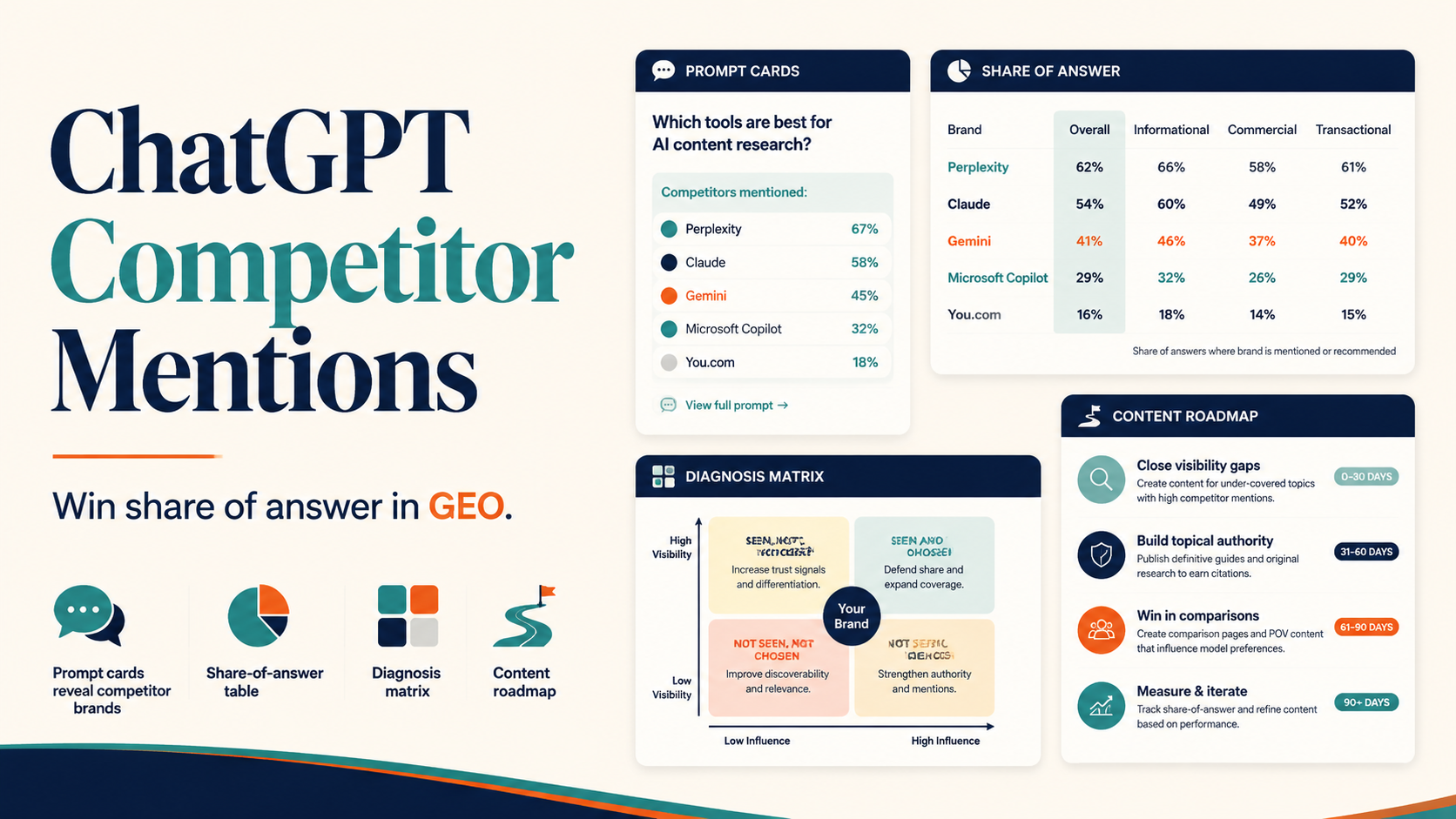
Competitor mentions in ChatGPT are not just a vanity metric. They show which brands an AI answer system considers relevant for a prompt, how your market is being framed, and where your brand is missing from the answer set. If competitors appear in category, problem, or alternatives prompts while you do not, you have a share-of-answer gap.
To improve, do not try to manipulate one answer. Build better category pages, comparison content, use-case pages, evidence assets, and third-party references that explain when your brand belongs in the same recommendation set.
The goal is to move from "competitors dominate the answer" to "our brand appears accurately in the right prompts with clear context."
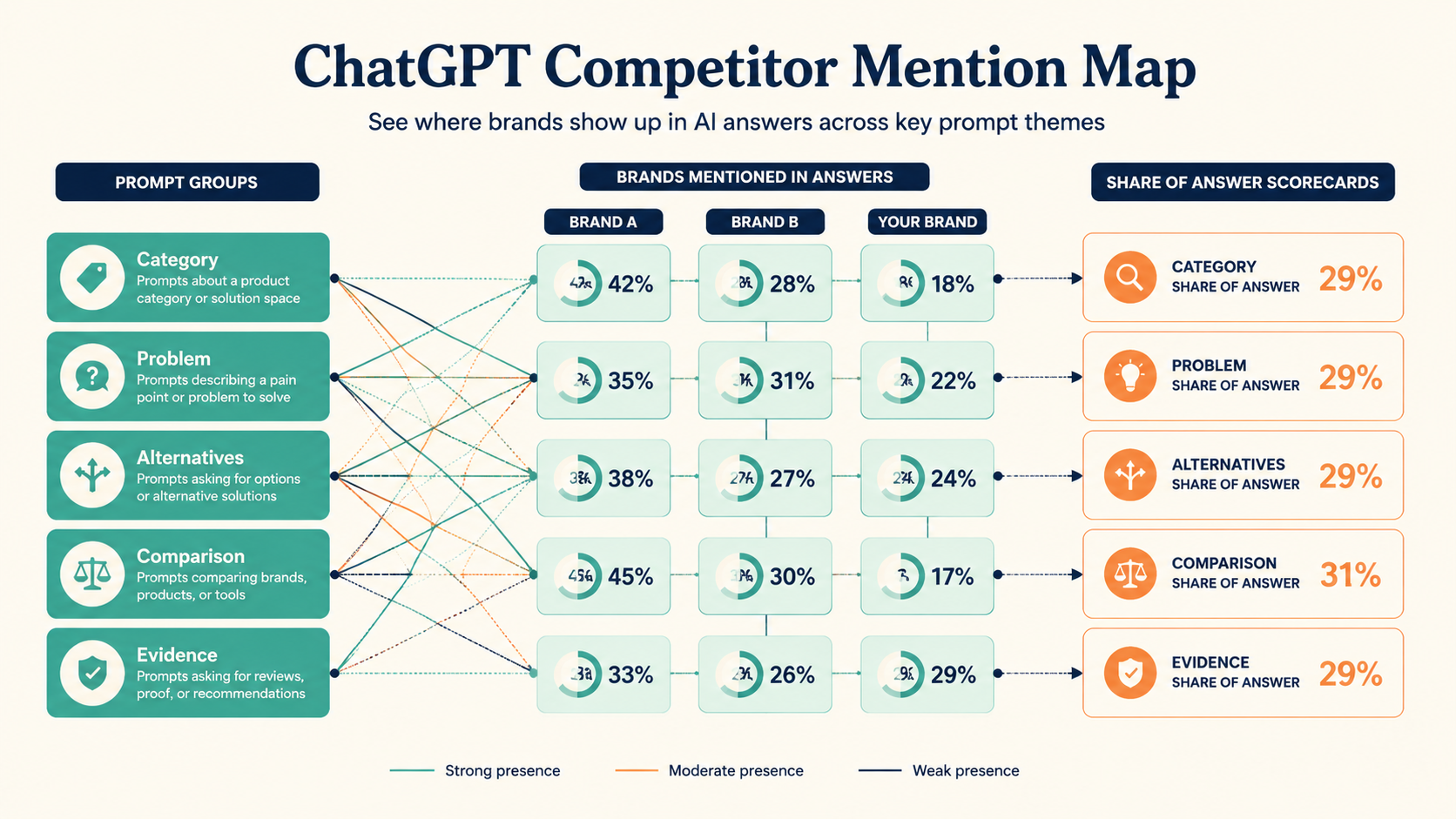
What competitor mentions reveal
When ChatGPT mentions competitors, it gives you clues about the market map it is using.
Look at:
- which competitors appear repeatedly
- which categories they are associated with
- which use cases trigger them
- how their strengths are described
- whether your brand appears with them
- whether the answer uses outdated or incorrect comparisons
- which proof points or sources are visible, if citations appear
Competitor mentions help answer a strategic question:
What does AI think this category looks like, and are we part of that map?
That is why share of answer matters.
Build a competitor prompt set
Start with a stable prompt set. Do not rely on one query.
Use five prompt groups:
1. Category prompts
- What are the best tools for [category]?
- Which platforms help with [outcome]?
- What companies should I consider for [category]?
2. Problem prompts
- How do I solve [problem]?
- What tools help with [problem]?
- What is the best way to handle [workflow]?
3. Alternatives prompts
- What are alternatives to [competitor]?
- What tools are similar to [competitor]?
- Which products compete with [competitor]?
4. Comparison prompts
- Compare [your brand] and [competitor].
- Which is better for [use case], [brand] or [competitor]?
- What are the differences between [brand] and [competitor]?
5. Evidence prompts
- What evidence supports [competitor]'s claims?
- What do users say about [competitor]?
- What are the strengths and limitations of [competitor]?
Run these monthly. Keep the core prompts consistent so you can see movement.
Score share of answer
A simple scoring model is enough.
Metric | What to record |
|---|---|
Brand present | whether your brand appears |
Competitor present | which competitors appear |
Position | order in the answer or shortlist |
Description accuracy | whether your brand is described correctly |
Use-case fit | whether the answer matches your target buyer |
Evidence | whether proof, citations, or examples appear |
Sentiment/context | whether the mention is positive, neutral, or cautionary |
You can summarize the prompt set with a share-of-answer table.
Brand | Mentions in 25 prompts | Accurate mentions | Recommended with context | Evidence included |
|---|---|---|---|---|
Your brand | 8 | 6 | 3 | 1 |
Competitor A | 18 | 17 | 12 | 6 |
Competitor B | 14 | 12 | 8 | 4 |
Competitor C | 9 | 8 | 4 | 2 |
This makes the gap visible without overcomplicating the analysis.
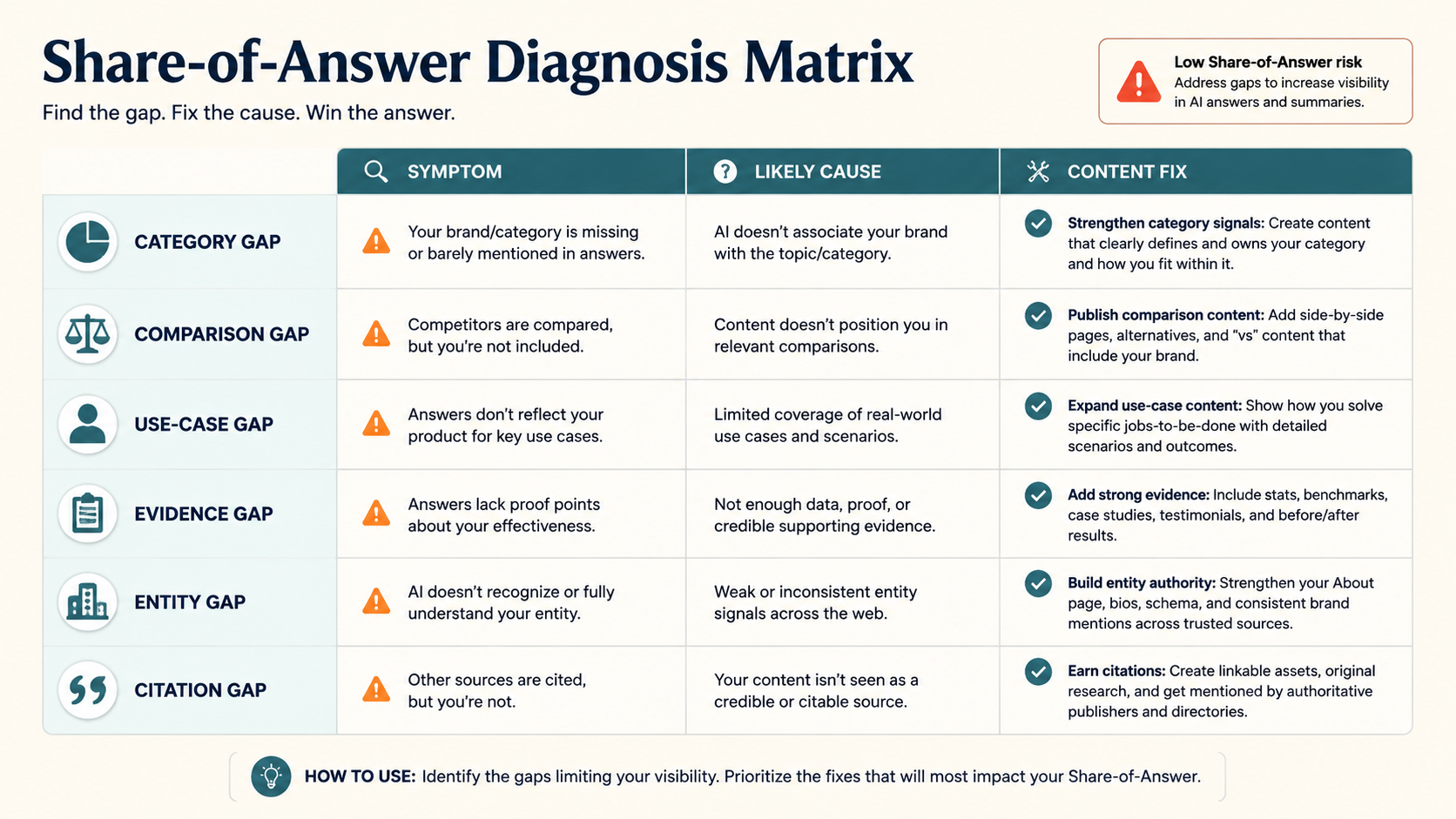
Diagnose why competitors win
Competitors usually win AI answers for one of six reasons.
Pattern | Likely cause | What to build |
|---|---|---|
Competitor appears in category prompts | stronger category association | category page and third-party category references |
Competitor appears in alternatives prompts | stronger comparison footprint | alternatives and comparison pages |
Competitor appears in problem prompts | better use-case content | use-case pages and workflow guides |
Competitor is described with proof | stronger evidence layer | case studies, reviews, benchmarks |
Competitor has clearer positioning | stronger brand entity | brand fact sheet and profile cleanup |
Competitor is cited more often | better source readiness | citation-ready pages and structured evidence |
The fix depends on the pattern. Do not respond to every gap with another blog post.
Build comparison context without sounding defensive
If competitors dominate, many teams rush to publish aggressive comparison pages. That can backfire.
A better approach is fair comparison content:
- what each option is best for
- where the products overlap
- where they differ
- when your product is not the best fit
- which buyer stage or team type each serves
- what evidence supports your claims
- what limitations matter
AI answers tend to need tradeoffs, not slogans. A fair comparison page is more useful source material than a one-sided attack page.
Strengthen the category map
If competitors appear in broad category prompts and you do not, the issue may be category association.
Build or improve:
- category explainer page
- product page with clear category language
- use-case pages tied to the category
- comparison hub
- documentation pages that prove category capabilities
- third-party directory profiles with correct category labels
- review pages that mention real use cases
The goal is to make your brand a normal member of the category answer set.
Create competitor-specific prompt briefs
For each important competitor, create a brief:
Field | Notes |
|---|---|
Competitor | |
Prompts where they appear | |
Prompts where we are absent | |
Strengths ChatGPT mentions | |
Weaknesses or caveats mentioned | |
Sources or evidence visible | |
Our missing content asset | |
Best next page to build |
This turns competitor visibility into a content roadmap.
Use competitor mentions to improve positioning
Competitor prompts can reveal how buyers and AI systems define the category.
If competitors are described as:
- "rank tracking tools"
- "AI search visibility platforms"
- "content optimization tools"
- "brand monitoring tools"
- "technical SEO crawlers"
...then you need to decide which market language you want to own or avoid.
Do not copy competitor positioning blindly. Use the data to sharpen your own category, audience, and differentiators.
What to do in the first 30 days
Week 1: baseline competitor prompts
Run 25 prompts across category, problem, alternatives, comparison, and evidence groups.
Week 2: diagnose gaps
Identify whether you are losing because of category, comparison, use-case, evidence, entity, or citation gaps.
Week 3: build one missing asset
Pick one:
- category page
- alternatives page
- product page rewrite
- use-case page
- case study
- review evidence hub
- citation-ready guide
Week 4: update external profiles and rerun prompts
Update review profiles, directory descriptions, partner pages, and social bios if they use outdated category language. Rerun the prompt set.
Common mistakes
Mistake 1: treating competitor mentions as rankings
AI answers vary. Look for patterns across prompt groups, not a single position in one answer.
Mistake 2: copying competitor content
Use competitor visibility to understand the market map. Do not clone their pages or claims.
Mistake 3: publishing attack pages
Aggressive comparison content can feel less trustworthy than fair fit guidance.
Mistake 4: ignoring why the competitor appears
If the competitor has stronger docs, reviews, and case studies, a new blog post alone may not close the gap.
Mistake 5: measuring only mentions
A mention is not enough. Track accuracy, fit, recommendation context, and evidence.
FAQ
What is share of answer in ChatGPT GEO?
Share of answer is the proportion of target AI prompts where your brand appears compared with competitors. It also considers accuracy, position, recommendation context, and evidence.
Why does ChatGPT mention my competitors but not my brand?
Usually because competitors have stronger category association, comparison content, use-case pages, review signals, third-party evidence, or citation-ready pages. The prompt pattern tells you which gap matters most.
Should I create competitor comparison pages?
Yes, when buyers actually compare you with those competitors. Keep the pages fair, specific, evidence-backed, and focused on fit rather than attacks.
How many competitor prompts should I track?
Start with 20-30 prompts across category, problem, alternatives, comparison, and evidence groups. Add more when you need deeper market coverage.
How often should I measure competitor mentions?
Monthly is a good default. Weekly checks can be useful during a product launch, repositioning, or content sprint.
Author: Theo Langford, Competitive AI Visibility Analyst for 120+ Markets at Auspia. Theo writes about competitor analysis, market maps, share-of-answer checks, and AI search visibility strategy.