The practical answer
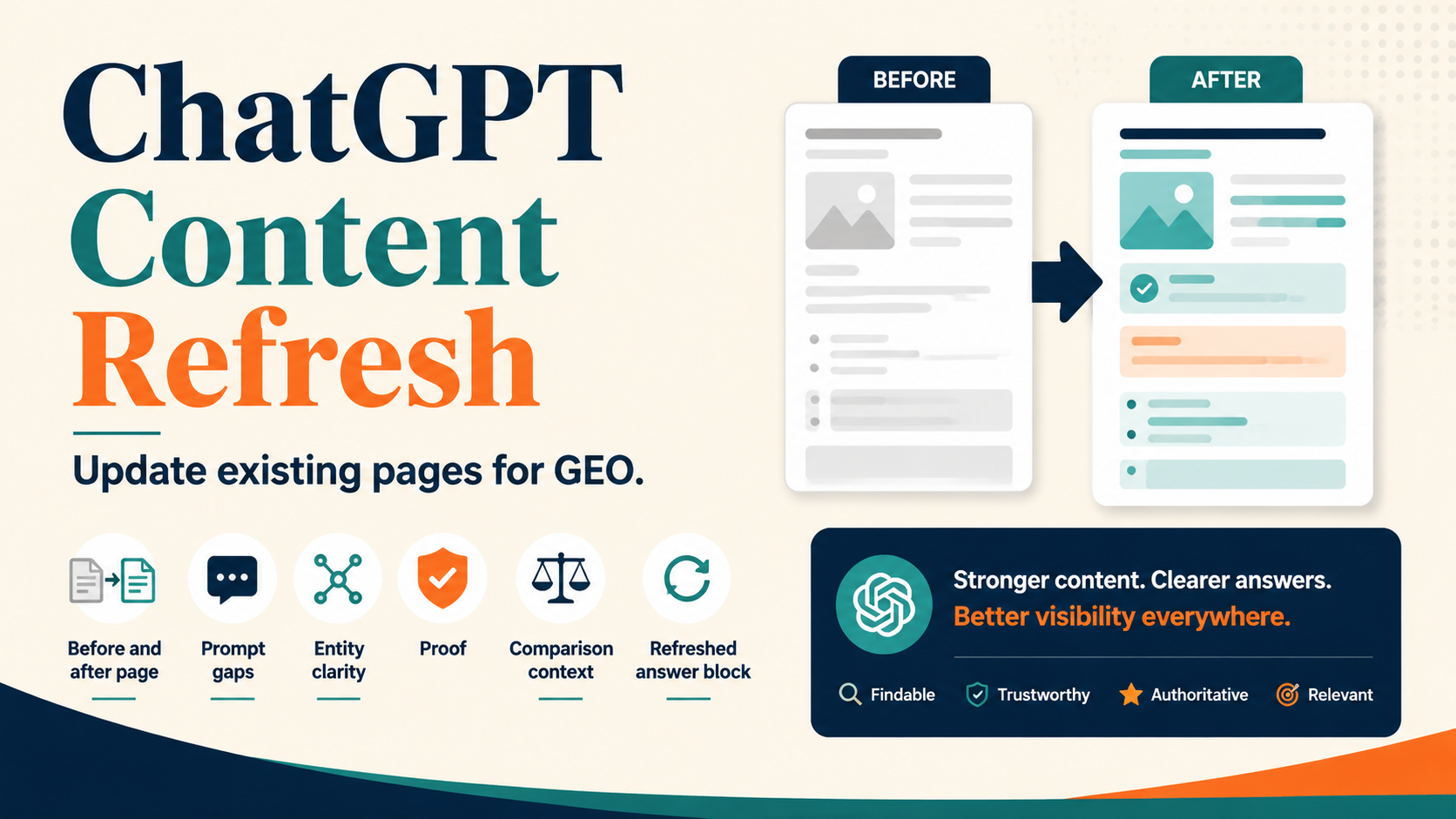
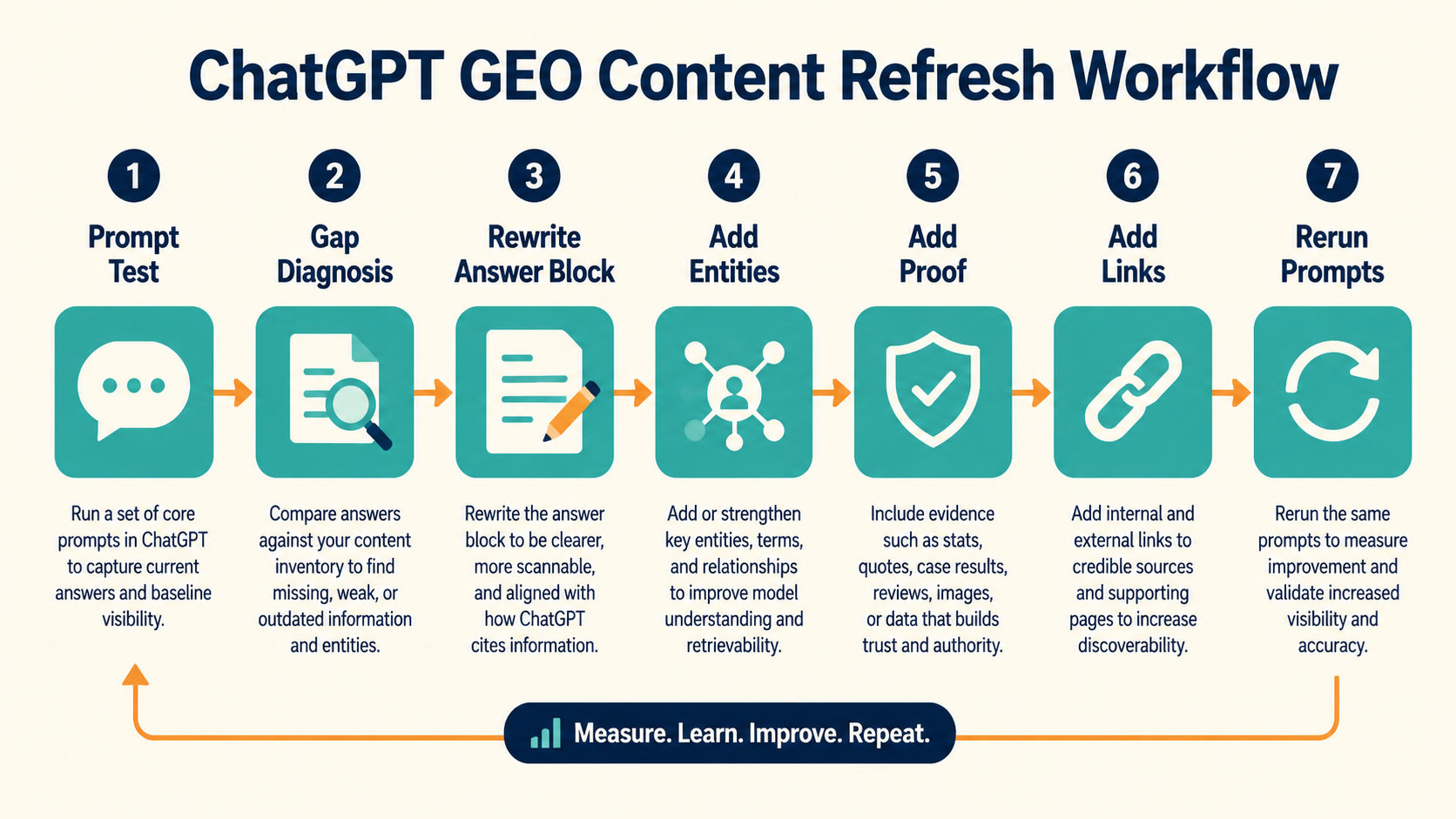
A ChatGPT GEO content refresh updates existing pages so AI answer systems can understand, summarize, compare, and recommend them more accurately. Instead of only adding keywords or changing titles, a GEO refresh improves answer blocks, entity clarity, prompt coverage, evidence, comparison context, internal links, freshness, and crawlable structure.
This is often faster than publishing new pages from scratch. Many sites already have useful articles, product pages, case studies, and guides. They simply are not structured as AI-readable source material.
The best refresh candidates are pages that already rank, already get traffic, or already explain an important topic, but fail ChatGPT prompt tests.
When to refresh instead of create a new page
Refresh an existing page when:
- the topic already exists on your site
- the page has backlinks, rankings, or internal links
- the page answers part of the prompt but lacks clarity
- the page has outdated positioning or examples
- AI answers describe the topic incorrectly
- your brand is missing from relevant prompts despite having a related page
- the page lacks comparison, proof, or next-action sections
Create a new page when:
- the search/prompt intent is clearly different
- the existing page targets a different audience
- the topic deserves its own category, use-case, or comparison page
- the old page is too broad to repair cleanly
GEO refresh work is about intent fit. Do not force one page to serve every prompt.
Start with prompt testing
Before editing, run prompts that the page should support.
Use five groups:
Prompt type | Example |
|---|---|
Definition | What is [topic]? |
Problem | How do I solve [problem]? |
Comparison | How is [topic] different from [related topic]? |
Use case | How should [audience] use [topic]? |
Recommendation | What tools or methods help with [outcome]? |
Record whether the answer:
- mentions your page or brand
- describes the concept accurately
- uses outdated language
- cites competitors instead
- misses a key use case
- lacks evidence or examples
The prompt test tells you what to refresh.
The GEO refresh checklist
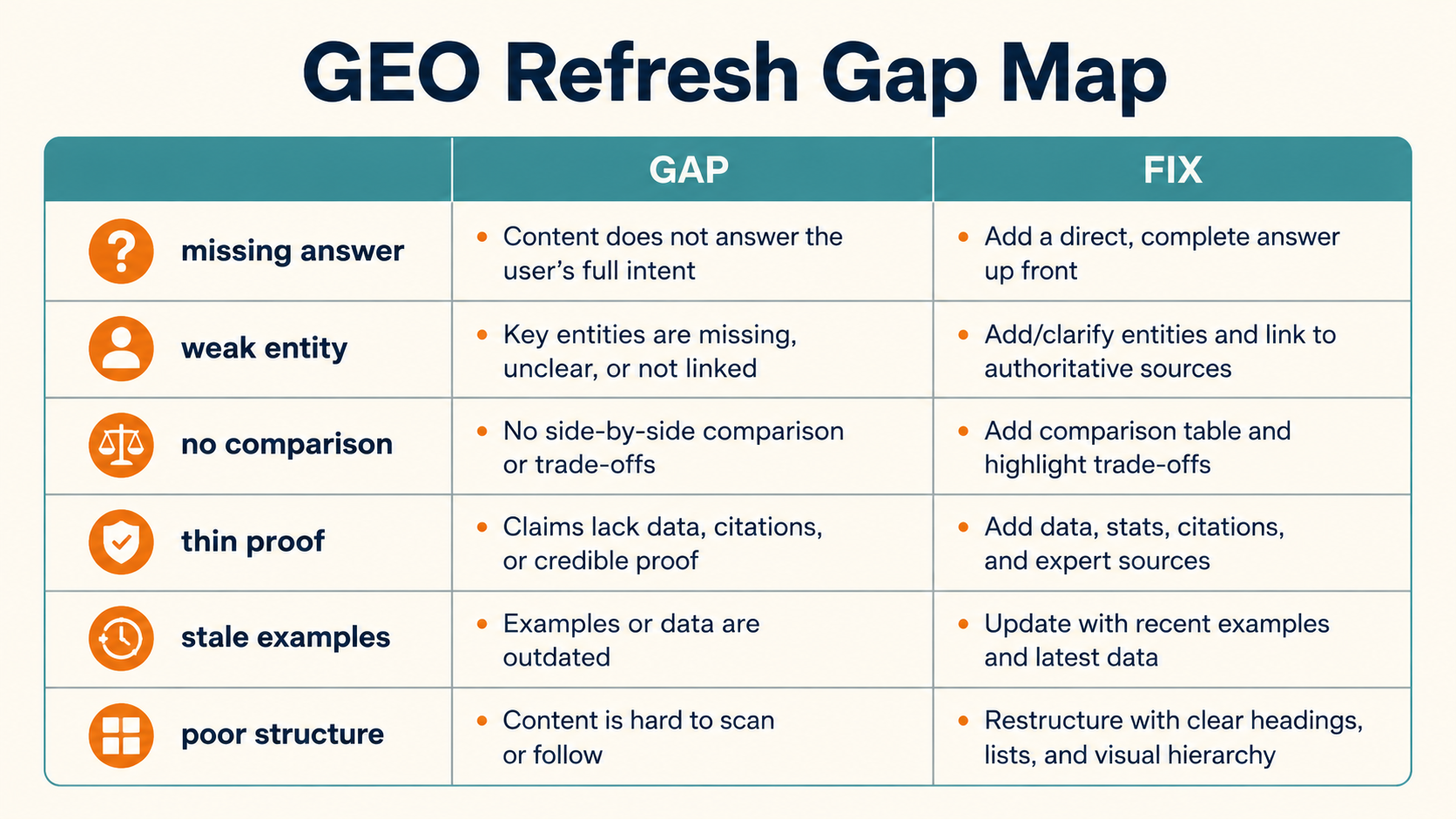
A strong refresh improves the page in seven areas.
Area | What to update |
|---|---|
Answer block | add a direct 3-5 sentence answer near the top |
Entity clarity | name brand, category, audience, competitors, and related concepts clearly |
Prompt coverage | add sections for missing question types |
Comparison context | explain adjacent categories and alternatives |
Evidence | add examples, screenshots, case links, data, or proof blocks |
Structure | add tables, checklists, workflows, or scorecards |
Freshness | update dates, screenshots, examples, links, and claims |
If you only change the title and meta description, you have not done a GEO refresh.
Rewrite the opening answer
Many old pages start with generic introductions. Replace them with a direct answer.
Weak:
The world of AI search is changing quickly, and brands need to adapt to stay ahead.
Stronger:
ChatGPT GEO is the practice of improving how a brand appears in AI-generated answers. It focuses on prompt coverage, brand entity clarity, comparison context, evidence, and answer-ready content. Teams use it to understand whether AI systems mention, describe, cite, or recommend their brand accurately.
The stronger opening gives AI systems source material immediately.
Add missing entities
Refresh the page so important entities are named consistently.
Common entities:
- brand name
- product name
- category
- buyer audience
- competitors
- adjacent categories
- platforms such as ChatGPT, Perplexity, Gemini, Google AI Overviews
- metrics such as presence rate, accuracy rate, evidence rate
- workflows such as prompt library, GEO audit, content brief, entity cleanup
Entity clarity prevents vague or wrong AI summaries.
Add comparison context
Old SEO pages often avoid comparisons. ChatGPT prompts do not.
Add sections that answer:
- how this topic differs from related topics
- when to use this method instead of another
- what alternatives exist
- what this page does not cover
- where the reader should go next
For example, a page about GEO measurement should explain how prompt tracking differs from keyword rank tracking. A page about LLMs.txt should explain how it differs from robots.txt and sitemap.xml.
Add proof close to claims
Refresh weak claims into supported claims.
Weak claim | Better refresh |
|---|---|
"This improves AI visibility" | explain the prompt baseline, scoring model, and measurement loop |
"This is the best approach" | state the fit criteria and limitations |
"Teams use this workflow" | add a template, example, or case-style proof block |
"AI systems can understand your brand" | show entity fields and source cleanup steps |
If you cannot support a claim, soften it.
Improve extractable structure
AI-ready pages are easier to parse when they include structured blocks.
Add:
- tables
- checklists
- numbered workflows
- scorecards
- summary boxes
- before/after examples
- FAQ sections when questions are real
- internal links to deeper proof
A long wall of prose may be readable, but it is harder to use as source material.
Refresh internal links
Internal links should connect the page to your GEO cluster.
Possible links:
- category page
- use-case page
- comparison page
- case study
- FAQ hub
- 30-minute GEO audit guide
- content brief template
- AI search visibility checker
- LLMs.txt or robots.txt technical guide
For example, a refreshed measurement page can naturally link to an AI search visibility checker because the reader's next step is testing prompts.
Update freshness signals
Refresh:
- examples
- screenshots
- product names
- platform names
- dates
- statistics
- broken links
- outdated recommendations
- author/editor notes
- schema markup
- related pages
Do not add a new date without real updates. Freshness should reflect actual improvement.
A 60-minute refresh workflow
Use this for one page.
Minutes 0-10: prompt test
Run 5-10 prompts the page should answer.
Minutes 10-20: gap diagnosis
Mark missing answer blocks, entities, proof, comparisons, and structure.
Minutes 20-40: rewrite core sections
Update the opening answer, add missing sections, and improve tables or examples.
Minutes 40-50: add proof and links
Add evidence, internal links, and caveats.
Minutes 50-60: QA and republish
Check readability, metadata, image alt text, schema, and next action.
Rerun prompts after publishing and again in a later measurement cycle.
How to measure refresh impact
For SEO:
- impressions and clicks
- ranking movement
- CTR
- engagement
- internal link clicks
- conversions
For ChatGPT GEO:
- answer accuracy for target prompts
- brand mention presence
- competitor overlap
- citation or source visibility where available
- use-case association
- reduction in outdated descriptions
A refresh is working if the page becomes a better source, even before traffic changes dramatically.
Common mistakes
Mistake 1: refreshing only for keywords
Keywords matter, but GEO refreshes also need prompts, entities, evidence, and answer structure.
Mistake 2: adding FAQs without real questions
FAQ sections help only when they answer real follow-up questions.
Mistake 3: ignoring comparison prompts
AI answers often compare. Add fair comparison context.
Mistake 4: leaving old claims in place
Old claims can keep AI descriptions wrong. Remove or update them.
Mistake 5: publishing without rerunning prompts
If you do not rerun prompts, you cannot learn whether the refresh helped.
FAQ
What is a GEO content refresh?
A GEO content refresh updates an existing page so AI answer systems can understand, summarize, compare, and reference it more accurately. It improves answer blocks, entities, evidence, structure, comparisons, and freshness.
Is GEO refresh different from SEO refresh?
Yes. SEO refresh often focuses on rankings, keywords, metadata, and topical completeness. GEO refresh adds prompt coverage, entity clarity, answer extractability, evidence, and AI visibility measurement.
Which pages should I refresh first?
Start with pages that already have rankings, backlinks, traffic, or strategic importance but fail ChatGPT prompt tests. Product pages, category pages, comparison pages, and evergreen guides are good candidates.
How often should pages be refreshed for GEO?
Review strategic pages quarterly or when platforms, product positioning, competitor context, or prompt results change significantly.
Can refreshing old pages improve ChatGPT visibility?
It can help when the page becomes clearer, more evidence-backed, and more aligned with real buyer prompts. It is not guaranteed, but it is often faster than creating new pages from scratch.
Author: Elise Morgan, 15-Year Editorial SEO Strategist at Auspia. Elise writes about refreshes, rewrites, content quality, editorial reviews, and AI-readable content improvements.