The practical answer
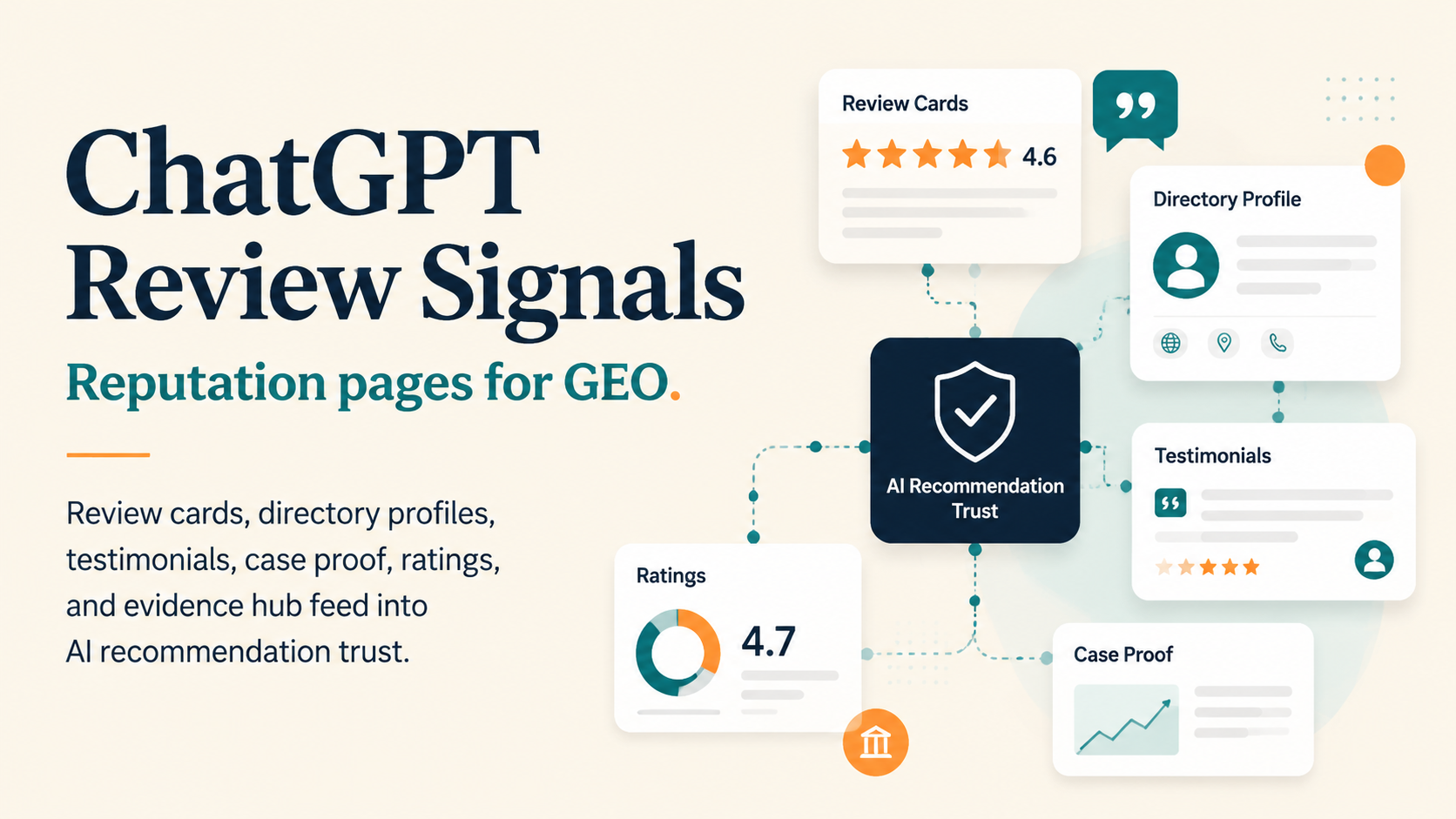
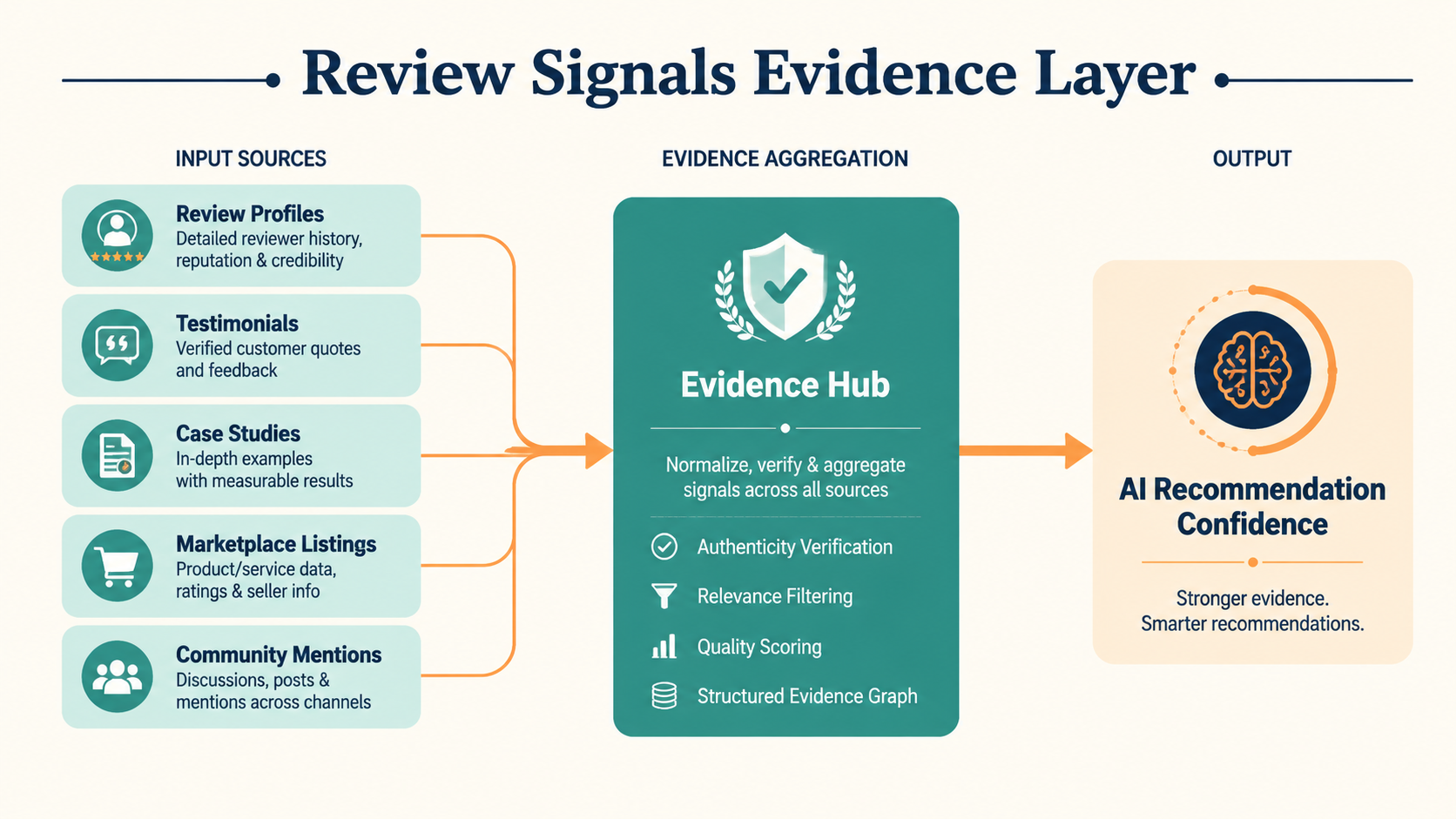
Review signals can support ChatGPT GEO because AI answer systems need public evidence when they describe, compare, or recommend a brand. Reviews, ratings, testimonials, directory profiles, marketplace listings, and reputation pages help show whether a product is real, who uses it, what people value, and where limitations appear.
Reviews do not guarantee ChatGPT visibility. They are one part of the evidence layer. But if your brand has no public feedback, outdated directory profiles, inconsistent category labels, or thin review pages, AI systems may rely on weaker sources or competitor evidence instead.
The goal is not to fake popularity. The goal is to make authentic customer evidence easier to find, summarize, and connect to the right use cases.
Why review signals matter for AI recommendations
Many AI prompts ask for advice that needs trust:
- What tools are best for [use case]?
- Is [brand] reliable?
- What are the strengths and weaknesses of [brand]?
- What do users say about [product]?
- Which alternatives should I consider?
If public review signals are thin or inconsistent, AI answers may have less evidence to support your brand. If review signals are clear and connected to the right category, they can help AI systems understand product fit.
Useful review signals include:
- software directory profiles
- marketplace reviews
- third-party review sites
- customer testimonials
- case study quotes
- public social proof
- partner pages
- app store or extension reviews
- community mentions
- analyst or expert roundups
Not all of these are equal. Relevance, specificity, and consistency matter more than volume alone.
What makes review evidence useful for GEO
Review evidence is GEO-friendly when it answers specific questions.
Question | Useful review signal |
|---|---|
Who uses this product? | reviews that mention team type, role, or industry |
What job does it help with? | reviews that describe workflows or use cases |
What is the product good at? | repeated strengths tied to real features |
What are the limitations? | honest tradeoffs or fit boundaries |
Which category does it belong to? | directory profiles with accurate category labels |
Why should it be trusted? | credible third-party pages and detailed examples |
A vague testimonial like "great platform" is weak. A review that says "our content team uses it to track recurring ChatGPT visibility prompts and prioritize GEO briefs" is much stronger.
Start with a reputation inventory
Before asking for more reviews, audit what already exists.
Create a spreadsheet with:
- source URL
- platform or domain
- review/profile type
- brand name used
- product category used
- audience mentioned
- use case mentioned
- strengths repeated
- limitations repeated
- freshness date
- crawlability
- action needed
Then score each source:
Score | Meaning | Action |
|---|---|---|
0 | missing, inaccurate, or private | fix or ignore |
1 | mentions brand but no useful context | update if possible |
2 | accurate but thin | add details, screenshots, or category clarity |
3 | specific, current, and useful | keep and link where relevant |
This inventory often reveals that the brand has public proof, but it is not organized or worded in a way that supports GEO.
Align review profiles with brand entity language
Directory and review profiles often become stale. They may use old categories, old product descriptions, or generic taglines.
Update profiles so they match your current brand fact sheet:
- official brand name
- product category
- target audience
- key use cases
- supported platforms or integrations
- current screenshots
- proof links
- documentation links
- pricing or plan context when public
Do not keyword-stuff profile text. The goal is clarity.
Example weak profile description:
Auspia is an AI-powered platform for modern growth teams.
Stronger:
Auspia helps SEO, content, and growth teams measure and improve brand visibility in ChatGPT, Google AI Overviews, Perplexity, and other AI answer surfaces through prompt tracking, GEO audits, and content workflows.
This is more useful for humans and AI systems.
Turn testimonials into source material
Testimonials are often written for conversion, not extraction. Make them more useful by adding context.
A strong testimonial block includes:
- who the quote represents
- what problem they had
- what workflow changed
- what result or improvement they observed
- what caveat or context matters
If exact names or metrics cannot be shared, say so clearly. Do not invent specificity.
Weak testimonial | Stronger evidence block |
|---|---|
"Auspia helped us grow." | "A B2B content team used Auspia to build a 30-prompt AI visibility baseline, identify missing category prompts, and prioritize three GEO content updates." |
"Great tool for SEO." | "The team used prompt tracking and entity audits to check whether ChatGPT described the brand accurately after a positioning update." |
The stronger version gives AI answers something concrete to summarize.
Build a review evidence hub
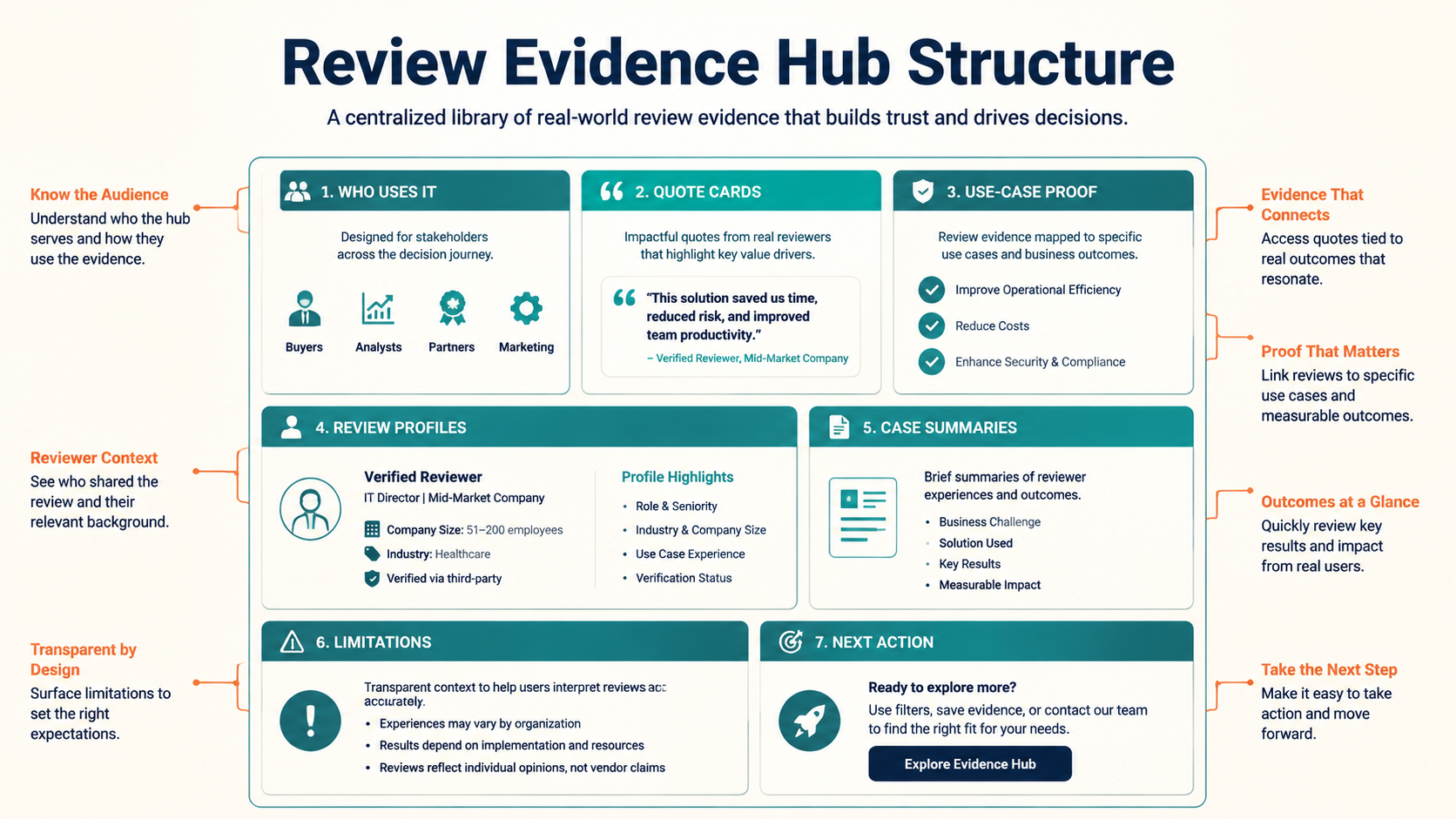
A review evidence hub is a page that organizes customer proof, reviews, testimonials, case studies, and external profiles.
It can include:
- short overview of who the product serves
- customer quote cards
- use-case proof blocks
- links to public review profiles
- case study summaries
- partner or marketplace listings
- screenshots or examples
- limitations or best-fit guidance
This page does not need to be called "reviews." It can be a customer proof page, trust page, evidence page, or customer stories hub.
Connect reviews to use cases
Generic review pages are less useful than use-case-linked proof.
For example:
Use case | Review evidence to highlight |
|---|---|
GEO audit | reviews mentioning prompt checks or visibility baselines |
Content workflow | reviews mentioning briefs, content updates, or editorial planning |
Brand entity repair | reviews mentioning positioning, wrong descriptions, or source cleanup |
Competitor analysis | reviews mentioning market comparison or competitor overlap |
Executive reporting | reviews mentioning dashboards, scorecards, or visibility reports |
This lets AI systems connect reputation evidence to recommendation prompts.
What not to do
Avoid shortcuts that damage trust:
- fake reviews
- review gating that hides negative feedback
- copying the same testimonial across many pages without context
- adding unverifiable claims to review snippets
- creating fake third-party pages
- exaggerating review meaning
- hiding all proof in images or PDFs
- publishing review pages with no crawlable text
AI visibility depends on trust. Manipulative review practices can create legal, platform, and brand risk.
Add review signals to the GEO cluster
Review signals should support other pages.
Link them from:
- product pages
- comparison pages
- use-case pages
- case studies
- category pages
- FAQ pages
- pricing pages
- demo pages
For example, a comparison page that says your product is better for GEO measurement should link to proof: a case study, review profile, or customer evidence block that supports that claim.
A review signal checklist
Before publishing or updating review pages, check:
Check | Pass? |
|---|---|
Review profiles use current category language | |
Testimonials include context, not just praise | |
Review evidence is crawlable as text | |
Customer proof is connected to use cases | |
External review profiles are linked where appropriate | |
Claims are supported by examples or caveats | |
Old product names or taglines are removed | |
Best-fit and limitation language is included | |
Review evidence links to product/use-case pages | |
Nothing looks fake, gated, or overclaimed |
How to measure review signal impact
For SEO:
- traffic to review or trust pages
- branded review query impressions
- comparison query engagement
- assisted conversions
- clicks from review evidence to product pages
For ChatGPT GEO:
- whether AI answers mention strengths that match real reviews
- whether brand descriptions become more specific
- whether recommendation answers include evidence or proof
- whether competitors with stronger review profiles dominate less often
- whether outdated claims disappear after profile updates
Review signals work slowly. Track them as part of the evidence layer, not as a one-day ranking hack.
Common mistakes
Mistake 1: chasing review volume without context
More reviews are not always better if they do not explain who uses the product and why.
Mistake 2: leaving directory profiles outdated
Old category labels can keep showing up in AI summaries.
Mistake 3: treating testimonials as decoration
Testimonials should support specific claims and use cases.
Mistake 4: hiding proof from crawlers
If the best evidence is inside images, PDFs, or gated pages, it may be less useful for AI answers.
Mistake 5: ignoring limitations
Honest limitations improve trust and help AI systems recommend the product in the right context.
FAQ
Do reviews affect ChatGPT GEO?
Reviews can support ChatGPT GEO by providing public evidence about who uses a product, what it does well, and where it fits. They do not guarantee AI recommendations by themselves.
Are third-party reviews better than testimonials?
They serve different roles. Third-party reviews can add independent context, while testimonials and case studies can explain specific workflows. A strong evidence layer usually uses both.
Should I create a reviews page for GEO?
If you have useful customer proof, yes. Build it as an evidence hub with use-case context, review links, testimonials, case summaries, and clear limitations.
What if we do not have many reviews yet?
Start with case-style examples, documented workflows, templates, product proof, and accurate directory profiles. Do not fake review volume.
How often should review profiles be updated?
Review them after product launches, positioning changes, category changes, major feature updates, and at least quarterly for strategic profiles.
Author: Naomi Ellis, Brand Mention Analyst Across 20k+ Visibility Signals at Auspia. Naomi writes about brand mentions, reputation signals, visibility gaps, and evidence quality for AI search.