The short answer
You cannot submit your brand to ChatGPT the way you submit a sitemap to Google.
But you can make your brand much easier for ChatGPT and other AI answer systems to understand, verify, and mention.
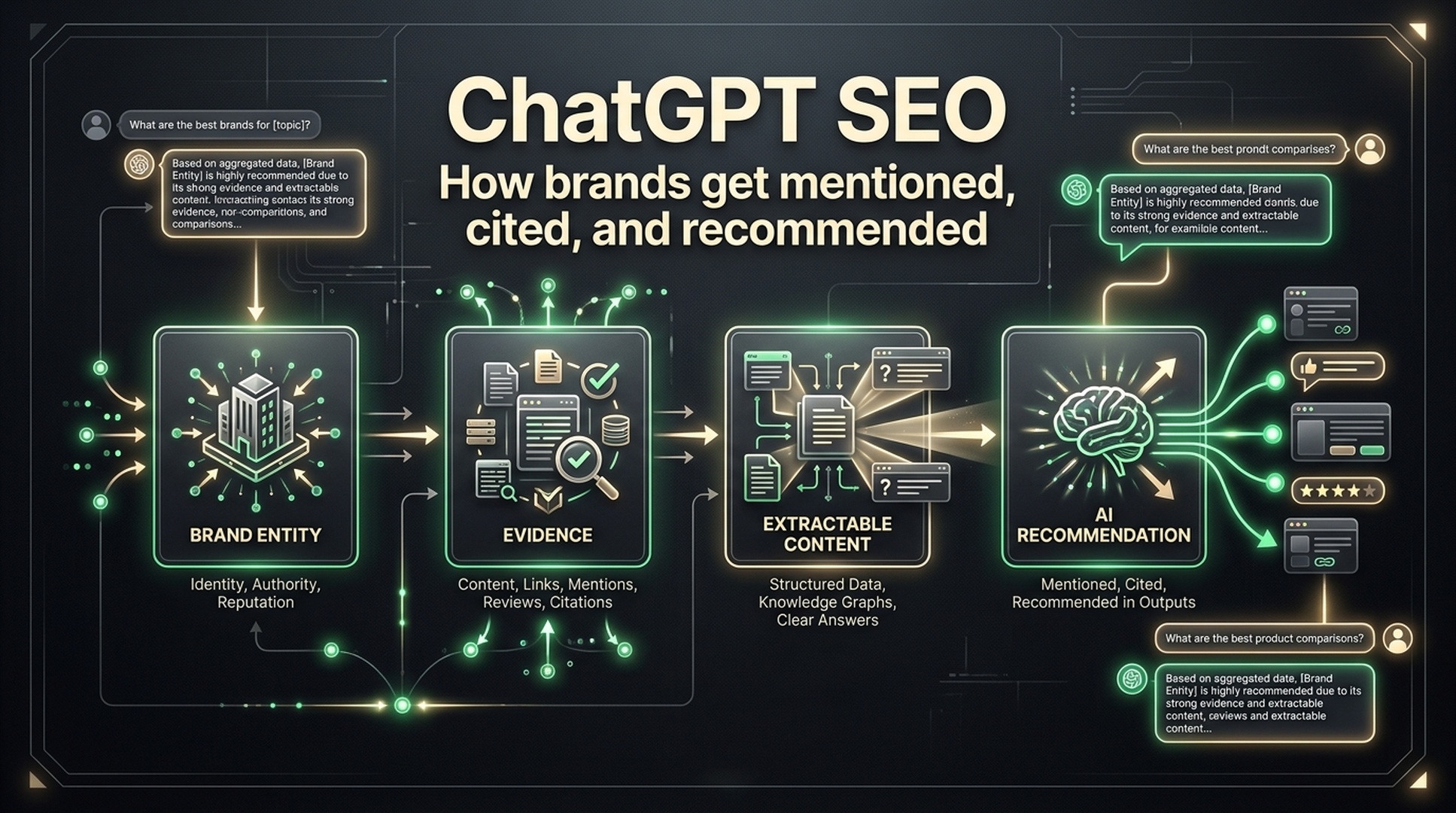
That is the real job of ChatGPT SEO. It is not a trick for forcing your company into AI answers. It is the work of making your brand entity clear, your pages easy to extract, your claims verifiable, and your presence strong enough that AI systems have a reason to include you when users ask for recommendations.
If ChatGPT recommends your competitors but not you, the problem is usually one of five things:
Visibility gap | What it looks like |
|---|---|
Weak brand entity | ChatGPT does not know what category your brand belongs to |
Thin evidence | Your site says you are good, but the wider web does not confirm it |
Generic content | Your pages rank in Google but do not answer buyer questions clearly |
Poor extraction | Important facts are buried in vague copy, JavaScript, or visual-only sections |
No measurement | Nobody tracks which prompts mention your brand, competitors, or pages |
The fix is not one page or one schema field. It is a system.
What ChatGPT needs before it can mention a brand
When someone asks ChatGPT for a product, company, tool, agency, consultant, software category, or recommendation, the answer has to be assembled from available knowledge.
That knowledge may come from model training, web retrieval, cited sources, user context, product integrations, or a mix of those inputs. The exact mechanics vary by surface and mode. Still, the visibility problem is surprisingly practical.
Before an AI system can recommend your brand, it needs to answer a few basic questions:
AI question | Brand-side requirement |
|---|---|
Who is this brand? | Clear brand entity and consistent naming |
What category does it belong to? | Precise category language, not vague positioning |
Who is it for? | Use-case pages, audience pages, and examples |
Why should it be trusted? | Third-party mentions, reviews, directories, case evidence, citations |
How does it compare? | Comparison pages, alternatives pages, and decision criteria |
Can the answer be extracted? | Clear headings, concise summaries, tables, FAQs, and crawlable HTML |
A brand that only has a polished homepage is hard to recommend. A brand with clear category pages, evidence pages, use-case pages, and third-party validation is easier to understand.
This is where traditional SEO and ChatGPT SEO overlap, but they are not the same job.
Traditional SEO | ChatGPT SEO / GEO |
|---|---|
Optimize pages to rank in search results | Optimize entities and evidence to appear in AI answers |
Focus on keywords, links, crawlability, and snippets | Focus on brand clarity, source quality, citations, and answer usefulness |
Measure rankings, clicks, impressions, CTR | Measure prompt visibility, mention rate, citation rate, and answer accuracy |
Win traffic from blue links | Win trust inside recommendations, summaries, and comparisons |
Traditional SEO still matters. If your pages cannot be crawled, indexed, understood, or trusted, AI visibility will be harder. But ChatGPT SEO adds another layer: your brand has to be a good answer, not just a ranking result.
Why brands get ignored by ChatGPT
Most teams assume the problem is "ChatGPT does not know us yet."
Sometimes that is true. More often, the issue is messier. ChatGPT may have weak, outdated, inconsistent, or low-confidence information about the brand. Or it may know the brand exists but choose better-supported competitors when asked for recommendations.
Here are the common patterns.
Symptom | Likely cause | What to fix first |
|---|---|---|
ChatGPT never mentions the brand | Weak entity footprint | About page, category language, third-party profiles |
ChatGPT describes the brand incorrectly | Inconsistent positioning | Brand facts, boilerplate, profiles, schema |
Competitors appear but you do not | Competitors have stronger evidence | Comparison pages, reviews, citations, category pages |
Your blog ranks in Google but is not cited | Content is too generic or hard to extract | Answer blocks, tables, original examples, source clarity |
ChatGPT mentions you only when prompted by name | Weak category association | "Best X for Y" pages, use-case pages, alternative pages |
AI answers cite other sources about your category | Your site does not provide quotable explanations | Definitions, data points, FAQs, examples, glossary pages |
The uncomfortable part: AI visibility is not only about your website.
Your website is the base layer, but ChatGPT-style recommendations are also shaped by what the wider web says about you. If review sites, directories, comparison pages, forums, partner pages, customer stories, and industry sources do not connect your brand to a category, the model has less to work with.
The ChatGPT SEO framework
A practical ChatGPT SEO program has six parts.
Not all six need to be perfect before you see progress. But if one layer is missing, the whole system gets weaker.
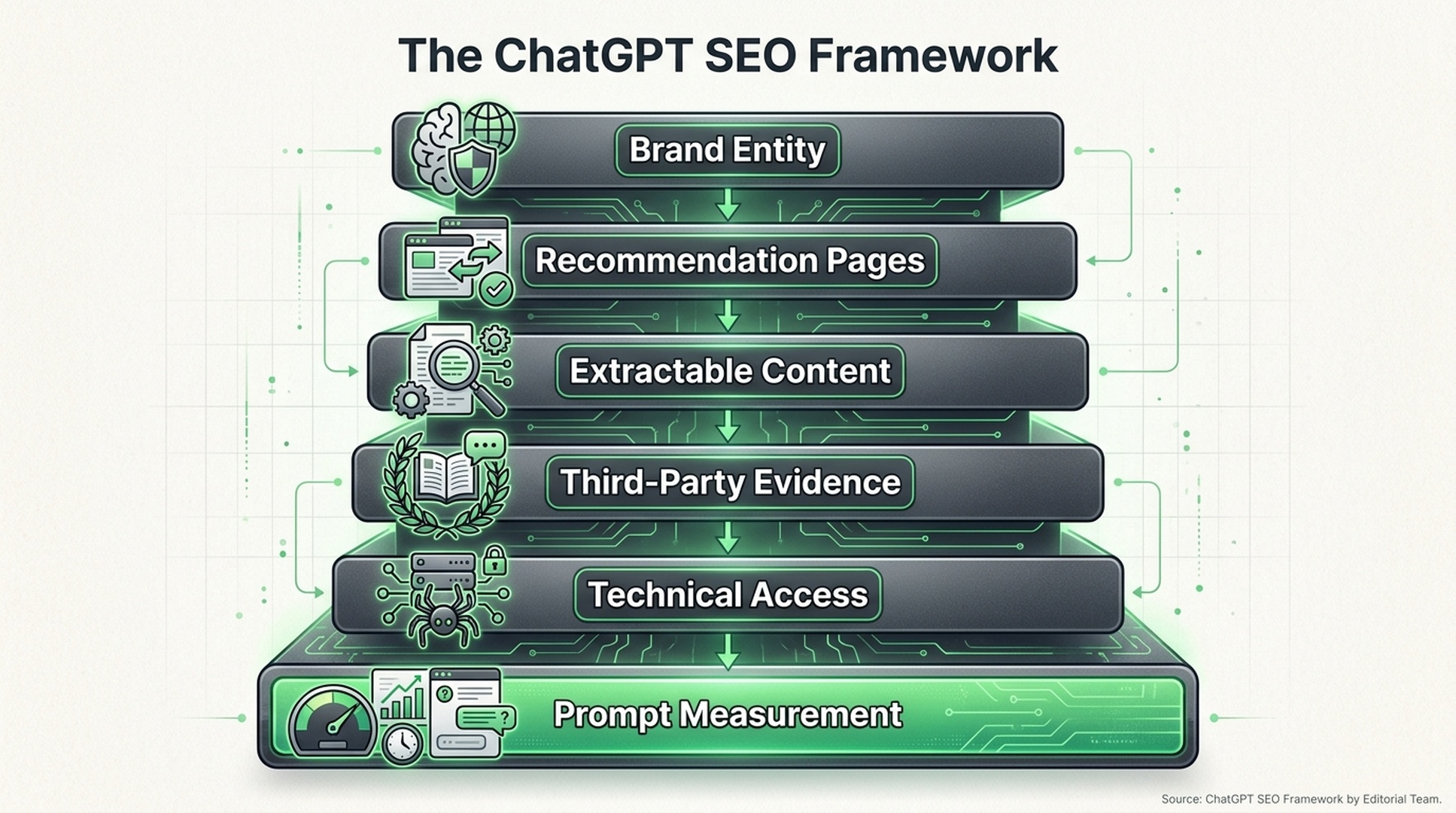
1. define the brand entity clearly
Start with the boring page most teams neglect: the About page.
Not the emotional "we believe in a better future" version. The useful version.
A strong brand entity page should make these facts obvious:
Brand fact | Example answer |
|---|---|
Brand name | Auspia |
Category | AI search visibility and GEO platform |
Primary audience | Growth teams, SEO teams, content teams, and founders |
Core use case | Measuring and improving how a brand appears in ChatGPT, Perplexity, Gemini, and Google AI Overviews |
Differentiator | Prompt tracking, AI visibility audits, GEO content workflows, and technical readiness checks |
Related concepts | GEO, AI SEO, AEO, brand entity optimization, AI search visibility |
You can adapt that format to any brand.
A weak version says:
We help businesses unlock growth with AI-powered innovation.
A stronger version says:
Acme Analytics is a product analytics platform for B2B SaaS teams that need to track activation, retention, and expansion revenue across self-serve and sales-led funnels.
The second version gives AI systems more handles. It names the category, audience, use case, and context. It can be compared. It can be summarized. It can be recommended for a specific situation.
Your brand facts should appear consistently across:
- Homepage
- About page
- Product pages
- LinkedIn company profile
- Crunchbase or relevant directories
- Review sites
- Partner pages
- Press pages
- Author bios
- Schema markup
- Help docs and glossary pages
If every profile describes the company differently, AI systems may still mention you, but the description can drift.
2. build pages that answer recommendation prompts
People do not only ask ChatGPT, "What is Acme?"
They ask things like:
Prompt type | Example prompt |
|---|---|
Recommendation | "What are the best tools for tracking AI search visibility?" |
Comparison | "Auspia vs another GEO tool, which is better for a small team?" |
Use case | "How can a startup check if ChatGPT mentions its brand?" |
Problem | "Why does ChatGPT recommend my competitors but not my company?" |
Category education | "What is GEO SEO and how is it different from SEO?" |
Buying decision | "Which AI SEO tools are worth testing in 2026?" |
If your site only has product-led pages, you miss many of these prompts.
The content set should include:
Page type | Why it helps ChatGPT SEO |
|---|---|
Category page | Connects your brand to the category people ask about |
Use-case page | Shows when your product or service is relevant |
Comparison page | Helps AI systems explain tradeoffs |
Alternatives page | Places your brand inside a competitive set |
Glossary page | Defines the language around your market |
Case study | Adds evidence and specificity |
FAQ page | Gives extractable answers to real questions |
Docs or help pages | Shows how the product works in practice |
The goal is not to create thin pages for every keyword variation. That usually backfires. The goal is to cover the questions a real buyer would ask an AI assistant before choosing a vendor.
3. make your content easy to extract
AI systems do not read your page like a patient human reader with ten minutes to spare.
They need clean, retrievable facts.
That means your pages should include:
- A direct answer near the top
- Descriptive headings
- Short definitions
- Tables for comparisons
- Named examples
- Specific claims with context
- FAQs based on real buyer questions
- Clear product and company facts
- Crawlable HTML text, not only text inside images
- Schema where it helps clarify entities, products, articles, FAQs, and organizations
A useful pattern for AI-readable content is:
Answer first
Explain the context
Show a concrete example
Add decision criteria
List common mistakes
End with a checklist or FAQ
This does not mean every article should look the same. It means each important page should give AI systems something specific to quote, summarize, or compare.
For example, this is weak:
Our platform helps modern teams transform their visibility across the digital ecosystem.
This is stronger:
Auspia helps teams measure how often their brand appears in AI answers across ChatGPT, Perplexity, Gemini, and Google AI Overviews. Teams use it to track prompts, compare competitor visibility, find missing citations, and prioritize GEO fixes.
The stronger version is less glamorous. It is also more useful.
4. earn third-party evidence
This is the part many SEO teams underinvest in.
Your own site can define your brand. Other sources help validate it.
Third-party evidence can include:
Source type | What it can prove |
|---|---|
Review sites | Customer perception and category fit |
Directories | Category membership and basic facts |
Partner pages | Ecosystem relationships |
Case studies | Use cases and outcomes |
Podcasts or interviews | Founder or expert perspective |
Guest posts | Topical authority |
GitHub or docs | Technical credibility |
Industry reports | Market relevance |
Community mentions | Real user language and objections |
This does not mean buying random backlinks or spamming directories. That can create more noise than signal.
The better question is:
If an AI system wanted to verify that our brand belongs in this category, what trustworthy sources would it find?
For a SaaS company, that might mean G2, Capterra, Product Hunt, integrations pages, partner directories, documentation, LinkedIn, comparison articles, and customer stories.
For a service business, it might mean case studies, local directories, industry associations, expert interviews, reviews, and named client use cases where allowed.
For a content brand, it might mean author profiles, cited research, newsletter archives, original data, media references, and topical clusters.
Auspia's view: third-party evidence is becoming part of the AI visibility stack. Not because AI systems simply count mentions, but because recommendations need confidence. A brand that is described consistently across credible sources is easier to trust than a brand that only praises itself.
5. remove technical barriers
Technical SEO still matters in ChatGPT SEO.
If important pages are blocked, rendered poorly, thin, duplicated, or hidden behind scripts, you make the job harder. AI systems and search systems need accessible text.
Check these areas first:
Technical area | What to check |
|---|---|
Robots.txt | Are important pages blocked for search or AI crawlers? |
Sitemap | Are core entity, product, category, and content pages included? |
Rendering | Is the main text available in HTML? |
Canonicals | Are important pages canonicalized correctly? |
Schema | Does Organization, Product, Article, FAQ, or Breadcrumb schema clarify the page? |
Internal links | Can crawlers discover the pages that define your brand? |
Page duplication | Are multiple pages giving conflicting descriptions? |
Speed and reliability | Are pages consistently accessible? |
You do not need to chase every new AI crawler rumor. Start with access, clarity, and consistency.
If you want a quick practical check, run your important pages through an AI visibility audit, then inspect whether the page is crawlable, extractable, and aligned with the prompts you care about. Auspia's AI Search Visibility Checker is built for that kind of first-pass review.
6. measure prompts, not just rankings
A brand can rank well in Google and still be invisible in ChatGPT.
That is why ChatGPT SEO needs a separate measurement loop.
Track prompts across five groups:
Prompt group | Example |
|---|---|
Brand prompts | "What is [brand]?" |
Category prompts | "Best tools for [category]" |
Problem prompts | "How do I solve [problem]?" |
Comparison prompts | "[Brand] vs [competitor]" |
Buyer prompts | "Which [category] tool should a startup use?" |
For each prompt, record:
Metric | What it tells you |
|---|---|
Brand mention rate | How often your brand appears |
Competitor mention rate | Who appears instead of you |
Citation rate | Whether your site or third-party sources are cited |
Answer accuracy | Whether your brand is described correctly |
Position in answer | Whether you are first, buried, or only mentioned after prompting |
Sentiment | Whether the answer frames you positively, neutrally, or with caveats |
Prompt coverage | Which buyer questions include your brand |
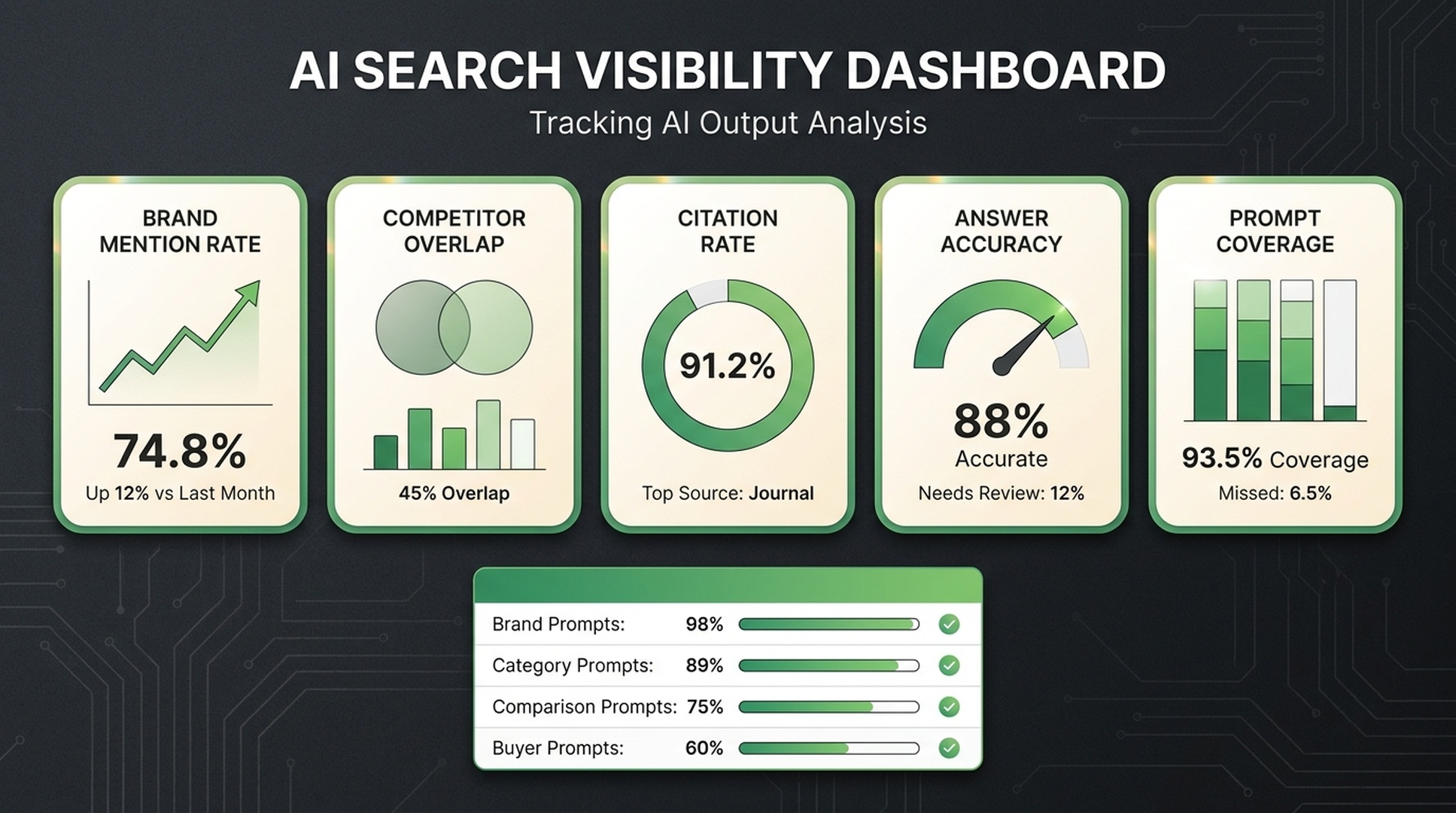
Do not overread one answer. AI answers vary by model, date, prompt wording, location, logged-in state, and retrieval mode.
The useful unit is not one screenshot. It is a prompt set tracked over time.
A 30-day plan to improve ChatGPT visibility
If you are starting from zero, do not try to fix everything at once. Run a focused 30-day sprint.
Week | Focus | Output |
|---|---|---|
Week 1 | Baseline visibility | 25-50 prompts, competitor list, current mention/citation snapshot |
Week 2 | Brand entity cleanup | Updated About page, product description, schema, external profiles |
Week 3 | Answer asset creation | Category page, FAQ section, comparison page, use-case page |
Week 4 | Evidence and measurement | Third-party profile updates, internal links, second prompt measurement |
The first sprint will not guarantee that ChatGPT starts recommending you next week. That is the wrong expectation.
The win is that you move from guessing to operating. You know which prompts matter, where competitors appear, which facts are wrong, which pages are weak, and which evidence gaps need work.
That is already more than most teams have.
What a ChatGPT-ready page looks like
A ChatGPT-ready page is not stuffed with the phrase "ChatGPT SEO."
It has a clear job.
For example, a product category page should include:
Section | Purpose |
|---|---|
One-sentence definition | Helps AI systems classify the page |
Who it is for | Connects the brand to audience prompts |
Problems solved | Connects the page to problem prompts |
Feature or service table | Makes comparison easier |
Example workflow | Shows practical use |
Proof points | Adds credibility |
FAQ | Captures natural questions |
Related pages | Helps crawlers and users move through the topic |
A weak page says:
We are the future of AI-powered growth.
A stronger page says:
Auspia helps SEO and growth teams measure AI search visibility. Teams use it to test prompts, track brand mentions, compare competitor visibility, identify missing citations, and prioritize GEO fixes across content, technical SEO, and third-party evidence.
The stronger page is not prettier. It is more useful. AI systems reward usefulness more often than slogans.
Common mistakes
The biggest mistake is treating ChatGPT SEO like a new label for old keyword tactics.
Here are the mistakes to avoid.
Mistake | Why it hurts |
|---|---|
Writing only blog posts | Your brand entity and product pages may still be unclear |
Publishing thin comparison pages | AI systems need useful tradeoffs, not fake "we are best" copy |
Ignoring third-party evidence | Your own claims are not enough for strong recommendations |
Blocking or hiding core content | Crawlers and retrieval systems need accessible text |
Using inconsistent descriptions | AI answers may describe the brand incorrectly |
Measuring only Google rankings | You miss prompt-level visibility gaps |
Expecting instant results | AI visibility usually changes through repeated evidence and retrievability improvements |
The quiet mistake is worse: not asking the right prompts.
If your team only checks "What is our brand?" you may feel visible. But buyers rarely ask only that. They ask for options, comparisons, recommendations, risks, and alternatives.
That is where the real competition happens.
Auspia take
ChatGPT SEO is not about hacking ChatGPT.
It is closer to brand evidence engineering.
You define the entity. You make the content extractable. You answer the questions buyers ask. You earn enough external validation that the brand is not floating alone on its own website. Then you measure how AI systems actually respond.
For most brands, the first breakthrough is not a ranking jump. It is seeing the visibility gap clearly:
- Which competitors get recommended
- Which prompts ignore you
- Which pages are not being cited
- Which brand facts are wrong
- Which sources AI answers seem to trust
- Which buyer questions you have not answered yet
Once you can see that, ChatGPT SEO becomes manageable work.
Still hard. But no longer mysterious.
FAQ
Can I submit my website to ChatGPT?
Not in the same way you submit a sitemap to Google Search Console. You can improve crawlability, publish clearer pages, build stronger third-party evidence, and track whether ChatGPT or other AI systems mention your brand for target prompts.
How does ChatGPT decide which brands to mention?
The answer depends on the model, product mode, retrieval settings, user context, and available sources. In practical terms, brands are more likely to be mentioned when they are clearly associated with a category, supported by reliable sources, and useful for the user's specific question.
Is ChatGPT SEO different from traditional SEO?
Yes, but it overlaps. Traditional SEO helps pages get crawled, indexed, ranked, and clicked. ChatGPT SEO focuses on whether AI answer systems can understand, verify, cite, compare, and recommend your brand.
Do backlinks help with ChatGPT visibility?
Backlinks can help indirectly when they come from credible, relevant pages that strengthen your brand's authority and discoverability. Random links are less useful than evidence-rich mentions, reviews, directories, partner pages, case studies, and category-relevant citations.
Does llms.txt help my brand appear in ChatGPT?
An llms.txt file can help document AI-readable resources for some workflows, but it is not a magic submission file. Treat it as one supporting asset. Your entity clarity, page quality, crawlability, citations, and third-party evidence matter more.
How long does it take to improve ChatGPT visibility?
It depends on the prompt, brand maturity, competition, source quality, and how the AI system retrieves information. A 30-day sprint can improve your assets and measurement. Actual AI answer changes may take longer and should be tracked across a prompt set rather than judged from one query.
What should I measure besides Google rankings?
Track brand mention rate, citation rate, competitor overlap, answer accuracy, prompt coverage, sentiment, and whether AI systems cite your own pages or third-party pages when describing your category.
Author: Adrian Cole, Analyst of 1,000+ AI Search Results at Auspia. Adrian writes about how brands appear in ChatGPT, Perplexity, Gemini, Google AI Overviews, and other answer surfaces.