Quick answer
SEO, or search engine optimization, is the work of making a page easier for search engines to crawl, understand, trust, and rank for the queries your buyers actually use. In 2026, that still means content, technical health, and authority. The difference is that search is no longer only a list of blue links. Google AI Overviews, Bing Copilot, Perplexity, ChatGPT Search, and Gemini can summarize the answer before a user clicks anything.
That changes the job. A modern SEO program has to win two moments at once: the traditional ranking moment, where a page earns a click, and the AI citation moment, where a page becomes a source inside an answer.
If you remember one thing, make it this: SEO is not dead, but thin SEO is. Pages built only around keyword density, generic summaries, and recycled advice are getting easier to ignore. Pages with clear answers, crawlable structure, named evidence, useful examples, and visible trust signals have a better shot in both Google search and AI answer systems.
What SEO means in 2026
Search engine optimization is a system for improving unpaid visibility in search results. It covers the decisions that help a search engine answer four basic questions:
Search engine question | What your site must prove |
|---|---|
Can we access this page? | The page is crawlable, indexable, fast, and not blocked by technical rules. |
What is it about? | The title, headings, copy, schema, internal links, and surrounding site context agree. |
Is it useful for this query? | The page answers the intent better than competing pages. |
Can we trust it? | The site shows experience, sources, authorship, brand credibility, and third-party signals. |
The definition is simple. The work is not. SEO touches content planning, site architecture, engineering, analytics, digital PR, product marketing, and conversion. That is why teams often get frustrated. They treat SEO like a publishing checklist when it is really a distribution system.
The three pillars that still matter
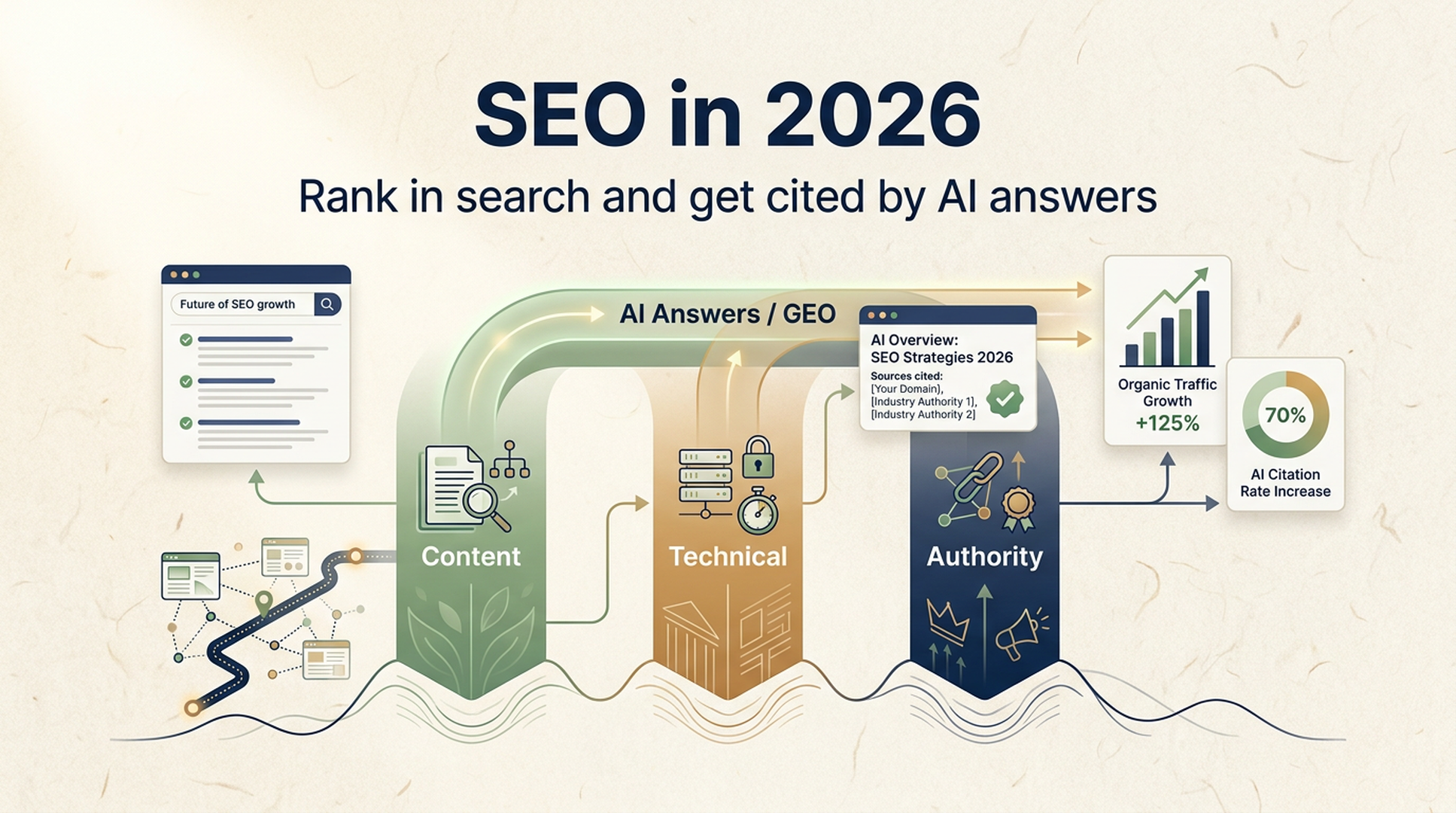
Most SEO work still fits into three pillars: content, technical SEO, and authority. The labels are old, but they are still useful because each one maps to a different failure mode.
Content SEO: match the real intent
Content SEO starts with the query, but it cannot stop there. A keyword like "best CRM for agencies" is not just a phrase. It carries assumptions about budget, team size, integrations, migration pain, sales process, and comparison criteria.
Good content SEO answers the obvious question first, then handles the follow-up questions that would otherwise send the reader back to search. That usually means:
- Choosing topics from actual demand, not internal slogans.
- Separating informational, commercial, navigational, and transactional intent.
- Writing headings that map to questions people would ask.
- Using examples, tables, checklists, and decision criteria instead of filler.
- Linking related pages so search engines understand the topic cluster.
This is where many teams still lose. They publish a 2,000-word article that says roughly the same thing as every other page on page one. It may be grammatically fine. It may even be optimized. But it adds nothing.
Technical SEO: remove crawler and user friction
Technical SEO is the part nobody notices when it works. Search engines need to discover pages, render them, understand canonical versions, and load enough content to evaluate quality. Users need the same pages to feel fast and usable.
The basics include:
- Clean URL structure and internal linking.
- XML sitemaps and a correctly configured robots.txt file.
- Canonical tags that prevent duplicate-content confusion.
- Mobile-friendly layouts.
- Core Web Vitals, especially LCP, INP, and CLS.
- Structured data where it genuinely clarifies the page.
- Server responses, redirects, and pagination that behave predictably.
Technical SEO will not rescue weak content. But weak technical foundations can bury strong content. If Googlebot or an AI crawler cannot access the page cleanly, the argument never gets heard.
For AI-era auditing, it is worth checking both classic crawlability and AI crawler access. Auspia's robots.txt AI crawler checker can help teams spot when bots such as GPTBot, Google-Extended, or PerplexityBot are being treated differently than expected.
Authority SEO: earn reasons to be trusted
Authority is not just backlinks, although backlinks still matter. Search engines and AI systems both look for signals that a source is worth relying on. Those signals can include links, brand mentions, author reputation, original data, citations from trusted websites, consistent entity information, and topical depth across the site.
The best authority work is usually boring in a good way. Publish something worth referencing. Make it easy to cite. Build relationships with the places your audience already trusts. Keep your brand and author information consistent.
Buying random links or chasing low-quality guest posts may create movement for a while, but it is a fragile strategy. In AI search, where answers often compress several sources into one summary, weak authority is even harder to hide.
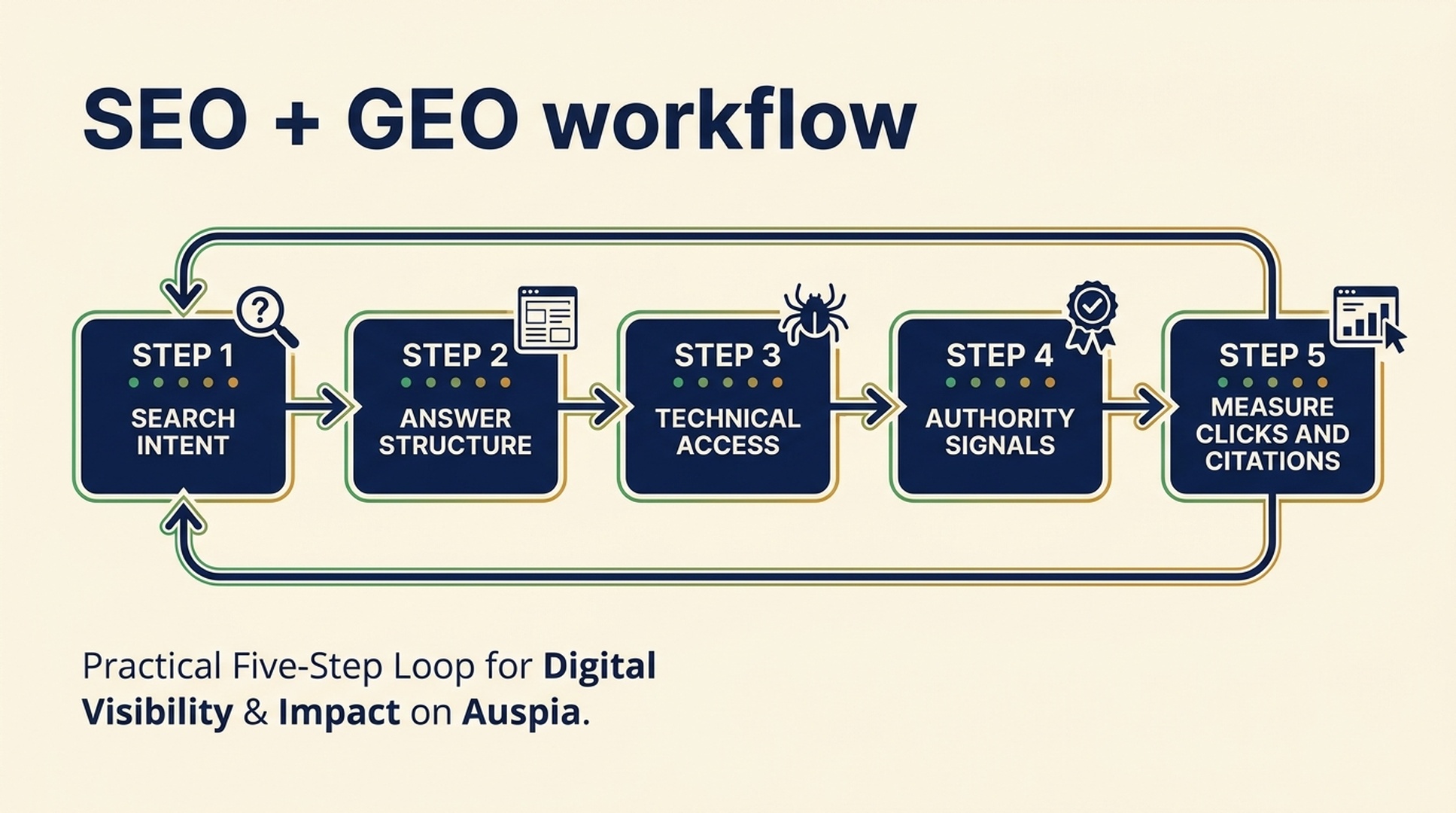
Caption: A practical SEO and GEO workflow starts with intent, then turns the page into something search engines and AI answer systems can parse, trust, and measure.
How search engines process a page
Traditional search has three broad steps: crawling, indexing, and ranking.
Crawling is discovery. Bots find URLs through links, sitemaps, feeds, and previous crawl history. If a page is blocked, buried, or isolated, it may not be seen often enough to compete.
Indexing is interpretation. The search engine decides what the page is about, which canonical URL should represent it, what entities appear on the page, and whether the content is worth storing for retrieval.
Ranking is selection. When a user searches, the engine compares indexed documents against the query and intent. It looks at relevance, quality, location, freshness, language, authority, page experience, and many other signals.
AI answer systems add another layer. They may retrieve documents, summarize passages, compare sources, and cite a subset of them. That makes passage clarity more important. A page can rank but still fail to be quoted if the answer is buried, vague, or unsupported.
A simple test: if a human has to read eight paragraphs to find your answer, an AI system may also struggle to extract it cleanly.
SEO vs SEM vs GEO
SEO is often confused with SEM and, more recently, GEO. They overlap, but they solve different problems.
Channel | Main goal | Speed | Cost model | Best measurement |
|---|---|---|---|---|
SEO | Earn unpaid rankings and clicks from search engines. | Slow to medium. New pages often need weeks or months. | Content, technical, and authority investment. No direct click fee. | Rankings, organic sessions, conversions, assisted revenue. |
SEM | Buy visibility through paid search ads. | Fast. Campaigns can start producing traffic quickly. | Cost per click or conversion. | CPC, CPA, ROAS, pipeline, revenue. |
GEO | Become a cited or referenced source in AI-generated answers. | Variable. Often depends on authority, structure, and retrievability. | Content quality, entity consistency, crawl access, third-party proof. | AI citations, share of answer, referral clicks, branded search lift. |
The practical answer is not to pick one forever. Paid search is useful for speed and testing. SEO is useful for durable demand capture. GEO is increasingly important for categories where buyers ask AI systems to compare vendors, summarize options, or explain complex topics.
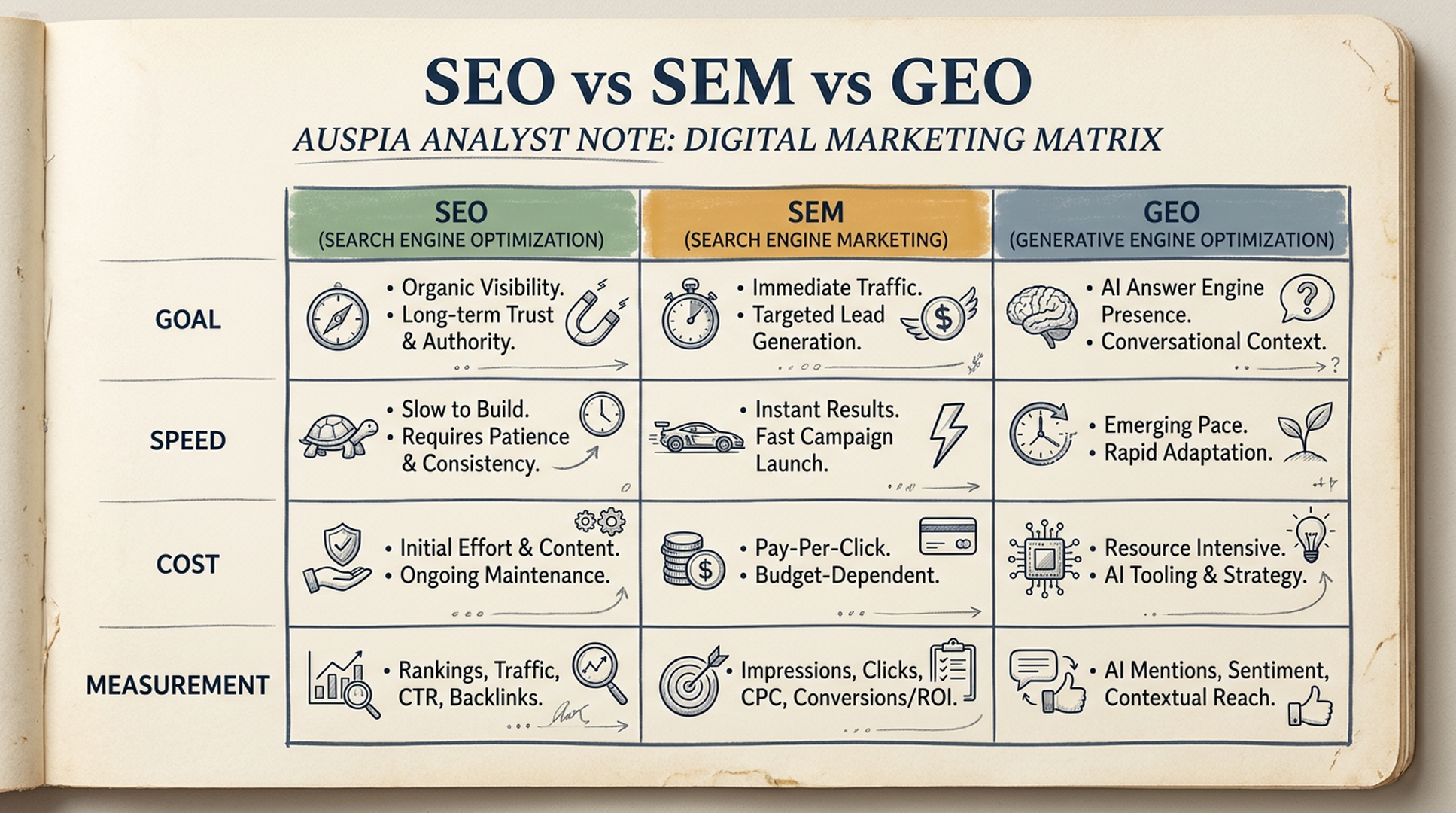
Caption: SEO, SEM, and GEO do different jobs. The best growth teams use each channel for the problem it actually solves.
What changed: AI answers and lower-click searches
The biggest SEO shift is not that search disappeared. It is that more answers are being resolved before the click.
AI Overviews can summarize a topic at the top of Google results. Perplexity and ChatGPT Search can answer with citations. Gemini and Bing Copilot can blend search retrieval with generated explanation. Users are learning to ask longer questions and expect a synthesized answer, not ten tabs.
That creates two uncomfortable realities.
First, ranking number one may not produce the same traffic it used to for some informational queries. If the answer is simple, the user may not click.
Second, visibility can happen without a classic ranking. A brand can appear as a cited source, a mentioned option, or a supporting reference inside an AI answer. That exposure may not always create a session, but it can influence awareness and later branded searches.
This is why SEO and GEO should not be managed by separate teams with separate content rules. A good page for 2026 needs to be findable, answerable, and citable.
The GEO layer: how to write SEO content that AI can cite
GEO, or generative engine optimization, is the practice of making content easier for AI answer systems to retrieve, understand, and cite. It does not replace SEO. It adds a stricter standard for clarity and evidence.
A GEO-ready SEO page usually has these traits:
- A direct answer near the top.
- Descriptive headings that match real questions.
- Short sections with one main idea each.
- Original examples, data, frameworks, or named sources.
- Clear entity signals: brand, author, product, category, location, date, and methodology where relevant.
- Tables or lists that can be extracted without losing context.
- Internal links that show topical coverage.
- Crawl settings that do not accidentally block AI retrieval.
The bad version of this is writing for bots. The good version is writing for busy humans. A clear answer, a useful table, and a concrete example help both.
If you want to benchmark this layer, run important pages through an AI search visibility checker and compare what AI systems actually cite against what you hoped they would cite. The gap is usually revealing.
Common SEO mistakes
The same mistakes keep showing up, even in teams with decent budgets.
Mistake | Why it hurts | Better move |
|---|---|---|
Treating SEO as keyword stuffing | Search systems understand intent better than exact repetition. | Use keywords naturally, then answer the underlying question. |
Publishing before technical checks | A crawl or indexing issue can waste the whole content investment. | Check indexability, canonical tags, speed, and internal links before launch. |
Copying competitors too closely | You become one more similar result. | Add examples, data, product context, or a sharper point of view. |
Measuring only rankings | Rankings can rise while clicks fall, especially with AI answers. | Track clicks, conversions, cited-source presence, and branded demand. |
Building links without brand logic | Random links may not build real trust. | Earn mentions from sources your audience and search engines recognize. |
Ignoring refresh cycles | Search intent, competitors, and SERP layouts change. | Review high-value pages every quarter or after major SERP changes. |
The painful part is that none of this is exotic. Most SEO failures come from skipping ordinary work because it is not glamorous.
A practical workflow for teams
Use this workflow when creating or refreshing a page:
- Define the query set. Group keywords by intent, not just volume.
- Inspect the live SERP. Note ads, AI Overviews, People Also Ask, videos, forums, tools, and comparison pages.
- Write the answer before the intro. If you cannot answer the query in five sentences, the page is not ready.
- Build the structure. Use headings that cover the main question, comparisons, examples, steps, mistakes, and FAQ.
- Add evidence. Include firsthand experience, screenshots, calculations, source links, benchmarks, or named examples.
- Check technical access. Validate crawling, indexing, schema, speed, mobile layout, and internal links.
- Publish with a measurement plan. Track rankings, clicks, conversions, AI citations, and branded search changes.
- Refresh based on evidence. Update pages when intent shifts, competitors improve, or AI answers cite weaker sources.
This workflow is intentionally plain. SEO compounds when the basics are done consistently.
Auspia take
The best SEO strategy for 2026 is not "write more content." It is to build pages that can survive three tests:
- A search engine can crawl and classify the page without confusion.
- A human reader can get a useful answer quickly.
- An AI answer system can extract and cite the page without inventing context.
That means the SEO team needs to sit closer to content, product marketing, analytics, and engineering. It also means the content brief needs to change. A modern brief should include search intent, citation-worthy claims, entity signals, internal links, schema needs, crawl constraints, and measurement targets.
Old SEO asked, "Can we rank for this keyword?" Better SEO asks, "Can this page become the most useful source for this question across search and AI answers?"
Checklist before publishing an SEO page
Use this before a page goes live:
- The page answers the main query in the first section.
- The title and H1 match the intent without sounding stuffed.
- The content includes specific examples, data, or decision criteria.
- Headings are clear enough to work as standalone questions.
- The page is indexable and not blocked by robots.txt or meta robots.
- Canonical tags, redirects, and internal links are correct.
- Core Web Vitals are acceptable on mobile.
- Schema markup is valid and relevant.
- The page links to related pages in the topic cluster.
- The measurement plan includes rankings, clicks, conversions, and AI citation checks.
FAQ
Is SEO still worth it in 2026?
Yes, but the expected outcome has changed. SEO can still drive durable traffic and conversions, especially for commercial, comparison, local, and high-consideration searches. For simple informational queries, some clicks may be absorbed by AI summaries or zero-click results. That makes conversion-focused topics, original evidence, and GEO readiness more important.
What is the difference between SEO and GEO?
SEO improves visibility in traditional search results. GEO improves the chance that your content is retrieved, trusted, and cited by AI answer engines. They overlap because both reward clear, useful, authoritative content. GEO adds more pressure to make answers explicit and evidence easy to extract.
How long does SEO take?
For a new site or competitive topic, meaningful movement often takes three to six months, sometimes longer. Established sites with strong authority can see faster results from technical fixes, internal linking, or content refreshes. Paid search is faster, but it stops when the budget stops.
Do backlinks still matter?
Yes, but quality matters more than volume. Links and mentions from trusted, relevant sources can help search engines and AI systems assess authority. Low-quality link schemes are risky and often disconnected from real brand trust.
Should I write for Google or for AI search?
Write for the user first, then structure the page so both Google and AI systems can understand it. In practice, that means direct answers, clean headings, specific evidence, crawlable pages, and strong internal context. A page that is vague for humans will not magically become useful for AI.