Executive summary
In 2026, AI traffic is moving from "answer me" to "do this for me." That shift changes how brands win visibility. A chatbot may mention your company in a paragraph. An AI agent may compare options, reject weak candidates, recommend one provider, and complete the booking, purchase, signup, or handoff.
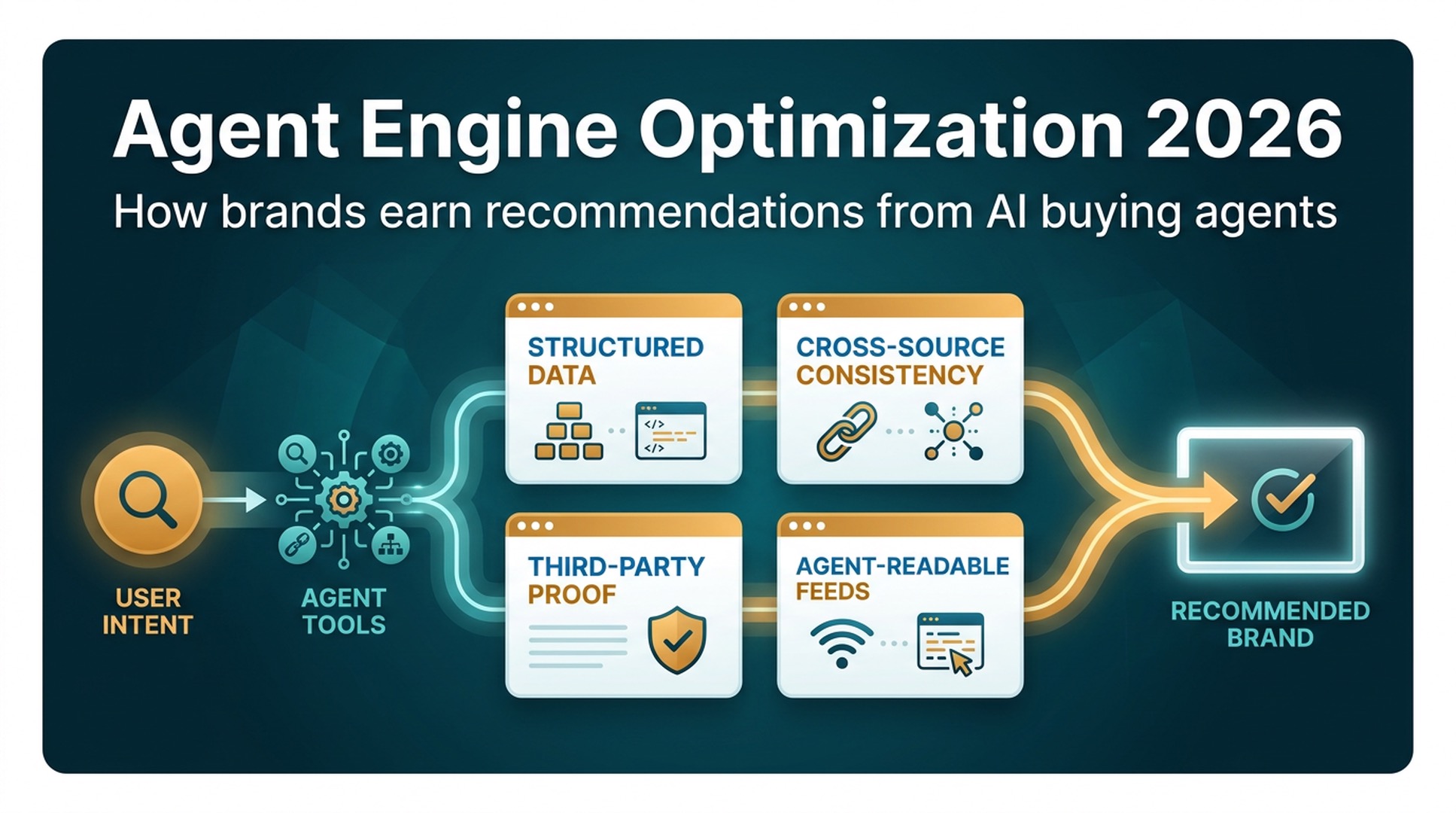
That is why AEO should now include a second meaning for growth teams: Agent Engine Optimization. It is the work of making your brand, product, price, proof, policies, and availability easy for AI agents to verify and act on.
The practical goal is not to "trick" agents. It is simpler and harder: make your brand the option with the clearest data, the least contradiction, the strongest third-party evidence, and the easiest path to action.
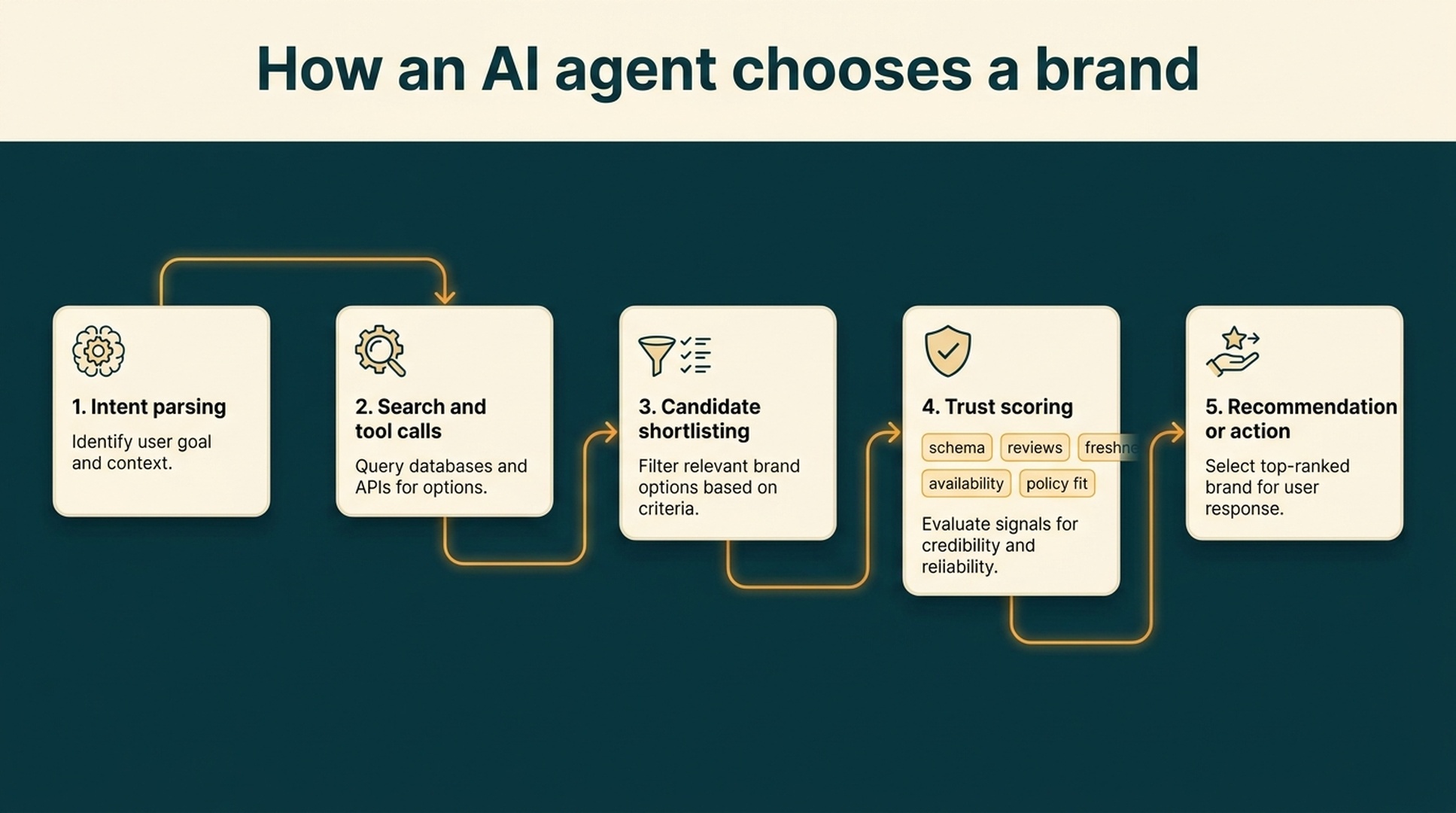
Caption: AI agents do not only retrieve content. They break a task into steps, compare candidates, score trust signals, and may take action on the user's behalf.
Why agent recommendations matter in 2026
Search used to be a page of choices. Generative AI turned some searches into a synthesized answer. Agents take the next step: they can plan, call tools, read live information, compare alternatives, and sometimes execute a task.
A user might say:
Find a compliance-friendly analytics tool for a B2B SaaS company, under $500 per month, with SOC 2 evidence and simple HubSpot integration.
Or:
Book a business hotel near our client office in Chicago for next Tuesday, with late check-in, strong Wi-Fi reviews, and a refundable rate.
In both cases, the agent is not looking for a catchy slogan. It needs structured facts it can compare. It needs proof that those facts are current. It needs to resolve conflicts across your site, review platforms, marketplaces, directories, docs, and third-party mentions.
For traffic growth, this creates a new middle layer between brand and buyer. The old question was: "Can people find us?" The new question is: "Can the agent confidently choose us?"
From SEO to GEO to Agent Engine Optimization
SEO, GEO, and Agent Engine Optimization are connected, but they optimize different decision moments.
Era | User behavior | System behavior | Brand task |
|---|---|---|---|
SEO | User searches and scans results | Search engine ranks pages | Earn rankings, clicks, and qualified sessions |
GEO | User asks an AI system | AI summarizes and cites sources | Become an understandable, citable source |
Agent Engine Optimization | User delegates a task | Agent compares options and may act | Become the most verifiable and executable option |
Traditional SEO still matters. GEO still matters. Agents often rely on search results, web pages, documentation, reviews, and structured data. But the evaluation changes. An agent does not only ask, "Is this page relevant?" It also asks, "Can I trust this enough to recommend or use it?"
That is a stricter test.
How AI agents evaluate brands
Most agent systems are not transparent, and brands should avoid pretending there is one universal ranking formula. Still, the same trust patterns show up across agent workflows, AI search experiences, shopping assistants, travel planners, procurement tools, and internal enterprise copilots.
Trust signal | What the agent tries to resolve | What the brand should provide |
|---|---|---|
Information consistency | Do the website, profiles, directories, and third-party pages say the same thing? | One canonical description for company, products, pricing, support, locations, and policies |
Structured data | Can product, organization, FAQ, review, offer, and local data be parsed without guesswork? | Schema markup, clean tables, FAQs, comparison pages, docs, feeds, and API-readable formats |
Freshness | Is price, availability, feature support, or policy information current? | Updated pages, timestamps where useful, synced inventory/pricing, changelogs, and status pages |
Third-party proof | Can claims be verified outside the brand's own site? | Reviews, analyst mentions, partner pages, customer stories, marketplace listings, citations |
Actionability | Can the agent complete the next step? | Clear CTAs, booking flows, contact routes, checkout paths, integrations, public docs, and machine-readable policies |
This is where many brands fail. Their homepage may look polished, but the data behind it is messy. Their product pages use vague claims. Their review profiles are stale. Their pricing page says one thing, the marketplace listing says another, and the help center contradicts both.
A human buyer might tolerate some friction. An agent may simply pick the cleaner option.
The three new optimization layers
1. Deep structured data, not decorative schema
Basic schema is no longer enough. In 2026, the useful question is not, "Did we add markup?" It is, "Can an agent use this information to compare us against alternatives?"
For most brands, start with these schema and content structures:
Business type | Priority structures |
|---|---|
SaaS | Organization, SoftwareApplication, Product, Offer, FAQPage, Review, HowTo, docs pages |
Ecommerce | Product, Offer, AggregateRating, Review, shipping/returns policy, availability, variant data |
Local service | LocalBusiness, Service, opening hours, service area, price range, reviews, appointment links |
Hospitality | Hotel or LodgingBusiness, room types, amenities, location, policies, ratings, booking availability |
B2B services | Organization, Service, case studies, compliance pages, partner pages, FAQPage, contact options |
Do not hide critical facts in long brand copy. Put them in tables, FAQs, comparison blocks, specs, policy pages, and product feeds. If a buyer needs the information before making a decision, an agent probably needs it too.
A weak product paragraph says:
Our platform helps modern teams work better with powerful AI capabilities and seamless integrations.
A stronger agent-readable block says:
Field | Example value |
|---|---|
Product category | AI search visibility monitoring platform |
Primary users | SEO teams, content leads, growth teams |
Integrations | Google Search Console export, CSV upload, API access, Slack alerts |
Pricing model | Monthly subscription, public plan tiers |
Evidence | Public documentation, changelog, customer examples, methodology page |
Best fit | Brands monitoring SEO, GEO, AEO, and AI search visibility |
That format is better for readers and easier for AI systems to extract.
2. Cross-source consistency governance
Agents often cross-check. They may compare your website, Google Business Profile, G2, Capterra, Shopify App Store, Trustpilot, LinkedIn, Wikipedia, partner directories, app marketplaces, documentation, and search snippets.
Small mismatches can create doubt:
Item | Common inconsistency | Fix |
|---|---|---|
Company name | Legal name, brand name, and abbreviations vary by platform | Define one canonical display name and one legal-name note |
Category | Website says "AI marketing platform" while directories say "SEO tool" | Use a consistent category sentence across profiles |
Pricing | Old marketplace listing shows retired plans | Audit pricing references monthly |
Integrations | Partner page lists an integration your docs no longer support | Tie integration claims to a maintained source of truth |
Location | Maps, footer, and business registry show different addresses | Use the same public address format everywhere |
Claims | Homepage says "enterprise-ready" but no security evidence exists | Add compliance, privacy, uptime, and support proof pages |
This is not glamorous work. It is also exactly the kind of work that improves agent confidence.
3. Agent-accessible sources and feeds
The next layer is access. If an agent is allowed to call tools, read structured feeds, or use enterprise connectors, the brand that provides clean access has an advantage.
This can include:
- Public documentation that answers implementation and policy questions directly.
- Product feeds with accurate availability, price, variants, and terms.
- Partner marketplace listings with maintained metadata.
- API documentation and changelogs for software products.
llms.txtor AI-readable guidance where appropriate.- Well-structured help-center pages that explain cancellations, refunds, eligibility, service areas, limits, and contact routes.
- Enterprise connectors or MCP-style access for brands where live data access is part of the product experience.
The principle is simple: if your data changes often, do not make agents infer it from stale marketing pages.
For a fast technical check, teams can use Auspia's AI Search Visibility Checker or review their AI-crawler setup with the Robots.txt AI Crawler Checker. These checks will not replace strategy, but they expose easy-to-miss visibility problems.
A practical 2026 agent readiness workflow
Use this workflow before a site redesign, product launch, marketplace expansion, or GEO/AEO program.
Step 1: map high-intent delegated tasks
List the tasks a buyer might hand to an agent. Do not start with keywords. Start with delegated jobs.
Examples:
Industry | Delegated task |
|---|---|
SaaS | "Find an AI search monitoring tool for a 20-person marketing team" |
Ecommerce | "Choose a carry-on suitcase under $250 with strong warranty reviews" |
Local service | "Book a dentist near me who accepts my insurance and has evening appointments" |
Travel | "Pick a refundable hotel near the conference venue with reliable Wi-Fi" |
B2B services | "Shortlist agencies that can run technical SEO and GEO audits for a mid-market SaaS company" |
For each task, write down the facts the agent would need to make a recommendation. Those facts become your optimization backlog.
Step 2: audit your source graph
A source graph is the set of pages and profiles an agent may use to understand you. Include owned, earned, and platform-controlled sources.
Source type | Examples | Audit question |
|---|---|---|
Owned site | Homepage, product pages, pricing, docs, FAQ, blog, support pages | Are claims specific, current, and structured? |
Search surfaces | Google, Bing, AI answer systems, snippets | Are summaries accurate and aligned with your positioning? |
Third-party proof | Reviews, directories, partner listings, customer stories | Do outside sources confirm your claims? |
Transaction surfaces | Booking engines, app stores, ecommerce marketplaces, sales forms | Can a user or agent complete the next step cleanly? |
Technical controls | robots.txt, sitemap, schema, feeds, API docs, | Can approved crawlers and agents access the right content? |
Step 3: fix the contradictions first
Most teams want to publish more content. Start with contradictions instead.
If your product category is inconsistent, your pricing is outdated, your reviews point to an old brand name, or your docs contradict your sales page, more content will not solve the trust problem. It may make the confusion worse.
Create one source-of-truth document for:
- Brand name, legal name, and approved short description.
- Product categories and use cases.
- Pricing, plan availability, and discount rules.
- Supported integrations and platforms.
- Security, privacy, compliance, and support policies.
- Locations, service areas, and contact options.
Then update the highest-visibility pages and profiles first.
Step 4: publish agent-readable decision pages
An agent-readable decision page is not a doorway page. It is a clean page built for real buyers and machine extraction.
Good candidates include:
- "Is [product] right for [use case]?"
- "Pricing, plans, and limits"
- "Security and compliance overview"
- "Integrations and supported workflows"
- "Comparison: [your category] options for [audience]"
- "FAQ for buyers evaluating [category] in 2026"
Each page should include direct answers, tables, eligibility rules, constraints, source dates, and next-step links. Avoid vague claims like "best-in-class" unless the page explains the evidence behind them.
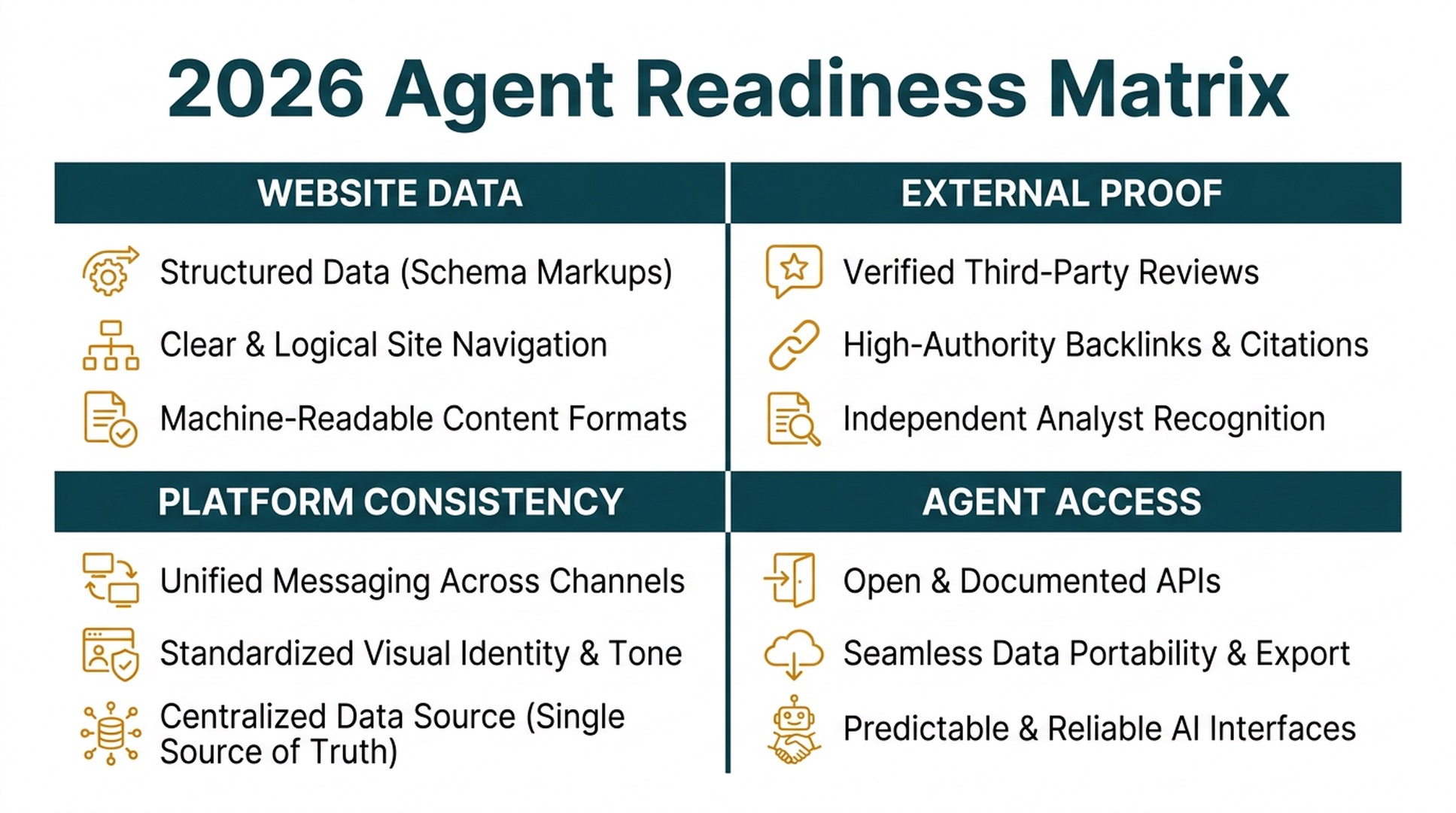
Caption: Agent readiness is a cross-functional system. SEO alone cannot fix stale third-party profiles, broken policies, or missing transactional data.
Step 5: monitor recommendations, not only rankings
Ranking reports are still useful, but they miss part of the agent journey. Add prompt and task monitoring.
Track questions like:
Monitoring prompt | What to inspect |
|---|---|
"Recommend three tools for monitoring AI search visibility" | Which brands appear, what reasons are given, which sources are cited |
"Find a vendor that can help with GEO and technical SEO" | Whether your service category is understood correctly |
"Compare [your brand] with [competitor] for a small marketing team" | Missing facts, outdated claims, weak differentiators |
"Can [your product] integrate with [platform]?" | Whether docs, partner pages, and AI answers agree |
"Is [your brand] trustworthy?" | Which third-party sources influence the response |
The output should become a weekly fix list: update a page, add proof, correct a profile, improve schema, refresh a directory listing, or publish a missing FAQ.
A 30-day action plan
Week | Focus | Actions | Owner |
|---|---|---|---|
1 | Task mapping | Identify 10-20 delegated buyer tasks and the facts agents need | Growth, sales, customer support |
2 | Consistency audit | Compare website, profiles, directories, reviews, docs, and marketplace listings | SEO, brand, operations |
3 | Structured data | Add or repair schema, tables, FAQs, product specs, pricing details, and policies | Web, SEO, product marketing |
4 | Proof and monitoring | Strengthen third-party proof, run prompt tests, document recommendation gaps | Growth, PR, customer marketing |
Do not try to fix every source at once. Start with the surfaces closest to revenue: pricing pages, product pages, category pages, review platforms, marketplace listings, booking or checkout flows, and the pages agents are most likely to cite.
Common mistakes
The first mistake is treating Agent Engine Optimization as a new name for publishing blog posts. Content helps, but only if it clarifies facts agents can use.
The second mistake is assuming agents trust your website by default. They do not. They compare.
The third mistake is blocking useful crawlers and then wondering why AI systems rely on outdated third-party summaries. Crawling control matters, but it should be intentional. Review your robots policies, sitemap coverage, and AI-crawler rules before making broad blocks.
The fourth mistake is optimizing for a single AI interface. Users may interact with search copilots, commerce agents, browser agents, internal enterprise assistants, vertical SaaS copilots, and marketplace recommendation tools. The more consistent your source graph, the less dependent you are on one platform.
Auspia takeaway
Agent Engine Optimization is not a separate department. It sits between SEO, GEO, product marketing, web operations, data governance, customer proof, and conversion design.
The 2026 opportunity is clear: brands that make themselves easy to verify will have a better chance of being recommended when users delegate decisions to agents. Brands that rely on vague copy, stale profiles, and inconsistent claims will be easier to skip.
Start with the boring work. Make the facts clean. Make proof easy to find. Make the next step obvious. Then use content and technical optimization to make those facts visible across the places agents actually read.
For teams building a broader AI visibility program, Auspia's GEO resources and AI growth tools can help turn the audit into a repeatable workflow.
FAQ
What is Agent Engine Optimization?
Agent Engine Optimization is the practice of making a brand, product, or service easy for AI agents to understand, verify, compare, recommend, and act on. It builds on SEO and GEO, but focuses more on structured data, source consistency, proof, freshness, and actionability.
Is this different from Answer Engine Optimization?
Yes. Answer Engine Optimization usually focuses on being included in AI-generated answers. Agent Engine Optimization focuses on delegated tasks where the system may compare options and help the user take action. The two overlap, but agent workflows require cleaner facts and stronger trust signals.
Does schema markup alone improve agent recommendations?
Schema helps, but it is not enough. Agents may compare your schema with page content, reviews, directories, documentation, marketplace listings, and transaction data. If those sources disagree, markup will not fix the trust issue.
Which teams should own agent readiness?
SEO can lead the audit, but ownership should be shared. Product marketing owns positioning and comparison facts. Web teams own schema and page structure. Customer marketing owns proof. Operations may own listings, availability, and local data. Legal or security may own policy and compliance pages.
What should brands do first in 2026?
Start with high-intent delegated tasks. Then audit whether your website and third-party sources give agents enough consistent information to recommend you. Fix contradictions before scaling new content.