The short version
Agent Engine Optimization is the part of AEO that asks a blunt question: can an AI agent actually use your website, or can it only read it?
Traditional SEO optimizes for a crawler, a ranking page, and a human click. Answer Engine Optimization widened that goal to citations, summaries, and AI answer visibility. The next layer is more operational. AI assistants are starting to compare products, fill forms, trigger workflows, and hand users a finished recommendation instead of a list of links.
That does not mean traffic stops matter. It means pageviews are no longer the only proof of demand. A site can lose some human browsing sessions and still win more qualified actions if agents can understand the offer, trust the facts, and complete a task without getting stuck.
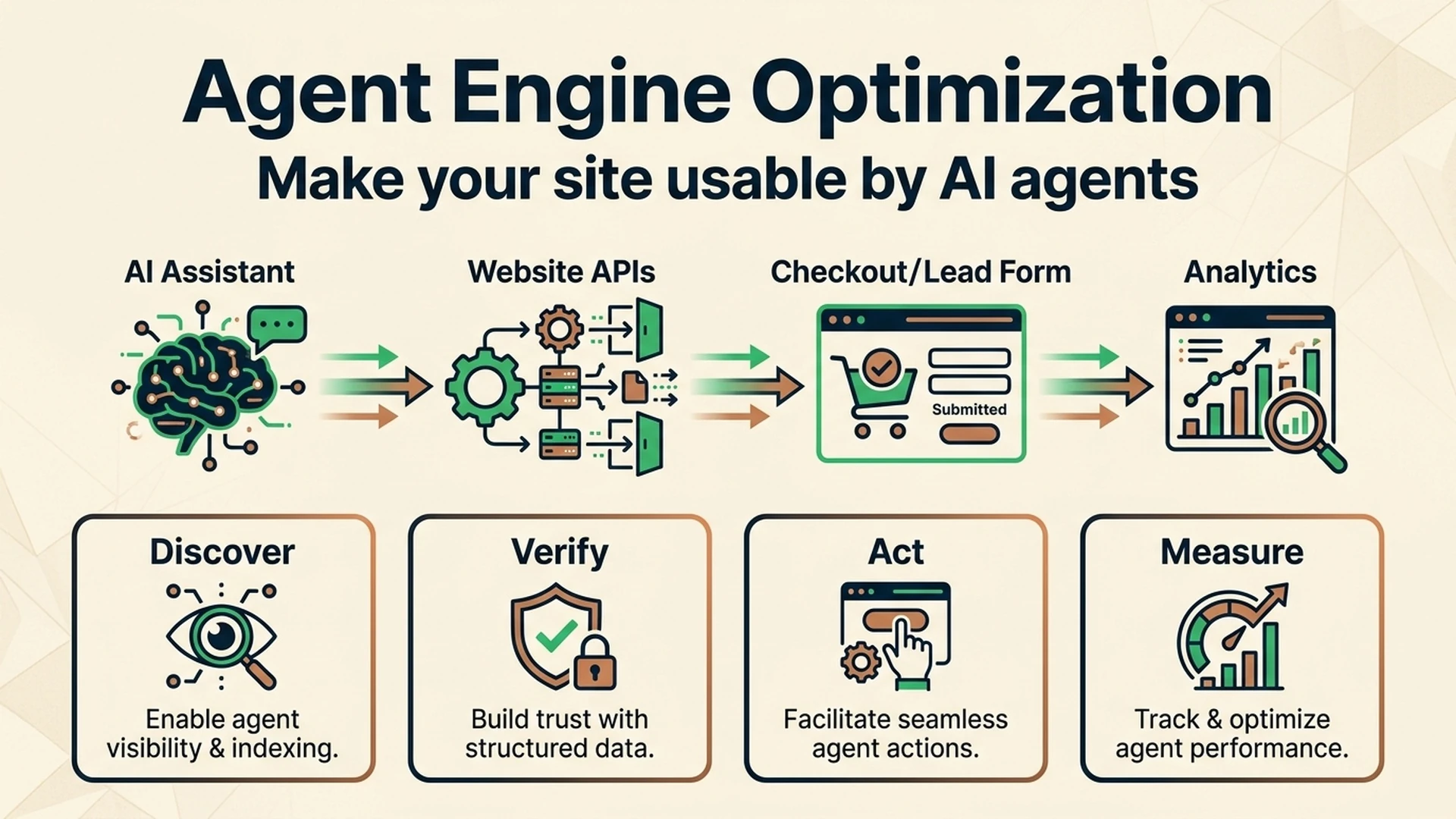
For most teams, the first move is not to build a science-fiction agent commerce stack. It is to make the current site agent-readable and action-ready: clean crawl access, structured data, clear product and pricing facts, forms that work without fragile UI tricks, evidence that can be verified, and logs that separate bots, AI referrers, assistant traffic, and real conversions.
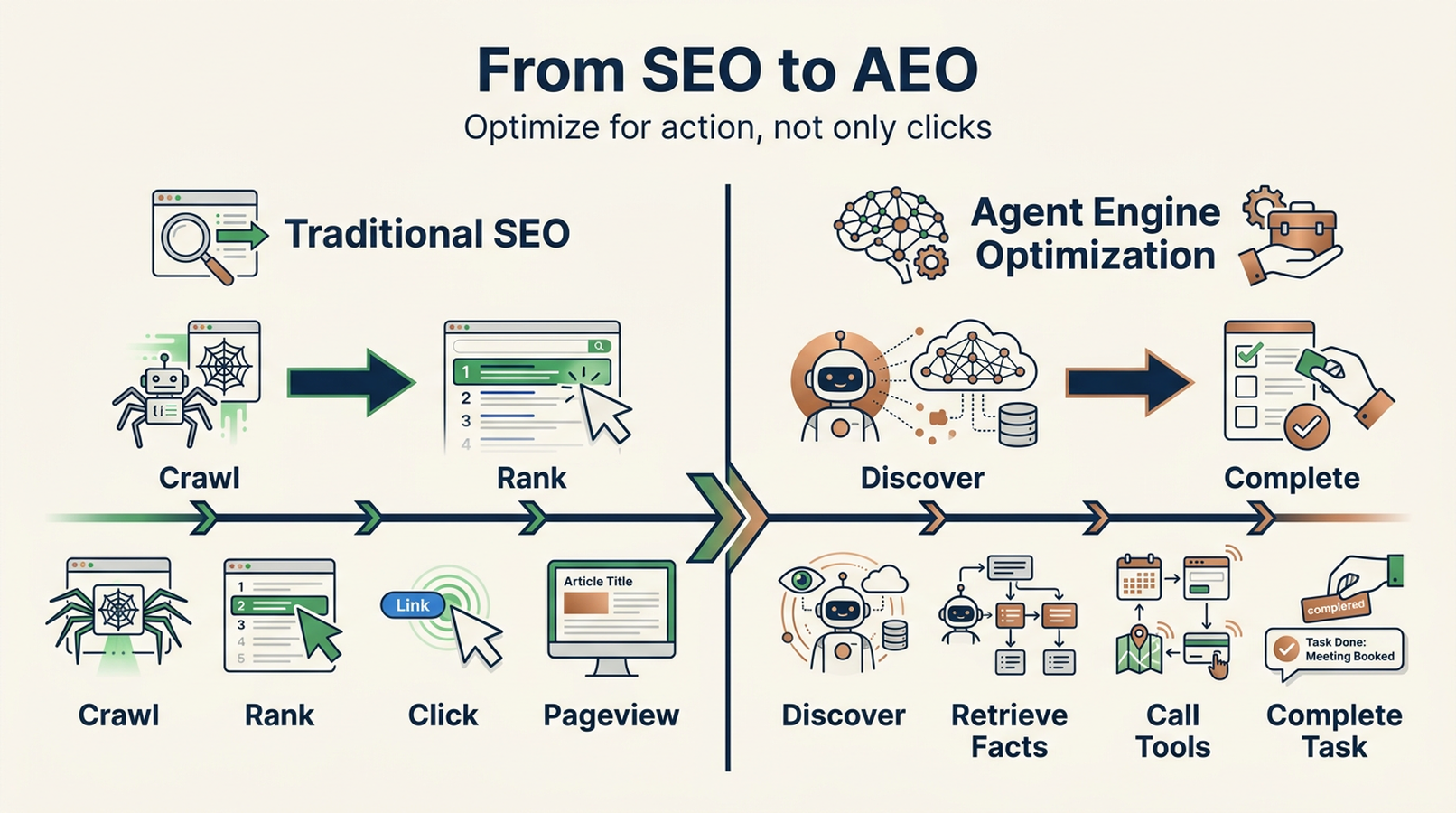
Caption: Agent Engine Optimization shifts the goal from "earn the click" to "help the agent complete the user's task."
Why this is suddenly worth paying attention to
The web is getting more agent-shaped. Google documents crawlers and fetchers as clients that perform actions for its products, either automatically or when a user triggers a fetch. Its crawler documentation also reminds site owners to verify Google requests through the user-agent header, source IP, and reverse DNS, not by the header alone. That detail matters because the agent web will bring more clients, more fetchers, and more confusing log files.
At the protocol layer, the direction is clearer. The Model Context Protocol describes itself as an open standard for connecting AI applications to external systems such as data sources, tools, and workflows. Google also announced Agent2Agent, an open protocol meant to let agents communicate, exchange information, and coordinate actions across enterprise systems. Those are not SEO products. They are plumbing for a world where agents do work across software.
Growth teams should not overreact to every new acronym. Some protocols will win, some will stall, and many will be invisible to marketers for a while. Still, the pattern is hard to ignore: AI systems are moving from answering questions to taking steps.
That changes what a "good" website looks like.
A good website for humans is persuasive, fast, and clear. A good website for agents is also explicit, machine-readable, permission-aware, and reliable under automation. If your value proposition is trapped in images, your pricing is inconsistent across pages, your product feed is messy, your forms break without a full browser session, or your trust evidence is hard to verify, an agent may choose a competitor that is easier to process.
AEO now has two jobs
Most people still use AEO to mean Answer Engine Optimization. That remains useful. You want AI search systems to understand your brand, cite your pages, and summarize your expertise correctly.
But there is a second meaning emerging in practice: Agent Engine Optimization. The overlap is large, but the success metric is different.
Layer | Main question | Typical asset | Success signal |
|---|---|---|---|
SEO | Can search engines crawl, index, and rank this page? | Technical SEO, content, links | Rankings, impressions, clicks |
Answer AEO | Can AI answer systems cite this as a trusted source? | Clear explanations, entity facts, evidence pages | AI mentions, citations, qualified brand discovery |
Agent AEO | Can an AI agent safely complete a task with this business? | Structured facts, APIs, forms, feeds, policies, trust data | Completed bookings, quotes, cart actions, lead submissions, verified recommendations |
The mistake is treating these as separate departments. They stack on top of one another. If a page is not crawlable, it is unlikely to be cited. If the facts are not clear, the agent cannot recommend you confidently. If the next action is fragile, the recommendation may never turn into revenue.
What agents need from a website
An AI agent does not browse like a patient shopper. It tries to compress the decision path. It wants to know what you sell, who it is for, what it costs, whether the claims are credible, what constraints apply, and what action can be taken next.
That creates six practical requirements.
First, the site must be accessible to legitimate crawlers and fetchers. Check robots.txt, server-side rendering, status codes, canonical tags, and content hidden behind scripts. Do not accidentally block the clients that help AI systems retrieve your pages.
Second, the facts must be structured. Product names, categories, prices, availability, locations, author details, organization data, reviews, FAQs, and policy pages should be consistent across HTML, schema markup, feeds, and internal data sources.
Third, actions must be simple. A lead form with five predictable fields is easier for an agent than a multi-step form that depends on popups, animations, and client-side validation nobody documented. For commerce, product feeds, checkout constraints, shipping rules, return policies, and payment options need to be explicit.
Fourth, trust needs receipts. Agents are risk-sensitive because they are acting on behalf of someone else. Case studies, certifications, security pages, review sources, pricing explanations, refund policies, and contact details help reduce uncertainty.
Fifth, you need a permission model. Agents should not be able to trigger destructive actions, scrape private data, or bypass consent. AEO is not "open everything." It is controlled access to the right facts and actions.
Sixth, measurement must change. If your analytics system only reports sessions, you will miss the story. You need logs for crawler behavior, AI referrers, assisted conversions, form completion quality, bot verification, and downstream revenue.
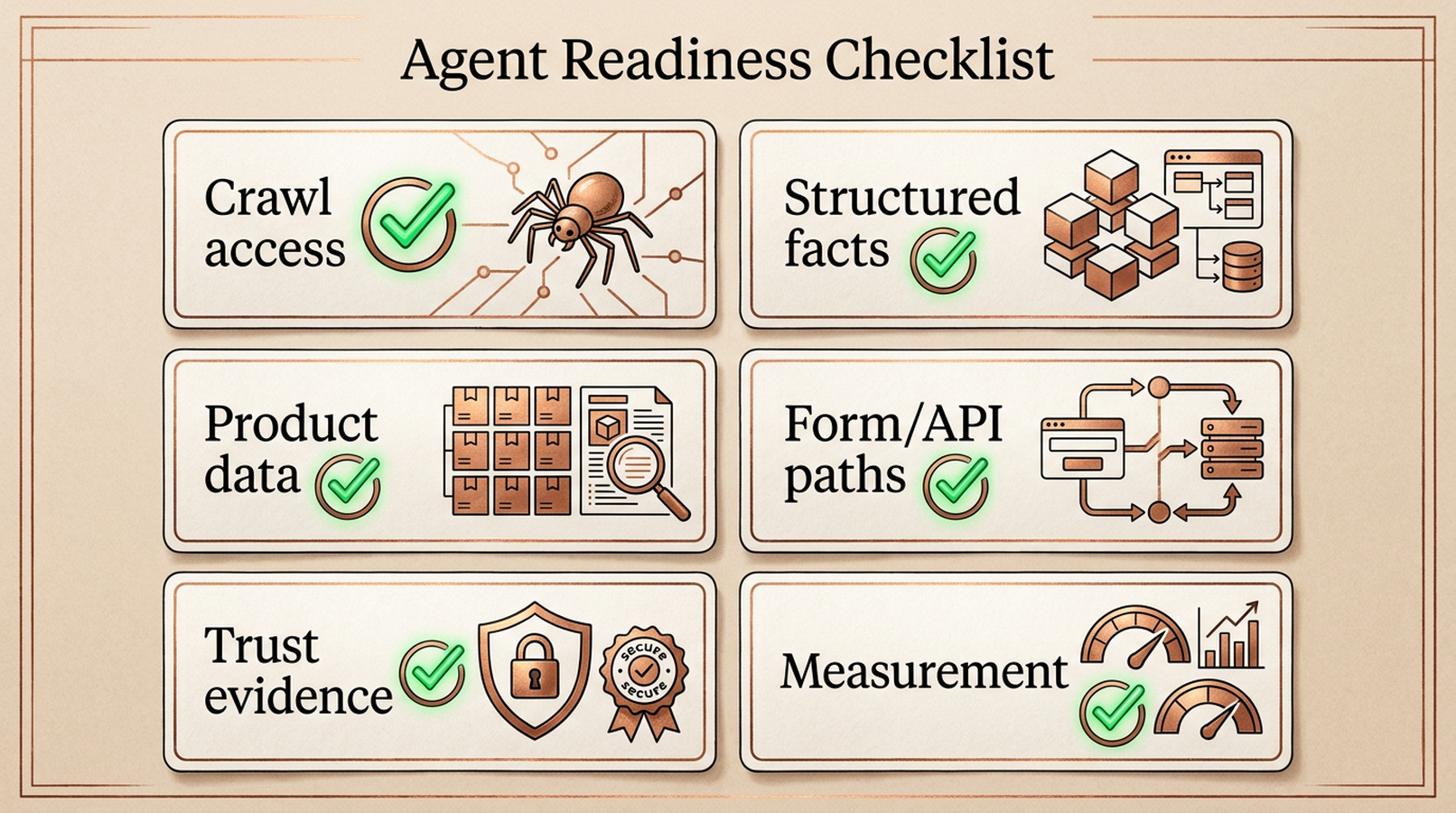
Caption: A practical readiness audit starts with six boring areas. Boring is good here. Agents prefer predictable systems.
The five-part Agent Engine Optimization playbook
1. Make crawl access intentional
Start with the basics because they still break more sites than people admit.
Open your robots.txt and check whether important paths are blocked. Review how your CDN, WAF, and bot protection treat non-human clients. Test whether key pages render meaningful HTML before JavaScript runs. Confirm that product, category, pricing, comparison, documentation, and policy pages return clean 200 status codes.
Then look at server logs. Separate known search crawlers, suspicious bots, AI-related fetchers, and user-triggered fetches where possible. Google's own crawler documentation says crawler identity is not just a user-agent string; use IP and reverse DNS verification when it matters.
The goal is not to allow every bot. The goal is to stop treating all automation as noise. Some automated visits are future distribution.
2. Turn vague marketing pages into fact pages
Agents do poorly with fluffy positioning. Humans might forgive a homepage that says "enterprise-grade platform for modern teams." An agent needs the nouns.
Create or improve pages that answer concrete questions:
Agent question | Page or data source that should answer it |
|---|---|
What does this company do? | About page, organization schema, homepage summary |
Which products or services are available? | Product pages, service pages, product feed |
Who is it for? | Use-case pages, industry pages, comparison pages |
What does it cost? | Pricing page, quote rules, plan data |
Can I trust it? | Case studies, review sources, security page, policies |
What can I do next? | Contact, demo, checkout, booking, API or form path |
This is where AEO becomes more than writing FAQs. Every claim should be easy to extract and easy to verify. Put the answer in plain HTML, support it with schema where appropriate, and keep it consistent across the site.
3. Build action paths that do not depend on luck
The agent path after discovery is where many sites will fail.
For B2B, audit your lead forms. Can an automated assistant identify required fields, submit valid data, receive a confirmation, and understand what happens next? Are hidden fields documented? Do you block all automation with CAPTCHA, even for low-risk inquiry flows? Is there an alternative endpoint for partners, marketplace agents, or authenticated workflows?
For ecommerce, look at product data and checkout constraints. Agents need clean product identifiers, variants, availability, shipping rules, return policies, and price validity. If the product page says one thing, the cart says another, and the feed says a third, the agent will hesitate or choose a cleaner merchant.
For SaaS, the action may be a trial, a demo booking, a pricing request, or an integration setup. Make the next step explicit. "Talk to sales" is fine for humans, but agents need the form fields, qualification criteria, scheduling logic, and confirmation flow to be predictable.
4. Expose tools carefully, not casually
MCP and A2A are useful mental models because they separate two jobs. MCP is about connecting AI applications to tools, data, and workflows. A2A is about agents communicating and coordinating with other agents. Both point to the same operational lesson: websites should prepare controlled interfaces for machines, not force every agent to guess through the visual UI.
That does not mean every company needs a public MCP server tomorrow. A safer roadmap looks like this:
Stage | What to expose | Who can use it |
|---|---|---|
Readiness | Clean HTML, schema, feeds, sitemaps, policy pages | Public crawlers and fetchers |
Structured retrieval | Product catalog, pricing rules, location data, documentation | Search systems, partners, internal agents |
Controlled actions | Quote request, booking, lead creation, cart preparation | Authenticated agents or approved partners |
Agent-to-agent workflows | Negotiation, procurement, support, onboarding | Trusted enterprise or marketplace agents |
Keep rate limits, auth, audit logs, consent, and rollback paths in the plan from the start. The fastest way to ruin agent readiness is to ship a clever endpoint that security, legal, and support teams do not trust.
5. Measure outcomes, not just sessions
Agent traffic will make old dashboards weird. A user may ask an assistant to compare vendors, the assistant may fetch your pages, and the user may never visit until the final conversion. Or the assistant may submit a form on the user's behalf. Either way, last-click web analytics will undercount the influence.
Add a measurement layer for:
- Verified crawler and fetcher visits to important pages
- AI search referrals and assistant-related referrers
- Mentions and citations in AI answer systems
- Form submissions that show signs of agent assistance
- Product feed usage and API calls
- Conversion quality, not only volume
- Sales notes that mention AI-assisted discovery
Use Auspia's AI search visibility tools to check whether your brand is showing up in AI answers, then pair that with server logs and CRM outcomes. Visibility without action is a content problem. Action without attribution is a measurement problem.
What most teams will get wrong
The first mistake is chasing protocol headlines before fixing the basics. If your product pages are thin, your schema is broken, and your pricing is inconsistent, an MCP experiment will not save you.
The second mistake is blocking agents out of fear. Some blocking is necessary. But a blanket "all bots are bad" policy can quietly remove your business from AI-assisted consideration.
The third mistake is confusing AI visibility with AI usability. Being mentioned in an answer is useful. Being chosen and acted on is better.
The fourth mistake is letting marketing own this alone. Agent readiness touches engineering, analytics, security, legal, sales operations, and customer support. AEO becomes real when those teams agree on what an agent is allowed to know and do.
A 30-day action plan
Week one: run an access audit. Review robots.txt, sitemap coverage, indexable pages, server rendering, bot protection, and log classification. Identify which valuable pages are hard for machines to retrieve.
Week two: clean the facts. Pick your top products, services, or use cases. Rewrite the pages so the offer, audience, pricing logic, proof, policies, and next step are explicit. Add or repair structured data where it helps.
Week three: test the action paths. Submit forms, book demos, prepare carts, request quotes, and download assets as if you were an assistant with limited patience. Document every point where the path depends on a visual trick, unclear label, or inconsistent rule.
Week four: set the measurement baseline. Track AI search visibility, crawler/fetcher behavior, AI referrals, form quality, and CRM mentions. Decide which metric would prove that agent readiness is helping revenue, not just producing interesting logs.
Auspia take
The old SEO question was "Can we rank?" The newer AEO question is "Can AI systems cite us?" The next question is sharper: "Can an agent safely do business with us?"
That is the real shift. Not every agent will buy. Not every protocol will matter. And no serious team should rebuild its site around rumors. But the direction is obvious enough to prepare for now.
Make your website easier to retrieve, easier to verify, and easier to act on. The companies that do this early will not just compete for traffic. They will compete for delegated decisions.
FAQ
Is Agent Engine Optimization the same as Answer Engine Optimization?
No. They overlap, but the goal is different. Answer Engine Optimization focuses on being understood and cited by AI answer systems. Agent Engine Optimization focuses on whether an AI agent can use your site to complete a task, such as comparing a product, filling a form, preparing a cart, or booking a meeting.
Do I need MCP or A2A to start?
Usually not. Start with crawl access, structured facts, clean product or service data, reliable forms, trust evidence, and measurement. MCP, A2A, and similar protocols become more relevant when you are ready to expose controlled tools or workflows to agents.
Should I allow all AI crawlers?
No. Treat crawler access as a policy decision. Verify important clients, block abusive traffic, protect private data, and document what you allow. The mistake is not blocking; the mistake is blocking everything without understanding which automated visits support discovery or conversion.
What is the best first AEO audit for a small team?
Pick one revenue-critical journey, such as "compare vendors and book a demo" or "choose a product and request a quote." Check whether an agent can retrieve the facts, verify the claim, understand the next step, and complete the action path without guessing.
How should we measure agent readiness?
Use a mix of AI answer visibility, verified crawler and fetcher logs, AI referral traffic, assisted form submissions, feed/API usage, and CRM notes. Pageviews alone are too narrow for agent-led discovery.
Sources
- Google Crawling Infrastructure, "Overview of Google crawlers and fetchers," last updated June 12, 2026: https://developers.google.com/crawling/docs/crawlers-fetchers/overview-google-crawlers
- Model Context Protocol documentation, "What is the Model Context Protocol (MCP)?": https://modelcontextprotocol.io/docs/getting-started/intro
- Google Developers Blog, "Announcing the Agent2Agent Protocol (A2A)," April 9, 2025: https://developers.googleblog.com/en/a2a-a-new-era-of-agent-interoperability/