Quick answer
Generative Engine Optimization, or GEO, is the work of making your content easier for AI answer systems to find, understand, cite, and recommend. SEO still matters because many AI systems pull from the open web and search indexes, but GEO adds a second layer: clear answer blocks, named sources, structured pages, crawl access, and consistent brand evidence across the places AI systems already consult.
The practical version is simple. Write pages that a human can trust in 30 seconds and that a retrieval system can quote without cleaning up your wording. That means direct conclusions, tables, FAQs, dated evidence, and fewer vague claims.
What GEO means in plain English
GEO is the practice of preparing web content for generative AI tools such as ChatGPT, Perplexity, Gemini, Claude, Copilot, and AI search experiences inside traditional search engines. The goal is not only to rank as a blue link. The goal is to become a source that can be pulled into an answer.
A useful metaphor: SEO tries to win a shelf position in a library. GEO tries to make the librarian comfortable reading your paragraph out loud.
That changes the writing standard. A page that says "our platform improves productivity" gives an AI system very little to reuse. A page that says "the template reduces a weekly reporting workflow from eight manual steps to three review steps" is easier to quote, compare, and cite.
SEO and GEO are related, but not the same
SEO is still the foundation for discoverability. If search engines cannot crawl your site, if your pages have weak titles, or if your brand is barely mentioned anywhere credible, GEO work has less to build on. But GEO asks a different question: can an AI system extract a clean answer from this page and defend why it used you?
Dimension | Traditional SEO | GEO for AI answers |
|---|---|---|
Primary goal | Rank pages in search results | Earn inclusion in generated answers |
User path | Search, scan links, click, read | Ask, receive synthesized answer, maybe click |
Content unit | Full page and keyword cluster | Quotable paragraph, table, FAQ, data point |
Trust signal | Links, topical authority, page quality | Source clarity, retrievable facts, entity consistency |
Common weakness | Keyword-heavy content with thin proof | Content that sounds good but cannot be cited |
The mistake is treating GEO as a replacement for SEO. It is more like an extraction layer on top of SEO. Strong pages still need crawlability, internal links, useful headings, and search intent coverage. They also need answer-ready sections.
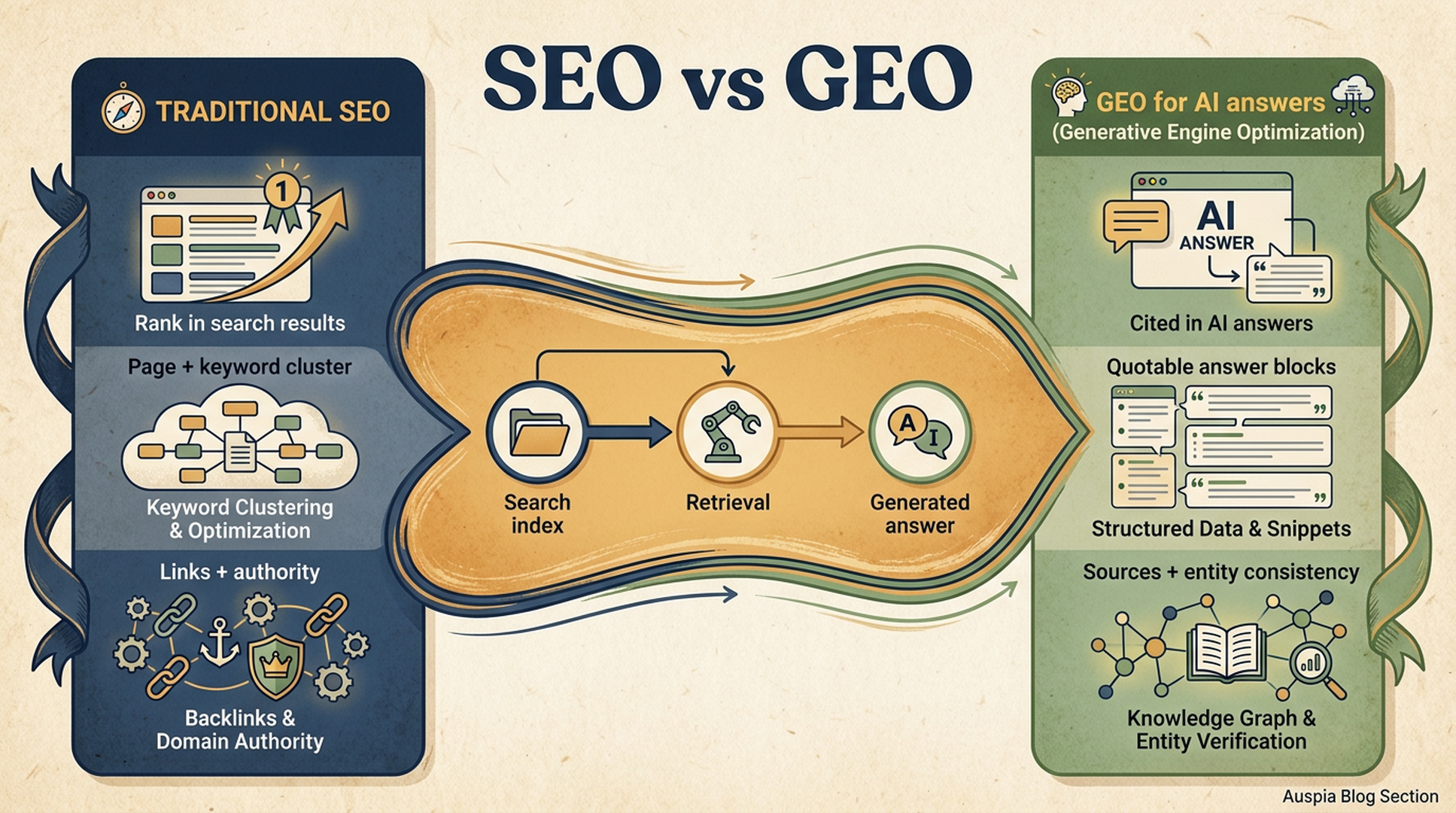
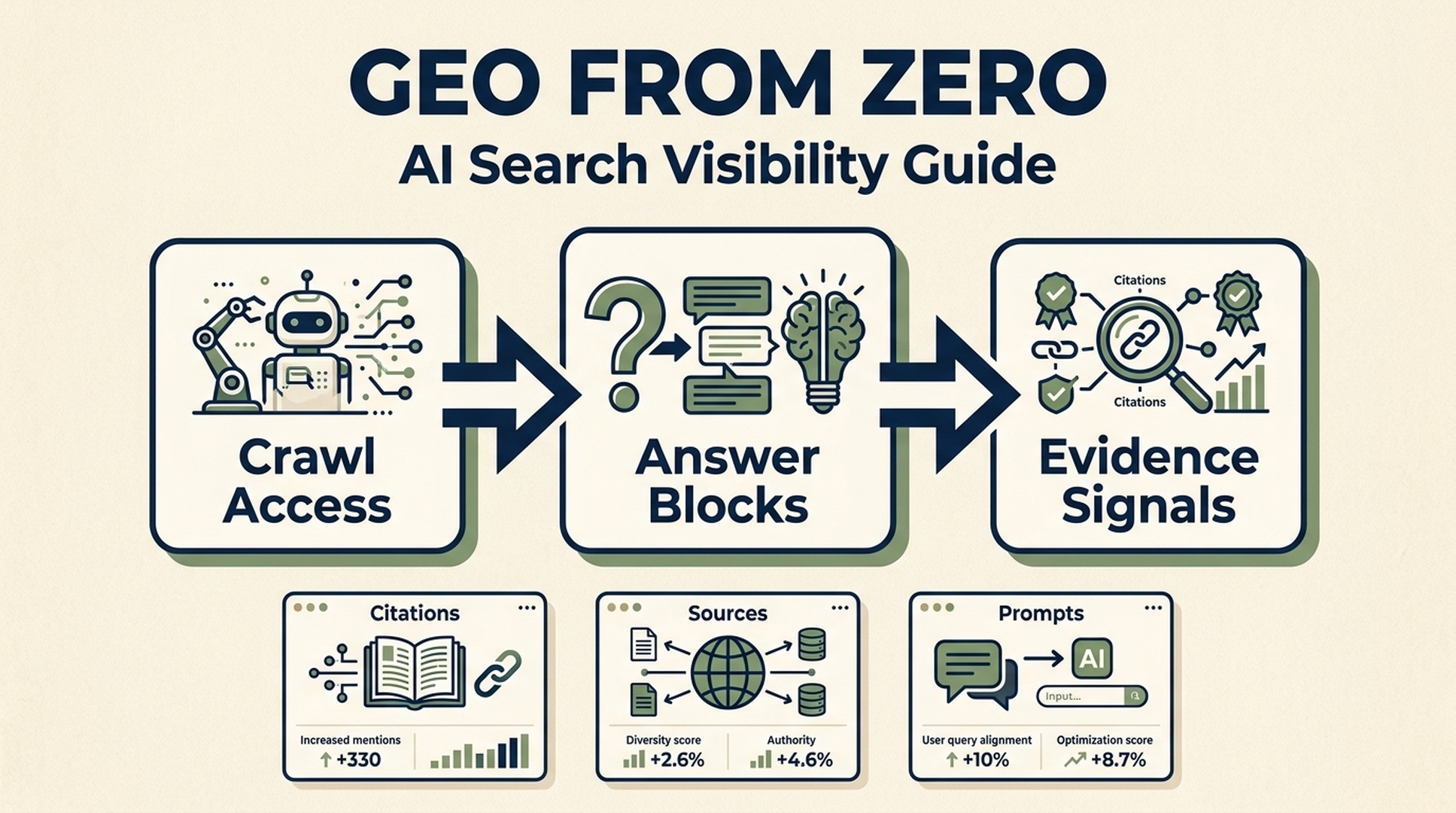
SEO and GEO share the same discovery foundation, but GEO needs quotable answer blocks and verifiable evidence signals.
Why AI answer systems prefer certain pages
Most AI answer workflows depend on retrieval. The exact architecture varies by product, but the basic loop is familiar: interpret the question, retrieve likely sources, select useful passages, assemble an answer, and attach citations when the product supports them.
That loop rewards content with low ambiguity. A retrieval system has an easier time with a paragraph like this:
"For a B2B SaaS pricing page, the most useful comparison table usually includes plan limits, support level, security controls, implementation time, and ideal customer profile. Update the table whenever packaging changes."
It has a harder time with this:
"Our plans are flexible, powerful, and designed for modern teams that want to scale with confidence."
The first passage has a task, a category, a list of attributes, and an update rule. The second passage is marketing fog.
For GEO, the best page sections usually have five traits:
Trait | What it looks like | Why it helps |
|---|---|---|
A direct answer | The first sentence resolves the question | Retrieval systems can quote it cleanly |
Specific entities | Products, dates, standards, markets, methods | The answer can be matched to user intent |
Source labels | "According to...", "In our test...", "Updated June 2026" | Trust is easier to evaluate |
Structured layout | Tables, steps, checklists, FAQ blocks | Passage extraction is less messy |
Consistent wording | Same product names and claims across pages | Entity recognition improves |
A practical GEO workflow for one page
Start with one high-intent page. A pricing page, comparison page, product use-case page, or evergreen explainer is better than a generic blog post because the user intent is clearer.
Step 1: choose the answer you want to be cited for
Write the target question at the top of your working document. Keep it specific.
Weak target: "AI marketing tools."
Better target: "What is the best workflow for checking whether a SaaS website is visible in AI search answers?"
This prevents the page from becoming a pile of loosely related tips. GEO works best when each page owns a narrow answer.
Step 2: write the answer block first
Put a short, factual answer near the top of the page. Aim for 40 to 80 words. Include the category, the audience, and the decision criteria.
Example:
"A SaaS team can check AI search visibility by testing branded and non-branded prompts across AI answer engines, recording whether the brand appears, checking which sources are cited, and fixing pages that lack clear answers, crawl access, or third-party evidence. Repeat the test monthly because answer sets change."
This is not a meta description. It is a reusable answer unit.
Step 3: add proof next to claims
AI answer systems are wary of claims that float without support. You do not need a footnote after every sentence, but you should label where numbers, benchmarks, and recommendations come from.
Use clear proof types:
Claim type | Better support |
|---|---|
Market trend | Named research report, platform announcement, or dated industry data |
Product capability | Public documentation, changelog, screenshot, or test result |
Performance claim | Your own experiment with method and sample size |
Recommendation | A checklist explaining when the advice applies and when it does not |
If you do not have proof, soften the claim. "This can help" is more honest than "this will increase AI citations."
Step 4: make the page easy to parse
Use headings that match real questions. Add tables where comparisons matter. Put definitions near the terms they explain. Add FAQ only when the questions are useful, not because a template told you to.
A clean GEO page often includes:
- A direct answer section
- A short definition
- A comparison table
- A process or checklist
- Examples of good and weak wording
- A technical crawlability note
- FAQ with plain answers
Step 5: test the technical basics
If AI crawlers cannot access a page, the writing improvements may never matter. Check your robots.txt, noindex rules, canonical tags, server rendering, page speed, and whether key content appears in the HTML rather than only after a heavy client-side interaction.
A fast sanity check: open https://yourdomain.com/robots.txt and confirm you are not blocking crawlers you actually want to allow. Then inspect the page HTML and make sure the main answer content is visible.
Auspia has a free Robots.txt AI Crawler Checker for this step, and the AI Search Visibility Checker can help you see how your brand appears across answer-style prompts.
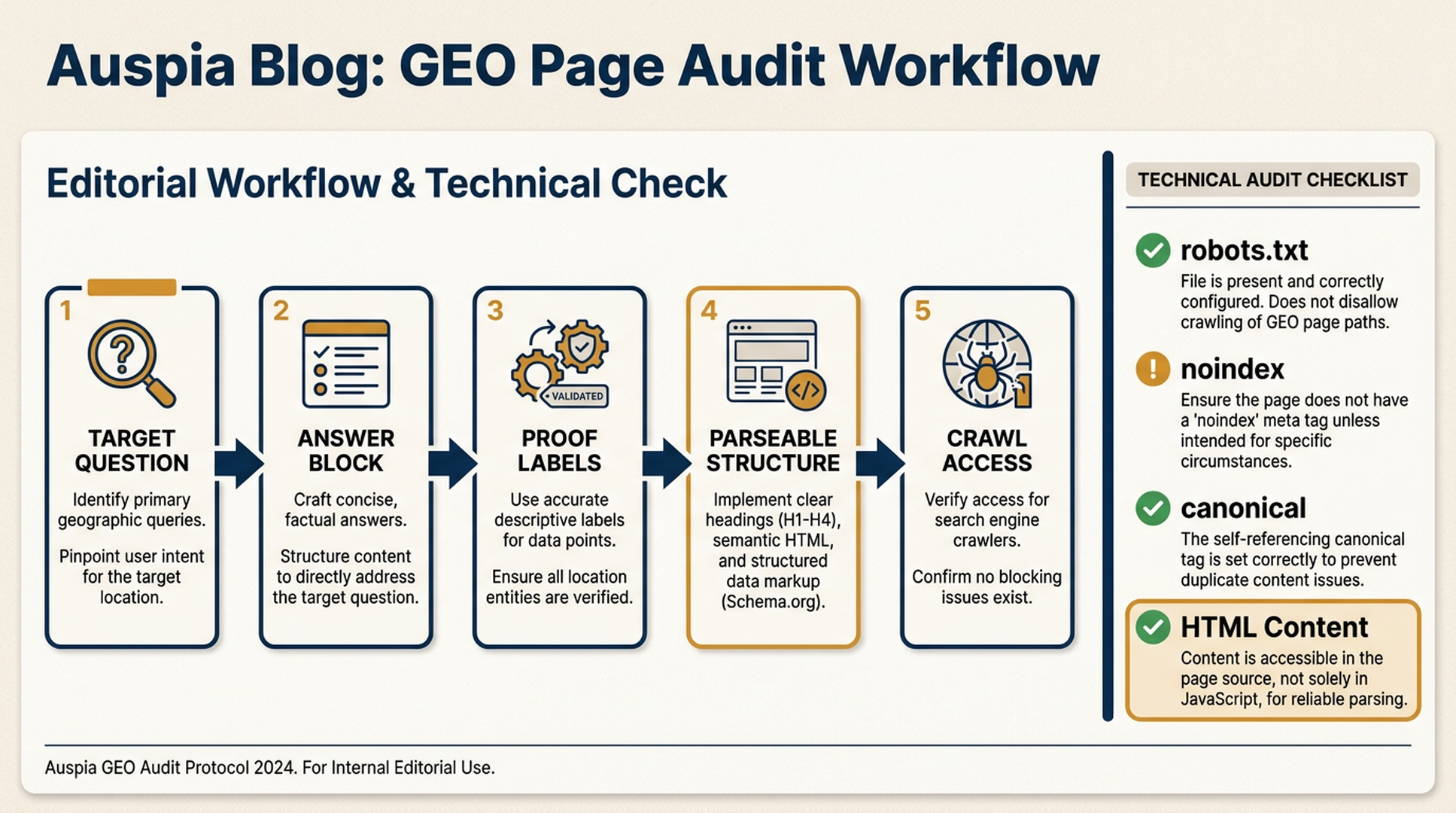
A one-page GEO audit should check the editorial answer, the proof layer, and the crawler access layer together.
Platform strategy: think in source ecosystems, not just tools
Different AI products draw from different source mixes. Some rely heavily on web search. Some use licensed content, first-party product data, knowledge graphs, user-generated content, documentation, or platform-specific indexes. The exact recipe changes, so do not build your GEO plan around one model's behavior for one week.
A more durable approach is to build source coverage by evidence type.
Evidence layer | Examples | GEO job |
|---|---|---|
Owned pages | Product pages, docs, blog, glossary, comparisons | Publish clear answer units and keep claims current |
Third-party validation | Reviews, partner pages, directories, analyst mentions | Make external proof easy to discover |
Community discussion | Reddit, Stack Overflow, forums, niche communities | Learn real language and address objections honestly |
Media and research | News, reports, podcasts, webinars | Earn credible references, not just backlinks |
Structured files | Sitemap, schema, llms.txt, robots.txt | Help crawlers understand what exists and what is allowed |
For global brands, this matters more than copying platform-specific hacks. A page optimized only for one ecosystem may disappear when that ecosystem changes. A brand with consistent owned content and credible third-party evidence is harder to ignore.
What most teams get wrong
The most common GEO mistake is writing for an imaginary AI judge instead of a real buyer. Teams add FAQs, schema, and "AI-friendly" labels, but the page still avoids the hard questions users ask before making a decision.
Other mistakes are more mechanical:
- Publishing broad explainers with no quotable answer block
- Using numbers without a source or date
- Hiding important content behind scripts, tabs, or images
- Repeating the same claim across pages with different wording
- Blocking useful crawlers by accident
- Treating AI mentions as a one-time audit instead of a monthly measurement
The uncomfortable part: GEO exposes weak content. If a page has no clear point of view, no proof, and no useful comparison, there is not much for an answer engine to cite.
A simple GEO checklist
Use this checklist before you publish or refresh a page.
Check | Pass condition |
|---|---|
Search intent | The page answers one specific user question |
Answer block | The top section contains a 40-80 word direct answer |
Entity clarity | Product, category, audience, and use case are named consistently |
Evidence | Important claims have sources, dates, examples, or test notes |
Structure | Tables, lists, and headings make extraction easy |
Crawl access |
|
Internal links | The page connects to one or two relevant supporting resources |
Refresh plan | The owner knows when to update facts and examples |
Auspia take
GEO is not a magic format. It is a discipline for making your best knowledge easier to retrieve and safer to quote.
For most teams, the fastest win is not a new content calendar. It is a rewrite of the pages that already matter: the homepage, product pages, comparison pages, pricing pages, and two or three evergreen explainers. Put direct answers near the top, remove vague claims, add proof, and check whether AI crawlers can access the content.
Then measure. Run the same prompts every month. Track whether your brand appears, which pages or third-party sources get cited, and which competitors show up when you do not. GEO gets much less mysterious once it becomes a repeatable audit.
FAQ
Is GEO replacing SEO?
No. GEO depends on many SEO basics: crawlability, page quality, internal links, topical coverage, and trustworthy sources. GEO adds answer extraction, citation readiness, and AI visibility measurement.
How long should a GEO-optimized page be?
There is no ideal length. The page should be long enough to answer the question, show proof, and handle the main objections. A clear 1,200-word page often beats a 4,000-word page that buries the answer.
Do I need schema markup for GEO?
Schema can help search systems understand your content, but it cannot fix vague writing. Treat schema as a support layer. The visible page still needs direct answers, named entities, and evidence.
Should every blog post include an FAQ?
No. Add FAQ when the questions match real search or buyer questions. Thin FAQ sections with generic answers add clutter and rarely make a weak page stronger.
What should I measure first?
Start with branded prompts, category prompts, and comparison prompts. Record whether your brand appears, whether your site is cited, which competitor sources are cited, and what claims the AI answer repeats.