The short version
AEO in 2026 is no longer just "answer engine optimization." For growth teams, it is agent engine optimization: the work of making a brand easy for AI agents to find, verify, compare, and recommend.
That distinction matters. A search engine sends a user to a list of pages. An AI agent may collapse the whole journey into one recommendation: "choose this product," "book this provider," or "shortlist these three vendors." If your facts are vague, inconsistent, blocked from crawlers, or trapped in images and PDFs, the agent may skip you even when your product is strong.
The practical job is simple to describe and hard to execute: turn brand information into verifiable answer assets. That means clear product facts, structured comparison pages, schema, crawl access, updated documentation, third-party reviews, and a weekly prompt audit that shows what AI systems actually say about you.
If you only do one thing this quarter, run 20 real buyer prompts across ChatGPT, Perplexity, Gemini, and Google AI experiences. Record which brands appear, what sources are cited, where your facts are wrong, and which competitor owns the recommendation. That spreadsheet is your first AEO backlog.
A buyer no longer has to search
Picture a procurement manager at a 70-person SaaS company. It is late, she is tired, and she needs to replace a customer support tool before renewal season.
She does not open ten tabs and type "best customer support software for startups" into Google. She asks an AI assistant:
"Compare three support platforms for a 70-person B2B SaaS team. We need HubSpot integration, SOC 2, good AI ticket routing, and pricing under $2,000 per month. Give me the safest option and explain why."
The assistant comes back with a ranked shortlist, a table, a few caveats, and links to documentation, review sites, pricing pages, and community threads. The procurement manager forwards that answer to her team.
A brand just entered the deal. Another brand disappeared.
That is the part many marketers underestimate. In the old journey, the buyer did the messy middle: search, scan, compare, check reviews, ask peers, and return to the vendor site. In the agent-mediated journey, a model may do much of that filtering before the buyer ever sees your homepage.
AEO asks one uncomfortable question: when an AI system builds its shortlist, what evidence makes your brand the safe recommendation?
From SEO to GEO to AEO
AEO is easier to understand if we stop treating every acronym as a replacement for the last one. SEO, GEO, and AEO stack on top of each other.
Layer | Main question | What you optimize | Failure mode |
|---|---|---|---|
SEO | Can search systems find and rank the page? | Indexing, crawlability, speed, internal links, search intent | Your pages are invisible or weak in search results |
GEO | Can generative systems extract and cite the answer? | Clear answers, tables, schema, entity clarity, quotable facts | AI mentions competitors because your content is too vague |
AEO | Can agents trust you enough to recommend you? | Third-party proof, consistency, decision criteria, comparison assets, monitoring | AI knows you exist but does not choose you |
SEO gets you into the index. GEO makes your information extractable. AEO pushes one step further: it makes the brand defensible inside a recommendation.
That final step depends on trust signals. A model can repeat a claim from your website. An agent making a recommendation needs more. It looks for corroboration: independent reviews, product documentation, security pages, pricing transparency, media mentions, analyst references, community experience, and consistent facts across the web.
This is why AEO is partly content, partly technical SEO, partly PR, partly product marketing, and partly brand governance. It is not a plugin. It is an operating habit.
Three common mistakes
Mistake 1: treating AEO as keyword SEO with AI language
Keyword coverage still helps, but agents do not think in keywords only. They break a buyer prompt into constraints.
A prompt like "best payroll software for a 40-person remote team in Texas" contains several decision criteria: company size, location, compliance, remote work, price, integrations, onboarding, support, and risk. A page that repeats "best payroll software" ten times may lose to a page that answers those criteria in plain, structured language.
A better asset says: who the product is for, who it is not for, what integrations it supports, what compliance coverage exists, what pricing tier fits the use case, what evidence backs each claim, and when the page was last updated.
Mistake 2: hiding the useful facts below the fold
Models and retrieval systems often favor clean, early, high-information passages. Do not bury the answer under brand storytelling.
If a page is about an AI search visibility checker, the first screen should say what it checks, which engines or answer surfaces it covers, what input the user needs, what output they get, and what to do with the result. Save the manifesto for later.
A useful test: copy the first 300 words of your page into a blank document. Could an agent use that text to answer a buyer's question accurately? If not, rewrite it.
Mistake 3: assuming your own website is enough
Your site is the source of truth, but it is not the whole truth. Agents compare your claims with outside signals.
A vendor page that says "trusted by growing teams" is weak. A vendor page that says "SOC 2 Type II report available, HubSpot integration supported, median onboarding time 12 days" is stronger. That same claim repeated on G2, Capterra, a partner marketplace, GitHub docs, and a serious comparison article is stronger still.
AEO rewards consistency. If your website says you serve mid-market teams, your pricing page hides enterprise-only pricing, your app marketplace listing is outdated, and review sites describe you as a freelancer tool, the agent has no clean story to tell.
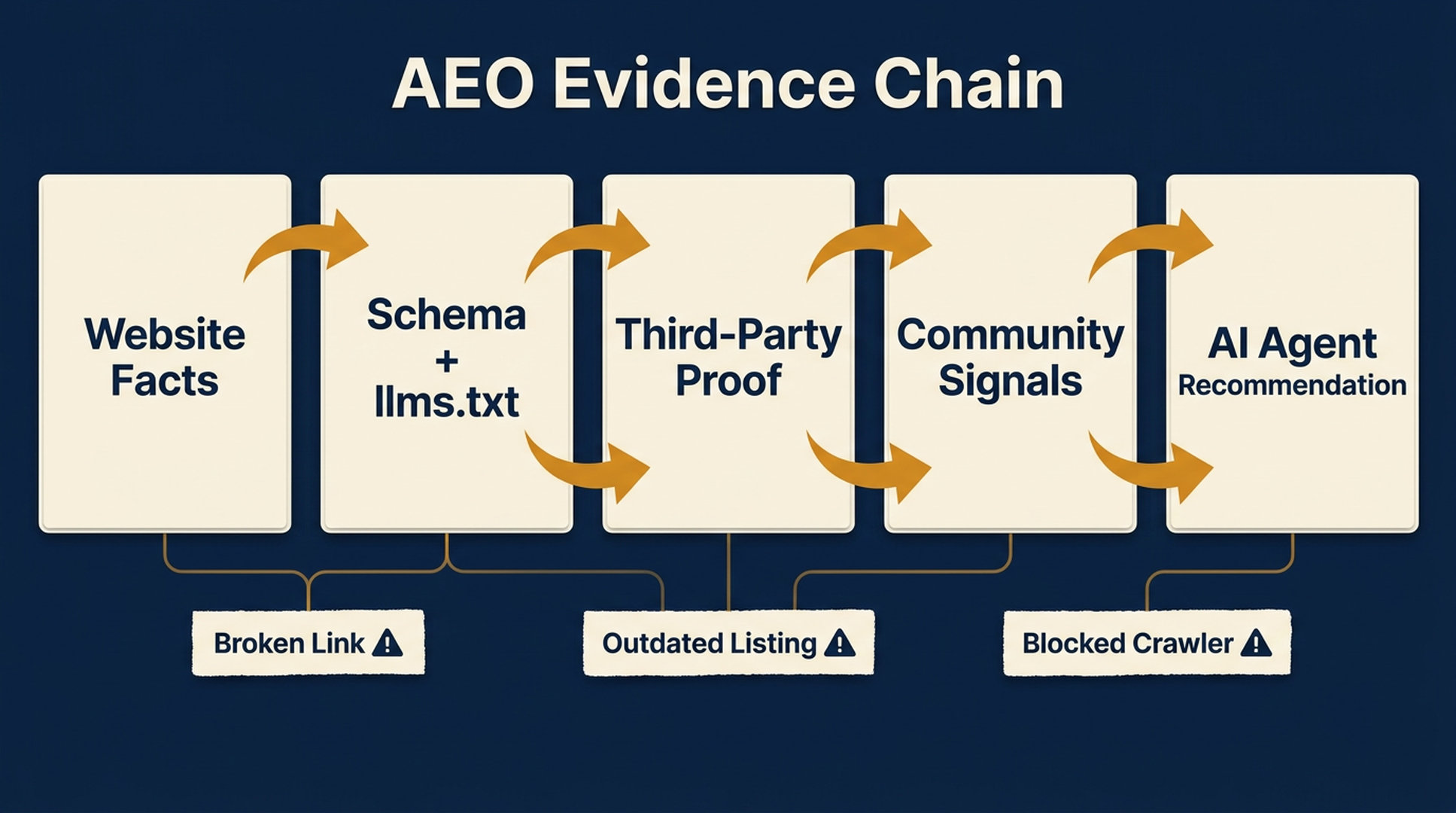
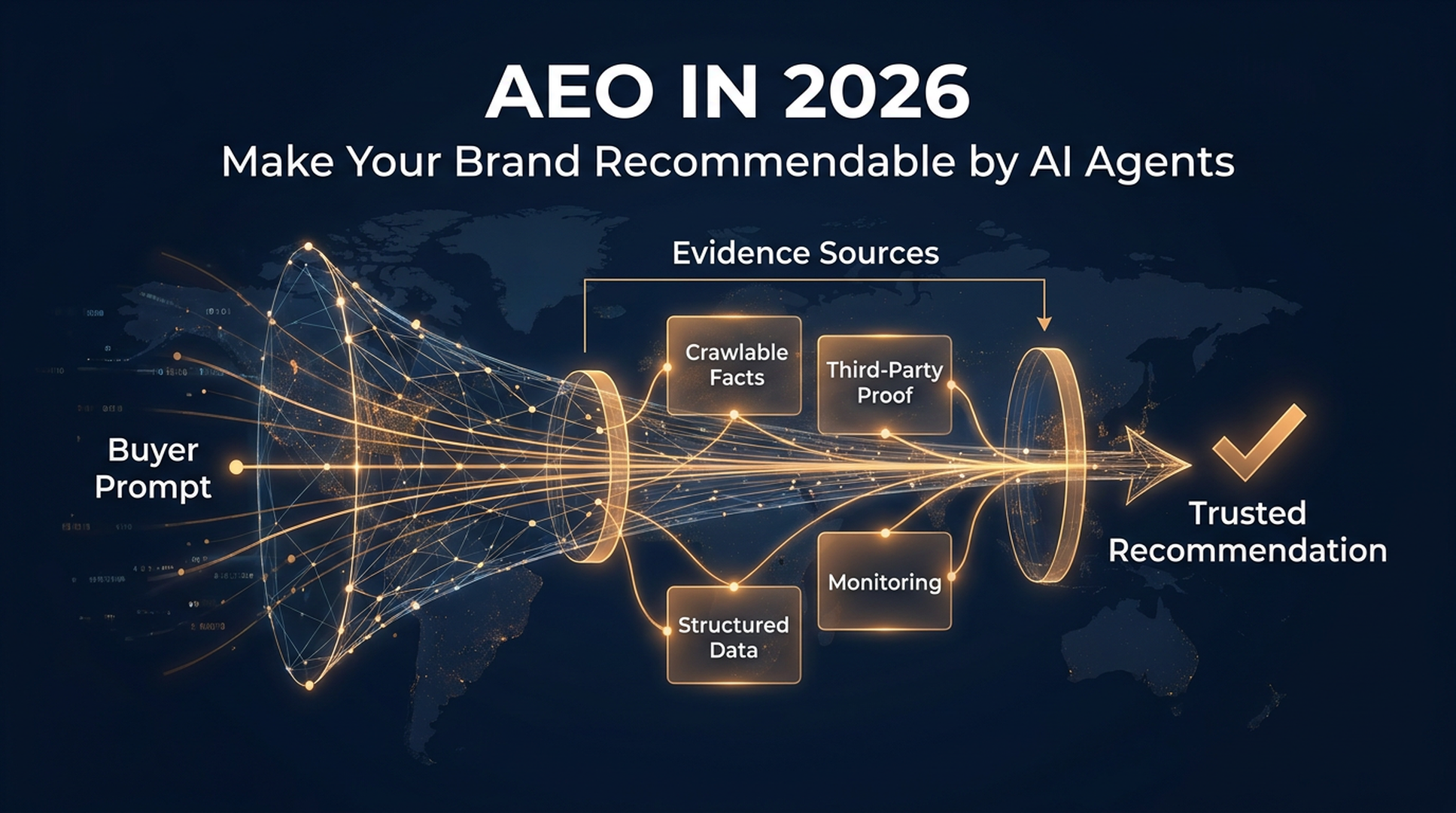
Caption: AEO works when website facts, technical access, third-party proof, and community signals form one verifiable evidence chain.
What AI agents need before they recommend a brand
Most agent recommendations depend on five evidence buckets.
Evidence bucket | What the agent looks for | Brand asset to build |
|---|---|---|
Entity clarity | What the brand is, who it serves, where it operates | Organization page, About page, entity schema, consistent profiles |
Product facts | Features, pricing, limits, integrations, certifications | Product pages, pricing pages, docs, comparison tables |
Decision fit | Which use cases the product is good or bad for | Use-case pages, "best for" sections, honest tradeoff pages |
Third-party validation | Reviews, media, community feedback, partner listings | Review profiles, marketplace pages, analyst mentions, case studies |
Technical access | Whether crawlers and retrievers can read the content | robots.txt, llms.txt, sitemap, schema, HTML tables, fast pages |
The gap is rarely one missing blog post. More often it is a broken evidence chain. The product page has facts, but no schema. The review profile has reviews, but the category is wrong. The comparison page exists, but it is a graphic the model cannot parse. The docs are accurate, but robots.txt blocks useful crawlers. The PR page has coverage, but none of it states what the product actually does.
AEO work starts by repairing the chain.
The 2026 AEO playbook
Step 1: run an agent visibility audit
Start with buyer prompts, not brand prompts. Nobody begins with "tell me about Acme." They ask for a recommendation.
Build a list of 20 to 50 prompts across four groups:
Prompt group | Example |
|---|---|
Category recommendation | "Recommend three AI search visibility tools for a B2B SaaS team" |
Use-case fit | "What tool should I use to check if ChatGPT can cite my website?" |
Comparison | "Compare [your brand] with [competitor] for a small marketing team" |
Risk and trust | "Which vendors in this category have clear pricing and credible proof?" |
Run them in ChatGPT, Perplexity, Gemini, Google AI experiences, and any industry-specific assistant your buyers use. Record five things: whether you appear, where you rank, what words describe you, what sources appear, and which facts are wrong.
Do not argue with the model. Treat the answer as a symptom. The backlog is hidden in the sources it uses and the sources it ignores.
Auspia users can start with the AI Search Visibility Checker to turn this manual audit into a repeatable baseline.
Step 2: convert brand pages into answer assets
An answer asset is a page or data block that an AI system can lift into a useful answer without guessing.
The difference is obvious when you put the two side by side.
Weak brand copy | Strong answer asset |
|---|---|
"We help teams unlock growth with intelligent solutions." | "Auspia helps growth teams audit SEO, GEO, AEO, AI crawler access, llms.txt files, and AI search visibility." |
A feature grid saved as a PNG | An HTML table with feature, use case, data source, output, and limitation |
"Loved by marketers worldwide" | Review count, rating source, customer segment, last updated date |
"Enterprise-grade security" | SOC 2 status, data retention policy, SSO support, DPA link |
A generic FAQ | Real buyer questions mapped to short answers and FAQPage schema |
Put the direct answer near the top. Use specific nouns. Use numbers when they are real. Name integrations, standards, locations, and limitations. Add a visible "last updated" date for pages that affect buying decisions.
Step 3: build comparison pages before competitors define you
Agents love comparison assets because buyer prompts often imply a comparison even when the user does not name competitors.
A useful comparison page is not a hit piece. It should include:
- who each option is best for
- pricing model and visible price ranges
- core features and limits
- integrations and platform coverage
- proof sources, such as reviews, docs, certifications, or case studies
- honest tradeoffs
- a last-updated date
If you avoid competitor names completely, you leave the comparison to someone else. That someone else may be a competitor, an affiliate site, an outdated review page, or a forum thread with one angry customer.
AEO does not require aggressive positioning. It does require readable evidence.
Step 4: make technical access boringly correct
The technical checklist is not glamorous, but it decides whether your best evidence is even available.
Check these items first:
Technical item | Why it matters |
|---|---|
robots.txt | Some sites accidentally block AI crawlers or important documentation paths |
llms.txt | Gives AI readers a clean map of important pages and documentation |
XML sitemap | Helps discovery and freshness tracking |
Organization, Product, FAQPage, Article schema | Clarifies entities, products, answers, and page types |
HTML tables | Easier for machines to parse than comparison screenshots |
canonical tags | Prevents duplicate or stale versions from confusing retrieval systems |
page speed and mobile rendering | Still affects crawl quality and user conversion |
If you are unsure where to start, run your site through Auspia's Robots.txt AI Crawler Checker and an llms.txt audit. Many AEO problems are not strategic. They are simple access mistakes.
Step 5: create third-party proof loops
Agents do not trust a brand because the brand says it is trustworthy. They trust patterns across sources.
For B2B software, the proof loop may include G2, Capterra, Product Hunt, GitHub, partner marketplaces, security pages, integration docs, case studies, analyst lists, and practitioner posts. For ecommerce, it may include Amazon, retailer pages, Reddit, YouTube reviews, independent tests, and product documentation. For local services, it may include Google Business Profile, industry directories, local media, review platforms, and licensing databases.
The task is not to spam the web. The task is to make true, useful facts repeatable across credible places.
Pick five facts you want agents to learn about your brand. Then ask: where can each fact be verified outside our own site?
Step 6: monitor recommendation share weekly
AEO decays. Product facts change. Competitors publish new comparison pages. Review sentiment shifts. AI products update retrieval behavior.
A lightweight dashboard should track:
Metric | What to record | Cadence |
|---|---|---|
Mention rate | How often your brand appears in target prompts | Weekly |
Recommendation rate | How often the answer explicitly suggests your brand | Weekly |
Citation share | Which domains support the answer | Weekly or monthly |
Fact accuracy | Incorrect pricing, features, markets, integrations | Weekly |
Competitor displacement | Prompts where a competitor wins but your evidence is stronger | Monthly |
Source quality | Whether answers cite your site, reviews, forums, media, or competitors | Monthly |
Do not chase every single answer. Look for repeated patterns. If five prompts cite an outdated marketplace page, fix the marketplace page. If agents recommend a competitor because they have clearer pricing, the problem is not the model. It is the evidence.
The harder brand questions
AEO forces teams to answer questions that were easy to avoid when marketing lived mostly in campaigns.
First: do you have facts, or only positioning? Agents are not moved by phrases like "next-generation," "trusted partner," or "industry-leading." They need concrete claims: what you do, who you serve, what proof exists, where you are available, what it costs, what the limits are.
Second: is your brand story consistent across the web? If your homepage, docs, review profiles, partner listings, and social bios describe different products, AI systems will often pick the most repeated version. That version may be old or unflattering.
Third: are you willing to be compared? A recommendation engine compares by default. If your content refuses to explain tradeoffs, the agent will learn those tradeoffs from somebody else.
Fourth: can your site be read by machines without losing meaning? A beautiful landing page with text embedded in images, vague section headings, and no structured data may convert humans who arrive there. It may still fail before the visit happens.
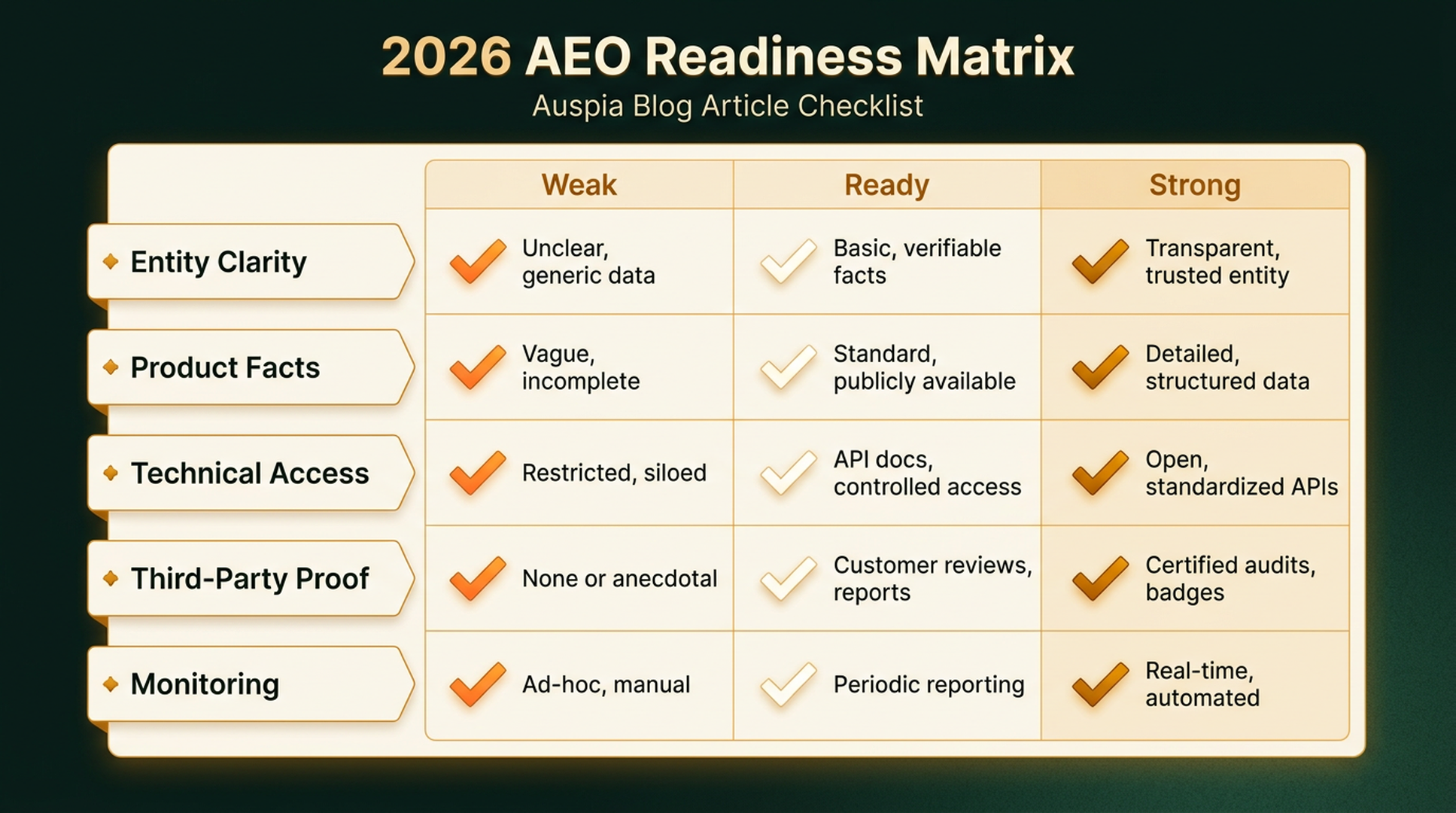
Caption: Use the readiness matrix to decide whether each AEO signal is weak, ready, or strong before scaling content production.
AEO readiness checklist for 2026
Use this checklist before you launch another content sprint.
Area | Pass condition |
|---|---|
Category prompts | You know your top 20 buyer prompts and run them regularly |
Entity profile | Your brand name, category, audience, location, and product names are consistent |
Product facts | Pricing, features, integrations, limitations, and proof are visible in HTML |
Structured data | Organization, Product, Article, BreadcrumbList, and FAQPage schema are implemented where relevant |
AI crawler access | robots.txt does not block the crawlers you want to reach |
llms.txt | Your site has a clean AI-readable map of priority pages |
Comparison assets | You explain where you fit against alternatives without hiding tradeoffs |
Third-party proof | Key claims are repeated on credible external sources |
Monitoring | You track mention rate, recommendation rate, sources, and fact accuracy |
Ownership | One person owns the AEO backlog across SEO, content, product marketing, PR, and web |
Auspia's take
AEO is not a replacement for SEO. It is what happens when search becomes a decision layer.
In 2026, the winning brands will not be the ones with the loudest claims. They will be the ones with the cleanest evidence. Clear pages. Crawlable facts. Real reviews. Honest comparisons. Current documentation. Structured data. Enough third-party proof that an AI agent can recommend them without taking a leap of faith.
That sounds less glamorous than a campaign. It is also more durable.
If your team wants a starting point, audit three things this week: how AI systems describe your brand, whether your best facts are machine-readable, and whether third-party sources confirm the claims you want buyers to believe. Those three checks will tell you where the work is.
FAQ
What does AEO mean in 2026?
AEO increasingly means agent engine optimization: making a brand easy for AI agents to find, verify, compare, and recommend. It overlaps with answer engine optimization, but it focuses more on recommendation readiness than simple visibility.
Is AEO different from GEO?
Yes. GEO focuses on whether generative engines can extract and cite your content. AEO focuses on whether agentic systems can trust your brand enough to include it in a recommendation or shortlist.
Does SEO still matter for AEO?
Yes. SEO is still the foundation because many AI systems use search indexes, crawlers, and web retrieval. If your site cannot be crawled, indexed, or understood, AEO work has a weak base.
What should a small team do first?
Run a prompt audit. Test real buyer questions across major AI systems, record what answers say, identify the sources, and fix the most repeated errors or missing proof first.
Do I need llms.txt for AEO?
llms.txt is not a magic ranking factor, but it is useful as an AI-readable map of important pages. It works best alongside good robots.txt rules, schema, sitemaps, clear HTML content, and current documentation.