Executive summary
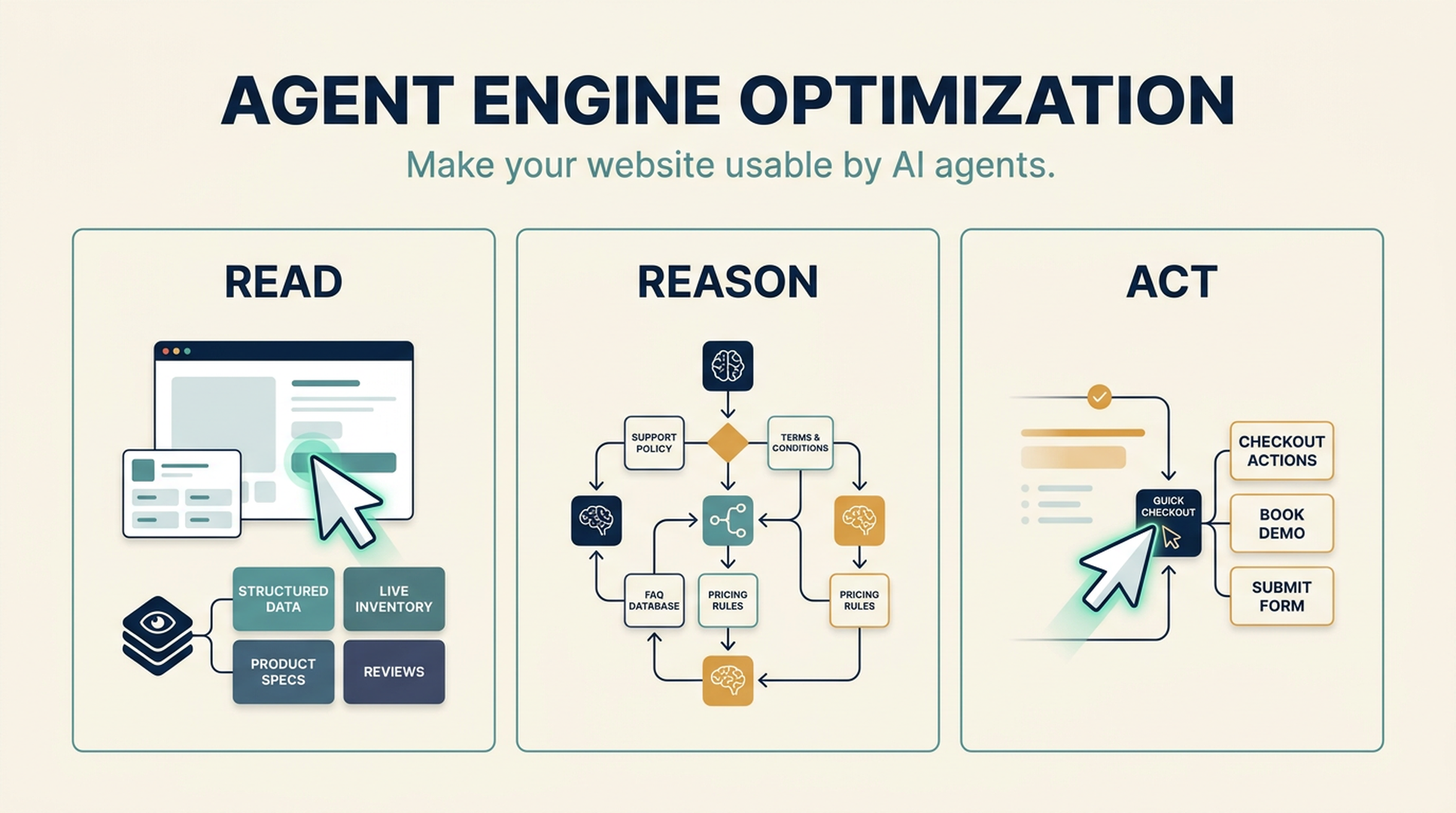
Agent Engine Optimization, or AEO, is the work of making a website easy for AI assistants and autonomous agents to read, trust, compare, and act on. It is close to SEO, but the end goal is different. SEO helps a page get discovered. AEO helps an agent understand what the page means and whether it can safely use the page to guide a user.
A recent Microsoft guide on AEO and GEO makes one thing clear: AI shopping and AI search are no longer just answer boxes. They combine crawled web pages, structured feeds, product data, reviews, policies, live page content, and agent actions such as navigation or checkout. This means growth teams need a new layer of optimization: agent-readable data, agent-friendly content, and agent-safe user journeys.
For most companies, the practical starting point is simple:
- Make product and service data machine-readable.
- Write pages around real user questions, comparisons, constraints, and use cases.
- Show trust signals that an AI system can verify.
- Remove the friction that blocks an agent from completing useful tasks.
If GEO is about being cited or recommended by generative systems, AEO is about being usable by the agent layer that sits between the user and the website.
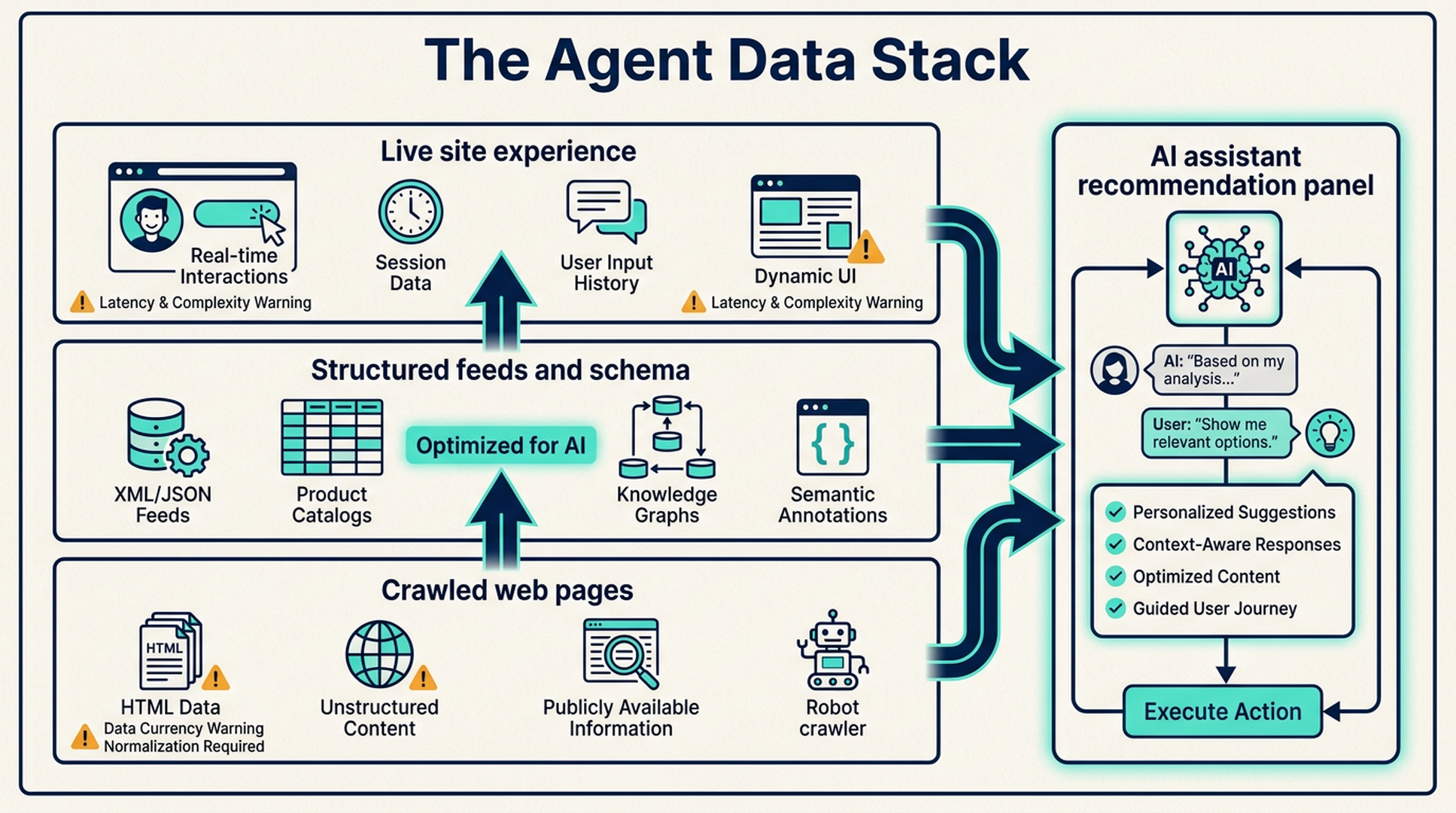
The agent data stack: crawled pages shape baseline understanding, structured feeds improve accuracy, and live site experience determines whether an agent can act with confidence.
What Microsoft's AEO guide gets right
Microsoft describes a shift from discovery to influence. That phrase is useful because it separates the old search habit from the new agent habit.
The old question was: "Can a user find us?"
The new question is sharper: "When an AI assistant compares options, can it understand, trust, and recommend us?"
That changes the optimization target. A product page cannot be written only for a human scanning above the fold. It also needs to serve several non-human readers:
Reader | What it needs | What often breaks |
|---|---|---|
Search crawler | Indexable content, canonical URLs, structured markup | JavaScript-only content, thin pages, duplicate templates |
AI answer system | Clear facts, definitions, comparisons, evidence | Vague marketing copy, missing context, unsupported claims |
Shopping assistant | Price, availability, specs, reviews, delivery terms | Stale feeds, mismatched schema, unclear variants |
AI agent | Navigable flows, stable actions, readable forms and policies | Modal traps, hidden checkout steps, inconsistent labels |
The useful part is that AEO does not replace SEO. It extends it. If a website is technically weak, poorly structured, and light on evidence, agents have less to work with. But a technically sound SEO page can still fail AEO if it does not answer how people actually ask, compare, and decide.
AEO is not only "answer engine optimization"
Many marketers use AEO to mean Answer Engine Optimization. That definition still matters. Clear answers, FAQ blocks, entity descriptions, and extractable paragraphs help AI systems summarize a page.
But the agent version of AEO goes further. Agent Engine Optimization asks whether an AI assistant can perform a useful task with your website as a source or destination.
For example:
- Can it compare your product against alternatives without guessing?
- Can it tell whether a price, plan, integration, or delivery promise is current?
- Can it find policies such as refunds, warranty, privacy, shipping, or cancellation?
- Can it identify which reviews are verified and which claims are supported?
- Can it move through a quote, booking, checkout, or lead form without hitting a dead end?
This is why AEO sits closer to product operations than traditional content marketing. It touches SEO, content, analytics, product feeds, customer support, web engineering, and conversion design.
A useful mental model:
- SEO makes the page discoverable.
- GEO makes the brand and content recommendable.
- AEO makes the website actionable for agents.
For a deeper category view, Auspia keeps related resources under the AEO topic hub.
The three data sources agents care about
An AI assistant does not rely on one clean input. It builds a view from several imperfect sources.
The Microsoft framing points to three useful buckets: crawled data, structured feeds or APIs, and real-time site data. This is the right way to think about agent readiness because each source answers a different question.
Data source | What it tells the agent | AEO work to do |
|---|---|---|
Crawled pages | What the brand is, what the product does, how it is positioned | Strong page structure, crawlable content, clear category language, internal links |
Structured feeds and schema | What is current and comparable | Product, offer, review, organization, FAQ, breadcrumb, and policy markup |
Live site experience | What the agent sees when it visits now | Current pricing, stock, delivery time, forms, media, reviews, checkout state |
Most AEO failures come from a gap between those buckets. The page says one thing, schema says another, and the feed is two weeks old. A human might notice and work around it. An agent may not. It may simply choose a cleaner competitor.
Strategy 1: build a technical foundation agents can read
The first AEO job is not clever copy. It is consistency.
Your public pages, structured data, product feeds, and visible user experience should agree with each other. If the page says "free returns for 30 days" but the policy page says "14 days," the agent has a trust problem. If the product schema says an item is in stock while the visible page says sold out, the agent has an accuracy problem.
A practical foundation includes:
- Schema for Organization, Product, Offer, Review, FAQPage, BreadcrumbList, Article, LocalBusiness, or SoftwareApplication where relevant.
- Dynamic fields for price, availability, delivery time, plan limits, and promotion dates.
- Stable canonical URLs for important product, service, comparison, and policy pages.
- Clean robots and crawler access rules, including decisions about AI crawlers.
- XML sitemaps and internal links that expose the pages agents need to verify claims.
- Product or service feeds that match the visible website.
This is also where many teams should inspect their AI crawler policy. A blocked crawler can mean fewer AI references. An open crawler with weak content can mean poor summaries. Use the Robots.txt AI Crawler Checker if you need a quick first pass.
Strategy 2: write pages around intent, not slogans
Agents are very good at ignoring vague positioning. They need facts that map to questions.
Bad product copy says:
"A modern solution for high-performing teams."
Agent-friendly product copy says:
"A project management tool for agencies that need client approvals, time tracking, and invoice-ready reports in one workspace."
That second version gives the assistant something to compare. It names the category, audience, use case, and differentiators.
For AEO, each priority page should include modular blocks that can be lifted, summarized, or cross-checked:
- Who it is for.
- Who it is not for.
- Main use cases.
- Pricing or plan logic.
- Limits and constraints.
- Comparison with alternatives.
- Setup requirements.
- Reviews or evidence.
- Policy details.
- FAQ written in the language users actually ask.
This does not mean stuffing the page with generic FAQs. It means answering the questions a buyer, assistant, or agent must resolve before making a recommendation.
For ecommerce, that might include size guidance, materials, compatibility, delivery windows, return rules, and verified customer sentiment. For SaaS, it might include integrations, data security, migration effort, support response times, usage limits, and ideal customer profiles.
Strategy 3: make trust signals visible and verifiable
AI assistants are cautious when they recommend. They prefer sources that look stable, specific, and verifiable.
This means trust needs to be visible in the content and readable in the data layer. A few trust signals matter more than polished brand claims:
Trust signal | Why agents may use it | How to improve it |
|---|---|---|
Verified reviews | Confirms real customer experience | Mark review source, date, rating, product variant, and moderation rules |
Clear policies | Reduces risk in recommendations | Publish refund, cancellation, warranty, shipping, privacy, and support pages |
Entity consistency | Helps systems connect the brand across sources | Keep name, address, social profiles, founder data, product names, and category terms consistent |
Third-party proof | Gives external confirmation | Add certifications, partner pages, press mentions, marketplace listings, and case studies |
Claim evidence | Prevents unsupported summaries | Tie performance claims to data, methodology, dates, and limitations |
The hard part is honesty. If a page exaggerates, hides limitations, or uses invented authority language, it may sound good to a buyer for five seconds. It is weak material for an assistant that needs to justify a recommendation.
Auspia's bias is to write the limitation directly. "Best for teams with more than 500 monthly support tickets" is more useful than "built for teams of all sizes." Clear boundaries help agents recommend you in the right situation.
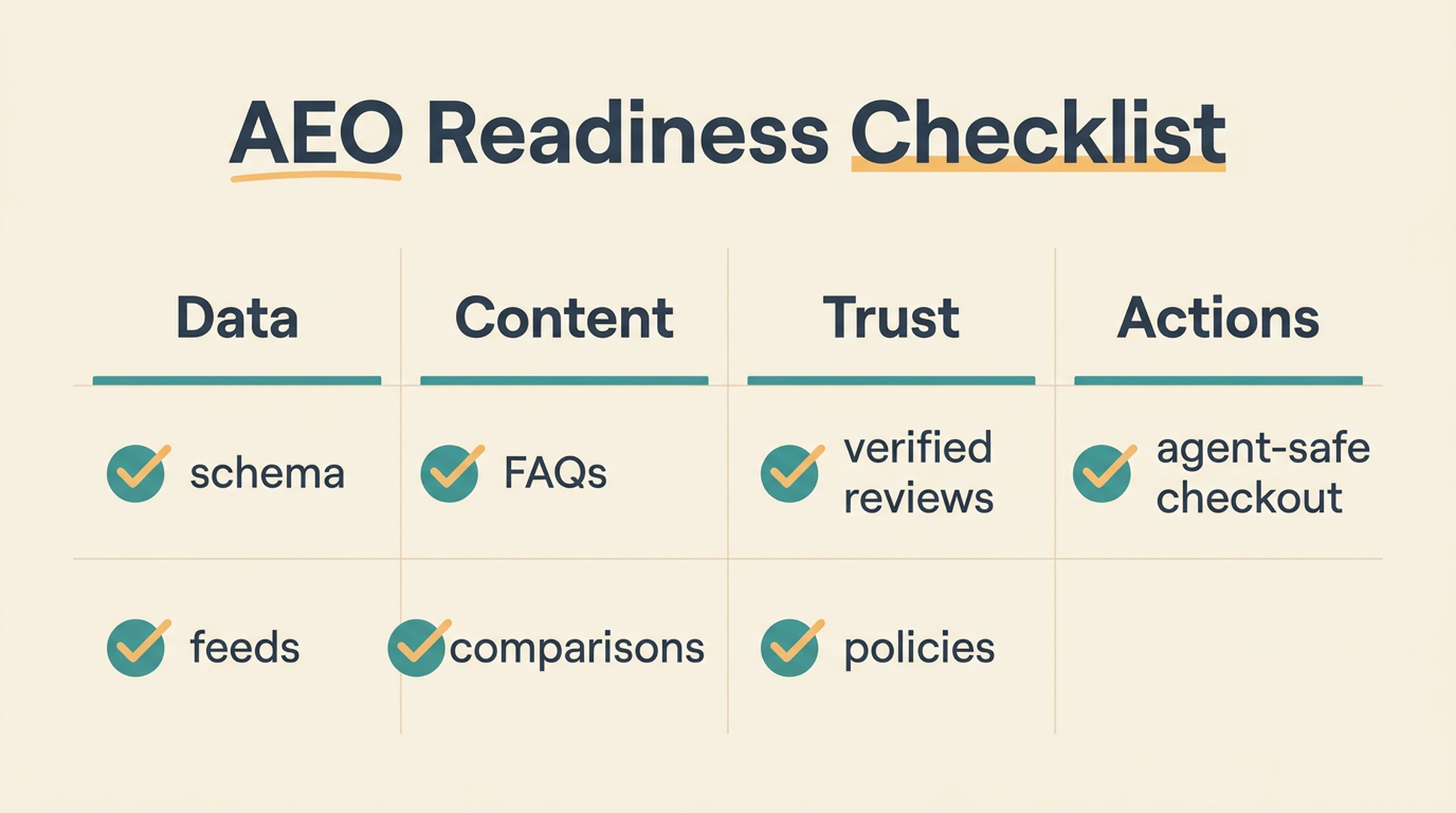
AEO readiness is easier to manage when teams audit data, content, trust, and agent actions as separate workstreams.
Strategy 4: optimize the action layer
This is where Agent Engine Optimization becomes different from classic answer optimization.
If agents only read your page, content quality matters most. If agents can act, the journey matters too.
Look at the tasks an agent might perform on behalf of a user:
- Find the right product variant.
- Compare pricing plans.
- Check delivery availability.
- Book a demo.
- Request a quote.
- Add an item to cart.
- Start a return.
- Download a report.
- Submit a support request.
Each task depends on interface clarity. Agents struggle with ambiguous buttons, popups that block the page, forms with hidden requirements, and policy pages that contradict checkout flows.
AEO teams should audit main flows with a simple question: "Could an assistant explain this step and complete it without guessing?"
That question quickly exposes the broken parts: unlabeled form fields, plan pages without feature limits, checkout pages that reveal fees late, or demo forms that do not explain what happens next.
A 30-day AEO audit plan
AEO can get complicated, but the first audit does not need to be huge. Start with the pages that influence revenue or qualified demand.
Week | Focus | Output |
|---|---|---|
1 | Inventory pages and data sources | List of priority pages, feeds, schema types, policies, and crawler rules |
2 | Compare visible content against structured data | Mismatch report for price, availability, claims, reviews, policies, and entity data |
3 | Rewrite high-intent sections | Updated FAQs, comparison blocks, use cases, constraints, and trust modules |
4 | Test agent-like journeys | Flow notes for quote, checkout, demo, booking, support, and policy verification |
The audit should produce fixes, not a theoretical score. A good deliverable is a spreadsheet with four columns: issue, affected page, why it matters for agents, and owner.
Here is a starting checklist:
- Does every priority page clearly state who the product or service is for?
- Are prices, plans, inventory, and availability current across visible pages and feeds?
- Can crawlers access the content needed to understand and verify the page?
- Do pages include structured data that matches what users see?
- Are reviews, testimonials, and case studies dated and attributable?
- Are policies easy to find from commercial pages?
- Do comparison pages explain tradeoffs instead of only praising the brand?
- Can an agent complete or explain the main conversion flow?
What most teams will miss
Most teams will treat AEO as another content format. They will add a few FAQ blocks, rewrite headings into question form, and call it done.
That helps a little, but it misses the deeper issue. Agents do not only need answers. They need dependable context.
The bigger AEO gains usually come from fixing messy operational details: inconsistent product data, thin policy pages, crawl blocks, missing review context, old pricing snippets, unclear variants, weak comparison pages, and forms that make no sense outside a human browser session.
This is why AEO belongs on the growth roadmap, not only the blog calendar.
Auspia takeaway
The strongest AEO strategy is boring in the best possible way: accurate data, clear pages, visible proof, and clean actions.
A brand does not win agent recommendations because it uses the newest acronym. It wins when an AI assistant can answer three questions with confidence:
- What exactly is this company offering?
- Why is it a credible option for this user's situation?
- What can the user or agent do next without risk or confusion?
If those answers are easy to extract, your website is closer to being agent-ready. If they are scattered across old pages, stale feeds, and vague claims, AEO is the work of putting them back together.
FAQ
What is Agent Engine Optimization?
Agent Engine Optimization is the practice of making websites, product data, content, and conversion flows easier for AI agents to understand and use. It includes technical SEO, structured data, clear content, trust signals, and agent-friendly actions.
How is AEO different from SEO?
SEO focuses on discoverability in search engines. AEO focuses on whether AI assistants and agents can interpret, trust, compare, recommend, and sometimes act on information from your site.
Is AEO the same as Answer Engine Optimization?
Not exactly. Answer Engine Optimization focuses on being summarized in direct answers. Agent Engine Optimization also includes data feeds, live site experience, policies, forms, checkout flows, and other action paths that agents may need.
Does AEO replace GEO?
No. GEO helps generative systems cite, summarize, and recommend your brand or content. AEO makes the site and data usable by agentic systems that can reason through options and take actions.
What should an ecommerce team fix first?
Start with product schema, product feeds, visible product details, inventory, price, delivery terms, return policy, verified reviews, and checkout clarity. These are the signals assistants need when comparing products.
What should a SaaS team fix first?
Start with plan pages, use case pages, integration pages, security and privacy pages, migration details, support policy, pricing limits, comparison pages, and demo or signup flows.