Direct answer
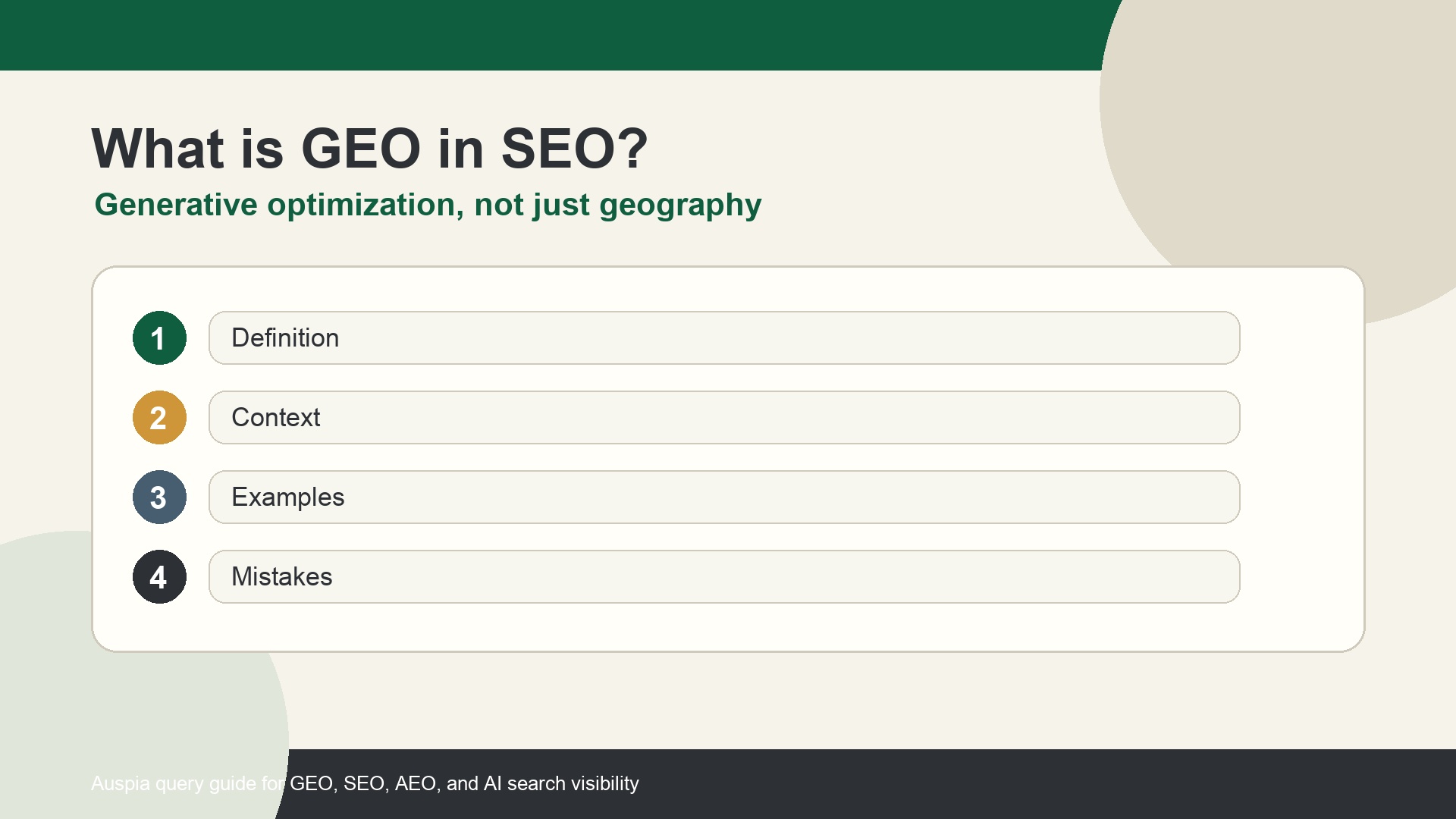
In 2026 SEO conversations, GEO usually has two meanings. The older meaning is geographic SEO: optimizing for a location, market, city, or country. The newer meaning is generative engine optimization: improving how your brand is understood, mentioned, and cited in AI-generated answers.
If the query says "GEO vs SEO," "generative engine optimization," "AI SEO," or "AI search," it usually means generative engine optimization. If the query says "geo-targeted SEO," "local SEO," "near me," "city pages," or "geotagging," it usually means location-based SEO.
Why the meaning changed
For years, SEO teams used "geo" as shorthand for geography. A local dentist wanted to rank in Dallas. A SaaS company wanted English pages for the United States, Germany, and Singapore. An ecommerce brand wanted country-specific category pages. That was geo-targeted SEO.
AI search changed the language. Marketers now use GEO to mean generative engine optimization because AI answer systems do not behave like a classic list of links. They synthesize claims, cite sources, compare vendors, and recommend options. A brand can rank on Google yet still be absent from a ChatGPT, Perplexity, Gemini, or AI Overview-style answer.
That is the new GEO problem.
The two meanings side by side
Term | What it means | Example query | Main metric |
|---|---|---|---|
Geo-targeted SEO | Optimizing for a location or market | "best tax advisor in Austin" | Local rankings, map visibility, calls, visits |
Generative engine optimization | Optimizing for AI-generated answers | "which tax software is best for consultants" | AI mentions, citations, share of answer, accuracy |
The overlap is real. A local company may need both. A clinic, law firm, agency, restaurant group, or home service provider still needs local SEO. But those buyers may also ask AI assistants for recommendations, comparisons, and checklists. That is where generative GEO enters.
Examples of GEO in an SEO workflow
A normal SEO page might target "project management software for agencies." A GEO-ready version also answers:
- What type of agency is this best for?
- Which alternatives are commonly compared?
- What integrations matter?
- What evidence supports the claims?
- Can an AI answer quote a clean definition or comparison from the page?
- Do third-party sources describe the brand the same way?
For a local business, the same logic applies. A local SEO page might target "family lawyer in Denver." A GEO-ready page also supports AI prompts such as "what should I ask before hiring a family lawyer in Denver" or "which Denver family law firms handle mediation."
How to tell which GEO a query means
Use this quick rule:
Query includes | Treat it as |
|---|---|
"AI," "AEO," "LLM," "AI Overview," "ChatGPT," "generative" | Generative engine optimization |
"near me," city names, country pages, maps, Google Business Profile | Geo-targeted SEO |
"GEO vs SEO," "what is GEO in SEO context" | Explain both, then clarify the modern AI meaning |
"geotagging photos" | Local SEO tactic, not AI-search GEO |
What to do next
Do not let the acronym drive the strategy. Start with the user's intent.
If the business needs more local leads, work on local SEO foundations: Google Business Profile, local pages, reviews, service-area clarity, citations, and local links.
If the business already has search visibility but is missing from AI answers, work on generative GEO: entity facts, prompt checks, citation-worthy content, third-party validation, and answer-ready pages.
For the full comparison, read Auspia's hub article on what GEO vs SEO means.
FAQ
What does GEO stand for in SEO?
It can stand for geographic targeting or generative engine optimization. In modern AI search discussions, GEO usually means generative engine optimization.
Is GEO the same as local SEO?
No. Local SEO optimizes for geographic search demand. Generative GEO optimizes for AI-generated answers, mentions, and citations.
Should local businesses care about generative GEO?
Yes, once local SEO basics are in place. Buyers increasingly ask AI systems for recommendations, comparisons, and pre-purchase questions.
Is there a schema type for GEO?
There is no universal "GEO schema" for generative optimization. Use relevant structured data such as Organization, LocalBusiness, Product, Service, FAQPage, Article, BreadcrumbList, and review-related markup where appropriate.
Author: Lydia Hart, Brand Entity Strategist for 200+ Entity Audits at Auspia. Lydia writes about search intent, AI search visibility, and practical organic growth systems for teams that need clearer decisions.