Before you try to be cited, make sure AI can describe you correctly
Many businesses start GEO by asking, "How do we get mentioned in ChatGPT?" The more useful first question is: what would a customer be told if they asked about us today?
If the answer is missing, vague, outdated, or wrong, publishing more AI-flavoured content will not fix the underlying fact problem. You need one accurate answer asset or correction first.
This lesson gives Codex a small approved prompt set and your owned facts. It returns an AI Answer Gap Card. The card records what was observed, what is unknown, and the first page or public fact to improve.
Definition of done: You have checked three to five real customer questions, saved one observed gap, and selected one correction or answer asset. You do not have a made-up citation score.
Allow 45 to 60 minutes. Bring three customer decision questions, one market and language, copied answer text where you can lawfully observe it, and the facts your business controls. You do not need a paid AI visibility tool.
Pick questions customers would actually ask
Create a tiny prompt log before you test anything
Do not open five AI tools and start typing variations of your brand name. Make a plain text or spreadsheet file named ai-answer-prompt-log.csv with these columns:
Prompt | Customer moment | Market/language | Platform | Date checked | Answer saved? |
|---|---|---|---|---|---|
Who offers monthly bookkeeping for freelance designers in Bristol? | Choosing a service | UK / English | [platform] | 2026-07-29 | yes/no |
What records should a UK freelance designer prepare before self-assessment? | Preparing for a deadline | UK / English | [platform] | 2026-07-29 | yes/no |
Does [brand] file personal tax returns? | Checking service fit | UK / English | [platform] | 2026-07-29 | yes/no |
Use one market and language in your first pass. A result in US English may be irrelevant to a UK local service, and a prompt that is too broad will produce a generic list rather than a business decision. Save the answer text exactly as you saw it, plus the date. You are recording an observation, not measuring a permanent AI ranking.
What you need: three to five decision questions, one market/language, and a short list of controlled facts. You do not need an AI visibility platform. If a platform blocks your test, record NOT OBSERVED rather than scraping it or asking Codex to invent an answer.
Build a controlled-facts sheet
Next, write the facts a customer must receive correctly. Include a source for each one:
FACT: We provide monthly bookkeeping for sole-trader designers.
STATUS: CONFIRMED.
SOURCE: /bookkeeping-for-designers, reviewed 2026-07-29.

FACT: We file personal self-assessment tax returns.
STATUS: FALSE / DO NOT CLAIM.
SOURCE: service terms, reviewed 2026-07-29.

FACT: We work only with Bristol customers.
STATUS: NEEDS OWNER FACT.
SOURCE: none; current website is unclear.
The difference between FALSE and NEEDS OWNER FACT matters. A false claim needs correction if it appears. An unknown cannot be used to accuse an AI answer of being wrong.
Use questions that could influence a visit, inquiry, purchase, or booking. Do not test vanity prompts such as Is [brand] good? unless that is a real decision question in your market.
Business | Useful question shape |
|---|---|
Content site |
|
SaaS |
|
Ecommerce |
|
Local business |
|
Write three to five prompts. For each, note language and market. Then collect the facts you would want an answer to state correctly: product/service name, location, audience fit, price boundary, policy, compatibility, or process. Use only facts you can prove on an owned page or approved document.
Give Codex a controlled comparison task
You may paste answer text from an AI platform, or let Codex inspect public answer pages only where your environment and the platform permit it. The easiest beginner path is to paste the answers you saw.
You are my AI Answer Gap analyst.

My business facts I can prove:
[paste bullets with source URLs or document paths]

Customer prompts, market, and language:
1. [prompt] | [market/language]
2. [prompt] | [market/language]
3. [prompt] | [market/language]

Observed AI answers, if I have them:
[paste answer text and platform name, or write NOT OBSERVED]

Create an AI Answer Gap Card with:
1. OBSERVED ANSWER: quote or summarize only what I supplied; label unobserved
   prompts as not checked.
2. FACT CHECK: correct, incomplete, wrong, or cannot verify for each claim.
3. HIGHEST-IMPACT GAP: choose one fact or answer missing from the customer
   decision.
4. FIRST FIX: choose one owned page to improve or one answer asset to create.
5. EVIDENCE NEEDED: facts, source links, examples, or policy text I must add.
6. SAFE NEXT PROMPT: one question I can re-check later.

Do not claim a citation, ranking, referral visit, or platform policy unless I
supplied evidence. Do not edit profiles, send corrections, publish a page, or
invent public facts.
Grade the card with a claim-by-claim check
For the bookkeeping example, imagine an observed answer says: "[Brand] helps Bristol freelancers file their self-assessment tax return." Your card should not jump to "AI search is wrong about us." It should split the claim:
Observed claim | Controlled fact | Verdict | First response |
|---|---|---|---|
Brand helps Bristol freelancers | Service page says monthly bookkeeping for designers | Incomplete | Clarify audience and service area on controlled page |
Brand files tax returns | Terms say it does not | Wrong | Add a clear scope boundary and check controlled profiles |
Bristol-only service | No approved source | Cannot verify | Ask owner before changing copy or requesting a correction |
That is an AI Answer Gap Card doing useful work. It tells you what is observed, what you control, and what you must not claim.
Bad output: Create 100 GEO articles and add FAQ schema everywhere.
Why it fails: it treats a factual problem as a volume problem. A customer still cannot tell the service boundary, and the next AI answer may repeat the same ambiguous source.
If Codex produces generic GEO tactics, use this repair instruction:
Stop proposing visibility tactics. Work only from the observed answer text and
the controlled-facts sheet. Identify one customer-decision fact that is wrong,
missing, or ambiguous. Then choose one controlled page or answer asset that
could state that fact clearly. Mark anything else unknown.
Turn an answer gap into something useful for people first
Suppose an AI answer says a local clinic offers a treatment it does not offer. The first fix might be a clear service page with eligibility, alternatives, and booking details, plus correction of controlled public facts. It is not a hidden block of keywords saying "we do not offer [treatment]" fifty times.
Suppose an AI answer can name your SaaS but cannot explain who it fits. The first answer asset might be a comparison or use-case page with workflow, integration facts, limits, and setup steps.
The best GEO asset is still useful if no AI system quotes it. It helps the visitor decide and gives search systems a cleaner source to retrieve.
Turn the selected gap into an owner-approved change sheet
Do not begin by submitting a correction to a third-party profile or messaging a platform. First improve the source you control. Use this prompt after you have approved one gap:
Read the approved AI Answer Gap Card and controlled-facts sheet. Prepare a
change sheet for [owned page URL or local file] that will help a customer get
the fact right. Include:

1. The exact customer question the page must answer.
2. The current wording or missing section that creates ambiguity.
3. Proposed replacement copy using CONFIRMED facts only.
4. A visible scope, eligibility, compatibility, price-boundary, or process
   statement where relevant.
5. One next action a qualified visitor can take.
6. A before/after verification note and a re-check prompt for the same AI
   platform, market, and language.

Do not edit the page, change a business profile, contact a platform, claim a
citation, or publish anything.
For the bookkeeping example, the change sheet might add a visible line: We prepare monthly bookkeeping records for sole-trader designers; we do not file personal self-assessment returns. It may also ask the owner to confirm whether service is Bristol-only or UK-wide. This helps people first. It also removes a conflict that answer systems can repeat.
Re-check without fooling yourself
Wait until your approved change is actually live and accessible. Then run the same prompt, on the same platform, in the same language and market, and record the date. A different result is an observation, not proof that the page caused it. Platforms change answers for many reasons.
Your completion artifact is a folder:
ai-answer-gap/
  ai-answer-prompt-log.csv
  controlled-facts.md
  ai-answer-gap-card.md
  approved-change-sheet.md
  recheck-log.md
If the observed answer remains wrong after you improve controlled sources, do not manufacture evidence or repeat submissions. Keep the log, check other controlled facts, and move to Lesson 16 when there is a real public-fact conflict to resolve.
One final rule: do not turn a single surprising answer into a company-wide rebrand. Fix the narrow customer fact you can verify, preserve the log, and repeat the same test later. That discipline is what makes GEO work reviewable instead of superstitious.
Course map
Next: Choose the One Traffic Mission That Makes Every SEO Decision Easier. Later, use Build the Page AI Search Can Quote When Customers Ask Your Best Question for a full answer-asset build.
Completion check
- [ ] I used three to five customer decision questions.
- [ ] Every AI observation is tied to a platform, date, prompt, and market or labelled unobserved.
- [ ] I supplied owned facts rather than asking Codex to guess.
- [ ] The card chooses one correction or answer asset.
- [ ] No public profile or page was changed automatically.
- [ ] I saved the observed answer text with platform, date, market, and language.
- [ ] Each claim is marked correct, incomplete, wrong, or cannot verify.
- [ ] I have an owner-approved source-page change sheet before attempting any external correction.
Author: Adrian Cole, Analyst of 1,000+ AI Search Results at Auspia. Adrian writes about turning AI-answer observations into accurate, useful source pages.
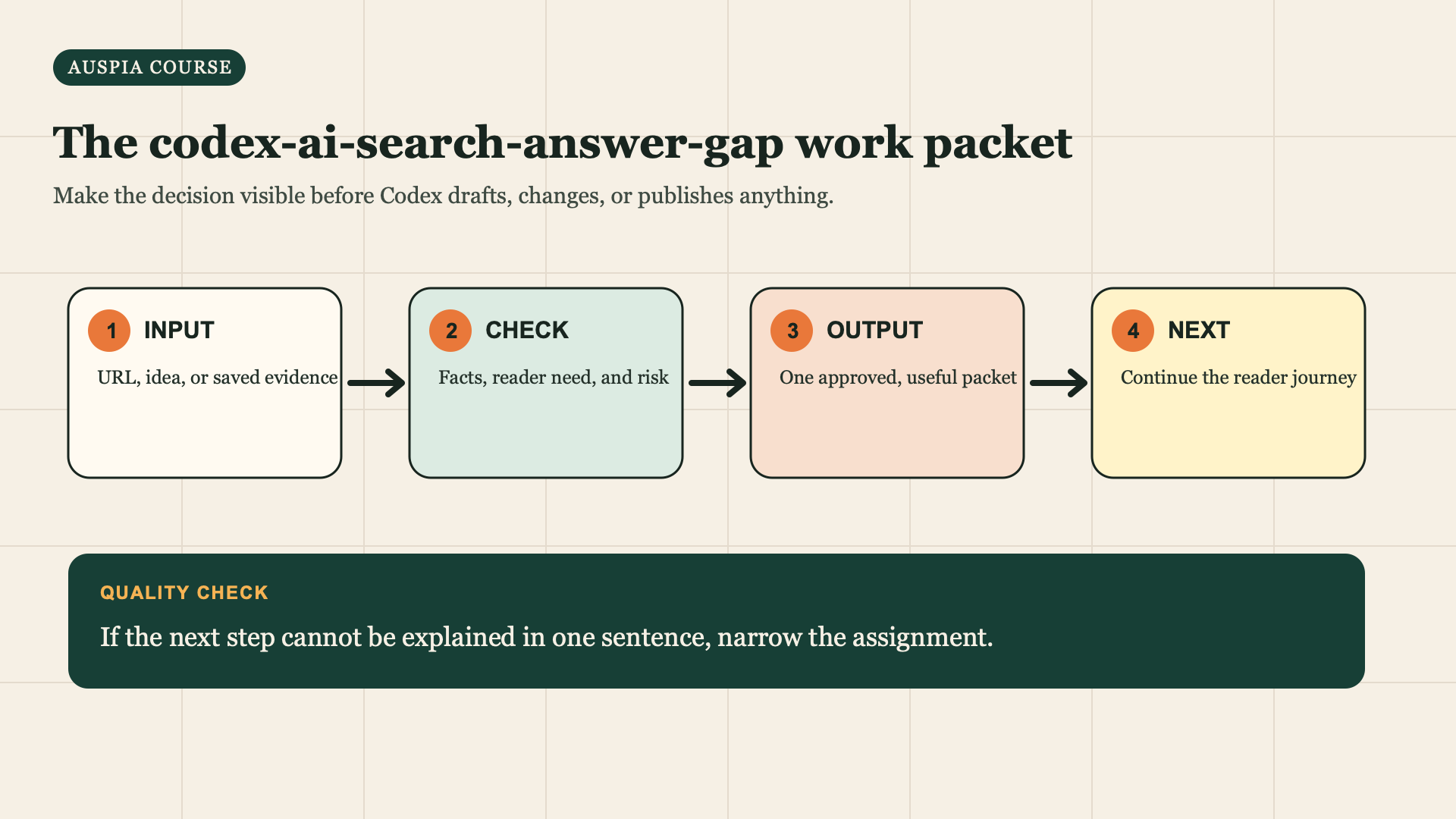
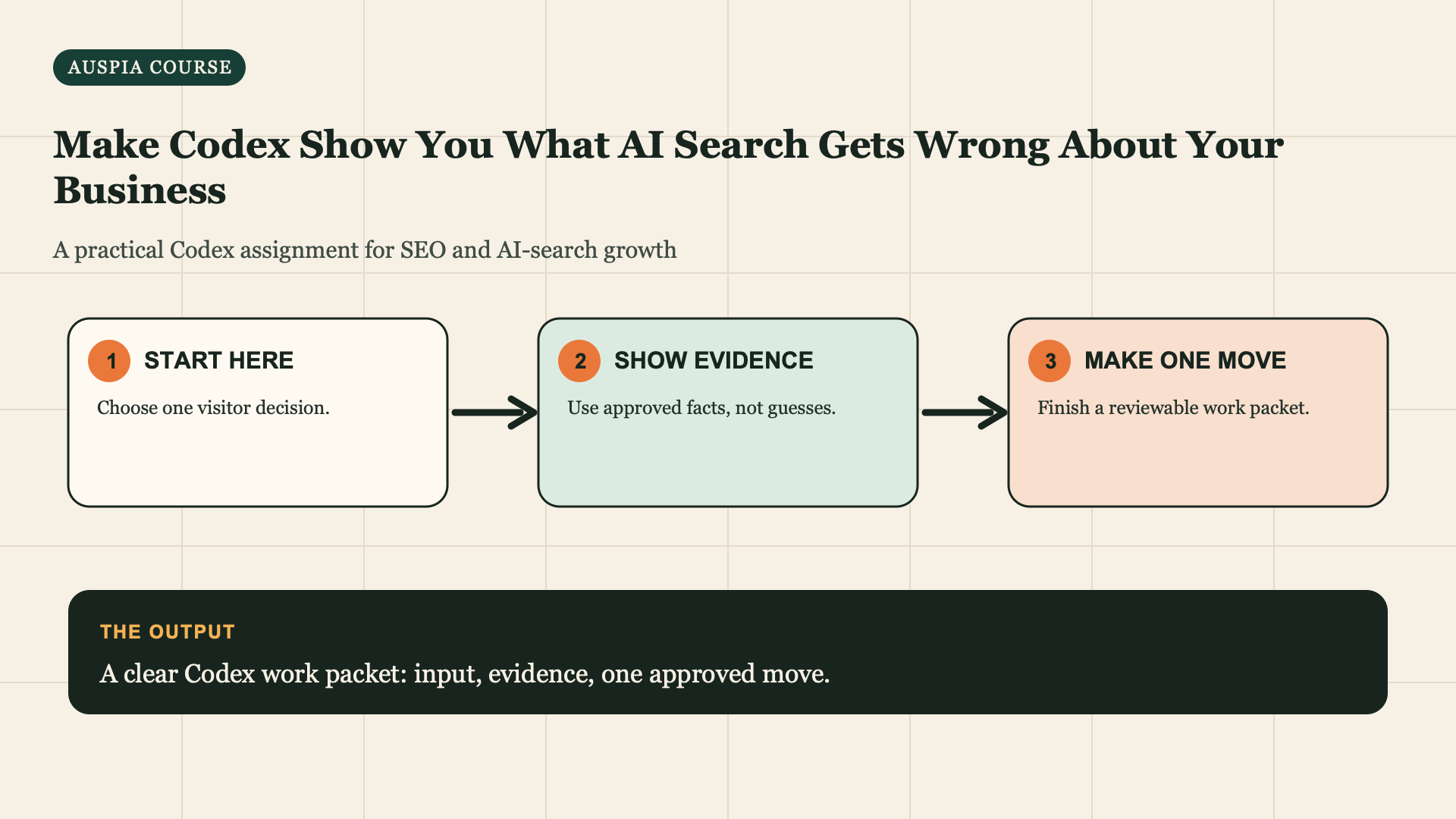
Use this sequence for the assignment: start with a real input, check the evidence, prepare one reviewable output, then choose the reader next step.