Direct answer: GEO vs SEO in one minute
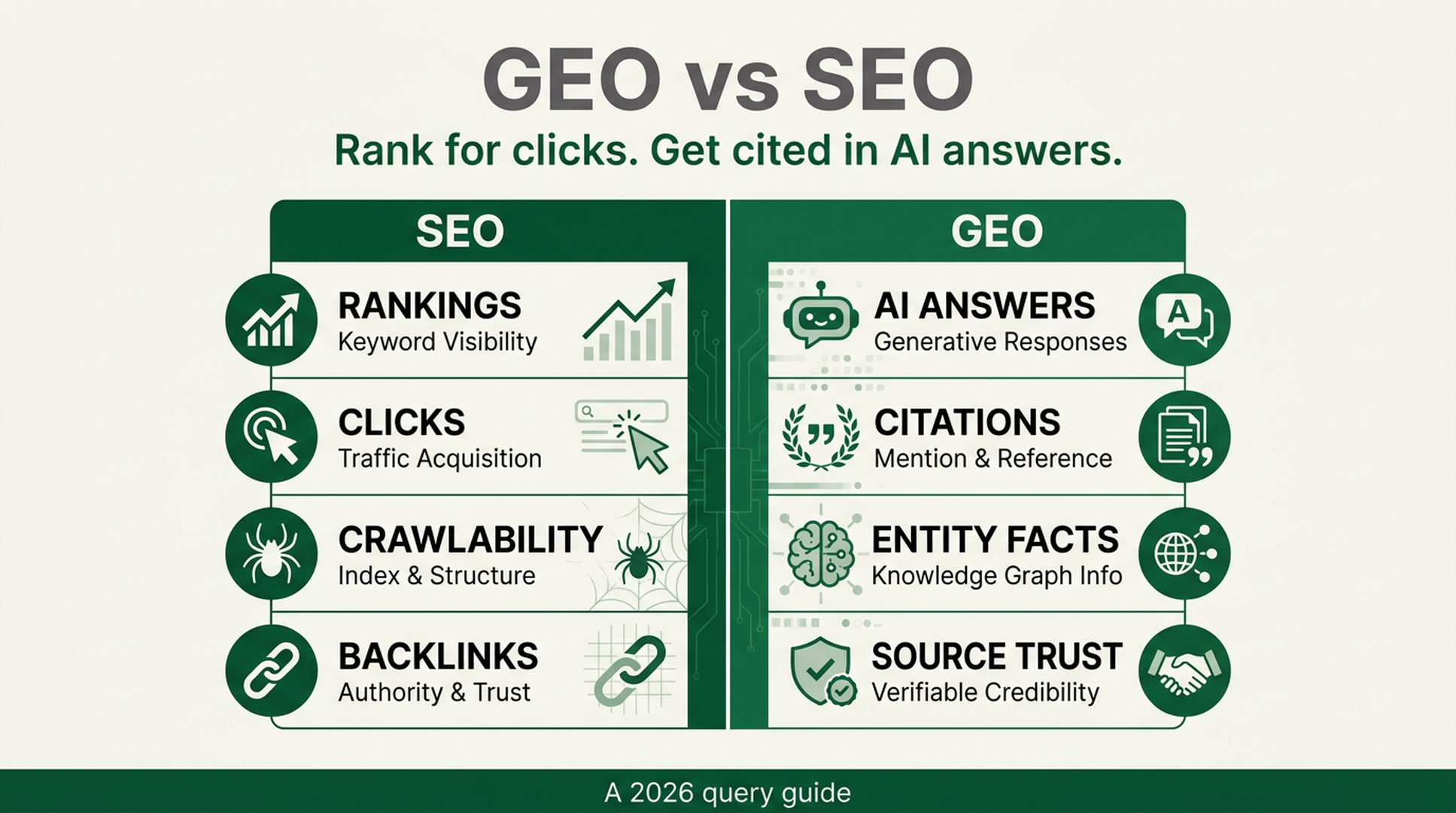
GEO, short for generative engine optimization, is the practice of making your brand, content, and evidence easier for AI answer systems to find, understand, trust, and cite. SEO, short for search engine optimization, is the practice of making pages easier for search engines to crawl, rank, and send traffic to.
The difference is simple:
- SEO asks: "Can this page rank for a query and earn a click?"
- GEO asks: "Can an AI system confidently use this brand or page in an answer?"
- AEO asks: "Can this content become the direct answer to a specific question?"
You do not need to pick one. In 2026, the strongest visibility strategy uses SEO as the technical and authority base, AEO as the answer-format layer, and GEO as the AI citation and brand-retrieval layer.
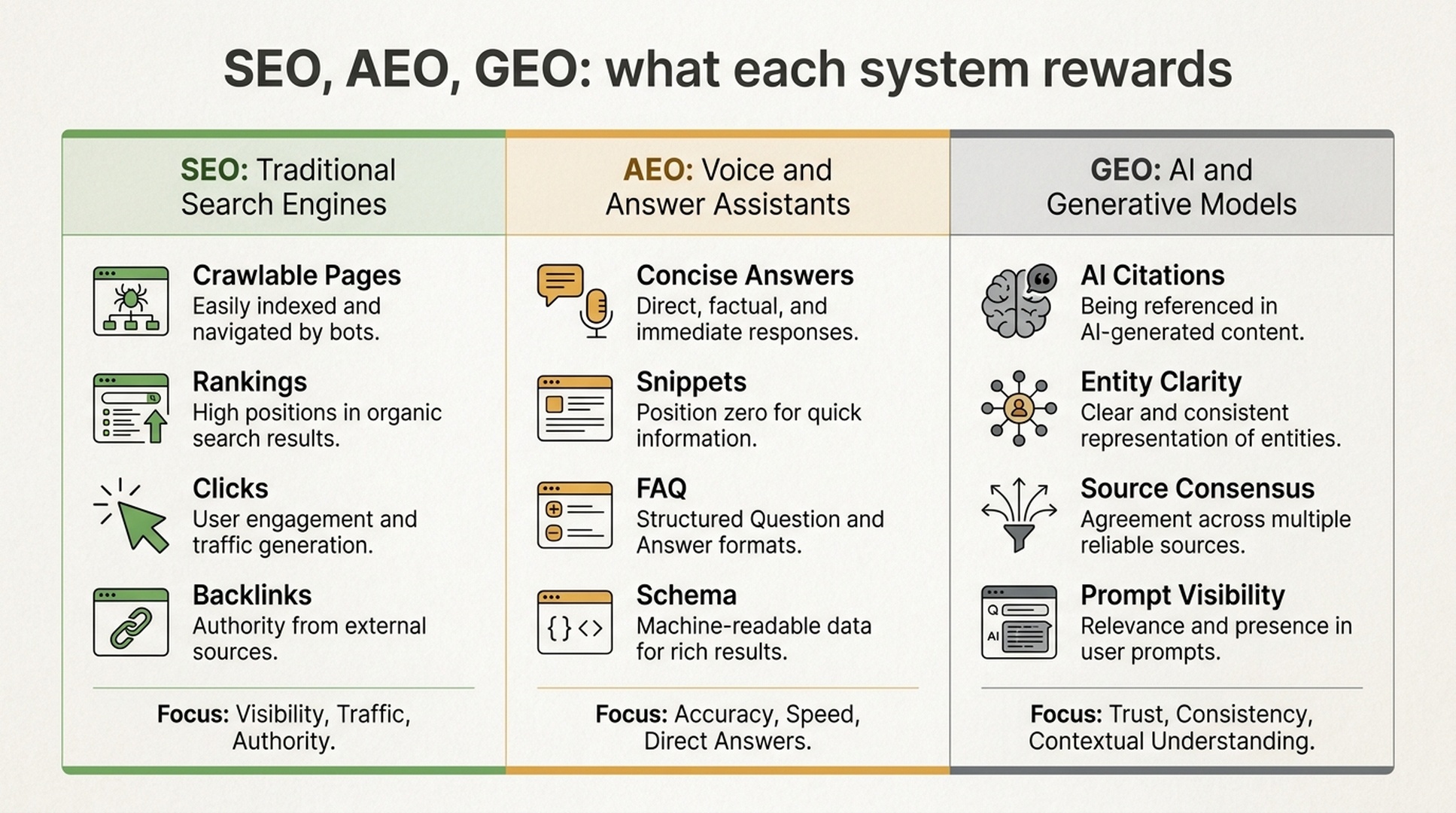
SEO, AEO, and GEO overlap, but they reward different signals. SEO still matters because AI systems cannot cite what they cannot discover, parse, or trust.
Why this question is confusing
The keyword list behind this article has hundreds of near-duplicates: "what is geo vs seo," "what is geo in seo context," "what does geo stand for in seo," "SEO vs GEO which is better," "what is AEO GEO SEO," and "how do I integrate GEO with SEO."
That confusion is reasonable. "GEO" used to mean geography in many SEO conversations: geo-targeted SEO, local SEO, geo tags, regional landing pages, Google Business Profile, local citations, and country-specific rankings. Now marketers also use GEO to mean generative engine optimization.
So when someone asks "what is GEO in SEO," they may mean one of two things:
Query wording | Usually means | Best answer |
|---|---|---|
"geo-targeted SEO" or "local geo SEO" | Location-based SEO | Optimize pages, listings, reviews, and local relevance for a city, region, or country. |
"GEO vs SEO" or "generative engine optimization" | AI search visibility | Optimize content and brand evidence so AI systems can mention and cite you. |
"SEO GEO AEO" | Search visibility acronyms | SEO ranks pages, AEO wins direct answers, GEO earns presence in AI-generated responses. |
"GEO in SEO context 2026" | Modern AI-search meaning | GEO is an added layer on top of SEO, not a replacement for SEO. |
This article uses GEO to mean generative engine optimization. When we discuss location-based SEO, we will call it geo-targeted SEO or local SEO.
What is SEO?
SEO is the work of improving a website's visibility in organic search results. A strong SEO program usually covers four areas:
- Technical access: crawlable pages, indexable URLs, fast loading, clean internal links, structured data, and canonical signals.
- Search intent: pages that match what users want to know, compare, buy, troubleshoot, or validate.
- Content quality: useful explanations, examples, visuals, original evidence, clear authorship, and updated information.
- Authority: links, mentions, reputation, topical coverage, and trust signals from other relevant sources.
SEO success is usually measured with rankings, impressions, clicks, click-through rate, conversions, indexed pages, and revenue influenced by organic search.
SEO is still the foundation. Google says site owners should focus on making pages eligible and useful for Search's AI features through the same core principles: make content crawlable, indexable, useful, and eligible for snippets. That matters because many AI answer experiences are still connected to search indexes, web retrieval, or source documents.
What is GEO?
GEO is the work of improving how your brand appears in AI-generated answers from systems such as ChatGPT, Perplexity, Gemini, Google AI Overviews, Copilot, Claude with web access, and other AI search or answer tools.
A GEO program looks at questions like these:
- Does the AI answer mention your brand when buyers ask about your category?
- Does it cite your content, or only your competitors and third-party directories?
- Does it describe your product accurately?
- Does it understand who you serve, where you operate, and what makes you different?
- Are your claims supported by sources outside your own site?
- Can your pages be summarized into clean, factual answer blocks?
GEO success is measured less by a single ranking position and more by AI answer visibility: mentions, citations, share of answer, sentiment, source inclusion, prompt coverage, factual accuracy, and the quality of traffic or leads that come after AI-assisted discovery.
The term became more visible after the 2023 paper "GEO: Generative Engine Optimization," which studied methods for improving visibility in generative engine responses. The field has changed quickly since then, but the core idea still holds: content must be structured and supported in ways that make it useful to answer-generating systems.
GEO vs SEO: the real differences
The easiest way to compare GEO and SEO is to look at the system making the decision.
Dimension | SEO | GEO |
|---|---|---|
Main target | Search engine result pages | AI-generated answers and summaries |
Primary user action | Click a result | Read, compare, ask a follow-up, sometimes click a citation |
Visibility unit | Ranking page or rich result | Brand mention, cited source, summarized claim, recommendation |
Content requirement | Match search intent and rank | Be extractable, verifiable, and useful for synthesis |
Authority signal | Links, topical authority, site quality, engagement signals | Source trust, consensus across sources, entity clarity, citations, brand facts |
Analytics | Rankings, clicks, impressions, CTR, conversions | Prompt visibility, citations, mentions, answer sentiment, AI referrals, share of answer |
Failure mode | Page does not rank or earn clicks | AI ignores you, misdescribes you, or cites weaker sources |
Traditional SEO often starts with keywords. GEO starts with prompts, buyer questions, comparison scenarios, and source ecosystems.
That does not mean keywords are irrelevant. The same user need may appear as a Google query, a Perplexity question, a ChatGPT prompt, a Reddit thread, a YouTube search, and an AI Overview. The words change. The intent is the asset.
How GEO differs from traditional SEO in practice
A normal SEO workflow might say: find a keyword, assess search volume, create or update a page, improve title tags, build internal links, earn backlinks, monitor rankings.
A GEO workflow adds more checks:
- Map the prompts buyers actually ask AI systems: definitions, comparisons, "best tool for," "which company offers," "how do I integrate," and "what should I do now."
- Check current AI answers across several platforms and record which sources are cited.
- Identify missing entity facts: company category, product use cases, supported markets, proof points, pricing model, integrations, and audience.
- Rewrite content into answerable sections with direct definitions, comparison tables, examples, constraints, and FAQs.
- Add evidence that a model can trust: original data, named sources, clear methodology, third-party mentions, case material, documentation, and review signals.
- Measure whether the brand appears more often, is described more accurately, and earns better citations over time.
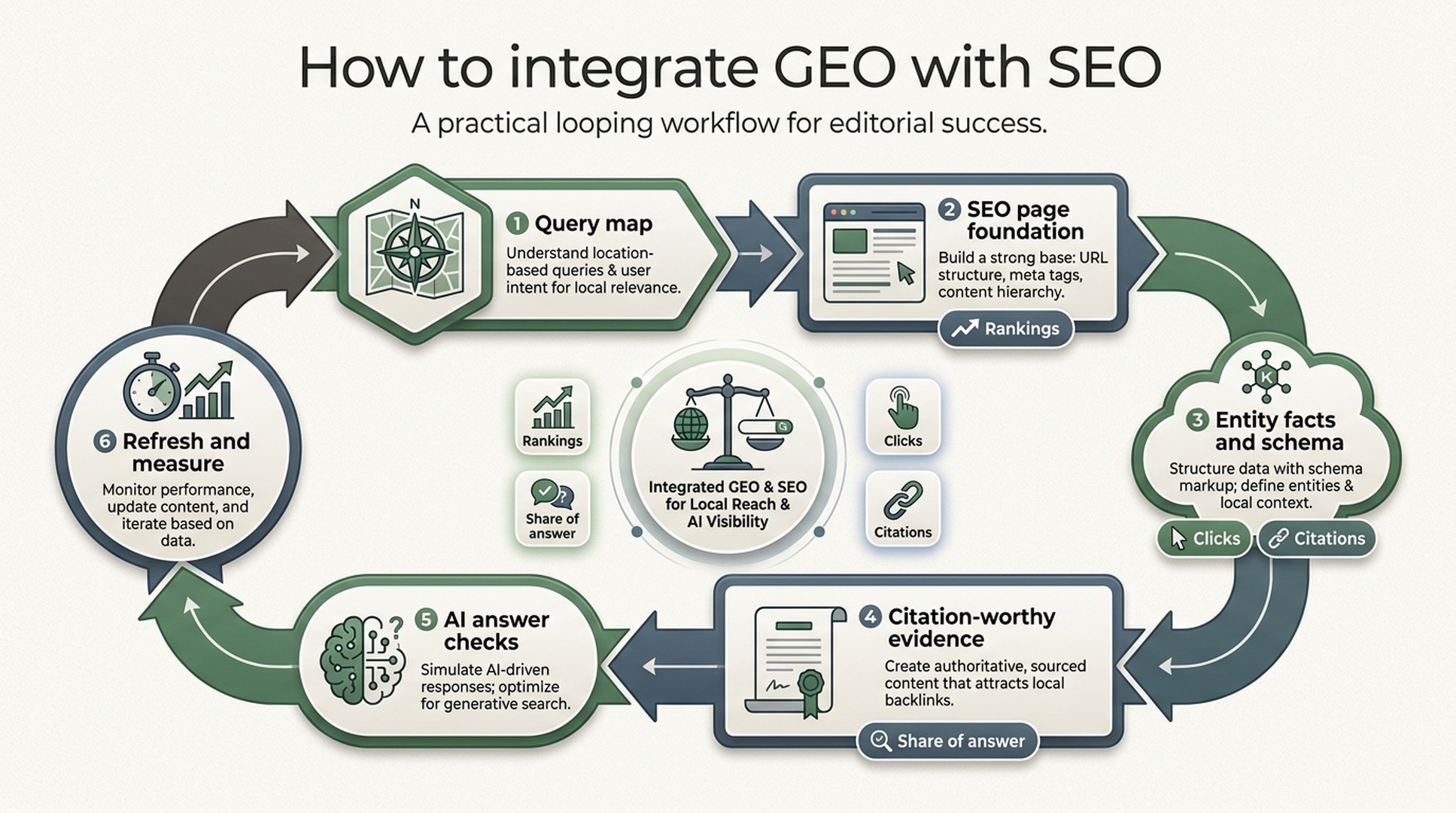
The useful operating model is a loop: build SEO foundations, make the page answer-ready, add evidence, then test how AI systems actually respond.
What about AEO?
AEO, or answer engine optimization, sits between SEO and GEO.
AEO focuses on direct answers: featured snippets, FAQ-style answers, voice assistant responses, People Also Ask patterns, and short answer blocks. AEO content is usually concise, structured, and question-led.
GEO is broader. It is not only about giving the short answer. It is about being included in a generated response that may compare vendors, summarize a market, recommend a tool, explain a workflow, or synthesize several sources.
A practical split:
- Use SEO to get discoverable and competitive in search.
- Use AEO to make your page answer a question cleanly.
- Use GEO to make your brand and evidence usable in AI-generated recommendations and summaries.
If you sell software or services, GEO matters because many buyer prompts are not simple questions. They are evaluative: "Which tool bridges traditional SEO and GEO?" "Which agency understands AI Overviews and GEO?" "What should a SaaS company do about GEO vs SEO in 2026?" Those are recommendation and comparison prompts, not just snippet prompts.
Is GEO more important than SEO?
No. Not for most businesses.
GEO is becoming important because AI answers can reduce clicks, shift buyer research away from classic search pages, and influence which brands make the shortlist. But SEO still supplies the basics: crawlable content, indexable pages, site architecture, internal linking, structured data, topical coverage, and many authority signals.
A better question is: "Which visibility gap is hurting us now?"
Situation | Focus first |
|---|---|
Your site has crawl/indexing issues | SEO |
You have no category pages or comparison content | SEO and content strategy |
You rank but AI answers ignore your brand | GEO |
AI answers mention you inaccurately | GEO and entity cleanup |
You win informational clicks but not buyer prompts | GEO and AEO |
Local buyers search by city or service area | Local/geo-targeted SEO plus GEO |
Executives want clearer reporting | SEO analytics plus GEO prompt tracking |
For a new site, SEO comes first. For a brand with decent organic visibility, GEO should start now because AI answer habits and source patterns are forming quickly.
How much overlap is there between SEO and GEO?
There is a lot of overlap, but the emphasis changes.
Both SEO and GEO benefit from:
- technically accessible pages;
- clear headings and page structure;
- concise definitions;
- original evidence;
- trustworthy authorship and sourcing;
- consistent brand/entity facts;
- links and mentions from relevant sources;
- useful content that answers real user intent.
The difference is that GEO puts more pressure on extractability and source trust. A generative answer system may not care that your page uses a clever headline. It needs to know what the claim is, who it applies to, whether another source supports it, and whether your brand is relevant to the prompt.
That is why many old SEO pages underperform in AI answers. They may rank, but they are hard to summarize. Or they talk around the answer for 800 words before saying anything concrete. Or they contain claims that only appear on the company's own website.
What tools help with GEO and SEO integration?
A useful tool stack does not need to be complicated. It needs to cover five jobs:
Job | What to use |
|---|---|
Find query and prompt intent | Google Search Console, keyword tools, SERP analysis, sales-call notes, support tickets, Reddit and forum research |
Check SEO foundations | Site crawlers, Search Console, page speed tools, schema validators, log analysis |
Test AI visibility | AI Search Visibility Checker, manual prompt sets, Perplexity/ChatGPT/Gemini checks, citation tracking tools |
Improve content structure | Content briefs, schema markup, answer blocks, comparison tables, source reviews |
Measure business impact | GA4, CRM attribution, demo/source forms, branded search lift, AI referral reports, prompt visibility dashboards |
If you want a fast starting point, run a page through Auspia's AI Search Visibility Checker and compare the result with a classic SEO audit. The SEO audit tells you whether the page can compete in search. The AI visibility check tells you whether the page is likely to be understood, cited, and recommended in AI answers.
How to integrate GEO with SEO
Use this workflow for one important topic cluster, not your entire site at once.
1. Build a query map
Group the queries by intent instead of treating every wording as a separate article.
For the keyword set behind this article, the clusters look like this:
Cluster | Example queries | Page type |
|---|---|---|
Definition | "what is GEO in SEO," "what does GEO stand for" | Glossary/explainer |
Comparison | "GEO vs SEO," "difference between SEO and GEO" | Comparison guide |
Strategy | "which is more important SEO or GEO" | Decision guide |
Integration | "how do I integrate GEO with SEO" | Playbook |
Tooling | "what tools help with GEO and SEO" | Tool guide |
Agency/vendor | "who offers GEO SEO support" | Service/comparison page |
Local confusion | "geo-targeted SEO" | Local SEO page |
One strong hub can answer the overlapping definition and comparison intent. Then you can create supporting pages for tools, agency selection, local SEO, ecommerce, SaaS, and measurement.
2. Keep the SEO foundation clean
Make the page crawlable. Use a descriptive URL. Write a title that matches search language. Add internal links. Use schema where it helps. Include a clear table of contents if the article is long. Do not bury the answer.
For Google Search specifically, follow Search Central guidance: help systems access and understand the page, avoid blocking resources, and make content eligible for search features. There is no magic GEO tag that replaces this.
3. Add answer-first sections
Every important section should be easy to quote or summarize. Use direct sentences:
- "GEO means generative engine optimization."
- "SEO focuses on rankings and clicks."
- "GEO focuses on AI mentions, citations, and source trust."
- "AEO focuses on direct answers, snippets, and question formats."
This looks simple, but it is where many pages fail. They use vague positioning copy instead of answerable facts.
4. Strengthen entity facts
AI systems need clean facts about the brand or product. Check whether your site clearly states:
- company name and category;
- product/service description;
- target customers;
- locations or markets served;
- use cases;
- integrations;
- pricing model if public;
- proof points and limitations;
- author and editorial information;
- contact and support paths.
If those facts differ across your homepage, About page, LinkedIn profile, software directories, review sites, and press mentions, fix the inconsistency. GEO often starts as brand hygiene.
5. Add citation-worthy evidence
Generative systems are more likely to use content that gives them something specific to cite. Add:
- original research or small benchmarks;
- dated observations from your own tests;
- comparison tables with clear criteria;
- named sources and links;
- case examples with honest scope;
- screenshots or diagrams that explain a process;
- FAQs that answer real questions from search data or sales calls.
Avoid unsupported claims like "the leading platform" unless you can prove the basis.
6. Test prompts, not just rankings
Create a prompt set for each topic. For this article, a prompt set might include:
- "What is GEO vs SEO?"
- "How is GEO different from traditional SEO?"
- "Which is more important for a B2B SaaS company, SEO or GEO?"
- "What tools help integrate GEO and SEO?"
- "What does GEO mean in an SEO context?"
- "How should an agency add GEO services to SEO packages?"
Run the prompts monthly across the AI systems your buyers use. Record mentions, citations, competitors, factual errors, and recommended next actions.
Geo-targeted SEO vs generative engine optimization
Some queries in the list ask about "geo-targeted SEO solutions," "local SEO and geo-targeting," "geo tags," and "does geotagging photos help SEO."
That is a different topic.
Geo-targeted SEO means optimizing for a location. It includes local landing pages, Google Business Profile, local reviews, NAP consistency, service-area pages, regional backlinks, hreflang for international sites, and localized content.
Generative engine optimization means optimizing for AI-generated answers.
They can overlap. A local law firm, clinic, restaurant group, or home services company may need both:
- local SEO to rank for "emergency plumber in Austin";
- GEO to be recommended when someone asks an AI assistant, "Who are reliable emergency plumbers near me and what should I check before calling?"
But do not confuse the two when briefing a team or vendor. Ask vendors to define exactly which GEO they mean.
What should businesses do now?
If you are responsible for organic growth, do not rename your SEO program and call it GEO. Add a GEO layer to the operating system you already have.
Start with this 30-day plan:
Week | Action | Output |
|---|---|---|
1 | Audit 20 buyer prompts across ChatGPT, Perplexity, Gemini, and Google AI results | Mention/citation baseline |
2 | Pick 5 pages that should be cited but are not | Priority page list |
3 | Rewrite pages with direct definitions, tables, evidence, schema, and entity facts | GEO-ready updates |
4 | Re-test prompts and compare answer changes | Visibility report and next backlog |
For an executive summary, report four numbers:
- how often the brand appears;
- how often the brand is cited;
- whether descriptions are accurate;
- which competitors appear more often.
That is more useful than arguing whether GEO is "better" than SEO.
Common mistakes
The biggest mistake is treating GEO as a new trick. Most low-quality GEO advice is just keyword stuffing with "AI" added to the pitch.
Watch for these errors:
Mistake | Why it fails |
|---|---|
Publishing generic "AI search" blog posts | AI systems need specific facts and evidence, not broad commentary. |
Ignoring technical SEO | Blocked or weak pages are harder to retrieve and cite. |
Tracking only AI referral traffic | Many AI-influenced journeys do not show up as clean referral sessions. |
Using unsupported claims | Models may avoid or dilute claims they cannot verify. |
Forgetting third-party sources | Your own site is important, but AI answers often rely on external validation. |
Confusing local geo SEO with generative GEO | The tactics and measurements are different. |
FAQ
What does GEO stand for in SEO?
In modern AI search discussions, GEO usually stands for generative engine optimization. It means optimizing brand and content visibility in AI-generated answers. In local SEO discussions, "geo" can still mean geographic targeting, so clarify the context.
What is the difference between SEO and GEO?
SEO focuses on improving page visibility in traditional search results and earning clicks. GEO focuses on improving brand mentions, citations, and factual representation inside AI-generated answers.
Is GEO replacing SEO?
No. GEO builds on SEO. If a page is not crawlable, useful, trustworthy, or clear, it is unlikely to perform well in either search results or AI answers.
Which gives better results, SEO or GEO?
SEO is usually better for measurable traffic and near-term search demand. GEO is better for AI-influenced discovery, brand inclusion, and buyer research prompts. Most businesses need both.
How do I integrate GEO with SEO?
Start with high-intent SEO pages, rewrite them with direct answers and comparison tables, add entity facts and evidence, then test the target prompts in AI answer systems. Track mentions, citations, and accuracy alongside rankings and clicks.
What tools help with GEO and SEO integration?
Use SEO tools for crawl, indexation, rankings, backlinks, and content gaps. Add AI visibility checks, prompt tracking, citation monitoring, and brand-entity audits to measure GEO. Auspia's GEO and AI search tools can help with the AI visibility side.
What is GEO vs AEO vs SEO?
SEO helps pages rank in search results. AEO helps content become a direct answer in snippets, FAQ blocks, and answer engines. GEO helps brands and sources appear in AI-generated responses that synthesize information from multiple sources.
Does geotagging photos help SEO or GEO?
Photo geotagging is a local SEO tactic, not generative engine optimization. It may help with local content organization in limited contexts, but reviews, location pages, local relevance, and trusted citations usually matter more.
Sources and further reading
- Google Search Central: "AI features and your website" and guidance on making content eligible and accessible for Search features.
- Semrush: "GEO vs. SEO: A Comparative Guide for Digital Marketers."
- Contentful: "What is Generative Engine Optimization (GEO) and how does it work?"
- arXiv: "GEO: Generative Engine Optimization."
- Search Engine Land: "How to plan for GEO in 2026 and evolve your search strategy."
Author: Maya Ellison, 12-Year GEO Strategy Researcher at Auspia. Maya writes about AI search visibility, brand entity clarity, and practical GEO operating systems for growth teams.