Short answer
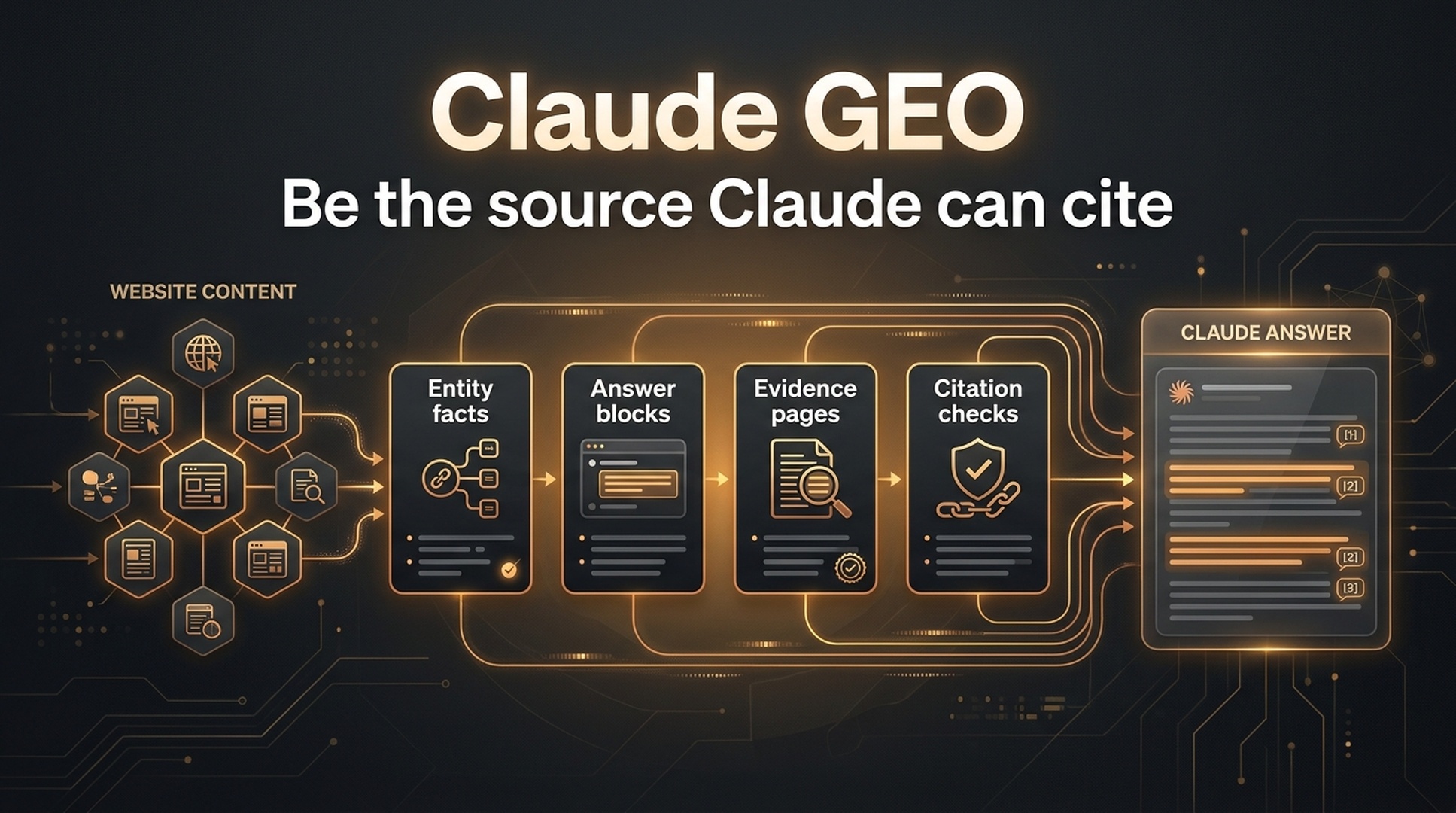
Claude GEO means optimizing your brand and content so Claude can find, trust, summarize, and cite it when users ask relevant questions.
It is a source-design problem: clear entity facts, answer-ready pages, crawlable evidence, and prompts that reveal whether Claude understands your category correctly. Traditional SEO still matters because many Claude answers are shaped by web pages, documentation, news, comparison content, and other retrievable sources. The difference is the output. You are not only trying to rank a blue link. You are trying to become a useful source inside an answer.
Why Claude GEO is different from ordinary SEO
Google SEO usually starts with keywords, pages, backlinks, and rankings. Claude GEO starts with questions, source quality, entity clarity, and citation behavior.
That changes the work in a few ways:
SEO question | Claude GEO question |
|---|---|
Can this page rank for the query? | Can Claude use this page to answer the prompt? |
Is the title optimized? | Is the answer clear enough to extract? |
Does the page target the right keyword? | Does the page cover the buyer's real decision context? |
Did organic traffic improve? | Did Claude mention, cite, or accurately describe the brand? |
Are backlinks growing? | Are trusted sources reinforcing the same facts? |
Claude can use web search in supported contexts to answer questions with current information and citations. Anthropic's documentation says the web search tool can give Claude access to real-time web content and include citations from search results. It also says Claude decides when to search based on the prompt, especially when the request depends on current or changing information. That matters for GEO because a stale, vague, or hard-to-parse page is less useful as a source, even if it still gets some search traffic.
Sources: Anthropic web search tool documentation, Anthropic citations documentation.
What Claude needs before it can trust your content
A Claude-ready page usually has five traits.
First, the page says what the entity is. Brand name, category, product, use case, audience, and geography should be stated plainly. Do not make Claude infer your company from a poetic homepage hero.
Second, the page answers a specific question. The answer should appear early, then the rest of the page can add proof, examples, caveats, and next steps.
Third, the page separates claims from evidence. If you say your product improves conversion, show the source: a case study, benchmark, methodology note, public customer story, or a clearly labeled internal test.
Fourth, the page uses stable language across the site. If your homepage calls the product an "AI search visibility platform," your docs call it a "GEO dashboard," and your comparison page calls it an "LLM traffic suite," Claude may struggle to connect the dots.
Fifth, the page is accessible. If important text is locked inside images, scripts, accordions that do not render cleanly, or PDFs with poor structure, the content becomes harder to retrieve and cite.
The Claude GEO visibility loop
Claude GEO works best as a loop, not a one-time rewrite.
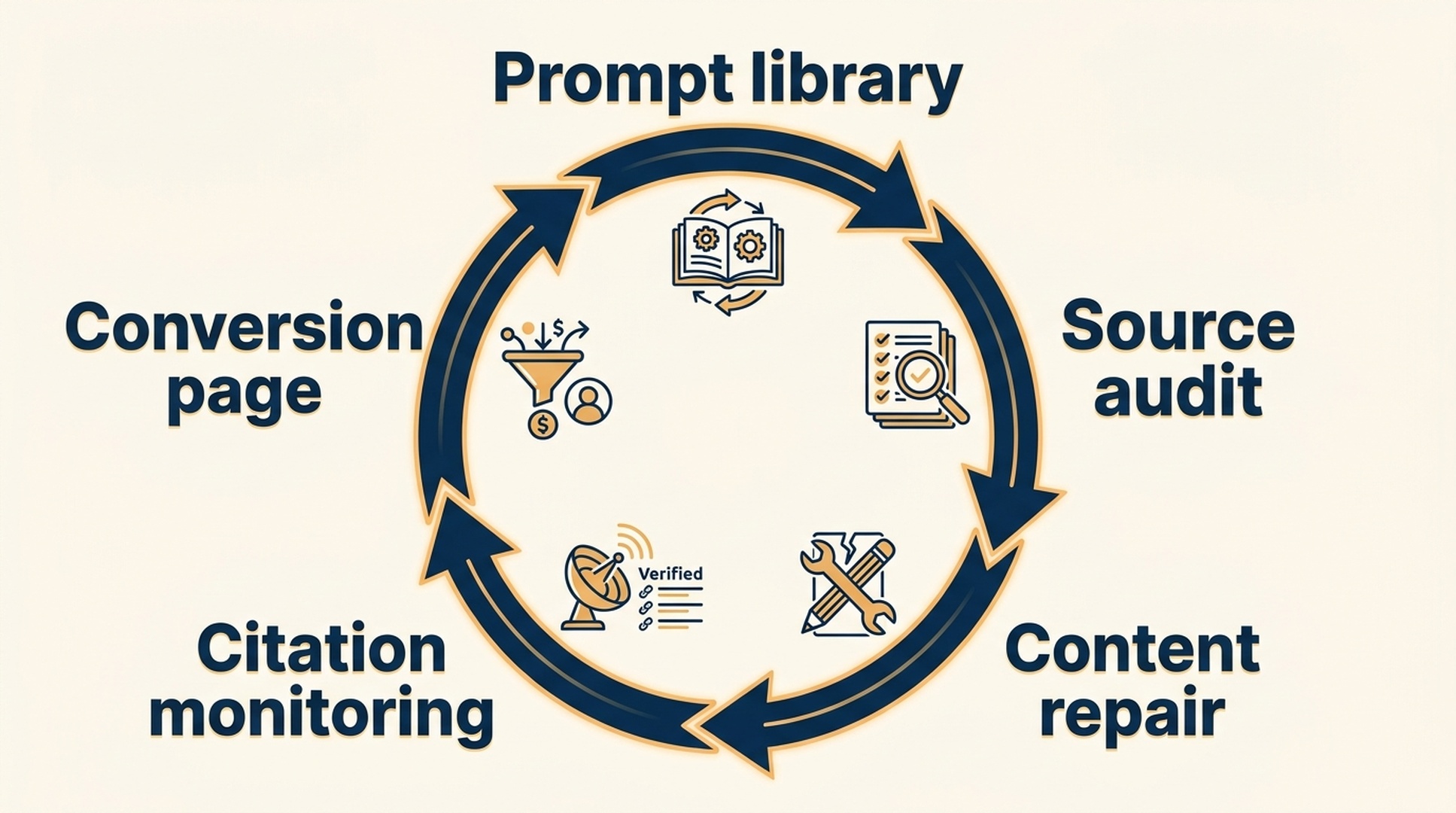
Caption: A practical Claude GEO workflow starts with prompts, then repairs the pages that should support those answers.
1. Build a prompt library
Start with 30 to 80 prompts your buyers might ask Claude. Split them by intent:
- Definition prompts: "What is [category]?"
- Comparison prompts: "Which tools help with [problem]?"
- Diagnostic prompts: "Why is my [metric] not improving?"
- How-to prompts: "How do I implement [workflow]?"
- Vendor prompts: "Who provides [solution] for [audience]?"
Do not only test brand prompts. If Claude already knows your brand, those checks feel good but teach you little. The useful prompts are category and problem prompts where your brand should appear but often does not.
2. Audit the sources Claude is likely to use
For each prompt group, list the pages that should support the answer. These can include your own pages, documentation, comparison pages, templates, case studies, third-party directories, review pages, partner pages, and high-quality explainers.
Ask a blunt question: if Claude had to answer from this page alone, would the answer be accurate?
If not, the page needs repair before you worry about more advanced tactics.
3. Repair pages for extractable answers
A Claude-ready page does not need to be short. It needs to be easy to quote, summarize, and verify.
Use this structure where it fits:
- A direct answer in the first 100 to 150 words
- Clear definitions of the main entities
- A comparison table when buyers need a decision
- Examples that use common global products or workflows
- Evidence blocks with dates, scope, and methodology
- FAQs that answer real follow-up questions
- A next step that matches the user's intent
This is also good SEO writing. The difference is discipline. Claude does not need a long intro about how fast AI search is moving. It needs a source that says something useful.
4. Monitor mentions, citations, and accuracy
Run the same prompt library on a schedule. Track four things:
Metric | What to record | Why it matters |
|---|---|---|
Mention rate | Whether Claude names your brand | Shows whether the entity is present in the answer set |
Citation rate | Whether Claude links to your page or a supporting source | Shows whether your pages are usable as evidence |
Position in answer | Whether you appear early, late, or only as a footnote | Indicates practical visibility, not just presence |
Accuracy | Whether Claude describes your product and category correctly | Prevents bad visibility from becoming a conversion problem |
Keep screenshots or exports of the answers. AI answer surfaces change, and you need a record that lets your team see the direction over time.
5. Connect visibility to conversion pages
A citation is not the finish line. If Claude cites a definition page but the reader lands on a vague article with no relevant next step, the value leaks.
Map each high-value source page to a conversion path. A beginner explainer might point to a checklist. A comparison page might point to a demo. A technical guide might point to a tool. Keep it natural. Claude GEO should make the site more useful, not turn every article into a sales page.
A relevant Auspia next step for this workflow is the AI Search Visibility Checker, especially when you need a quick baseline before building a larger prompt library.
Which pages are most likely to help Claude cite you
Not every page deserves the same GEO effort. Start with pages that answer specific questions and carry evidence.
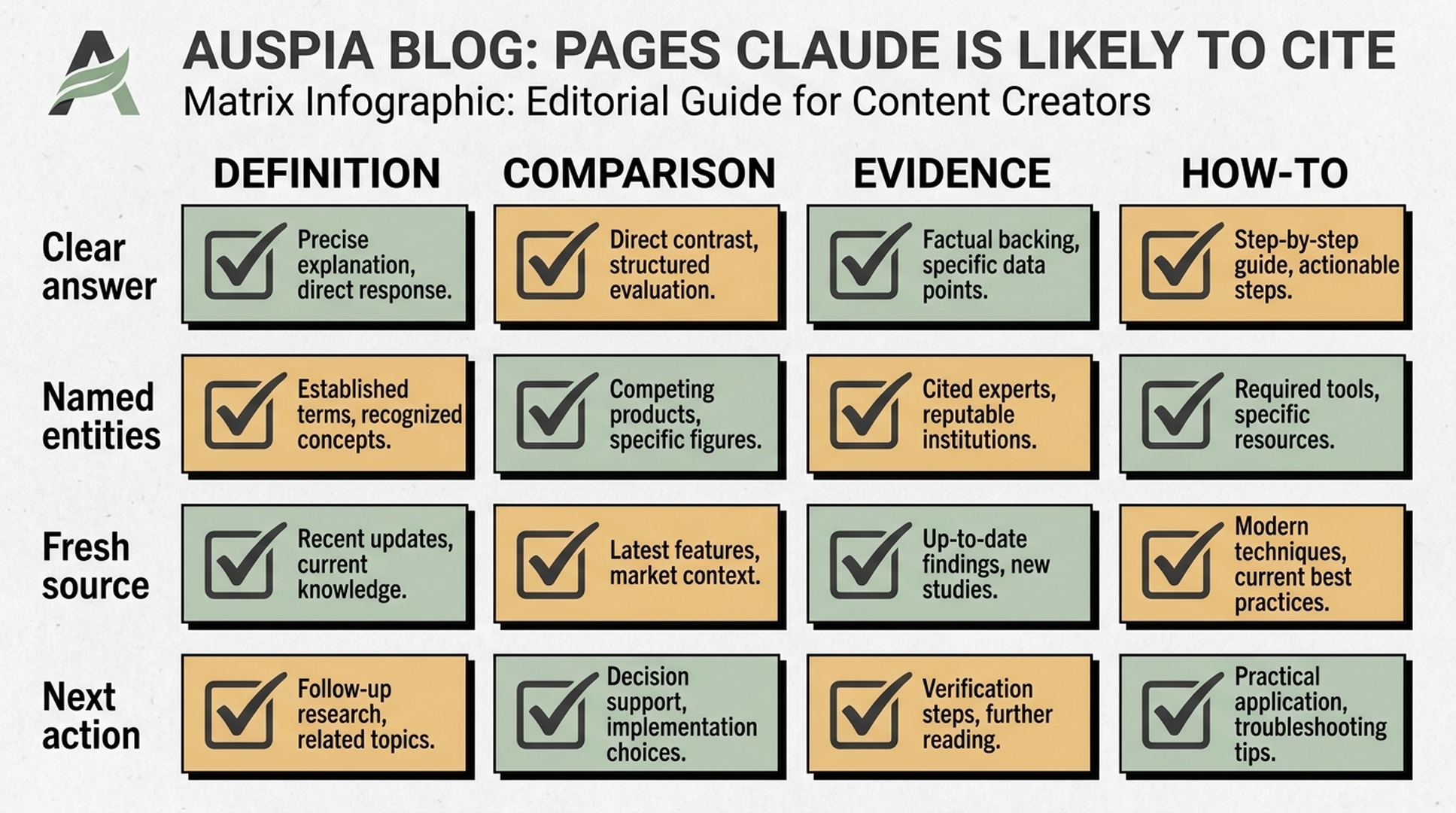
Caption: The strongest Claude GEO pages combine a clear answer, named entities, fresh source material, and a useful next action.
Page type | Best use | What to add |
|---|---|---|
Definition page | "What is..." prompts | Direct definition, examples, related terms, FAQ |
Comparison page | Vendor and category prompts | Criteria, tradeoffs, honest fit guidance |
Evidence page | Trust and citation prompts | Methodology, dates, scope, numbers, caveats |
How-to page | Implementation prompts | Steps, inputs, owner, quality gate, example output |
About or entity page | Brand understanding | Consistent category, product facts, audience, locations |
Documentation page | Technical questions | Version details, examples, limitations, troubleshooting |
If you only have blog posts, Claude may understand your ideas but not your product. If you only have product pages, Claude may understand what you sell but not why it should recommend you. You need both.
A 14-day Claude GEO repair plan
Here is a lean version your team can run without turning it into a quarter-long project.
Day | Task | Output |
|---|---|---|
1 | Pick one category and one audience | GEO scope statement |
2 | Write 30 buyer prompts | Prompt library v1 |
3 | Run baseline checks | Mention and citation snapshot |
4 | Identify missing or inaccurate brand facts | Entity repair list |
5 | Choose five source pages to improve | Priority page list |
6-8 | Rewrite answer blocks and evidence sections | Updated page drafts |
9 | Add comparison tables, examples, and FAQs | Better extraction blocks |
10 | Check crawlability and rendering | Technical access notes |
11 | Add natural internal links | Source-to-conversion paths |
12 | Re-run prompt library | Second visibility snapshot |
13 | Fix inaccurate answer patterns | Repair queue |
14 | Decide the next page cluster | GEO backlog |
The goal is not to "beat Claude" in two weeks. The goal is to find the gap between what your site says and what Claude can safely repeat.
Mistakes that weaken Claude visibility
The most common mistake is treating Claude GEO as keyword stuffing for AI. That usually produces pages that sound optimized but say very little.
Other mistakes are more subtle:
- Publishing generic explainers with no brand facts, examples, or evidence
- Hiding the best answer below a long narrative intro
- Using different category names across homepage, blog, docs, and comparison pages
- Creating FAQ sections where every answer repeats the same sentence
- Claiming results without dates, scope, or methodology
- Measuring only traffic, not answer accuracy or citation behavior
- Forgetting the landing page after the citation
Claude GEO rewards source usefulness. If a page would not help a human make a decision, it probably will not help Claude give a strong answer either.
Auspia take
Claude GEO is not a replacement for SEO. It is a layer on top of search, content strategy, technical accessibility, and brand entity work.
The teams that benefit fastest are usually not the ones publishing the most AI content. They are the ones cleaning up source pages, making claims easier to verify, and checking whether AI answers describe them accurately. That work is less glamorous than chasing a new tactic, but it compounds. A clear definition page supports search. A strong comparison page supports sales. A good evidence page supports citations. Together, they give Claude something safer to use.
FAQ
Is Claude GEO the same as Generative Engine Optimization?
Claude GEO is a platform-specific application of Generative Engine Optimization. GEO is the broader practice of improving visibility in AI-generated answers. Claude GEO focuses on how Claude understands, retrieves, summarizes, and cites your content.
Can I force Claude to cite my website?
No. You can improve the quality and accessibility of your source pages, but you cannot force Claude to cite a page. Treat citations as an outcome to measure, not a switch you control.
Does Claude always search the web?
No. Anthropic's documentation says Claude searches when the request depends on current, changing, or outside-training-data information. It can answer directly for stable knowledge or when the needed content is already provided in the conversation.
What should I optimize first?
Start with entity clarity and answer-ready pages. If Claude cannot identify what your brand is, who it serves, and which problem it solves, more content will not fix the core issue.
How often should teams check Claude visibility?
For an active GEO program, weekly checks are usually enough. Run the same prompt set, record mentions and citations, and investigate changes. Daily checks often create noise unless you are monitoring a launch or major market event.
Author: Maya Ellison, 12-Year GEO Strategy Researcher at Auspia. Maya writes about AI search visibility, brand entity clarity, and practical GEO operating systems for growth teams.