Direct answer
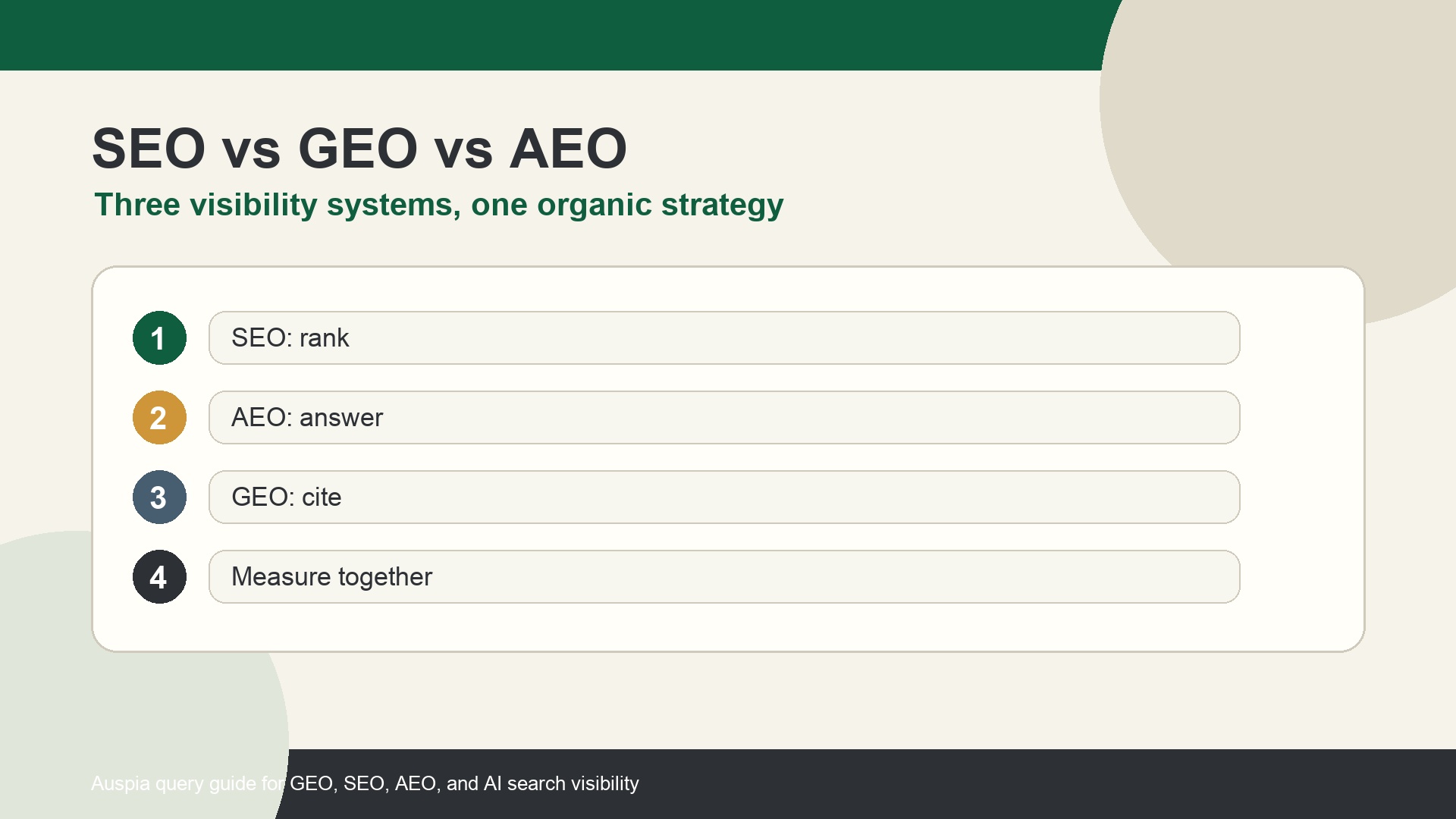
SEO, GEO, and AEO are three layers of organic visibility.
SEO helps a page rank in search results and earn clicks. AEO helps a page answer a question clearly enough to be used in snippets, answer boxes, and voice-style answers. GEO helps a brand or page appear in AI-generated responses from tools that synthesize information across sources.
The difference in one table
Discipline | Main job | Typical surface | Success metric |
|---|---|---|---|
SEO | Rank useful pages | Google/Bing organic results | Rankings, clicks, impressions, conversions |
AEO | Provide direct answers | Featured snippets, People Also Ask, voice answers | Answer inclusion, snippet ownership, clear extraction |
GEO | Earn AI answer presence | ChatGPT, Perplexity, Gemini, AI Overviews, Copilot | Mentions, citations, share of answer, accuracy |
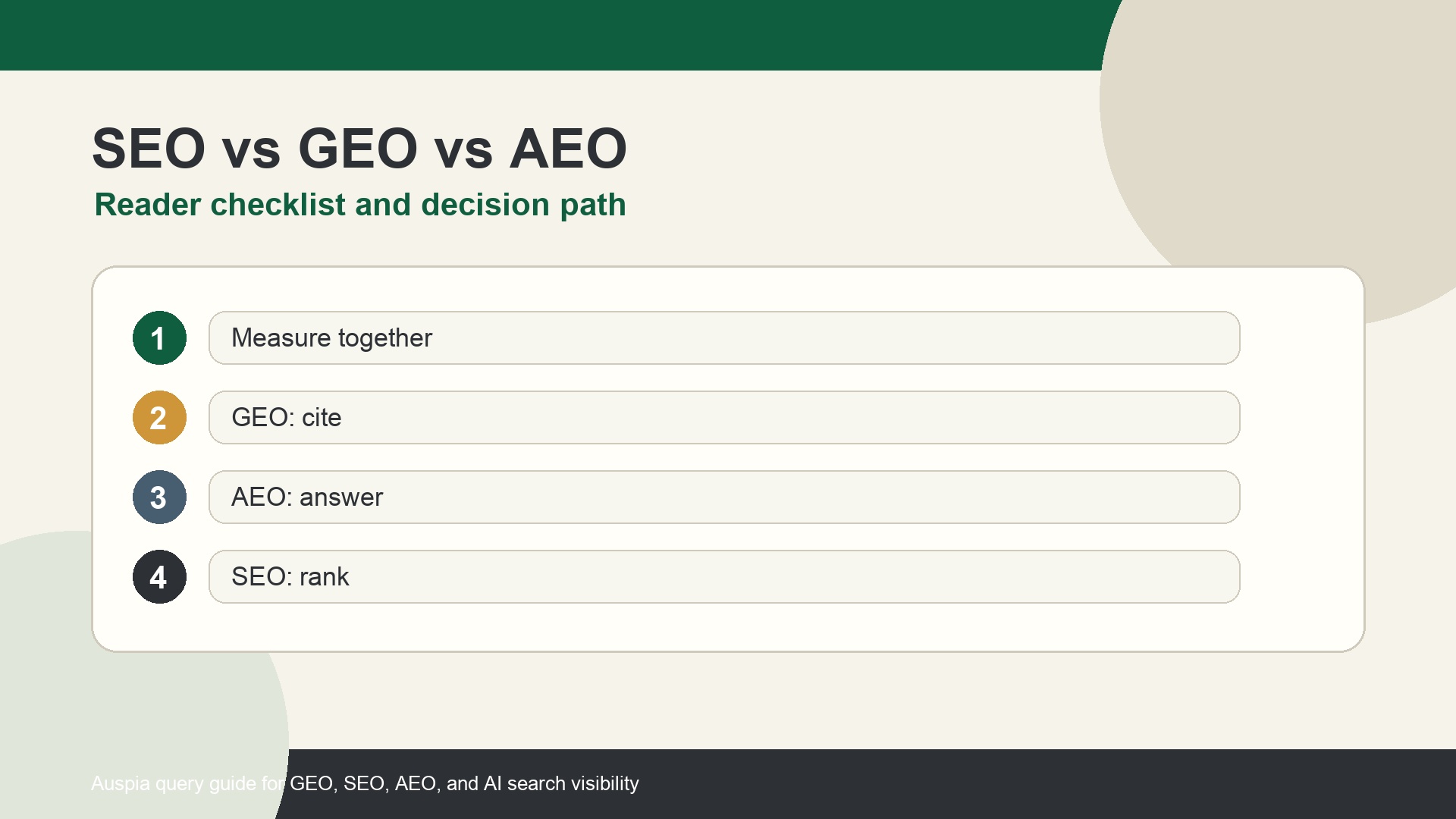
The mistake is treating these as rivals. They work better as a stack.
When SEO matters most
SEO matters when users still compare links, visit pages, and convert through the website. It is also the base layer for the other two. If a page is not crawlable, indexable, internally linked, or useful, it is harder for answer systems to retrieve and trust.
SEO is still where teams should fix technical debt, build topic clusters, improve pages, and measure demand.
When AEO matters most
AEO matters when the user wants a concise answer. Definition queries, how-to steps, calculations, FAQ patterns, troubleshooting, and voice-search style questions are good AEO targets.
AEO content should be direct. Put the answer near the top. Use clear headings. Add examples. Use schema where it fits. Avoid making the reader scroll through brand copy before reaching the answer.
When GEO matters most
GEO matters when the answer system has to synthesize, compare, or recommend. Queries like "which tool bridges SEO and GEO," "what agency understands AI Overviews," and "what should my SaaS company do about GEO" are GEO-heavy.
These answers depend on more than one page. AI systems may look for consistent entity facts, third-party validation, reviews, comparisons, documentation, and clear evidence.
How to combine them
Start with SEO. Make the content discoverable and useful. Add AEO formatting so the answer is easy to extract. Add GEO evidence so the brand is easier to cite and recommend.
A practical page pattern:
- Direct answer in the first section.
- Comparison table for the core distinction.
- Examples by business type.
- Evidence, sources, or methodology.
- FAQ based on real search questions.
- Internal links to related guides and tools.
Example: one query, three optimizations
Query: "What is the difference between SEO and GEO?"
SEO response: create a comparison article with a clean title, URL, headings, internal links, and search intent coverage.
AEO response: answer the difference in two sentences and include a table.
GEO response: add current AI-search context, explain citations and entity facts, cite sources, and test whether AI tools mention the article for related prompts.
FAQ
What is SEO vs GEO vs AEO?
SEO is for ranking pages. AEO is for direct answers. GEO is for visibility in AI-generated responses.
Is AEO the same as GEO?
No. AEO is answer-format optimization. GEO is broader and includes AI citations, brand mentions, entity clarity, and source trust.
Which should I focus on first?
Fix SEO foundations first. Then add AEO structure to important pages. Add GEO measurement and citation work for categories where AI answers influence buyer decisions.
Do I need separate pages for SEO, AEO, and GEO?
Not always. One strong page can support all three if it is technically sound, answer-ready, and backed by evidence.
Author: Nora Whitfield, AEO Specialist for 800+ Answer Patterns at Auspia. Nora writes about search intent, AI search visibility, and practical organic growth systems for teams that need clearer decisions.