Build the answer you would want a customer to receive
An AI answer asset is not a page stuffed with platform names. It is the clearest source you can publish for a decision that matters: an answer first, evidence close by, limits stated, and a next action that helps a real visitor.
Definition of done: One answer-asset brief or approved page draft that answers a high-stakes question with named facts, clear limits, and a source list.
Allow 60 minutes. Bring an AI Answer Gap Card or question-map short list, the Fact Pack, and a real customer decision. You do not need an AI citation tool. The goal is an accurate source page, not a promise that a platform will quote it.
Choose one question with consequences
Use the AI Answer Gap Card or question map. Select a question where a wrong answer could cause a bad purchase, failed setup, wasted appointment, or inaccurate comparison. Avoid generic prompts such as What is SEO? unless your site has unusual authority and evidence.
Write a reader-first test: if an AI system never cites this page, would the page still help a visitor make the decision? If no, select a better question.
Choose a question that can hurt someone if answered badly
For the bookkeeping example, What records should a designer gather before self-assessment, and what does monthly help include? is a suitable answer asset. A wrong answer can make a visitor waste time or assume the service files their tax return. Is bookkeeping important? is not suitable because it is too generic and does not lead to a concrete decision.
Use this filter before you write:
Test | Keep the question when | Park it when |
|---|---|---|
Customer consequence | Wrong information changes a purchase, setup, booking, or eligibility decision | It is trivia or a vague brand-opinion prompt |
Source boundary | You control facts that can answer it | The answer depends on unsourced claims or third parties |
Page value | A human would use the page even without AI traffic | The page only exists to attract a citation |
Updateability | You can review facts when they change | The answer depends on a fast-changing claim you cannot maintain |
Make an answer-evidence map
Read my AI Answer Gap Card, Traffic Mission, Fact Pack, and selected question:
[paths/text]. Create answer-asset-brief.md with:
1. THE QUESTION in the visitor's words.
2. A DIRECT ANSWER of no more than 80 words, using confirmed facts only.
3. DECISION CRITERIA the answer must explain.
4. EVIDENCE MAP: every factual claim -> source URL/document -> page section.
5. LIMITS AND EXCLUSIONS: what the answer cannot safely claim.
6. PAGE OUTLINE and one appropriate next action.
7. RECHECK PROMPT: same market/language, to use after publication.

Do not claim that any AI platform will cite the page. Do not fake citations,
reviews, research, or structured data. Do not publish or alter public profiles.
Build the answer line before the page outline
The answer should be brief enough to check but not so short that it hides the boundary. For the bookkeeping example:
Sole-trader designers can use this checklist to gather records before deciding
whether monthly bookkeeping support fits. The documented service helps organize
ongoing records and begins with a discovery call; it does not file personal
self-assessment tax returns.
Now map each claim:
Answer claim | Fact Pack row | Page section that proves it | Status |
|---|---|---|---|
Checklist helps prepare records | Onboarding checklist | Records to gather | Confirmed |
Monthly support organizes ongoing records | Service scope | What monthly help includes | Confirmed |
Discovery call comes first | Onboarding process | What happens next | Confirmed |
Does not file personal returns | Terms/exclusion | Service limits | Confirmed |
If the most important sentence has no row, do not write around it. Change the question, collect the fact, or state a narrower answer.
Ask for an evidence-first draft
After you approve the map, use this prompt:
Read answer-asset-brief.md and fact-pack.md. Create an evidence-first page plan
for the selected question. For every section, state the visitor question, the
direct claim or decision help, the Fact Pack rows that support it, a limitation
where needed, and a relevant next action. Add no claim without a CONFIRMED row.
Do not create schema, make up sources, edit a page, publish, or contact anyone.
The draft should look like a useful guide, product-fit page, local service answer, or comparison. It should not announce that it was made for ChatGPT, Google, or any other platform. Readers care about the answer; retrieval systems can work from the same clear facts.
Add evidence where the answer needs it
An answer such as Our app integrates with Shopify is weak when the decision is setup fit. A useful asset says what connection is required, what setup steps exist, what it does not support, and where the visitor can verify current requirements. A local service answer says service area, eligibility, process, and booking boundary. An ecommerce answer says compatibility, returns, sizing, and care where relevant.
Check the answer line by line
Sentence or claim | Source | Status | Action |
|---|---|---|---|
The service is available in Bristol | Service page or owner confirmation | Confirmed | Keep |
Same-day appointments are always available | No source | Needs owner fact | Remove or qualify |
Remote setup takes 15 minutes | Approved onboarding documentation | Confirmed | Keep with conditions |
The asset fails if its most important sentence is unsupported. Use the Publishing Gate before it goes live, then link it from the relevant offer, guide, product, or help page. Do not create a hidden "AI page" when the answer belongs in a useful existing page.
Decide between a new asset and improving a controlled page
Choose an existing page when it already serves the same decision and has room for the answer, evidence, and limit. Choose a new page when the question needs a substantial distinct explanation and can link to a relevant offer or help page. Do not split a single answer into an SEO version and an AI version.
Ask Codex to prepare a change sheet, then send it through the same Claim Review and Publishing Gate as Lesson 10. Keep a record of the selected question, answer map, fact sources, live URL, and review date in answer-asset/.
Test facts, not rankings
After you approve and publish the page through the quality gate, re-check the same prompt manually at a later date. Save the prompt, platform, language, location, date, observed answer, and cited URL if visible. A changed answer is an observation. Do not call it a caused result without a measured referral or other evidence.
Create ai-answer-observations.csv with:
checked_date,prompt,platform,market_language,observed_answer,fact_status,cited_url,referral_evidence,next_actionUse the same prompt wording and market when re-checking. Keep this log separate from organic sessions: the log records public-answer accuracy; analytics records visits.
Interpret re-checks without superstition
If an AI answer changes after your page is live, log the date, platform, prompt, market, wording, and any visible source link. Do not claim your page caused the change unless you have direct evidence. If the answer stays inaccurate, compare it to the controlled-facts sheet. Improve a missing owned fact or move to the Entity Correction Queue when a public source you control conflicts.
Make the live page easy to verify
Before publishing, run a reader check on the exact URL or preview. The opening should contain the decision answer; the supporting section should contain the source-backed detail; the limit should be visible before the CTA. Add a clear last-reviewed date only when you have a real editorial process to maintain it. Do not add dates merely to imply freshness.
Use this pre-release prompt:
Review the answer asset against its question and evidence map. Return PASS, FIX,
or NEEDS OWNER DECISION for the direct answer, every factual claim, limitation,
internal link, CTA, title, and source accessibility. Cite the exact section for
each finding. Do not edit, publish, add schema, or claim AI visibility.
If the answer page belongs inside an existing guide, update the guide rather than publishing a competing URL. A precise page architecture is more useful to readers and easier to maintain than a set of duplicate answer assets.
Troubleshoot an answer asset that feels generic
If the page could answer the question for any business, it lacks first-party evidence. Return to the Fact Pack and add a documented process, concrete scope, compatibility condition, policy, or observed limitation. If no such evidence exists, narrow the page promise. Do not fill the gap with citations you have not checked or with made-up testimonials.
Completion check
- [ ] The selected question has a customer consequence and a durable page value.
- [ ] Every answer sentence maps to a confirmed source or is removed.
- [ ] I chose a new page or existing-page change for a reader reason, not a platform reason.
- [ ] I saved a re-check log with the same prompt, market, and language.
Course map
Next: Fix the Public Facts That Make Search and AI Describe You Wrong.
Author: Isabel Grant, Researcher of 2,000+ AI Citation Patterns at Auspia. Isabel writes about evidence-rich pages that remain useful with or without a citation.
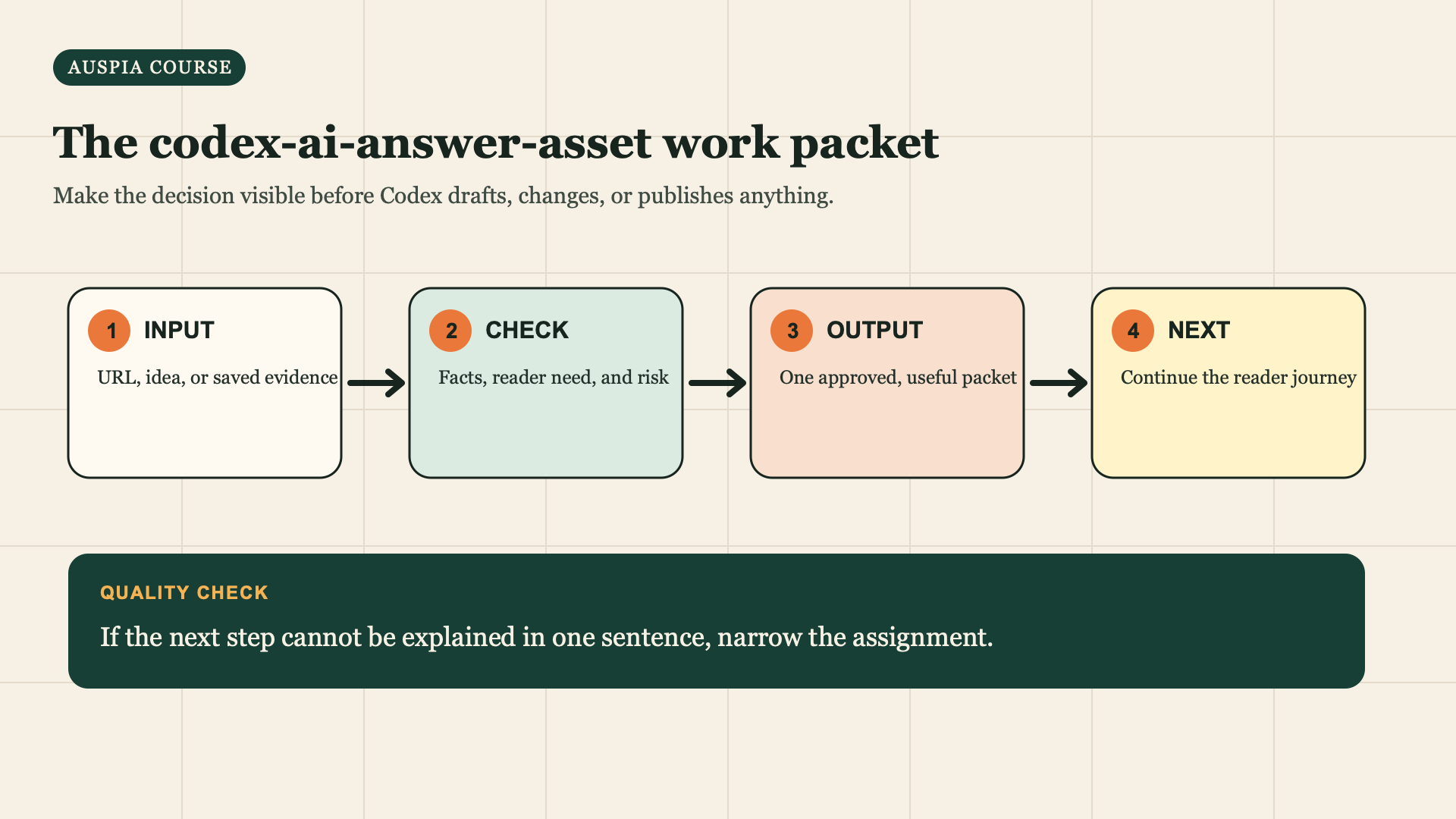
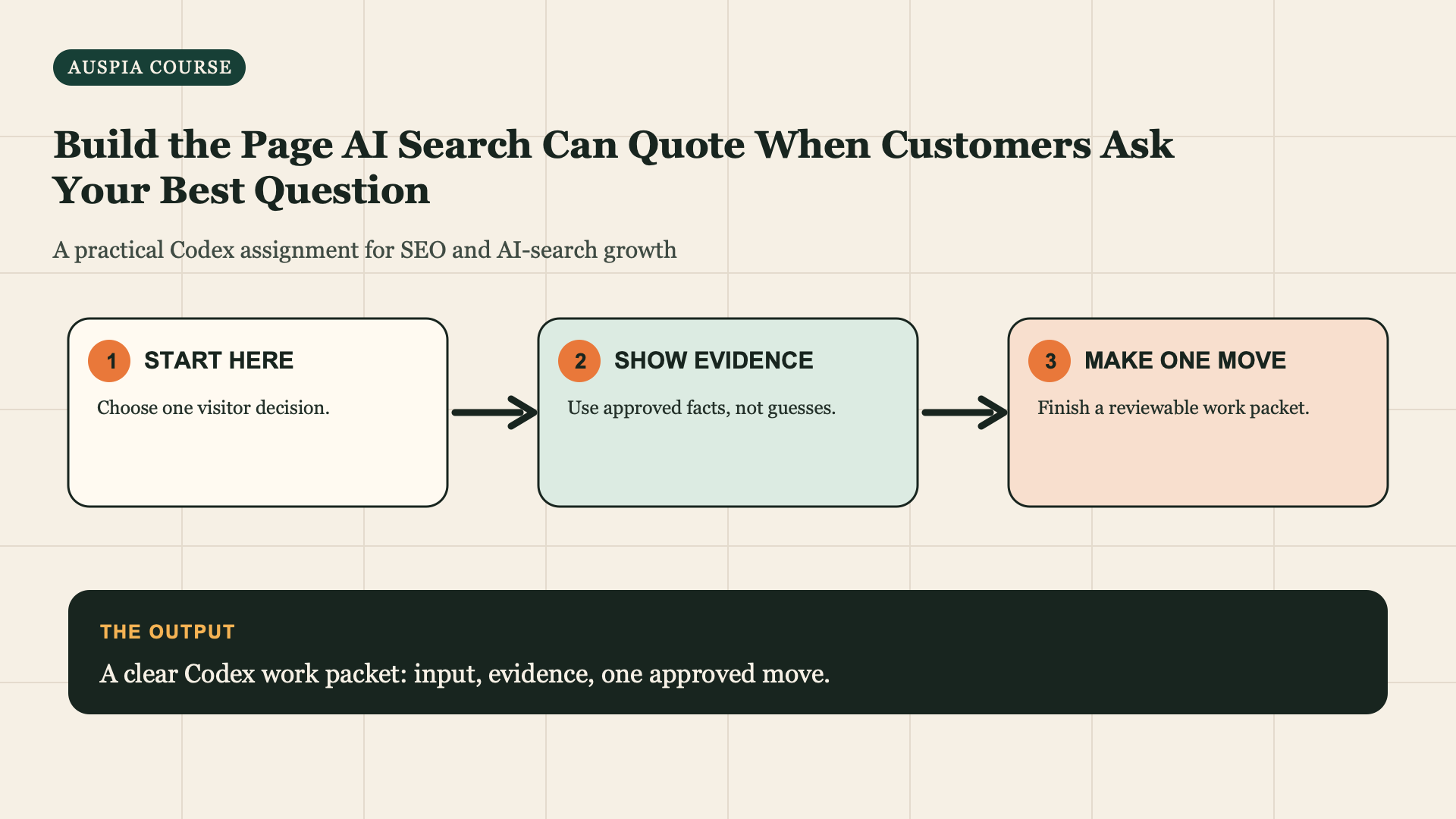
Use this sequence for the assignment: start with a real input, check the evidence, prepare one reviewable output, then choose the reader next step.