Executive Summary
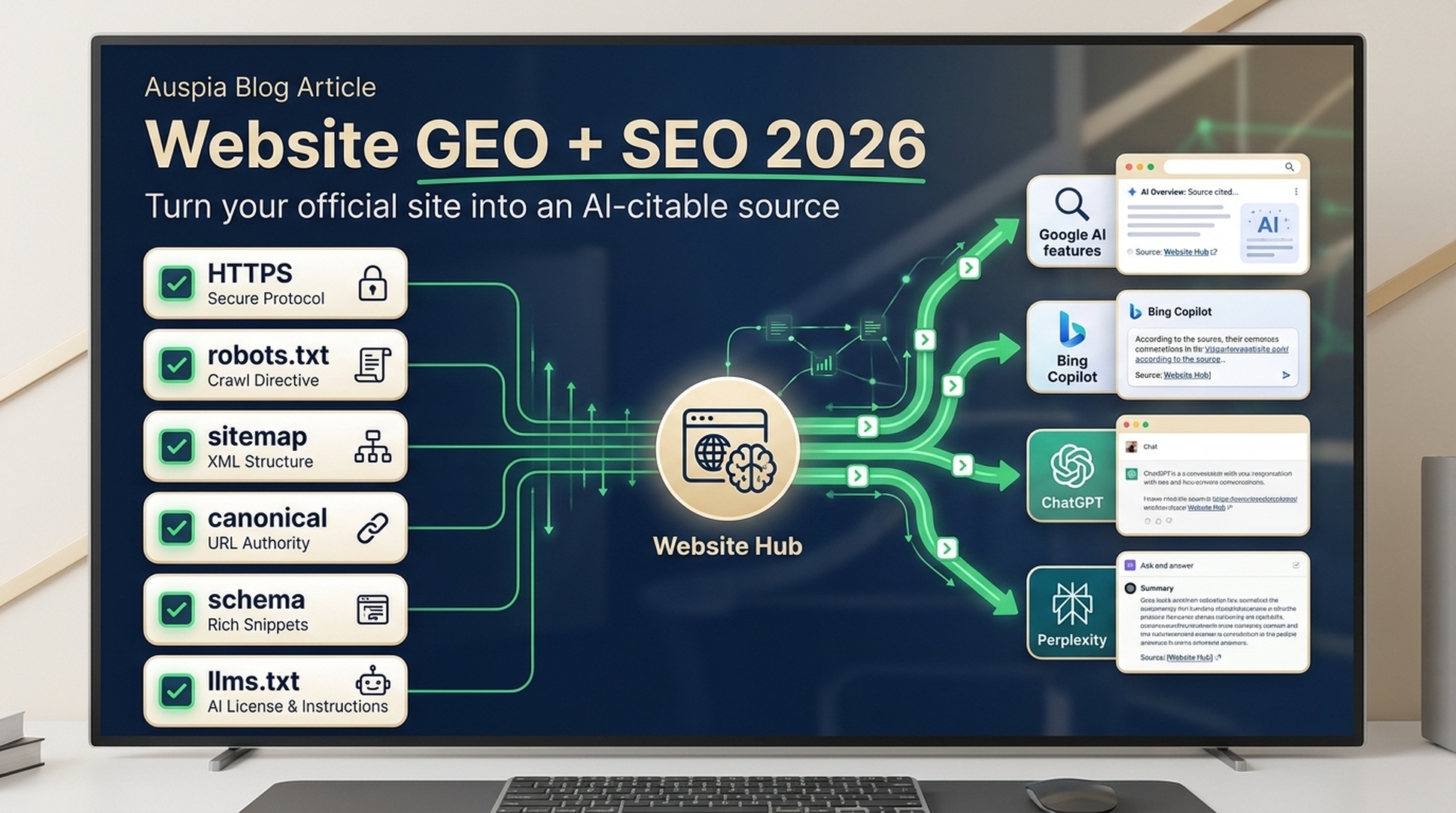
In 2026, your official website should not be treated as a brochure. It should act as the cleanest source of truth for search engines, AI answer engines, partners, journalists, and prospects.
The practical point is simple: strong SEO already does a large part of the work for GEO. If a page is crawlable, fast, canonical, specific, well sourced, and updated, it is easier for Google, Bing, ChatGPT-style retrieval systems, Perplexity-like answer engines, and other AI products to understand and cite. If the page is thin, blocked, duplicated, outdated, or hard to parse, no amount of PR distribution will fully solve the problem.
Auspia's view: third-party mentions still matter, but the official site has to become the reference layer. Build that first. Then use external coverage to reinforce it, not replace it.
Why Website GEO And SEO Are Converging In 2026
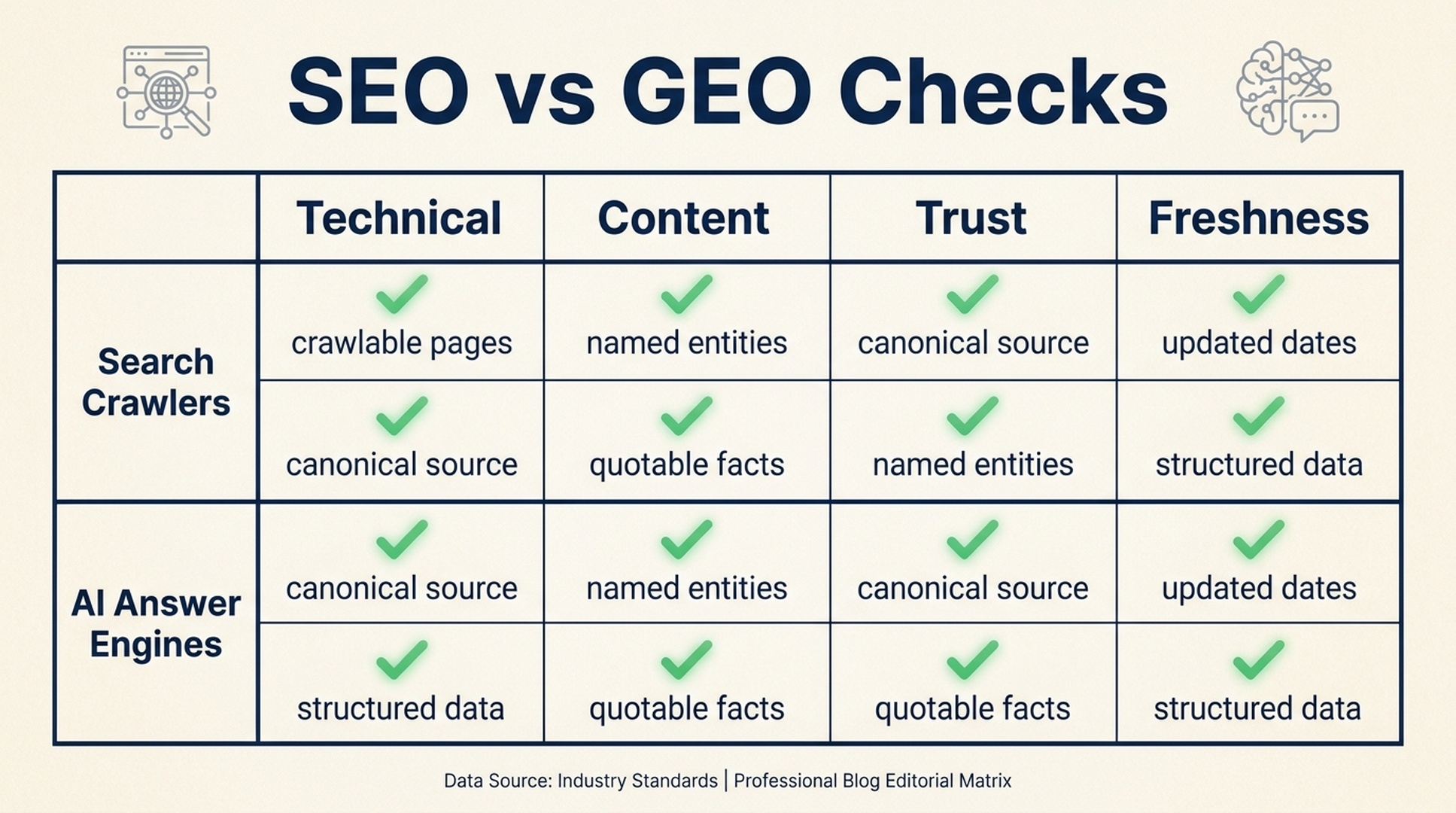
Traditional SEO and generative engine optimization are not identical, but they share the same plumbing.
Search engines need to discover pages, crawl them, index them, understand their topic, and rank or display them. AI answer systems often add another step: retrieval. When a user asks a live question, the system may fetch current web pages, read them, compare sources, and generate an answer.
That changes the shape of optimization, but not the foundation.
Requirement | SEO version | GEO version | What your website must do |
|---|---|---|---|
Access | Search crawlers need reachable pages | AI retrievers need clean fetchable pages | Use stable hosting, HTTPS, correct status codes, and crawl-friendly HTML |
Understanding | Search systems infer topic and intent | LLMs infer entities, claims, and relationships | Use clear headings, direct answers, examples, and structured data |
Authority | Links, brand demand, quality signals | Source trust, consistency, citations, mentions | Publish first-party evidence and keep facts consistent across the web |
Freshness | Updated content can be recrawled | AI answers often prefer current sources | Show dates, update important pages, and submit changed URLs |
Google's AI features documentation says pages must meet normal technical requirements for Google Search to be eligible for AI experiences. IndexNow's protocol documentation is built around a similar operational idea: when URLs change, tell participating search engines quickly instead of waiting passively.
So the 2026 version of GEO is not magic. It is source readiness.
The Official Website Should Become Your Citation Hub
Many teams still treat GEO as a media placement game: publish quotes on third-party sites, wait for AI tools to pick them up, and hope the brand appears in answers.
That can work in narrow cases. It is also fragile.
Third-party pages may change, disappear, sit behind messy templates, or describe your product less accurately than you would. Your own website is the only source where you control the facts, the entity names, the page hierarchy, the update cadence, and the conversion path.
A good official site gives AI systems answers to basic questions:
- What does this company do?
- Which product or service page is the canonical source?
- Who wrote or reviewed the content?
- When was the information last updated?
- Which facts are claims, and which are supported by examples or data?
- Where should a user go next if they want to verify or buy?
If those answers are missing, AI systems may assemble a profile from directories, old articles, scraped listings, or competitors' comparison pages. That is not a position you want to volunteer for.
The 2026 source-readiness stack: access, index, entity clarity, evidence, and answer extraction.
Layer 1: Make The Site Crawlable And Stable
Before you worry about prompts, citations, or answer visibility, check whether machines can fetch the site reliably.
Start with the basics:
- Use HTTPS everywhere. Google announced HTTPS as a ranking signal years ago, and in 2026 it is simply table stakes for trust.
- Pick one canonical host:
https://example.comorhttps://www.example.com, not both. - Redirect every alternate version with a real 301 status, not only the homepage.
- Return true 404 or 410 status codes for missing pages. Do not serve a fake error page with a 200 response.
- Keep important HTML light enough that crawlers and retrievers can reach the main content quickly.
- Put the primary content early in the HTML source when possible.
A surprising number of GEO problems begin here. The content may be good, but the server times out. The page may look fine in the browser, but the canonical tag points to a parameter URL. The help center may contain useful answers, but robots.txt blocks the whole directory.
Use a crawler, log files, Search Console, Bing Webmaster Tools, and a simple command-line check before you make strategic conclusions.
Layer 2: Use Robots, Sitemaps, Canonicals, And URL Submission Correctly
A website should tell crawlers what matters.
That starts with robots.txt. It should block low-value or sensitive areas such as admin routes, internal search results, session URLs, and parameter traps. It should not block CSS, JavaScript, product pages, documentation, blog articles, pricing pages, or comparison pages that you want machines to understand.
Then check your sitemap setup.
For most sites, XML sitemaps should include only indexable canonical URLs. Large sites can split sitemaps by type: product pages, articles, documentation, templates, and tools. The point is not to list everything. The point is to make priority pages easy to discover.
Canonical tags are just as important. If the same content appears across tracking parameters, filters, print versions, or localized variants, search systems and AI systems need a single official URL. Without that, your authority gets split across duplicates.
For faster discovery, use URL submission workflows. IndexNow is useful for participating search engines because it lets sites notify them when URLs are created, updated, or deleted. For Google, use Search Console and clean sitemap updates. Do not spam submission APIs with every tiny template change. Use them for meaningful content changes.
A simple 2026 rule: if a page is important enough to influence an AI answer, it should appear in your sitemap, be internally linked, return a clean 200, and declare its canonical URL.
Layer 3: Write Pages That Machines Can Actually Understand
AI answer engines do not want clever copy. They want extractable facts.
That does not mean your writing should become robotic. It means each important page needs a clear job.
For a product page, answer:
- What is the product?
- Who is it for?
- What problem does it solve?
- What are the main features?
- What does it integrate with?
- How is it different from alternatives?
- What proof supports the claims?
For an article or guide, answer:
- What is the direct answer?
- What changed in 2026, if freshness matters?
- What steps should a team take?
- What are the limits or risks?
- Which examples make the advice concrete?
This is why FAQ blocks, comparison tables, checklists, glossaries, and annotated examples keep showing up in AI-friendly content. They give retrieval systems clean chunks to reuse.
Here is the part teams often miss: the page must still read well for humans. If every paragraph sounds like a glossary entry, users will leave. Use direct language, but keep a point of view.
For example, instead of writing:
Our platform provides comprehensive solutions for modern digital transformation.
Write:
Auspia helps growth teams find SEO and AI-search visibility gaps, then turn those gaps into pages, briefs, and technical fixes.
The second version gives both humans and machines more to work with.
Layer 4: Add Structured Data, But Do Not Hide Behind It
Schema markup helps machines interpret a page. It can describe articles, organizations, products, breadcrumbs, FAQs, authors, dates, reviews, videos, software applications, and more.
Use it where it matches visible content. Do not add fake FAQ schema, fake reviews, or markup that claims things the page does not show.
For most B2B and SaaS sites, the useful starting set is:
Page type | Useful schema | Why it helps |
|---|---|---|
Homepage | Organization, WebSite | Confirms brand name, URL, logo, same-as profiles |
Blog post | Article, BreadcrumbList | Clarifies author, dates, topic path, and canonical content |
Product page | Product or SoftwareApplication | Describes features, category, pricing hints, operating system, or application type |
Help article | FAQPage or HowTo when appropriate | Makes direct answers easier to extract |
Author page | Person | Connects expertise, bio, role, and published work |
Structured data is not a substitute for content quality. It is a label on the box. The box still needs something useful inside.
Layer 5: Create An AI-Facing Source File With llms.txt
`llms.txt` is an emerging convention rather than a guaranteed ranking lever. Treat it as a clarity tool, not a hack.
The idea is straightforward: place a Markdown file at the root of the site, usually https://example.com/llms.txt, that summarizes the website for AI systems. A practical version can include:
- Company description in plain language
- Main product or service categories
- Canonical URLs for important pages
- Documentation or API references
- Best pages for definitions, comparisons, and examples
- Update frequency and contact information
Will every AI system read it? No. Can it help your own team keep a clean source map? Yes. Can it reduce ambiguity for tools that do read it? Also yes.
Auspia's recommendation is conservative: create llms.txt only after the core site structure is already clean. If the website has broken canonicals and thin product pages, a neat AI summary file will not fix the real issue.
You can also use Auspia's LLMs.txt Generator / Checker to draft and validate a source file before publishing it.
Layer 6: Build Trust Signals That AI Can Verify
AI visibility depends on more than page formatting. The source has to look credible.
That means publishing the boring things that real buyers and evaluators look for:
- About page with a specific company description
- Author or reviewer bios for expert content
- Case studies with context, actions, and constraints
- Product documentation that matches the public marketing pages
- Clear pricing or buying path when possible
- Security, privacy, and compliance pages where relevant
- Updated dates on pages that change over time
- External references for claims that are not first-party facts
Backlinks still matter too, but they should support the official source. A podcast mention, partner listing, integration page, analyst note, or customer story is more useful when it points back to a clear canonical page.
Do not confuse volume with trust. Ten relevant mentions from real industry pages usually beat a hundred low-quality syndicated placements.
A 2026 Website GEO Audit Checklist
Use this checklist before investing in more content or PR.
Check | Pass condition | Common failure |
|---|---|---|
HTTPS | All public pages load on HTTPS | Mixed host versions or expired certificates |
Status codes | Important pages return 200; missing pages return 404/410 | Soft 404 pages returning 200 |
Canonical URLs | Each indexable page declares one correct canonical URL | Canonical points to staging, HTTP, or parameter URL |
Robots.txt | Important pages are allowed; low-value paths are blocked | Accidentally blocks blog, docs, or assets |
Sitemap | Only canonical indexable URLs are listed | Includes blocked, redirected, or noindex URLs |
Internal links | Priority pages are linked from hubs and related content | Key pages exist but are orphaned |
Structured data | Schema matches visible content | Markup is missing, invalid, or exaggerated |
Entity clarity | Brand, product, authors, and categories are named consistently | Different pages describe the company differently |
Evidence | Claims include examples, data, screenshots, or source links | Pages make broad claims with no proof |
Freshness | Time-sensitive pages show publish and update dates | Old advice looks current but is not maintained |
Answer extraction | FAQs, summaries, tables, and checklists answer real questions | Long copy hides the direct answer |
AI source file |
| File exists but lists stale or low-value URLs |

SEO and GEO share the same base checks. GEO adds pressure for clearer entities, fresher evidence, and answer-ready structure.
What Most Teams Get Wrong
The biggest mistake is starting with the wrong question.
Teams ask, "How do we get mentioned by AI?" A better question is, "If an AI system tried to verify us today, what would it find?"
That shift changes the work.
You stop chasing random mentions and start fixing the source graph. You clean up duplicate URLs. You rewrite vague product pages. You add dates and authors. You publish useful comparisons. You make documentation easier to cite. You check whether the official site, third-party listings, and social profiles describe the company in the same way.
None of this is glamorous. It works because it removes doubt.
Auspia Take: Build The Source Before You Chase The Citation
In 2026, GEO should sit next to SEO, not replace it.
A strong official website gives you three advantages:
- Search engines can crawl, index, and rank the right pages.
- AI systems can retrieve and quote cleaner source material.
- Users who click through land on pages that can actually convert.
That last point matters. A citation without a conversion path is just visibility. Useful visibility sends people to a page that answers the next question.
If you want a practical starting point, run a technical crawl, inspect your sitemap and robots rules, then test your priority pages with an AI search visibility workflow. Auspia's AI Search Visibility Checker can help you see where your brand and pages appear across answer-style discovery.
FAQ
Is GEO replacing SEO in 2026?
No. GEO extends SEO into AI answer environments. The technical, content, and trust foundations still overlap heavily. Teams that skip SEO basics usually struggle with GEO too.
Should my company rely on third-party media for AI citations?
Use third-party mentions as reinforcement, not as the whole strategy. Your official website should hold the most accurate, complete, and current version of your company, product, and expertise.
Does llms.txt guarantee AI citations?
No. It is an emerging convention, not a guaranteed visibility lever. It can still be useful as a clear source map for AI tools and for your own content governance.
Which pages should I optimize first?
Start with your homepage, product or service pages, pricing or contact path, documentation, comparison pages, high-intent blog posts, and any pages that define your category or methodology.
How often should GEO source pages be updated?
Update pages when facts change, products change, search behavior changes, or the page is tied to a year-specific claim. For 2026 guides, review at least quarterly and show the last updated date when the page is materially revised.