Quick answer
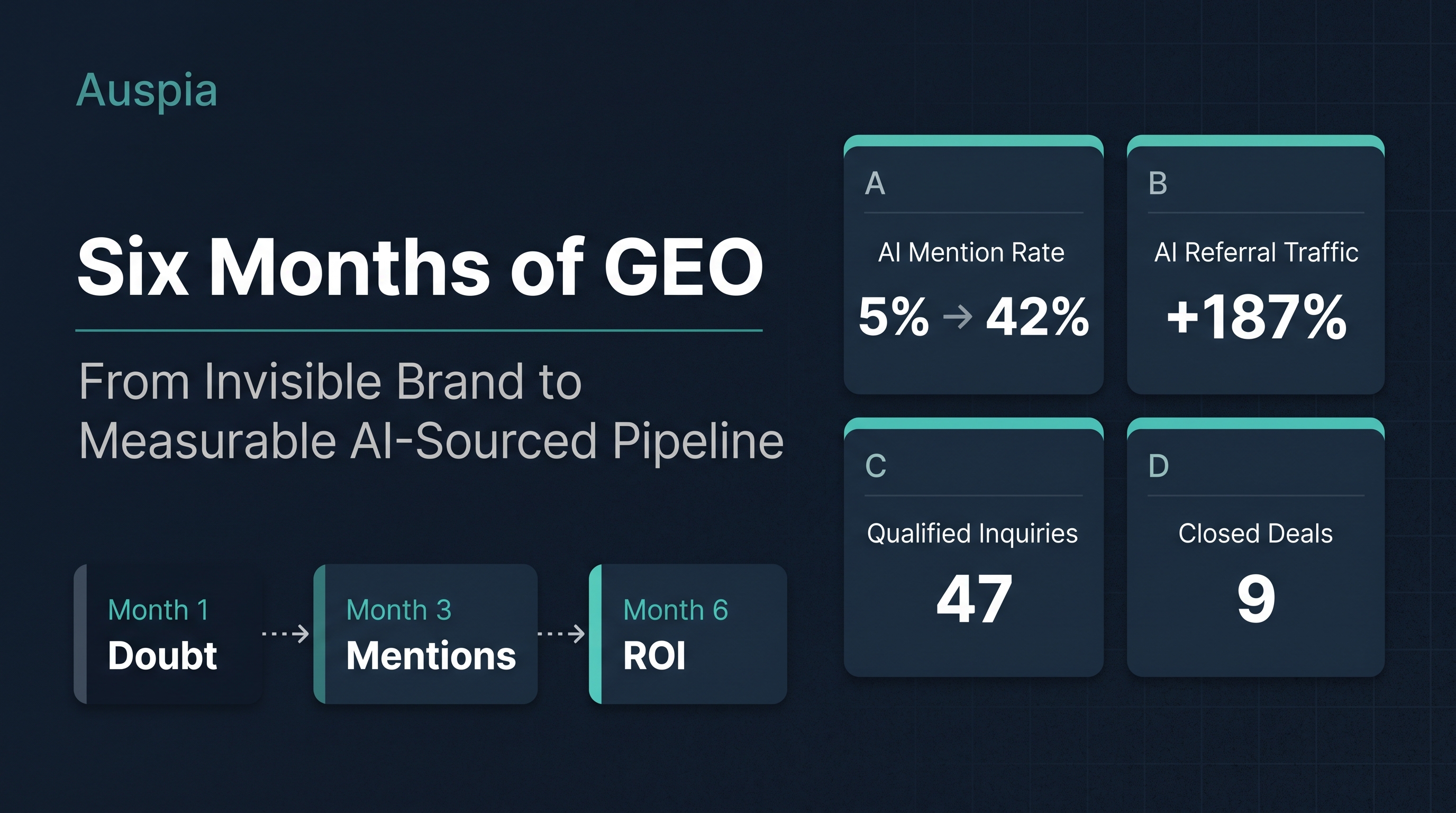
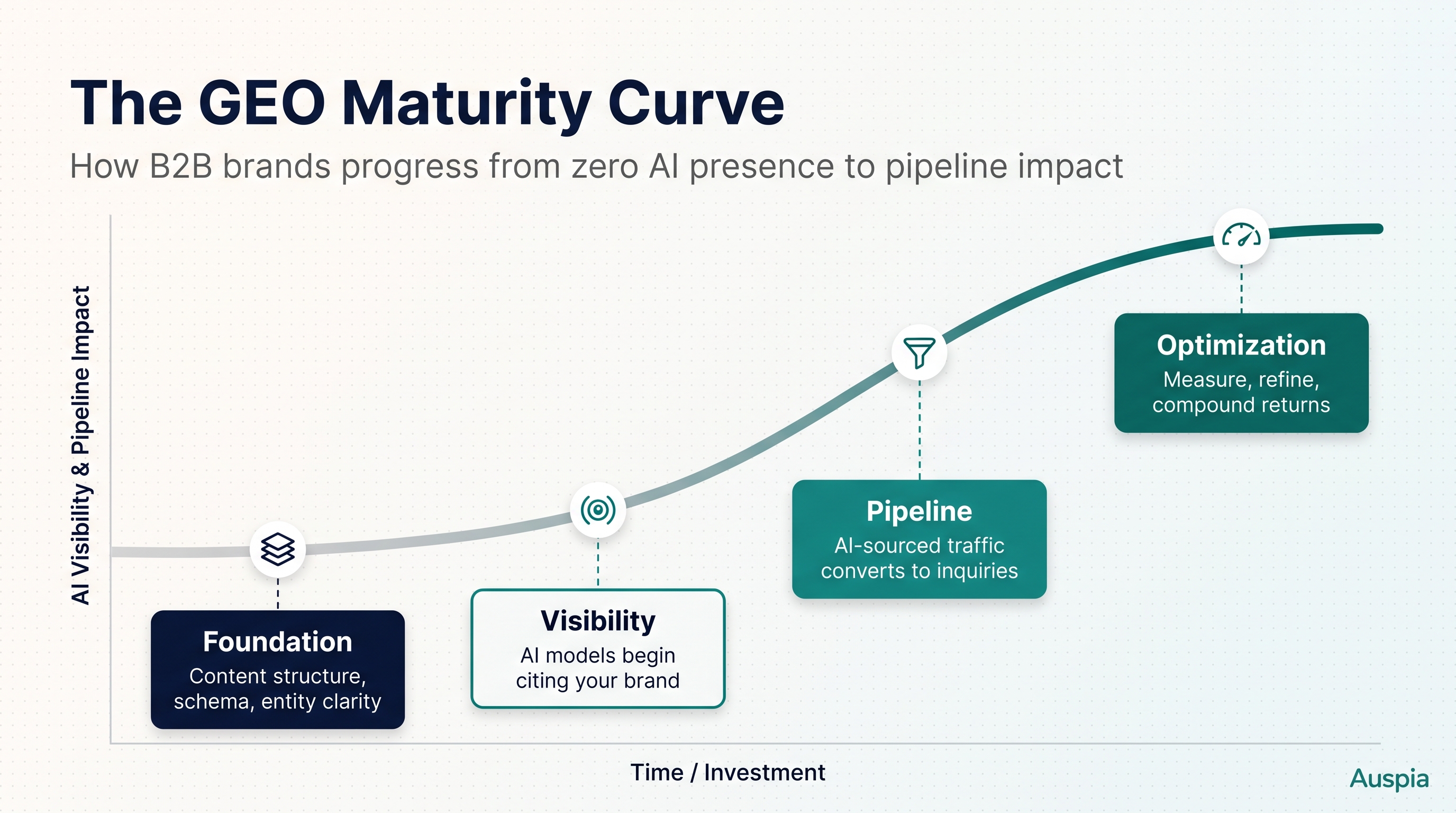
A six-month GEO program usually does not feel useful in the first few weeks. That is normal. The first month is mostly foundation work: entity cleanup, answer-friendly pages, citation assets, and prompt tracking. By month three, the team should start seeing brand mentions or citations in AI answers. By month six, the conversation should move away from "are we visible?" and toward "which AI-sourced visits, inquiries, and deals can we prove?"
For a B2B founder, that shift matters. GEO is not a branding hobby. It is a patient acquisition channel that has to be measured like pipeline.
The pattern below is a composite operating review based on the way B2B teams typically move through a first GEO cycle. The numbers are illustrative, but the management lesson is real: do not judge GEO like paid ads in week two, and do not keep funding it after month six unless it is connected to sales evidence.
The message every founder wants to receive
Imagine a founder getting this Friday afternoon note from the growth lead:
"We pulled the six-month GEO data. Your AI answer mention rate moved from under 5% to roughly 42% across our tracked buyer prompts. AI referral sessions are up 187%. More importantly, sales tagged 47 qualified inquiries where the buyer first discovered or validated the company through an AI answer. Nine have already closed."
The founder does not need a 60-slide report at that moment.
The question is simple: did the work create enough qualified demand to justify the spend?
That is the right question. It is also the question many teams avoid because early GEO signals are awkward. Mentions are inconsistent. Citations appear and disappear. ChatGPT, Perplexity, Gemini, Google AI Overviews, and vertical answer systems do not behave like a traditional SERP. You cannot refresh a ranking tracker and pretend the job is done.
A useful GEO review needs three layers:
Layer | What to measure | Why it matters |
|---|---|---|
Visibility | Brand mentions, citations, answer inclusion | Shows whether AI systems can find and describe the brand |
Demand | AI referral traffic, high-intent page visits, assisted conversions | Shows whether visibility sends people somewhere useful |
Revenue | Qualified inquiries, sales notes, closed deals, deal quality | Shows whether the channel deserves more budget |
Most teams stop at the first layer. Founders should not.
Month one: the uncomfortable foundation period
The first month of GEO often feels disappointing.
A founder who is used to paid search expects feedback quickly. Spend money on ads, see impressions. Increase bids, see clicks. Change landing page copy, watch conversion rate. GEO does not move that way.
In the first few weeks, the work is usually not glamorous:
- cleaning up the company description across the site, about page, product pages, documentation, and third-party profiles
- building pages that answer buyer questions in plain language
- adding comparison, use case, proof, pricing, integration, and FAQ content where it is missing
- improving schema, crawlability, internal links, and content structure
- creating a prompt library that represents real buyer questions
- recording baseline AI answers before the team starts optimizing
This is why month one can make executives nervous. The team is spending time on assets that may not produce visible AI mentions immediately.
That does not mean nothing is happening. It means the brand is becoming easier for retrieval systems to understand.
A good month-one report should not promise magic. It should show the foundation:
Month-one deliverable | Good evidence |
|---|---|
Entity cleanup | One consistent brand description across owned and key third-party sources |
Prompt baseline | 50-200 buyer prompts grouped by funnel stage, persona, and category |
Content gap map | Missing pages tied to real prompts, not vague topic ideas |
Technical readiness | Crawlable pages, structured headings, schema, clean indexation |
Measurement setup | Analytics segments, CRM source notes, weekly AI answer checks |
If a GEO vendor cannot explain what was built in month one, that is a problem. If a founder expects revenue proof in month one, that is also a problem.
Month three: the first visible proof
Month three is usually when people start to believe the work might be real.
The first meaningful signal is not always a lead. Sometimes it is a brand mention in a Perplexity answer. Sometimes it is a citation from a comparison page. Sometimes a prospect says, "I asked ChatGPT which vendors to look at and your name came up."
That moment changes the internal conversation.
Before month three, GEO can sound abstract. After the first visible proof, it becomes easier for sales, content, and leadership to understand the channel. The brand is no longer waiting for people to search its name. It is being introduced inside the answer flow.
But this is also where teams get sloppy. They celebrate screenshots and forget to ask what the screenshot means.
A month-three review should separate three types of signals:
Signal | Useful question | Risk if ignored |
|---|---|---|
Mention | Is the brand named in relevant buyer prompts? | Vanity mentions in low-value queries |
Citation | Is our owned or earned content being used as a source? | Mentions without authority or proof |
Message accuracy | Does the AI answer describe us correctly? | Wrong positioning that creates bad-fit leads |
A mention is not the finish line. It is a door opening.
At this stage, the team should update the prompt library, fix inaccurate brand descriptions, strengthen cited pages, and build more proof around the prompts that show early movement. GEO compounds when the team responds to what AI systems are already picking up.
Month six: the ROI conversation becomes unavoidable
By month six, a serious GEO program should be judged more like a business system.
Not perfectly. Attribution will still be messy. Some buyers will see an AI answer, visit the website later through direct traffic, and talk to sales without remembering the exact tool they used. Some AI answers will influence category trust without sending a trackable click. That is normal.
Still, the team should have enough evidence to answer the founder's real questions:
- Are we more visible in the AI answers our buyers actually use?
- Which pages or third-party sources are being cited?
- Did AI-originated sessions grow?
- Did any qualified inquiries mention AI discovery or AI validation?
- Did sales hear better-informed prospects?
- Which deals would we reasonably connect to GEO influence?
This is where the conversation moves from excitement to discipline.
For example, a six-month review might look like this:
Metric | Baseline | Month six | What it tells the team |
|---|---|---|---|
AI mention rate across tracked buyer prompts | Under 5% | 42% | The brand is entering relevant AI answers |
AI referral traffic | Low baseline | +187% | Answer visibility is sending visitors to owned assets |
Qualified inquiries with AI discovery notes | 0 | 47 | Sales is seeing demand influenced by AI answers |
Closed deals from tagged inquiries | 0 | 9 | GEO is starting to connect with revenue |
Monthly inbound questions mentioning AI tools | 0 | 6-8 | Buyers are using AI as a vendor discovery layer |
These numbers should not be treated as a universal benchmark. Markets differ. A niche cybersecurity vendor, a local service company, an ecommerce brand, and a B2B SaaS platform will not move at the same speed.
The point is the shape of the review. By month six, GEO should be discussed in the same room as pipeline, sales feedback, and budget planning.
Three lessons founders usually learn the hard way
GEO is infrastructure, not a one-off campaign
The easiest mistake is to treat GEO like a launch campaign.
Publish a few pages. Add some schema. Generate a report. Wait for AI engines to recommend you forever.
That is not how this works.
GEO behaves more like a knowledge and distribution layer. Product positioning changes. Competitors publish new comparison pages. Review sites update rankings. AI platforms change retrieval behavior. New buyer questions appear after every product release, pricing shift, integration, and market trend.
A company that wants durable AI visibility needs a maintenance rhythm:
Cadence | Work |
|---|---|
Weekly | Check priority prompts, log answer changes, capture new citations |
Monthly | Refresh high-value pages, fix inaccurate AI descriptions, review referral quality |
Quarterly | Rebuild prompt groups, update proof assets, compare competitors, reset priorities |
Annually | Reassess category positioning, entity strategy, and budget allocation |
This is why GEO should have an owner. If nobody owns the operating rhythm, the early gains decay.
AI mentions are useful, but leads pay the bill
A high mention rate feels good. It also creates a trap.
A brand can appear in dozens of AI answers and still fail to create pipeline. The answer might be too generic. The cited page might not match the buyer's next question. The brand might be mentioned alongside stronger competitors. The website might not give the visitor a reason to book a call.
So the better question is not "How often are we mentioned?"
The better question is: "What happens after the mention?"
Teams should connect GEO to the next action:
- a comparison page that helps buyers evaluate options
- a use-case page that makes the fit obvious
- a proof page with examples, data, or customer evidence
- a clear demo, audit, or consultation path
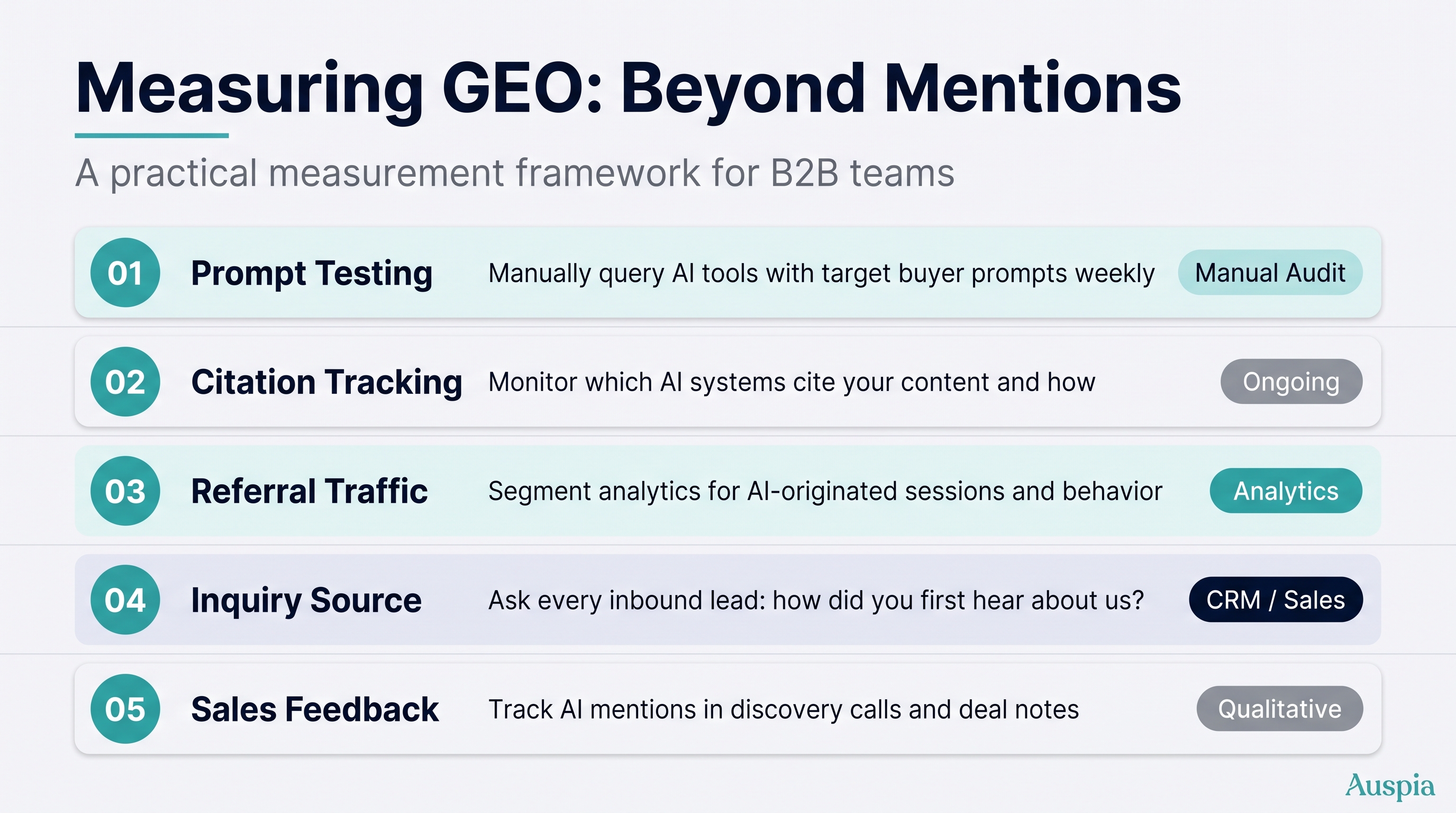
- CRM notes that ask how the buyer discovered the brand
This is where AI search visibility becomes a commercial metric instead of a vanity metric. The visibility check tells you where the brand appears. The sales system tells you whether that appearance is worth anything.
The cheapest GEO provider can become the most expensive one
Founders often compare GEO vendors by monthly fee. That is understandable, but it is incomplete.
The expensive failure is not paying too much for GEO. The expensive failure is paying for work that cannot be measured, maintained, or connected to revenue.
A useful GEO partner should be able to answer basic questions without hiding behind jargon:
Question | What a good answer sounds like |
|---|---|
Which buyer prompts are we tracking? | A categorized prompt library tied to personas and funnel stages |
Why are these pages being created? | Each page maps to a prompt, citation gap, or conversion path |
What changed this month? | Specific answer shifts, citation gains, traffic changes, and sales notes |
What should we stop doing? | Honest removal of low-value prompts, pages, or channels |
How will we prove value? | Shared dashboard across AI visibility, analytics, and CRM evidence |
Cheap execution without measurement creates rework. Six months later, the company may have a pile of generic content, no prompt history, no citation trail, and no idea whether AI search helped sales.
A simple six-month GEO review template
Founders do not need a bloated report. They need a review that forces clarity.
Use this structure at the end of month six:
Section | Questions to answer |
|---|---|
Executive readout | What improved, what did not, and what should we fund next? |
Prompt visibility | Which buyer prompts now include us, cite us, or exclude us? |
Citation quality | Which owned and third-party sources influence the answers? |
Website behavior | Which AI-referred sessions reached high-intent pages? |
Sales evidence | Which inquiries mentioned AI discovery, AI validation, or AI comparison? |
Content gaps | What pages or proof assets are still missing? |
Next-quarter plan | Which five actions have the highest expected impact? |
The most useful review is often the most uncomfortable one. It names the weak spots.
Maybe the brand is visible but positioned incorrectly. Maybe the content is being cited but the landing page does not convert. Maybe competitors are mentioned more often because they have better comparison assets. Maybe the team is chasing too many low-intent prompts.
Good. Now the team has something to fix.
What Auspia automates in GEO work
Auspia's automated GEO service is built for teams that want this operating rhythm without turning GEO into another manual reporting burden.
The system helps teams move through the full loop:
- Map buyer prompts across ChatGPT, Perplexity, Gemini, Google AI Overviews, and other AI answer surfaces.
- Audit brand entity clarity, owned content, technical readiness, and citation gaps.
- Generate prioritized GEO tasks tied to prompts, pages, and conversion paths.
- Monitor AI visibility, citation movement, and competitor presence over time.
- Turn findings into content briefs, page updates, structured FAQs, and measurement reports.
- Connect GEO visibility to traffic, inquiry quality, and the sales conversations that matter.
The goal is not to chase every AI mention. The goal is to build a repeatable system where AI visibility becomes easier to measure, improve, and explain to leadership.
If your team is trying to decide whether GEO is worth funding for another quarter, start with an audit. Run your priority prompts through Auspia's GEO Score Checker, inspect the gaps, and use the result as the first version of your GEO operating plan.
FAQ
How long does GEO take to show results?
Most B2B teams should expect the first month to focus on foundations, with clearer visibility signals around months two to four. Revenue evidence usually takes longer because buyers need time to discover, evaluate, and enter the sales process.
What is a good GEO metric for executives?
Use a small set: AI answer mention rate, citation quality, AI referral traffic, qualified inquiries influenced by AI discovery, and closed or assisted deals. Mention rate alone is not enough.
Should GEO replace SEO?
No. GEO builds on SEO foundations: crawlable pages, clear entities, useful content, structured information, and strong third-party signals. The difference is that GEO optimizes for AI answer retrieval and recommendation behavior, not only traditional rankings.
How should sales teams support GEO measurement?
Add a simple discovery question to inbound qualification: "Where did you first hear about us?" Also ask whether the buyer used ChatGPT, Perplexity, Gemini, Google AI Overviews, or another AI tool during vendor research. The answer will not be perfect, but it gives the team evidence that analytics alone may miss.
What should a company do if it gets AI mentions but no leads?
Check the prompts, answer context, cited pages, and next-step path. The brand may be visible in low-intent answers, described poorly, or sending visitors to pages that do not help buyers evaluate fit. GEO visibility needs a conversion path.
Author: Ethan Marlowe, GEO Measurement Lead Across 500+ Prompts at Auspia. Ethan writes about prompt tracking, citation reporting, visibility dashboards, and practical ways to connect AI search visibility with business outcomes.