Direct answer
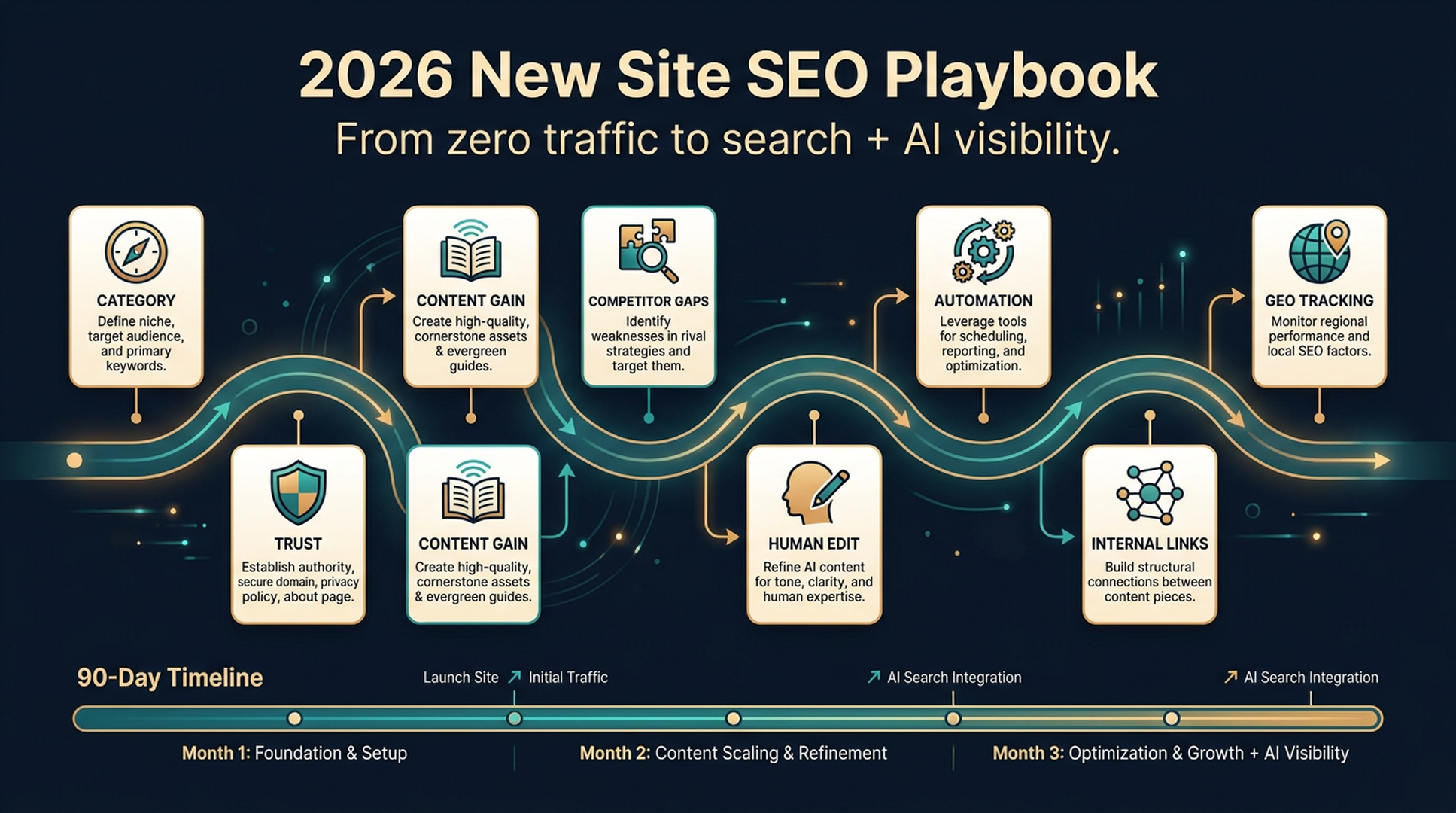
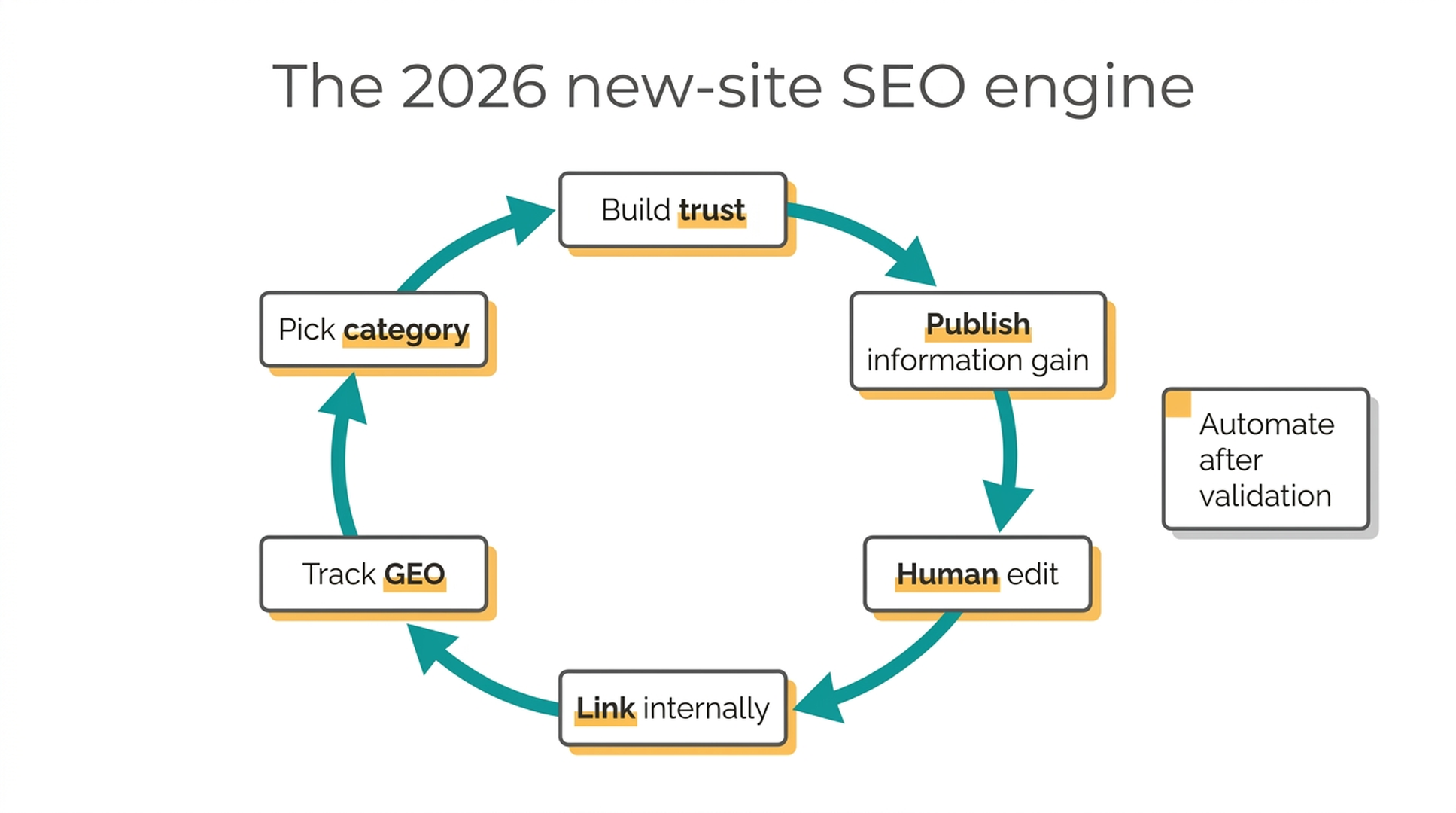
A new website can still grow through SEO in 2026, but not by publishing dozens of generic AI articles and waiting for Google to reward them. The sites that start gaining traction early usually do four things well: choose a market with real search demand, build trust signals from day one, publish content with clear information gain, and automate only after the manual workflow proves it can earn impressions, clicks, and conversions.
The short version:
- Pick a category where people search many specific questions.
- Build on a clean domain and launch fast.
- Create differentiated content, not AI copycat pages.
- Use timely topics only when they fit your niche.
- Study competitors to find gaps, not to rewrite them.
- Remove the generic AI tone before publishing.
- Automate research, monitoring, and drafting gradually.
- Add GEO readiness so the site can appear in AI answers, not only classic rankings.
This is the 2026 playbook for new sites: content is the core, trust is the accelerator, and automation is the lever. Use them in that order.
Why new sites get stuck with zero traffic
Most zero-traffic sites do not fail because SEO is dead. They fail because the site gives search systems no reason to care.
The common pattern is easy to spot. Someone buys a fresh domain, installs WordPress or Shopify, asks an AI tool to write 30 articles, publishes everything in a week, adds a few plugins, and waits. Three months later, Search Console shows a few impressions and almost no clicks.
Then the conclusion is: "SEO does not work anymore."
A better conclusion is: thin execution does not work anymore.
In 2026, search systems and AI answer systems are both better at recognizing sameness. If your page says the same thing as 100 other pages, with no proof, no original examples, no sharper structure, and no reason to trust the site, it will struggle.
Step 1: Choose the battlefield before building pages
The first decision is not the theme, plugin, or logo. It is the category.
A strong SEO category has fragmented, frequent search demand. People ask many questions in many forms. That creates room for long-tail pages, comparison pages, buying guides, troubleshooting content, glossaries, and templates.
Good signs:
- Many long-tail keywords with clear intent
- Repeated questions in Reddit, Quora, forums, YouTube comments, and Google suggestions
- Competitors ranking with weak or outdated content
- Buyers needing education before purchase
- Multiple subtopics that can support internal links
- High enough commercial value to justify content work
Weak signs:
- Very low search demand
- One or two head terms dominate the category
- Search results are controlled by huge brands and marketplaces
- The topic has little depth beyond product listings
- Users do not research before buying
Use this simple matrix:
Search demand | Competitor content quality | What it means |
|---|---|---|
High | Low | Best opportunity. Move fast and publish better pages. |
High | High | Worth doing, but expect a longer runway. |
Low | Low | Possible, but the ceiling may be limited. |
Low | High | Usually avoid unless the conversion value is exceptional. |
A new site needs unfair focus. Do not enter a broad market with generic pages. Enter a narrow slice where you can become unusually useful.
Step 2: Treat the domain as a trust decision
A domain is not just an address. It is part of the trust layer.
Some teams use aged domains because they may come with historical links and faster discovery. That can help, but it is risky if the domain history is dirty, unrelated, or previously used for spam. A clean new domain can work too. It just needs more patience and a stronger launch plan.
Before buying or reusing any domain, check:
- Historical snapshots in Wayback Machine
- Prior topic relevance
- Existing backlink profile
- Spam, adult, gambling, piracy, or hacked history
- Indexing status
- Brand fit
- Trademark risk
If you use an aged domain, relevance matters more than raw metrics. A domain that used to be a wedding planning blog is more useful for a wedding service site than a random expired tech forum with inflated link numbers.
If you use a new domain, compensate with clarity: publish core pages quickly, submit sitemaps, build internal links, create credible author and organization information, and avoid leaving the domain empty for weeks.
Step 3: Make content the core, not the filler
The source article is right about one thing: content is the main battlefield now. But "content" does not mean bulk AI output.
Google does not need another article that begins with "in today's fast-changing digital landscape" and repeats the same headings as every competitor. AI answer systems do not need that either.
Useful content in 2026 has information gain.
Information gain can come from:
- A newer 2026 update
- A better decision framework
- Real screenshots or examples
- Specific numbers or constraints
- A clearer comparison table
- A local or industry-specific angle
- A failure case competitors ignore
- A workflow the reader can copy
- First-hand product or service experience
AI can help draft, summarize, and structure. It should not decide what makes the page worth publishing. That judgment still belongs to the operator.
Step 4: Use timely topics, but do not chase noise
Timely content can help a new site get discovered faster. When a topic starts trending, competition may be thin for a short window. If your site can publish a useful, niche-relevant page early, it may earn impressions before larger competitors react.
But relevance is the filter.
A cybersecurity site should not chase a celebrity trend. A wedding planner should not publish random AI news. A Shopify app can publish about new commerce platform changes if the topic affects its users.
Use trend sources carefully:
- Google Trends
- Reddit rising threads
- YouTube search suggestions
- Product changelogs in your industry
- Search Console emerging queries
- Customer support questions
- Industry newsletters
The rule: if the trend does not help your target buyer make a better decision, skip it.
Step 5: Study competitors without becoming a copycat
Before writing a page, search the target query and read the top results. You are not looking for text to rewrite. You are looking for gaps.
Ask:
- What do all top pages repeat?
- What do they ignore?
- Which examples feel outdated?
- What questions remain unanswered?
- Is the page written for beginners, buyers, or experts?
- Are there missing tables, workflows, visuals, or checklists?
- What would make this page easier to trust?
If every page about "outdoor wedding timeline" covers venue selection, ceremony flow, and basic reminders, the better page might add rain-plan switching, power and sound setup, guest shade planning, vendor timing, and photo-light direction.
That is not rewriting. That is adding value.
Step 6: Remove the AI tone before publishing
Generic AI writing has patterns readers notice quickly:
- Big empty openings
- Too many transition phrases
- Over-neat lists of three
- Abstract claims without scenes
- Bland examples
- Motivational conclusions
- No author judgment
Fixing this is not about tricking detectors. It is about making the page worth reading.
Use specific scenes instead of vague advice.
Weak: "Choosing the right venue is important."
Better: "For an outdoor ceremony, ask where the sun will be at the exact ceremony time. A 4 p.m. setup can look perfect at noon and still leave every guest squinting into the light during vows."
Use real constraints, not generic claims. Mention budgets, tools, timelines, platform limits, weather, inventory, compliance, buyer objections, or implementation details when they matter.
The more specific the page becomes, the less it sounds like everyone else.
Step 7: Automate only after the workflow works
Automation is powerful, but it multiplies whatever is already true. If your manual process produces weak pages, automation produces weak pages faster.
Use this rollout:
Stage | Timing | What to automate | What stays manual |
|---|---|---|---|
Manual validation | Weeks 1-4 | Basic monitoring and data collection | Topic choice, research, writing, editing |
Semi-automation | Weeks 5-8 | Trend alerts, competitor SERP capture, outline drafts | Information gain, examples, final edits |
Assisted scale | Week 9 onward | Drafting, internal link suggestions, refresh alerts, reporting | Quality review, claims, proof, publishing approval |
This sequence is slower than bulk publishing. It is also safer. New sites cannot afford to burn trust with hundreds of similar pages.
Step 8: Plan internal links from the first article
Many new sites publish content as isolated pages. That slows discovery and weakens topical authority.
Create a simple structure:
- One main hub page for the category
- Supporting guides for major subtopics
- Comparison pages for decision-stage searches
- FAQ or glossary pages for beginner queries
- Case studies or examples for proof
- Product or service pages for conversion
Every new article should link back to the relevant hub and to at least one related supporting page. Use descriptive anchor text.
Internal links are the site's own trust network. Build it early.
Step 9: Do not ignore mobile speed and basic UX
New sites often obsess over articles while the mobile experience quietly destroys performance.
Check:
- Page load under real mobile conditions
- Image compression
- Font size
- Sticky popups
- Checkout or form friction
- Core Web Vitals
- Layout shift
- Navigation clarity
- Broken links
- 404 pages
A page that earns clicks but frustrates users will not compound well.
Step 10: Add GEO readiness from the start
In 2026, a new site's content should be built for search results and AI answers.
That means each priority page should include:
- A direct answer near the top
- Clear entity names
- Specific examples
- Visible author or organization trust signals
- Comparison tables where useful
- Current dates when freshness matters
- Internal links to supporting pages
- Schema that matches visible content
- Claims that can be verified
Then track a small prompt library monthly. For example:
- "Best tools for [buyer type] in 2026"
- "How should a small business choose [category]?"
- "Compare [solution A] and [solution B] for [use case]"
- "What should I check before hiring a [provider type]?"
Record whether your brand appears, whether your pages are cited, and which competitors the AI answer trusts.
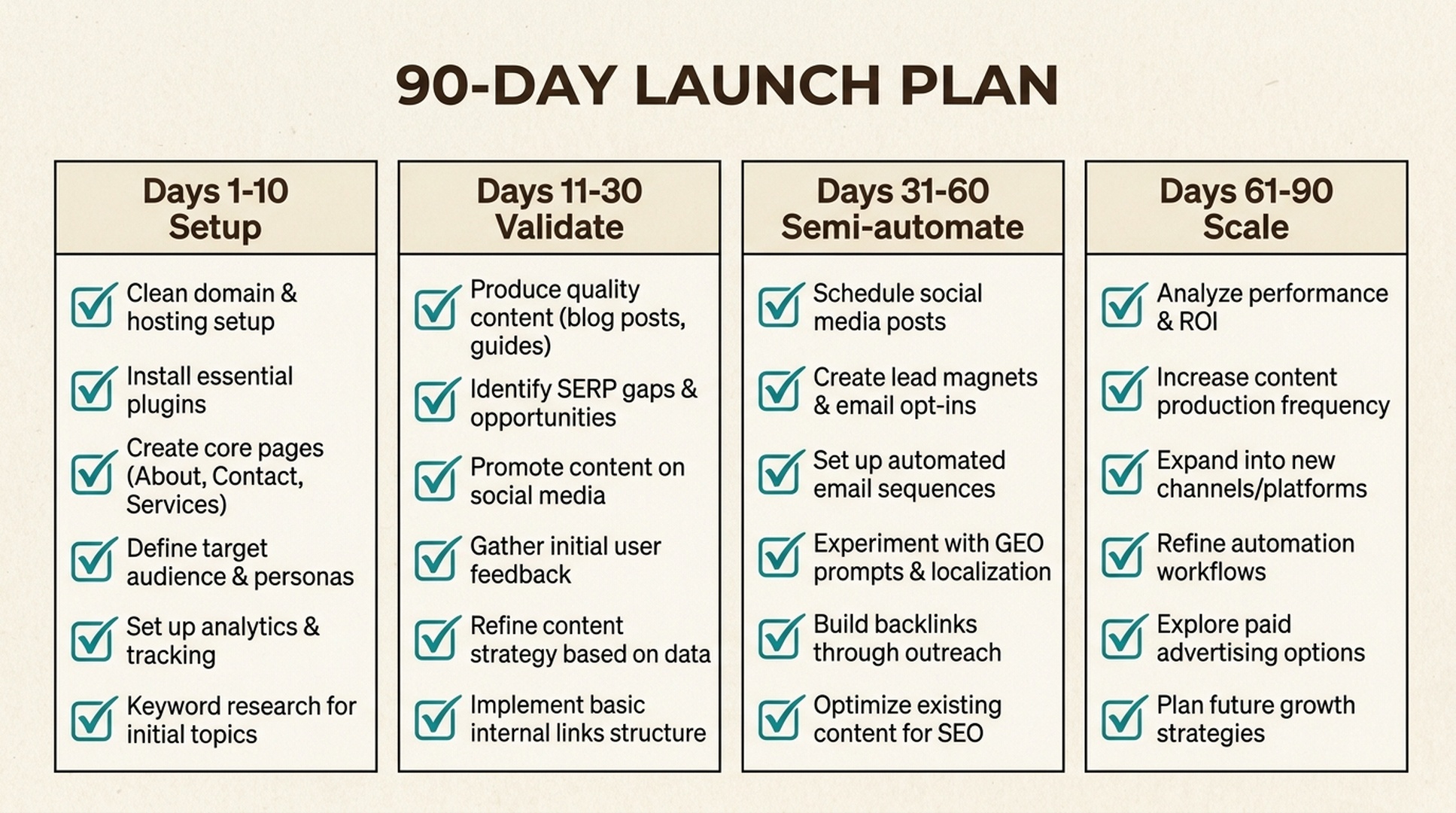
A 90-day new-site SEO plan for 2026
Timeframe | Focus | Output |
|---|---|---|
Days 1-10 | Category, domain, setup | Market matrix, clean domain, GSC, GA4, sitemap, core pages |
Days 11-30 | Manual content validation | 6-12 high-quality pages, internal links, initial indexing checks |
Days 31-60 | Semi-automated research | Trend alerts, competitor gap tracking, refresh workflow, first backlinks |
Days 61-90 | Scale carefully | More page clusters, GEO prompt tracking, conversion review, content pruning |
Fast traction is possible, but do not build a strategy around miracle timelines. Build around repeatable improvement.
Auspia's 2026 takeaway
New-site SEO still works. The playbook is just less forgiving now.
The old formula was publish content, build links, wait. The 2026 formula is sharper: choose a searchable niche, build trust early, publish content with information gain, make pages technically clean, connect them with internal links, and track both classic rankings and AI answer visibility.
If you want to skip the manual complexity, use Auspia.ai. Auspia automates SEO audits, GEO readiness checks, page-level recommendations, AI visibility monitoring, and ongoing prioritization, so a new site can move from guesswork to intelligent execution faster.
FAQ
Can a new website still get SEO traffic in 2026?
Yes. New sites can still grow through SEO, but generic AI content and weak technical setup rarely work. The site needs a focused category, useful pages, clean indexing, internal links, and trust signals.
How long does new-site SEO take?
Some pages can earn impressions within days or weeks, especially for low-competition long-tail queries. Meaningful traffic usually takes months. A realistic first checkpoint is 90 days, not overnight success.
Should I buy an aged domain for SEO?
An aged domain can help if it has a clean, relevant history and trustworthy links. It can also hurt if it has spam history or irrelevant backlinks. Always review Wayback history and backlink quality before using one.
Is AI content bad for SEO?
AI-assisted content is not automatically bad. Generic AI content is the problem. Use AI to speed up research and drafting, but add original examples, clear judgment, real constraints, and human editing before publishing.
How does GEO fit into new-site SEO?
GEO helps pages become easier for AI systems to understand, summarize, and cite. For new sites, GEO readiness means clear answers, specific claims, structured pages, entity consistency, and prompt-level visibility tracking.