Quick answer
SEO is not dead in 2026. It has become the operating system behind AI search visibility.
The teams that keep winning organic traffic are not choosing between Google, AI Overviews, ChatGPT, Perplexity, Claude, or other answer engines. They are building pages that search crawlers can access, humans can trust, and AI systems can quote without doing extra interpretation.
That sounds less dramatic than "SEO is over." It is also closer to reality.
The practical shift is this: your page now has to satisfy two readers at once. One reader is a human scanning for a useful answer. The other is a retrieval system looking for clean chunks, evidence, entities, and links it can use inside an answer.
If your SEO program still treats traffic as a list of blue-link rankings, it will miss part of the market. If your GEO program ignores crawlability, intent, links, and content quality, it is building on sand.
What changed in 2026
Search behavior is splitting across more surfaces. A customer might discover a topic in ChatGPT, compare vendors in Google, ask a follow-up in Perplexity, and check a brand on Reddit or YouTube before booking a demo.
That does not make SEO irrelevant. It makes the job wider.
Modern SEO now has to cover:
Search layer | What users expect | What your site must provide |
|---|---|---|
Classic search | Pages, products, guides, comparisons | Crawlable pages, clear intent match, strong titles, useful internal links |
AI answers | Direct summaries with cited sources | Concise definitions, tables, evidence, author signals, extractable sections |
Local and vertical search | Nearby, specialized, or marketplace results | Accurate profiles, reviews, schema, consistent entity data |
Brand verification | Proof that you are real and credible | Case studies, mentions, third-party references, original data |
The mistake is treating these as separate channels. They overlap. AI systems often lean on web content, search results, knowledge graphs, structured data, and third-party context. If your content is weak in classic search, it usually has less surface area for AI answers too.
How AI search actually uses web content
Most AI answer systems do not "read the internet" the way a person reads a site. In many workflows, the system rewrites a user question into several related searches, retrieves documents or passages, breaks content into chunks, and then composes an answer from the strongest pieces.
That means a page can fail even if the writing is decent. It may be too slow to crawl. It may hide the answer behind scripts. It may bury the point under a long introduction. Or it may make claims without enough context for a retrieval system to trust.
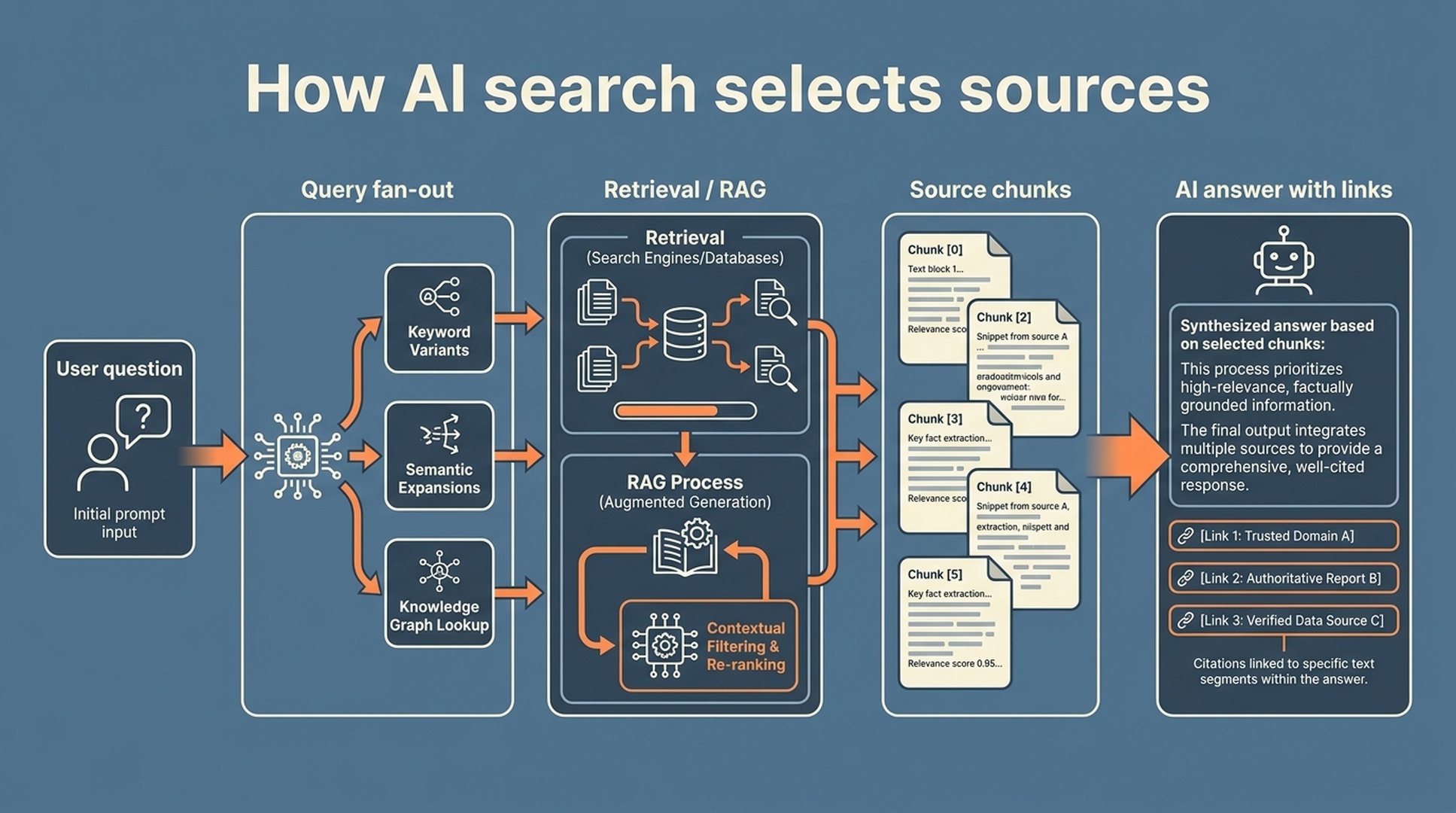
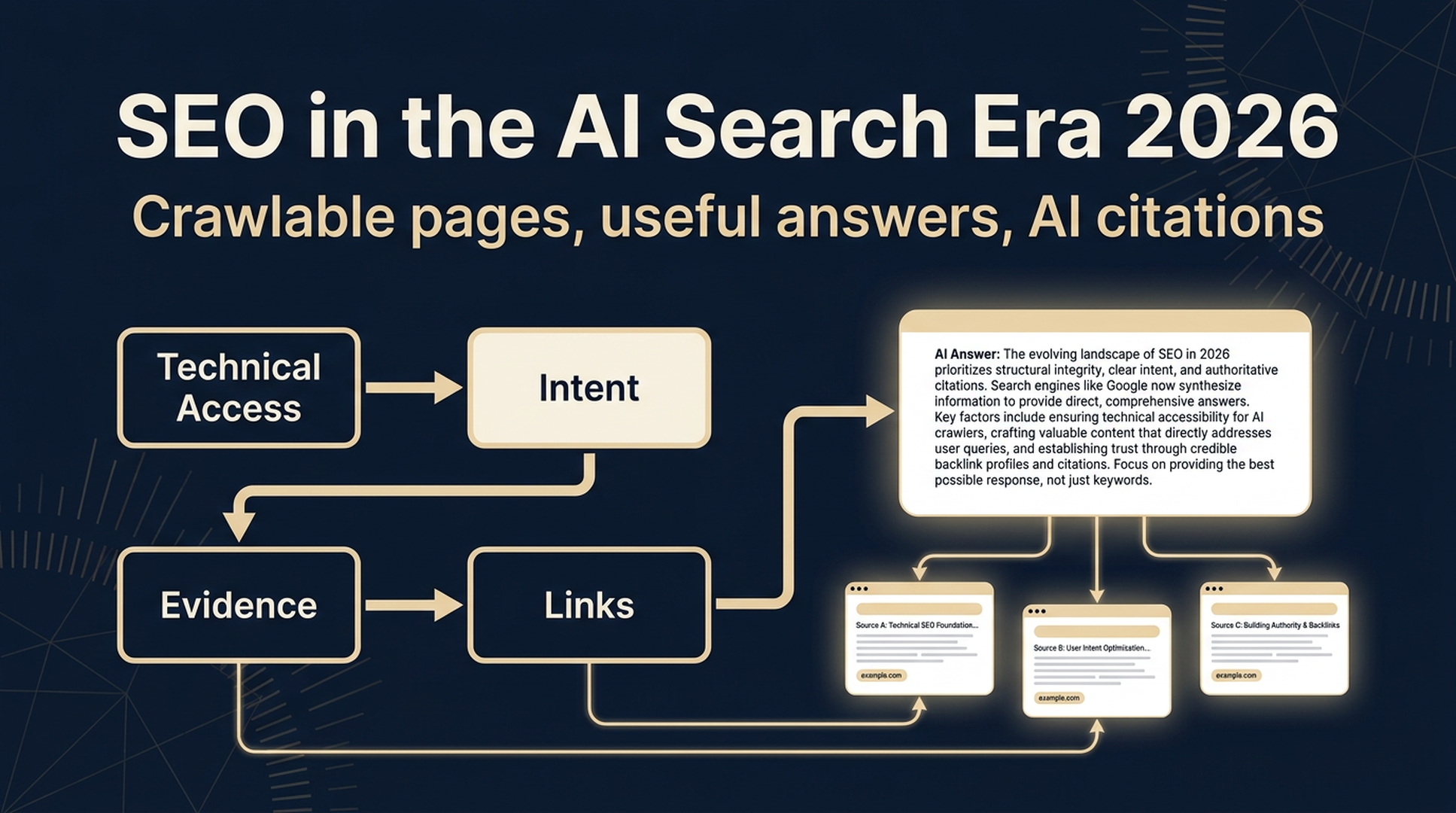
Caption: AI search visibility depends on retrieval-friendly pages, not just polished prose.
A useful mental model is: every important section should work as a self-contained answer block.
A good block usually has:
- A clear heading that matches a real question or subtopic.
- A direct answer in the first one or two sentences.
- Specific entities, dates, tools, metrics, or examples.
- Supporting evidence, not just opinion.
- Internal links that show where the topic sits in your site.
This is why old-school SEO basics still matter. Title tags, headings, internal links, schema, page speed, and indexability are not cosmetic details. They help machines find, classify, and reuse your content.
The four pillars still hold
A lot of 2026 SEO advice sounds new because the labels are new. Under the surface, the work still rests on four pillars.
1. Technical access
If search engines and approved AI crawlers cannot access your pages, nothing else matters. Check robots.txt, noindex tags, canonical tags, JavaScript rendering, redirects, broken pages, Core Web Vitals, sitemaps, and structured data.
Do not block AI crawlers by reflex. Some sites should restrict certain bots for legal, business, or server-cost reasons. But a blanket block can also remove your brand from AI discovery paths. Make the decision intentionally.
A simple starting point is to audit whether important pages are crawlable and whether your robots rules match your AI visibility goals. Auspia's Robots.txt AI Crawler Checker is built for exactly this kind of review.
2. Intent and keyword demand
Search volume still matters, but it is a blunt instrument. A low-volume query with strong commercial intent can be worth more than a broad keyword that attracts students, competitors, and casual readers.
In 2026, keyword research should answer five questions:
Question | Why it matters |
|---|---|
What job is the searcher trying to finish? | Prevents content that ranks but does not convert |
What format does the result page reward? | Shows whether to write a guide, tool page, list, template, or comparison |
What adjacent questions appear in AI answers? | Reveals subtopics that need extractable answer blocks |
What would make this page cite-worthy? | Pushes the team toward data, examples, and proof |
What business action should follow? | Connects content to demos, signups, audits, or product use |
The best keyword is rarely the biggest keyword. It is the query where search intent, authority, and business value overlap.
3. Content that adds something
AI can produce average SEO copy quickly. That has made average copy less useful.
A strong page now needs information gain. It should include something a generic model would not know or would not state with confidence: original screenshots, a real workflow, a benchmark, a teardown, customer questions, pricing context, expert commentary, or a useful template.
For a product-led company, the easiest source of original content is often internal work already happening: support tickets, sales objections, onboarding calls, implementation notes, failed experiments, and before-after audits.
Do not turn these into vague thought leadership. Turn them into answers.
Weak: "AI search is changing how brands think about visibility."
Better: "If your pricing page is blocked by robots.txt, AI answer engines may still mention your competitors while omitting your product when users ask for vendor comparisons."
The second version gives the reader something to check.
4. Links and trust signals
Links still matter, but the useful definition of a link is broader now.
Backlinks from relevant sites remain a strong trust signal. So do unlinked brand mentions, reputable citations, reviews, author profiles, public datasets, community discussions, and third-party comparisons. AI systems need evidence that your brand is not just describing itself.
The cleanest link-building strategy is still the least hacky one: publish assets worth referencing. Original data, free tools, calculators, benchmark reports, comparison tables, and practical templates earn more durable links than mass outreach to random blogs.
The 2026 SEO + GEO readiness checklist
Use this checklist before publishing any important page.
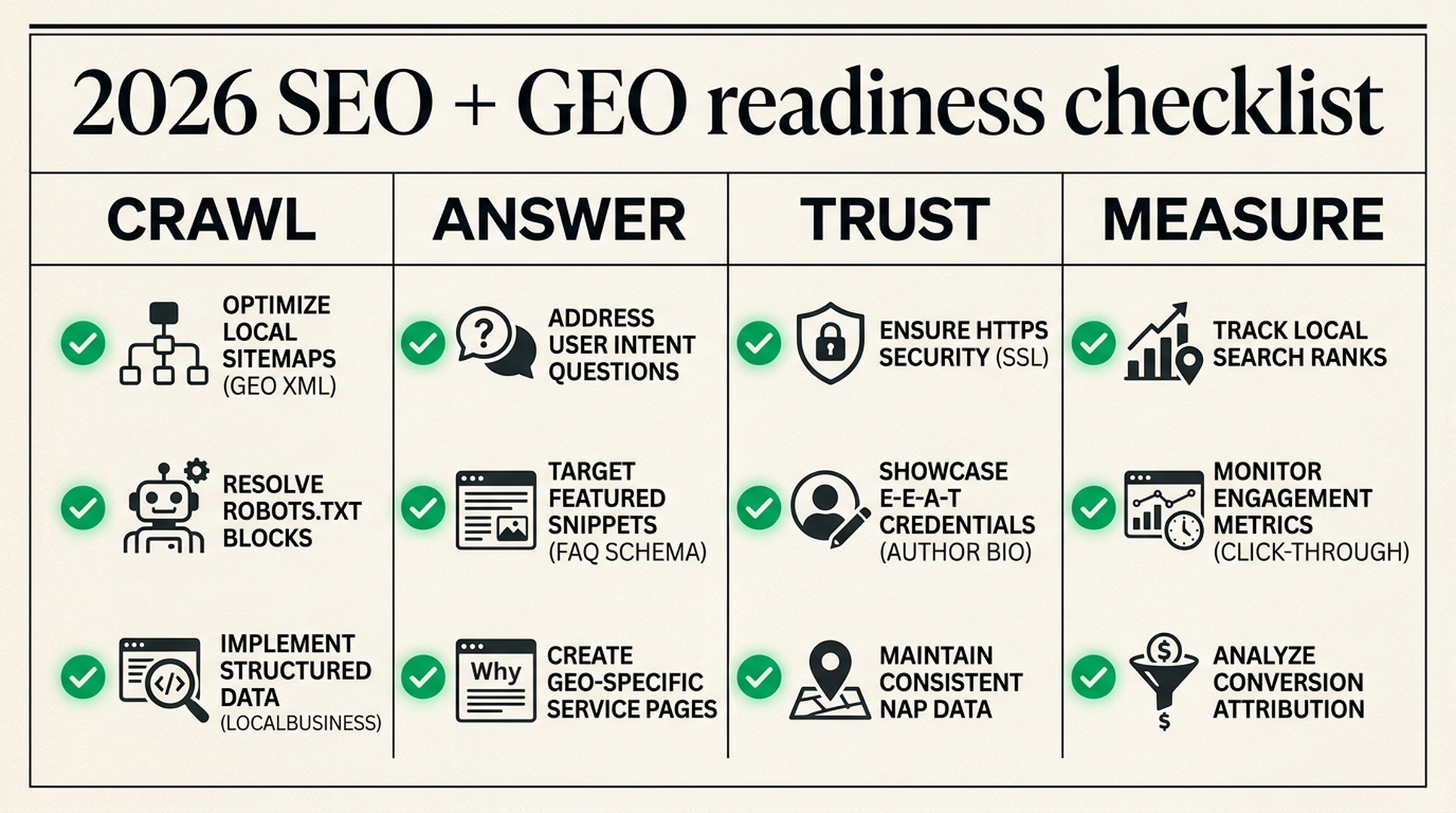
Caption: A page is AI-search-ready only when it can be crawled, extracted, trusted, and measured.
Area | Check before publishing |
|---|---|
Crawl | Page returns 200 status, is not blocked, has a clean canonical, and appears in the sitemap |
Intent | Page format matches the search result pattern and the user's job |
Answer extraction | Important sections start with direct answers, lists, tables, or definitions |
Evidence | Claims include examples, data, screenshots, expert input, or linked references |
Entity clarity | Brand, product, author, category, and audience are easy to identify |
Internal links | Page connects naturally to one or two related resources, not a pile of random links |
Conversion | The next step is obvious without turning the article into a sales page |
Measurement | Track rankings, clicks, impressions, assisted conversions, and AI visibility mentions |
For a faster starting point, run your site through the AI Search Visibility Checker, then manually inspect the highest-value pages.
How to write pages AI systems can cite
The goal is not to trick AI systems. The goal is to make your useful material easy to verify and reuse.
A practical structure:
- Put the conclusion near the top.
- Use headings that sound like real questions.
- Answer each question directly before adding nuance.
- Use tables when comparing options, steps, criteria, or tradeoffs.
- Name entities clearly: products, platforms, locations, dates, authors, sources.
- Add examples from real use cases where possible.
- Link to stronger supporting pages instead of repeating everything.
- Keep introductions short. Nobody needs four paragraphs of throat-clearing.
Here is a simple before-and-after.
Weak section | Stronger section |
|---|---|
"Technical SEO is important for modern websites because it helps improve discoverability." | "Technical SEO makes sure search engines and AI crawlers can access your pages. Start by checking robots.txt, noindex tags, canonical tags, status codes, sitemaps, and JavaScript-rendered content." |
"High-quality content can improve authority." | "Add first-hand proof: screenshots, teardown notes, customer questions, benchmark data, or named expert quotes. Generic summaries are easy to replace." |
"Measure performance across channels." | "Track organic clicks, impressions, indexed pages, assisted conversions, cited mentions in AI answers, and visibility across your core question set." |
The stronger version gives a machine more structure and gives a human more value. That is the sweet spot.
What most teams still get wrong
The most common error is building a GEO project that ignores the website.
Teams create prompt lists, check whether ChatGPT mentions them, and write a report. That can be useful, but it is not enough. If the underlying pages are thin, blocked, untrusted, or hard to extract, the visibility problem will keep coming back.
Another error is publishing AI-generated pages at scale without adding experience. This may create temporary coverage, but it rarely creates trust. In competitive categories, the page that wins is often the page with the clearest evidence, not the longest word count.
A third error is measuring only keyword rankings. Rankings still matter, but they do not show the full picture. A 2026 SEO dashboard should include:
- Organic impressions and clicks.
- Indexed page coverage.
- Share of voice across a keyword set.
- Assisted conversions from organic landing pages.
- Backlinks and high-quality mentions.
- AI answer visibility for priority prompts.
- Crawl blocks that affect search and AI systems.
If that sounds like more work, it is. The upside is that it is also harder for competitors to copy.
Auspia take
SEO has not been replaced by AI search. It has been exposed by it.
Pages that were only written to satisfy a keyword brief now look thin. Pages that actually answer a problem, prove their claims, and connect to a trustworthy site are more useful than ever.
For 2026, the most reliable approach is not "SEO versus GEO." It is one workflow:
Step | Output |
|---|---|
Audit access | Know which pages can be crawled by search engines and relevant AI bots |
Map demand | Build a question and keyword set tied to business value |
Rewrite priority pages | Make answers direct, structured, evidenced, and internally linked |
Build citation assets | Publish tools, templates, datasets, and case notes others can reference |
Measure visibility | Track classic search performance and AI answer presence together |
Start with the pages closest to revenue: comparison pages, category pages, use-case pages, pricing support content, integration pages, and high-intent guides. Do not begin with a 200-page content calendar. Fix the pages that should already be doing more work.
FAQ
Is SEO still worth investing in during 2026?
Yes. SEO is still worth investing in because AI search systems depend on web content, citations, structured information, and brand trust. The work has expanded beyond blue-link rankings, but the foundations still matter.
What is the difference between SEO and GEO?
SEO improves visibility in search engines. GEO, or generative engine optimization, improves the chance that AI answer systems understand, trust, and cite your brand. In practice, strong GEO usually needs strong SEO underneath it.
Should I block AI crawlers?
Only if you have a clear business, legal, or infrastructure reason. Blocking every AI crawler can reduce your visibility in AI-driven discovery. Review crawler rules page by page and make sure they match your strategy.
What kind of content works best for AI search visibility?
Content with direct answers, clear headings, tables, original examples, named entities, and verifiable evidence tends to be easier for AI systems to retrieve and cite. Generic summaries are much easier to ignore.
What should I measure besides rankings?
Measure organic clicks, impressions, indexed pages, conversions, quality backlinks, brand mentions, and AI answer visibility across priority prompts. Rankings are useful, but they are no longer the whole map.