Your brand may be in the answer, but your page may not get the click
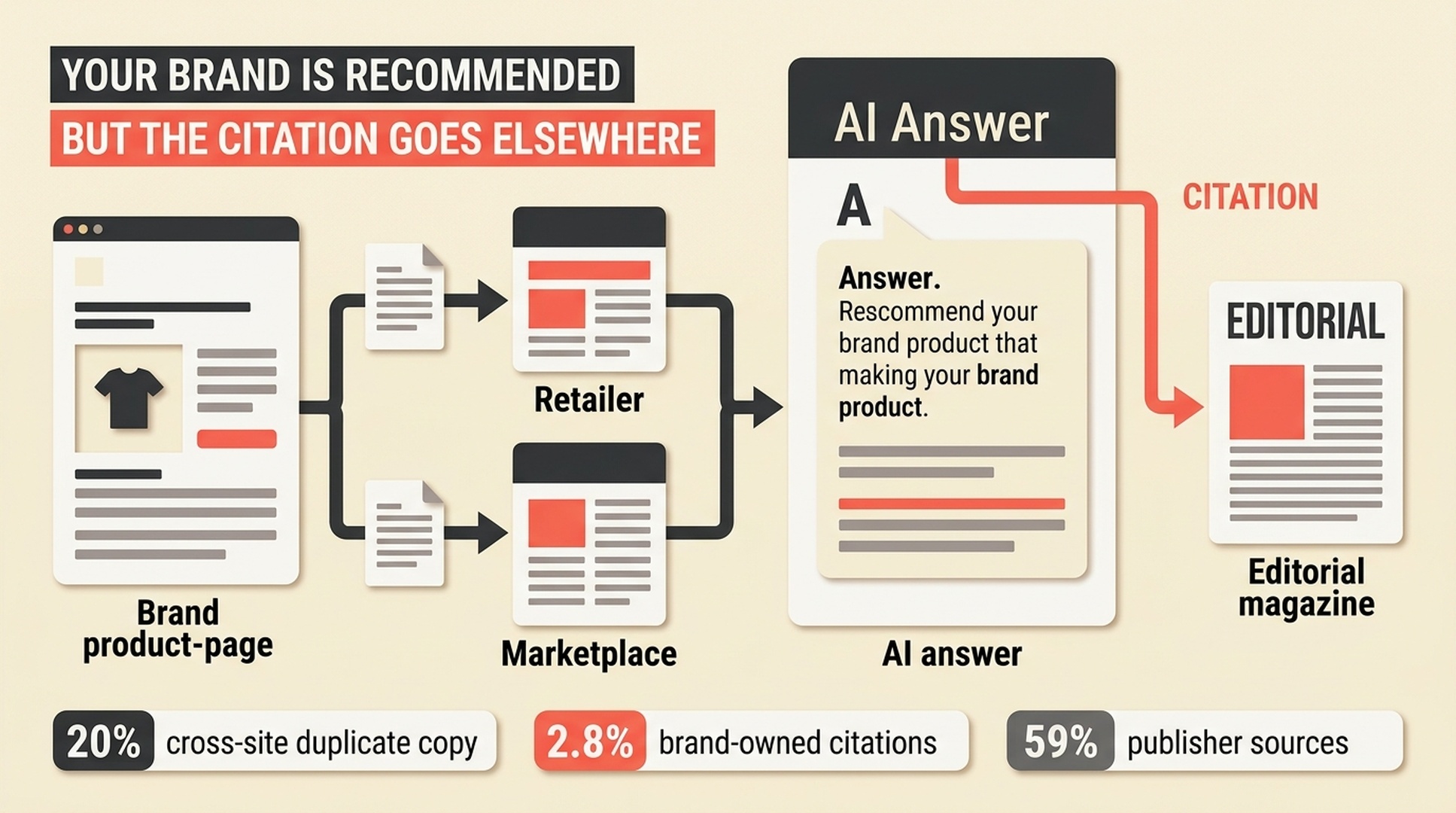
Picture a familiar shopping query: "What are the best squat-proof leggings?" An AI answer names your brand. That sounds like a win, until the citation points to a review site, a retailer, or a Reddit thread rather than your product page.
That is more than a reporting detail. The cited page gets the click. It also becomes the page that explains the product to the buyer, and may remain a source in later answers. The brand gets a mention. Someone else gets the trust entry point.
A recent Shero Commerce study puts numbers around that pattern. The researchers analyzed 8,573 product descriptions across 1,000 Shopify stores and ran 60 real buying questions through Google AI Mode, ChatGPT, and Perplexity. Their most useful finding for ecommerce teams is not "write more copy." It is this: when the same product language appears on several domains, an AI system has little basis for treating the brand site as the original source worth citing.
A brand mention is not the same as owning the answer. The goal is to give the model a clear reason to cite your page when it makes a recommendation.
What the study shows, and what it does not
The method is unusually transparent. Of the 1,000 stores, 883 returned usable product data. The researchers drew up to ten products per store from public feeds, then examined raw page HTML, structured data, and repeated text where pages could be fetched. They checked external duplication by searching distinctive product-description sentences in quotation marks and manually confirming matches.
The citation test was observed rather than modeled. The team entered purchase-intent questions into three AI products and logged whether a brand's own domain was cited, whether the brand was recommended, or whether it was absent. That is enough to describe a meaningful pattern. It does not prove that duplicate copy causes a specific page to lose rankings or citations. The prompt sample covers 60 categories, and retrieval and citation behavior differ by product and will keep changing.
Within that boundary, the numbers are hard to ignore.
Study observation | Result | What it means for a brand |
|---|---|---|
Product descriptions that appeared verbatim or near-verbatim on another domain | 20% | Many brands distribute the same language to retailers and marketplaces |
Cleanly measured stores with fewer than 50 words of product-specific text in raw HTML | 15.6% | Genuinely thin pages are less common than field-only audits suggest |
Stores emitting Product schema | 88% | The technical wrapper is common |
Schema descriptions under 50 words or missing | 59% | The machine-readable summary layer often lacks substance |
All AI citations that came from a brand-owned page | 2.8% | Brand sites captured a very small share of cited sources |
All AI citations that came from publishers | 59% | Editorial, review, and list content dominated the citations |
In Google's answer layer, established DTC brands in the sample were cited or recommended only 9.5% of the time, and a third of the categories named none of them. Even when a brand was recommended, its own page received the supporting citation 31% of the time. The rest often went to sources such as Good Housekeeping, Verywell Fit, CNN Underscored, or Reddit.
The deeper failure is not lack of copy. It is unclear authorship.
Ecommerce teams often diagnose this as one of two problems: the product page is too short, or the schema is incomplete. Both are worth checking, but the study points to a more precise diagnosis.
First, a short product-description field does not necessarily mean a thin page. In the study, many products with fewer than 50 words in the standard description field still had product-specific modules, tabs, and details in the raw HTML. Auditing one field can mistake a rich page for a thin one.
Second, a page that looks rich to a shopper may be weak for a crawler. If the important claims live only in images or are injected after JavaScript runs, the fetched page may contain very little. The study called out structured-data descriptions for a reason: most stores output Product schema, but many leave the description field too thin to explain the product.
Third, and this is the study's most useful observation, a supplier-style paragraph loses its source value once it appears on Amazon, department-store sites, distributor pages, and the brand site. That does not mean an engine is "penalizing" any one page. It means the system has several near-identical statements and little textual evidence of which source is most useful or original. A publisher that has written an independent comparison, review, or use-case explanation now looks like a better source for the answer.
The practical question is no longer "Do we have product copy?" It is whether that copy belongs to this product, appears in crawlable text, answers a buyer's real question, and offers more than the syndicated version sent to every channel.
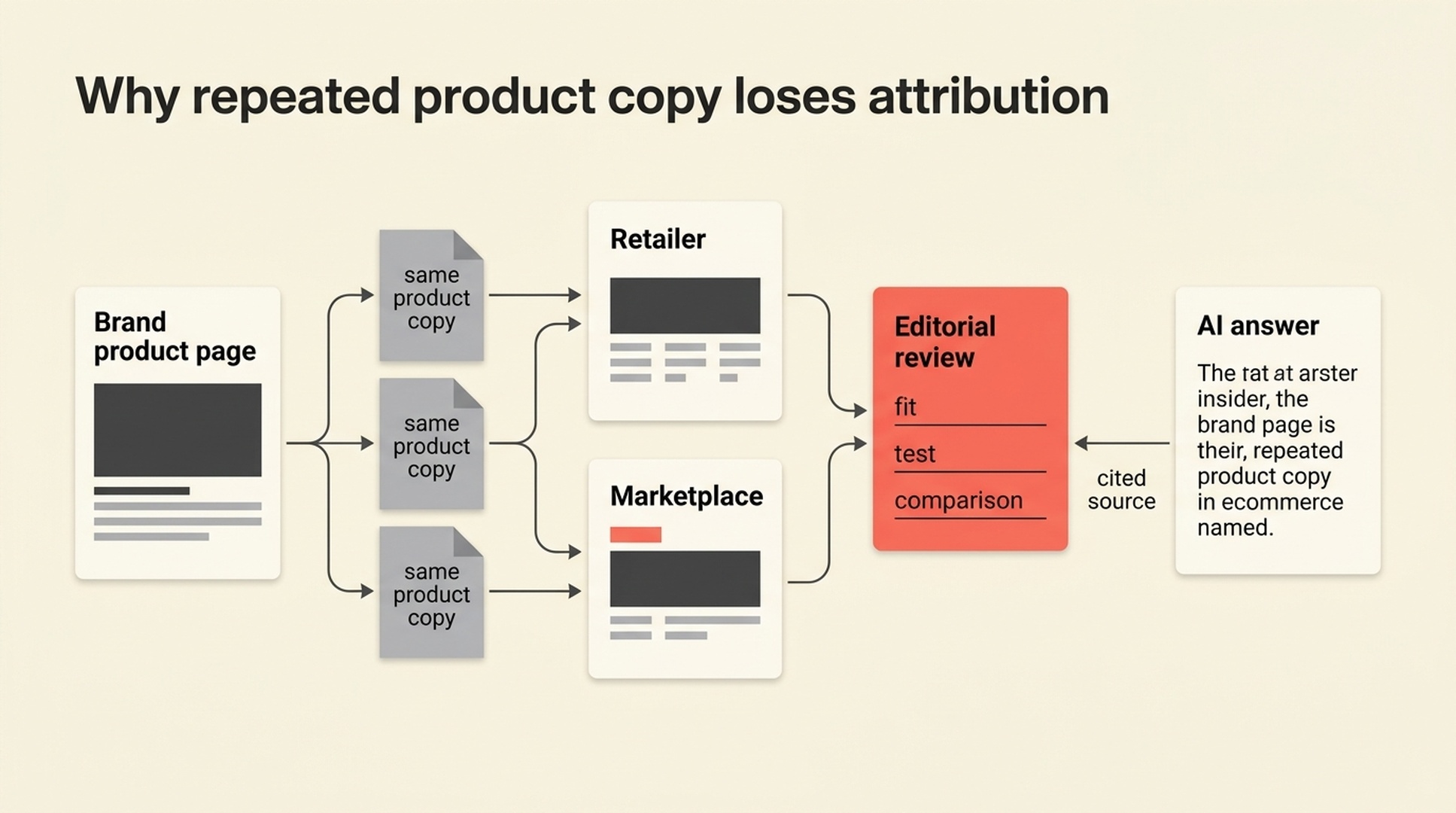
Visual brief: show identical product copy flowing from a brand site to retailer and marketplace pages. Beside it, show an editorial page with original testing and comparison information receiving the AI citation. Do not use real publication logos.
Why AI may cite a magazine instead of the brand site
It is tempting to explain this entirely as publisher authority. That is too convenient. Publishers often give the model information that the product page does not.
A review might say whether fabric shows through during squats, which body types a cut suits, how a product held up over time, or how it compares with alternatives. A product page made of phrases such as "lightweight," "comfortable," and "made for everyday performance" gives the model little evidence for a purchase recommendation.
The answer is not to imitate magazine prose or to pad every SKU with generic paragraphs. It is to make product pages carry first-party information: product-specific facts, clear fit and non-fit boundaries, real specifications, and plain-language answers to buyer questions.
Rebuild a product page that can be attributed to you
Most teams should not try to rewrite an entire catalog at once. Start with high-intent products and rebuild four information layers. None guarantees an AI citation, but together they reduce the chance that your website is simply another copy of the channel description.
Page layer | What to write | What to avoid |
|---|---|---|
Purchase summary | In 40-60 words, say what the product is, who it is for, the job it does, and a material limitation | A slogan or channel-wide brand description |
Product-specific evidence | Verifiable materials, dimensions, compatibility, test conditions, care requirements, and package contents | Invented performance claims, certifications, or customer experiences |
Decision answers | Honest answers to "Who is this for?", "How does it differ?", and "When is it not a fit?" | Template FAQs written only to add length |
Machine-readable summary | An edited product summary in the Product schema description, confirmed in raw HTML | An empty schema description or a 15-word placeholder |
There is an important distinction here. Channels need consistent product facts. Your brand site needs additional first-party explanation. Keep SKU data, materials, pricing rules, and safety information consistent wherever the product is sold. But do not let the brand site stop at the same standard paragraph delivered to resellers. Explain why the product suits a use case, what changed from the prior model, and what a buyer should verify before purchasing. That is the content layer only your site can own.
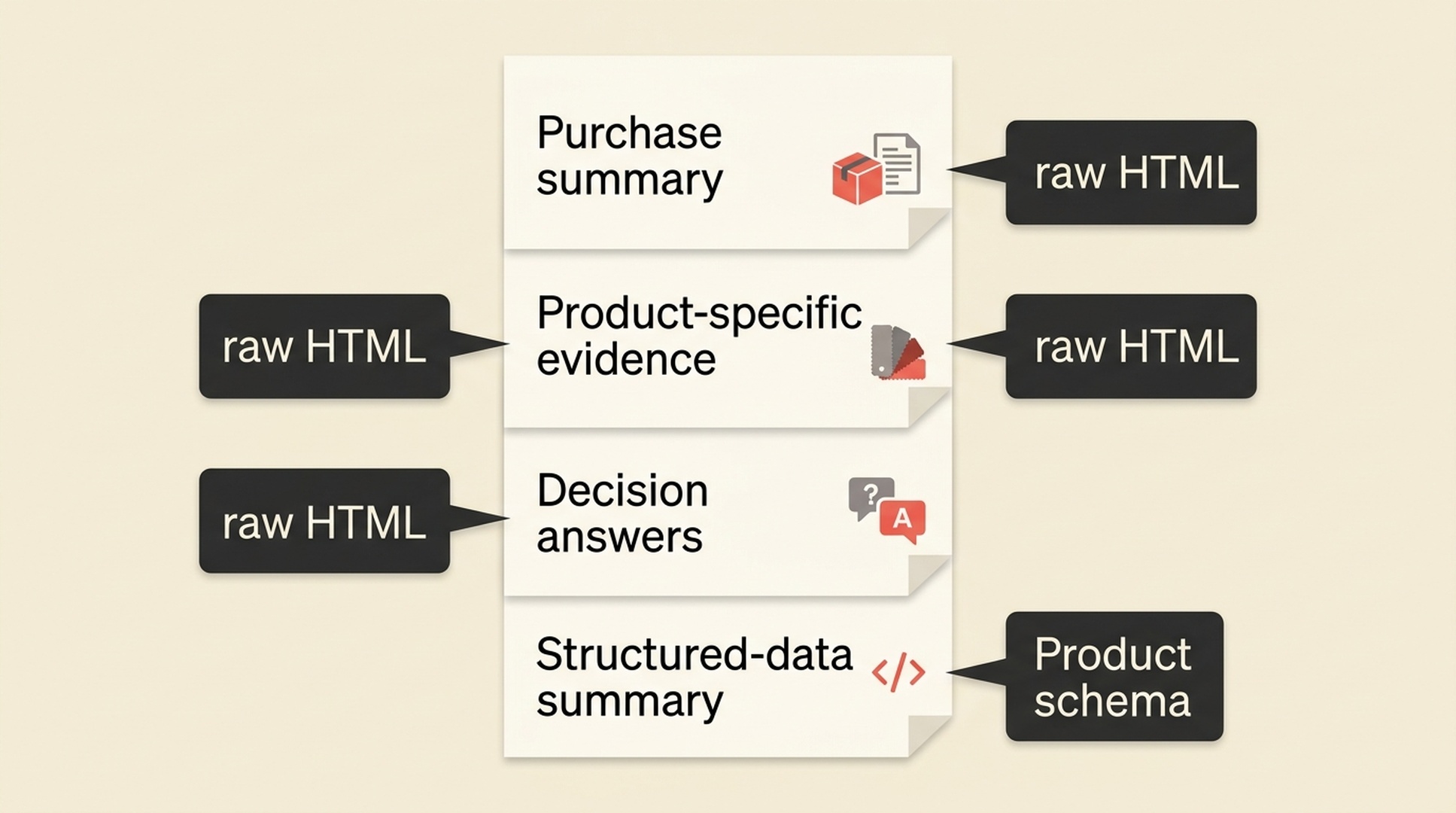
Visual brief: a four-tier product-page anatomy diagram. Label raw HTML and Product schema touchpoints. Make it an editorial information diagram, not a simulated software dashboard.
A sensible starting sequence for content teams
Do not begin with a mandate to "rewrite every description." Run a small, inspectable iteration instead.
- Pick 20-50 SKUs closest to a buying decision. Favor products with organic demand, broad reseller distribution, or a place in "best," "for [use case]," and comparison queries.
- Build a fact sheet for each SKU. Gather specifications, materials, fit, limitations, differences from adjacent models, and any public test or certification evidence. If a claim cannot be supported, do not let AI manufacture it.
- Compare against external duplication. Search one or two distinctive product-description sentences in quotation marks to see where that language appears. The point is not to remove every channel listing. It is to find what your product page does not uniquely explain.
- Rewrite the purchase summary, long description, and real buyer FAQ for the brand site. Then confirm that the approved text appears in server-returned HTML and in the structured-data description.
- Track a fixed set of buying prompts before and after the work. Record whether the brand appears, which domains receive citations, and whether the landing page fits the question. Treat this as an observation loop, not proof of short-term causality.
Adding schema across the site may be faster. Generating 5,000 similar descriptions may be faster too. Neither fixes the attribution problem if the brand page still lacks information that competitors, retailers, and publishers do not have.
Four wrong conclusions to avoid
Duplicate product copy triggers a search penalty. The study does not say that. Google has long said it handles duplicate versions by selecting a canonical. The finding here is about source selection in AI citations, not a penalty mechanism.
Fifty words is the target. Fifty words was a measurement threshold, not a magic number. Eighty vague words still give an answer engine little to cite.
Schema solves the problem by itself. Schema helps machines parse a page. It cannot create the product-specific substance the page lacks. The description inside it should be an edited summary, not an empty wrapper.
A publisher citation is as good as a brand citation. It can help awareness, but the third party receives the high-intent click and owns the product explanation. The brand loses a direct chance to convert, clarify, and build first-party evidence.
Auspia's view: writing should extend to every page worth citing
AI search breaks an old content assumption: if people see the brand name, the brand site will naturally benefit. Now important pages need attributable content, not merely a paragraph that can be reused across channels.
That is where Auspia's writing feature and content services fit. Start with buyer questions and verified product facts. Use Auspia to produce a structured first draft, then have people who know the product add the specific details, limits, and experience that can be checked. From there, shape the work into a product page, buying guide, comparison page, or FAQ instead of copying one generic description to every channel.
For large SKU catalogs, Auspia helps bring research, writing, and content review into one workflow: identify the purchase questions worth earning, create and review original page content, then check whether the priority pages contain clear, crawlable material that can support an answer. A tool cannot prove your product, and it should not invent proof. Its job is to make original content production and review easier to sustain.
Start with a small group of high-intent products. Write the explanations only the brand can provide, then watch how source patterns change in AI answers. You can begin building that workflow with Auspia.
FAQs
If AI recommends my brand but does not cite my site, should I act?
Yes. A brand mention has value, but the citation determines where the buyer clicks and which page explains the product. First check whether your site contains distinct, crawlable information that answers the purchase question directly.
Do retailers and marketplaces need to remove my product description?
No. Channels need accurate, consistent baseline facts. The more practical approach is to give the brand site a deeper layer of product context, differences, fit boundaries, and buying answers that channel pages do not contain.
Should I write a blog post or improve the product page first?
If the buyer question maps directly to a SKU, start with the product page. If it requires education, comparison, or use-case context, a buying guide, comparison page, or blog post may be the better format. Both should contribute distinct information rather than repeat each other.
Author: Eva Laurent, Ecommerce Search Strategist for 10k+ Product Pages at Auspia. Eva writes about ecommerce SEO, product discovery, and AI-assisted shopping journeys.