The practical answer
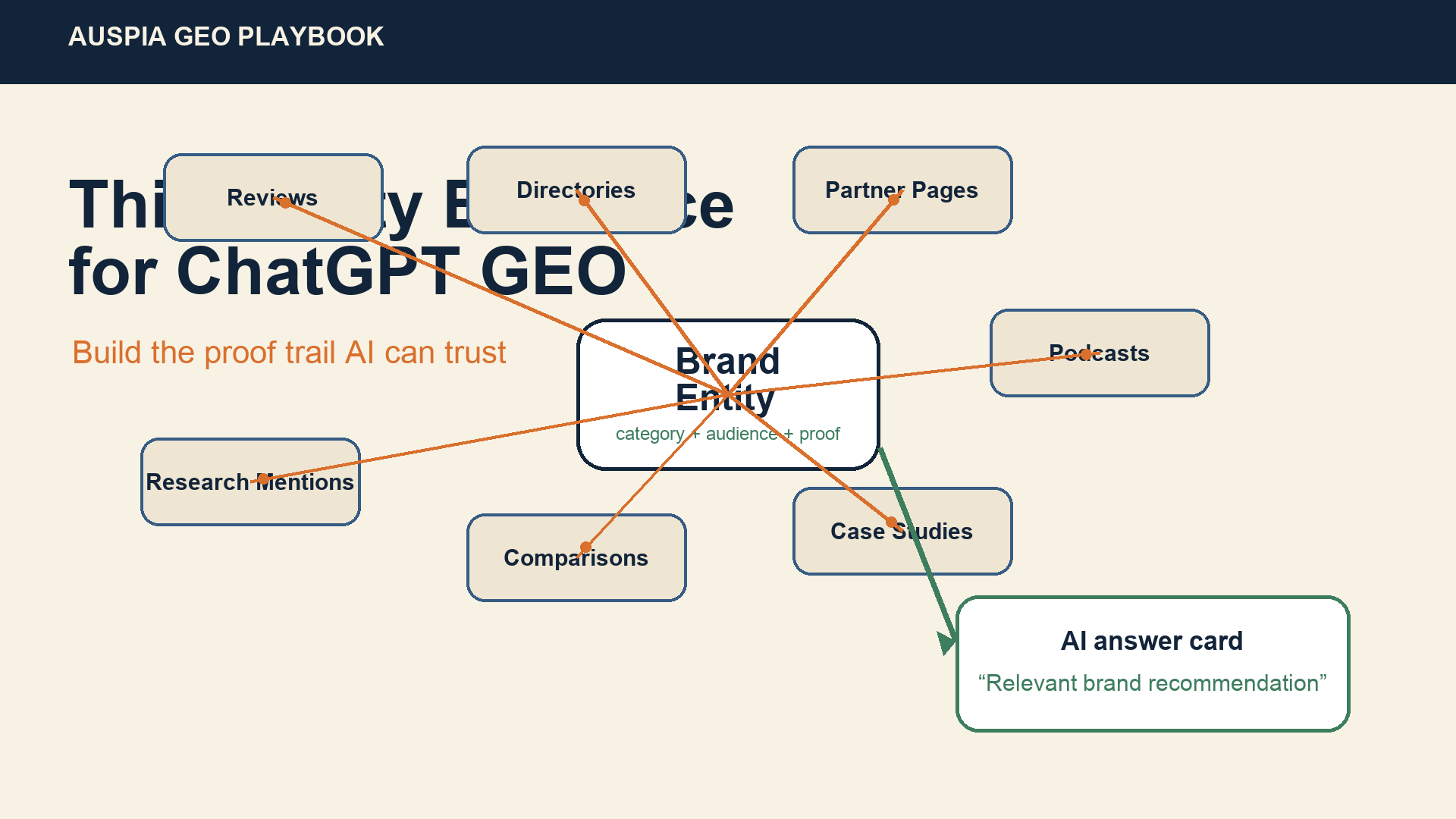
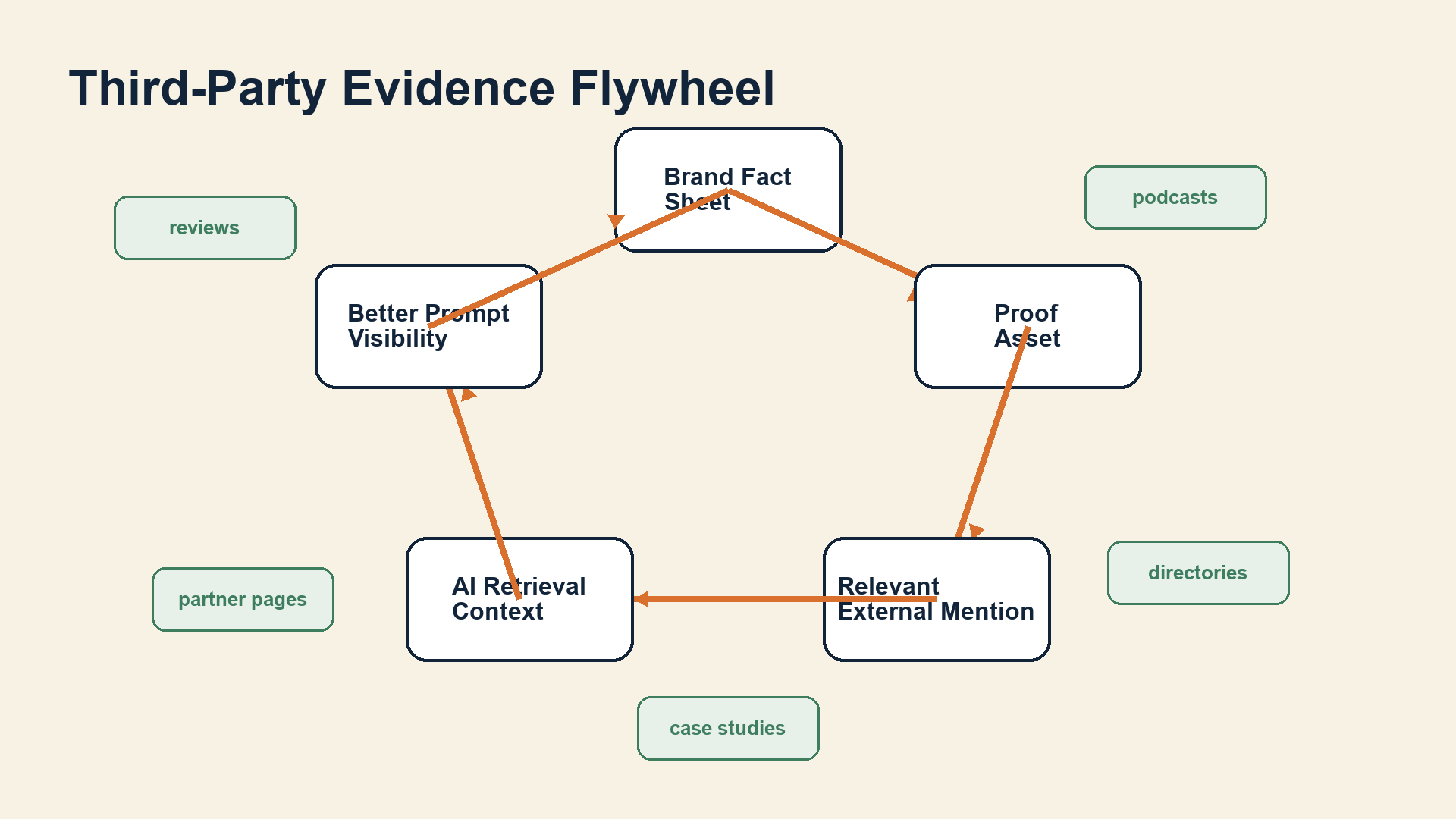
Third-party evidence is the public proof outside your own website that helps ChatGPT and other AI answer systems understand whether your brand is credible, relevant, and worth mentioning. It can include independent reviews, software directories, partner pages, expert roundups, media mentions, podcast pages, GitHub profiles, marketplace listings, analyst pages, comparison articles, and customer case studies hosted on trusted external domains.
For ChatGPT GEO, third-party evidence matters because your own website is only one source. If your homepage says you are a category leader but the rest of the web is silent, inconsistent, or outdated, AI systems have less reason to include you in recommendations. If your brand appears repeatedly in relevant, crawlable, well-described places, the brand becomes easier to retrieve and compare.
The goal is not to manufacture fake authority. The goal is to build a clean, verifiable evidence trail that matches what your product actually does.
What counts as third-party evidence?
Third-party evidence is any useful public source that describes, evaluates, lists, compares, quotes, reviews, or references your brand outside properties you fully control.
Not all evidence has the same value. A single low-quality directory listing is weak. A relevant review profile with accurate category language, a partner page explaining the integration, a podcast page summarizing your point of view, and a comparison article that places you in the right market can be much stronger together.
A practical evidence trail usually includes four types of sources:
Evidence type | Example | Why it helps ChatGPT GEO |
|---|---|---|
Descriptive evidence | software directories, marketplace pages, partner listings | Confirms what the brand is and which category it belongs to |
Evaluative evidence | reviews, ratings, comparison articles, alternatives pages | Helps AI systems compare brands and summarize tradeoffs |
Expert evidence | podcasts, webinars, guest articles, conference pages, quoted commentary | Connects brand people and ideas to a topic area |
Proof evidence | customer stories, public case studies, integration examples, templates | Supports claims with specific use cases and outcomes |
The strongest GEO programs combine these sources instead of relying on one channel.
Why ChatGPT may ignore brands with thin evidence
When users ask ChatGPT for recommendations, the answer often depends on a market map: which brands belong in the category, which sources mention them, which claims are repeated, and which names appear in comparison-style contexts.
A brand with thin evidence has three problems:
- It is harder to classify.
- It is harder to compare.
- It is harder to justify in an answer.
Imagine two companies in the same category.
Company A has a clear website, review profiles, partner pages, founder interviews, customer stories, documentation, and mentions in category explainers.
Company B has a homepage, a few blog posts, and a LinkedIn page with outdated positioning.
Even if Company B has a strong product, the public evidence trail is weaker. ChatGPT-style systems may have fewer stable signals to support a recommendation.
That is why third-party evidence is not PR vanity. It is retrieval infrastructure.
Start with an evidence inventory
Before pitching podcasts or buying directory listings, make an inventory of what already exists.
Create a spreadsheet with these columns:
- source URL
- source type
- domain or platform
- page title
- brand name used
- category used
- audience mentioned
- product or feature mentioned
- proof point mentioned
- freshness date
- crawlability status
- quality score
- action needed
Then classify each page:
Score | Meaning | Action |
|---|---|---|
0 | Missing, inaccurate, duplicate, or not crawlable | Remove, replace, or ignore |
1 | Mentions the brand but uses weak or outdated language | Update if possible |
2 | Accurate but thin | Add detail, examples, or category clarity |
3 | Clear, relevant, and useful for comparison or proof | Keep and reference internally |
This audit often reveals a simple truth: the brand has more mentions than the team remembers, but many of them do not say anything useful.
Build evidence around prompts, not vanity metrics
The best third-party evidence strategy starts from the prompts you want to win.
Do not ask, "Where can we get mentioned?" Ask, "What would a user ask ChatGPT before choosing a solution like ours?"
For a GEO or AI search visibility platform, useful prompt clusters might include:
- best tools for tracking ChatGPT mentions
- platforms for measuring AI search visibility
- alternatives to traditional SEO tools for AI search
- how to audit whether a brand appears in ChatGPT
- tools for GEO content workflows
- ChatGPT SEO software for content teams
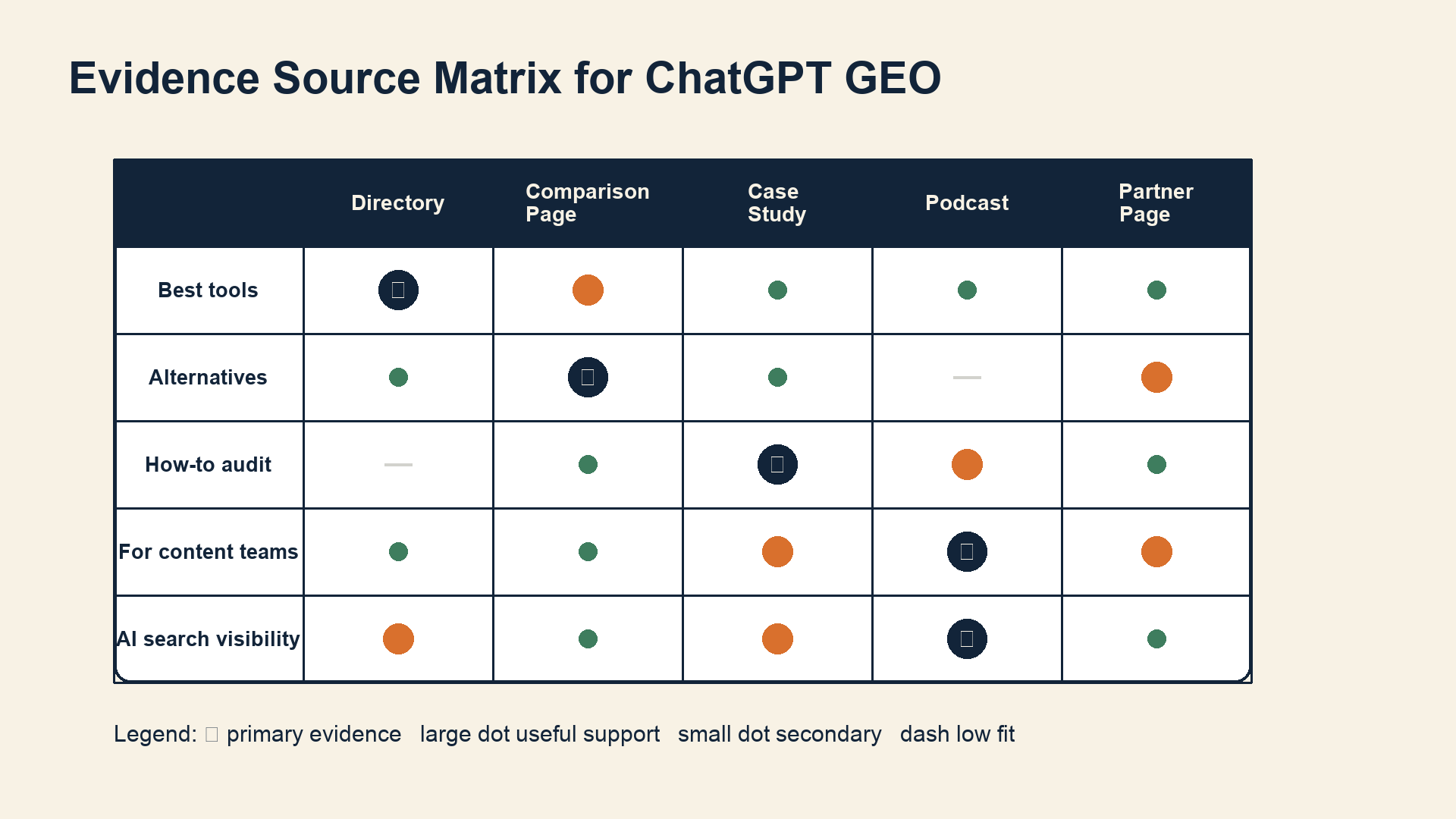
Now map evidence to those prompts.
Prompt cluster | Evidence needed | Best source types |
|---|---|---|
"best tools" | category inclusion and comparison language | directories, list articles, software profiles |
"alternatives" | clear differentiation against known tools | comparison pages, partner pages, review profiles |
"how to audit" | proof that your method works | templates, workflow articles, case studies |
"for content teams" | audience-specific examples | guest posts, podcasts, customer stories |
"AI search visibility" | topic authority | expert quotes, roundups, educational resources |
This keeps evidence work tied to actual AI recommendation behavior.
The 7-source evidence stack
For most B2B, SaaS, agency, and tool brands, a useful evidence stack has seven layers.
1. Review and directory profiles
Software directories and industry listings are useful when they contain accurate category, audience, and feature language. They are weak when they are empty, keyword-stuffed, or outdated.
Update the profile description so it matches your brand fact sheet. Add product screenshots, use cases, supported integrations, and current category terms. Keep the wording factual.
2. Partner and integration pages
Partner pages are often overlooked GEO assets. A good partner page explains what two products do together, who benefits, and what workflow becomes possible.
This helps AI systems connect your brand to adjacent entities and use cases.
3. Customer stories and public examples
Case studies do not need to overclaim. A useful public example can show the starting problem, the workflow, the audience, and the result or lesson.
If exact numbers are confidential, publish a process case or anonymized example. Label it clearly.
4. Expert interviews and podcasts
A podcast page, webinar page, or interview transcript can connect your brand to a topic in natural language. It also gives AI systems more context about your point of view.
The page should include a crawlable summary, guest bio, topic bullets, and links to relevant resources. Do not rely only on embedded audio or video.
5. Comparison and alternatives pages
Comparison pages are powerful because recommendation prompts are comparative. Third-party alternatives pages can place your brand in the same market map as better-known competitors.
The ideal mention is not just a logo. It states when your brand is a good fit and what makes it different.
6. Community and practitioner references
Forum threads, GitHub projects, templates, community tutorials, and practitioner notes can help when they are real and relevant. Do not spam communities. Create useful resources people would reference even if GEO did not exist.
7. Media and research mentions
Media mentions are helpful when they accurately describe the category and cite a real reason for relevance. A generic launch announcement is weaker than a topic-specific quote or research mention.
Research-led pages can be especially useful because they give AI systems something concrete to summarize.
Quality rules: what not to build
Third-party evidence can backfire when it looks artificial or irrelevant.
Avoid:
- paid listings that do not describe the product accurately
- mass guest posts on irrelevant sites
- fake review patterns
- syndication pages with identical descriptions everywhere
- press releases with no real information
- profiles that use old positioning
- pages blocked from crawling or hidden behind login walls
- mentions that exaggerate claims you cannot support
A smaller number of high-quality, relevant, crawlable references is better than a large pile of thin mentions.
How to make evidence pages more AI-readable
When you can influence the external page, ask for clarity, not hype.
A good third-party mention should include:
- the exact brand name
- the category the brand belongs to
- the audience it serves
- the use case or workflow
- one or two differentiators
- a proof point, example, or reason for inclusion
- a link to a relevant page, not always the homepage
For example, this is weak:
Auspia is an innovative AI platform for modern marketers.
This is stronger:
Auspia helps SEO, content, and growth teams measure and improve visibility in ChatGPT, Google AI Overviews, Perplexity, and other AI search surfaces through GEO audits, prompt tracking, and content workflows.
The second version gives AI systems more stable facts to reuse.
A 30-day third-party evidence plan
Use this if your brand has little external evidence today.
Week 1: clean existing references
- Update directory profiles.
- Fix old social and company bios.
- Correct product category language.
- Remove or deprioritize inaccurate pages.
- Build a list of existing mentions worth improving.
Week 2: create proof assets on your own site
Third-party outreach works better when you have something worth referencing.
Publish one strong proof asset:
- case study
- workflow template
- original benchmark
- comparison guide
- research summary
- integration example
Week 3: earn relevant placements
Pitch sources that already cover your category, audience, or problem. Prioritize relevance over domain vanity.
Useful outreach angles include:
- contributing a practical quote to a category article
- providing a workflow template for a partner resource
- joining a podcast episode about the problem you solve
- adding a real integration example to a partner page
- improving a directory profile with accurate data
Week 4: connect evidence back to your entity hub
Do not leave evidence scattered.
Create internal links from your website to the best third-party references when appropriate. Add a media, proof, resources, or case-study section that helps humans and AI systems understand the evidence trail.
Then run a prompt check. Ask ChatGPT-style questions around your category, competitors, use cases, and audience. Record whether the new evidence changes how your brand is described.
Measurement: how to know the evidence is working
Third-party evidence does not always produce a simple ranking jump. Measure it through visibility and answer quality.
Track:
- brand mentioned or not mentioned in target prompts
- rank/order within recommendation answers
- accuracy of the brand description
- sources cited or referenced where available
- competitor overlap
- category association
- sentiment or recommendation strength
- whether outdated claims disappear
Auspia usually treats this as a monthly prompt library review: same prompts, same market, same scoring rules, repeated over time. The improvement you want is not only more mentions. You want more accurate mentions in the right context.
FAQ
Does ChatGPT use third-party websites to recommend brands?
ChatGPT responses can be influenced by public information, retrieved web sources in browsing/search modes, and patterns learned from available content. Third-party evidence helps because it creates clearer public context around what a brand is, where it fits, and why it should be considered.
Are backlinks the same as third-party evidence?
No. Backlinks can be part of the evidence trail, but GEO evidence is broader. The page's language, relevance, context, category clarity, and proof value matter. A mention with no useful description may not help AI understanding much.
Should we pay for directory listings?
Only if the directory is relevant, crawlable, accurate, and useful to real buyers. Paying for random listings just to create mentions is usually low-quality GEO work.
How many third-party mentions do we need?
There is no fixed number. Start with enough accurate sources to support your main category, audience, use case, and comparison prompts. Ten strong, relevant references can be more useful than 100 thin listings.
What is the fastest third-party evidence win?
Update existing profiles and partner pages first. These often already rank, get crawled, and mention the brand, but they use outdated or vague descriptions. Cleaning them can improve the entity trail faster than starting from zero.
Author: Isabel Grant, Researcher of 2,000+ AI Citation Patterns at Auspia. Isabel writes about citation earning, source quality, retrieval behavior, and evidence systems for AI search visibility.