The practical answer
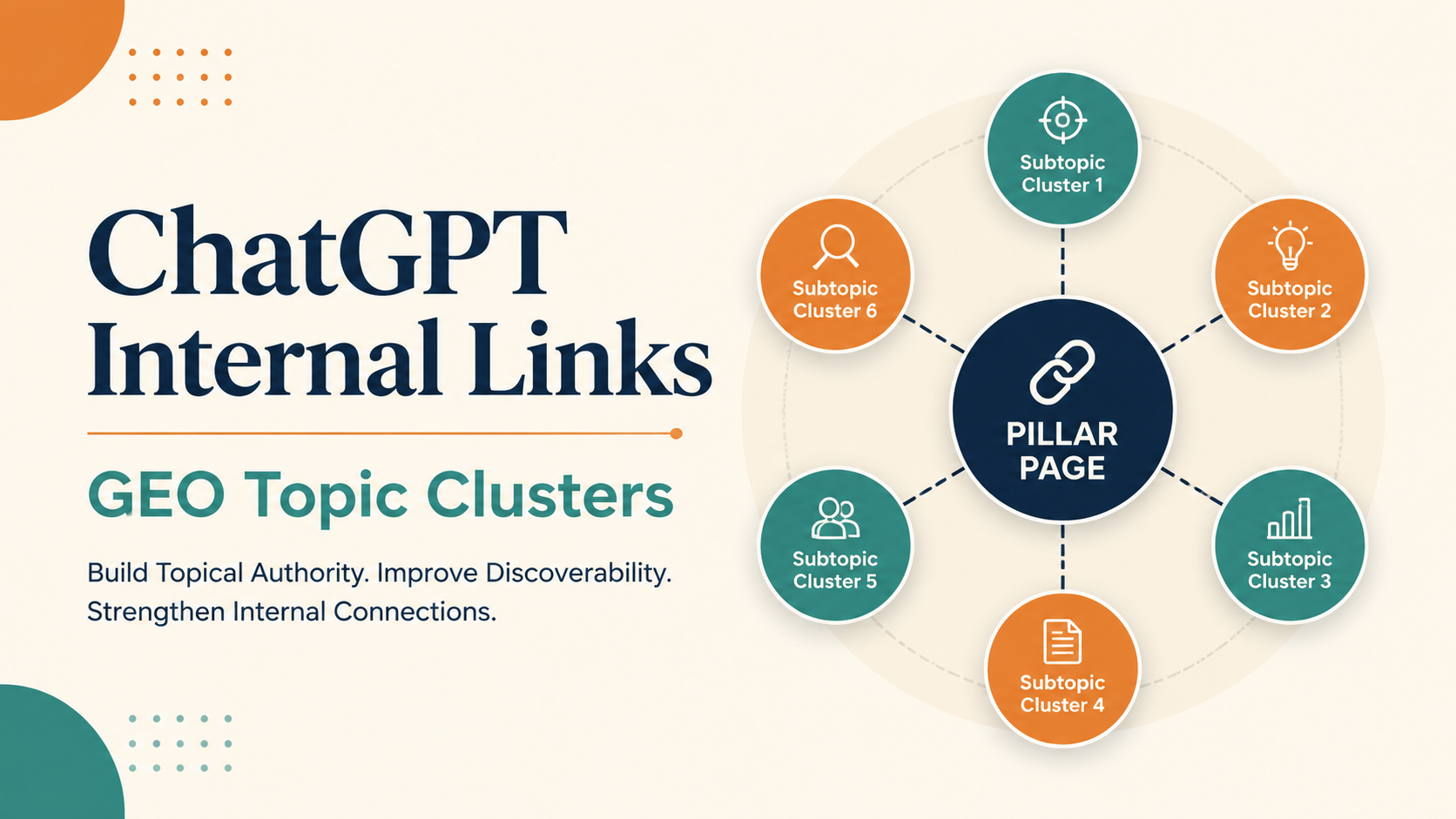
Internal links help ChatGPT GEO by connecting your brand, category, use-case, proof, and measurement pages into a clear topic cluster. AI answer systems do not only look at isolated pages. They need to understand how pages relate to each other, which pages are authoritative, and where the best source material lives.
A good internal linking system does three things: it helps humans navigate, it helps search engines discover and prioritize pages, and it helps AI systems infer the relationships between your topics, entities, and evidence.
The goal is not to stuff links into every paragraph. The goal is to build a cluster that makes your best GEO pages easier to understand and reuse.
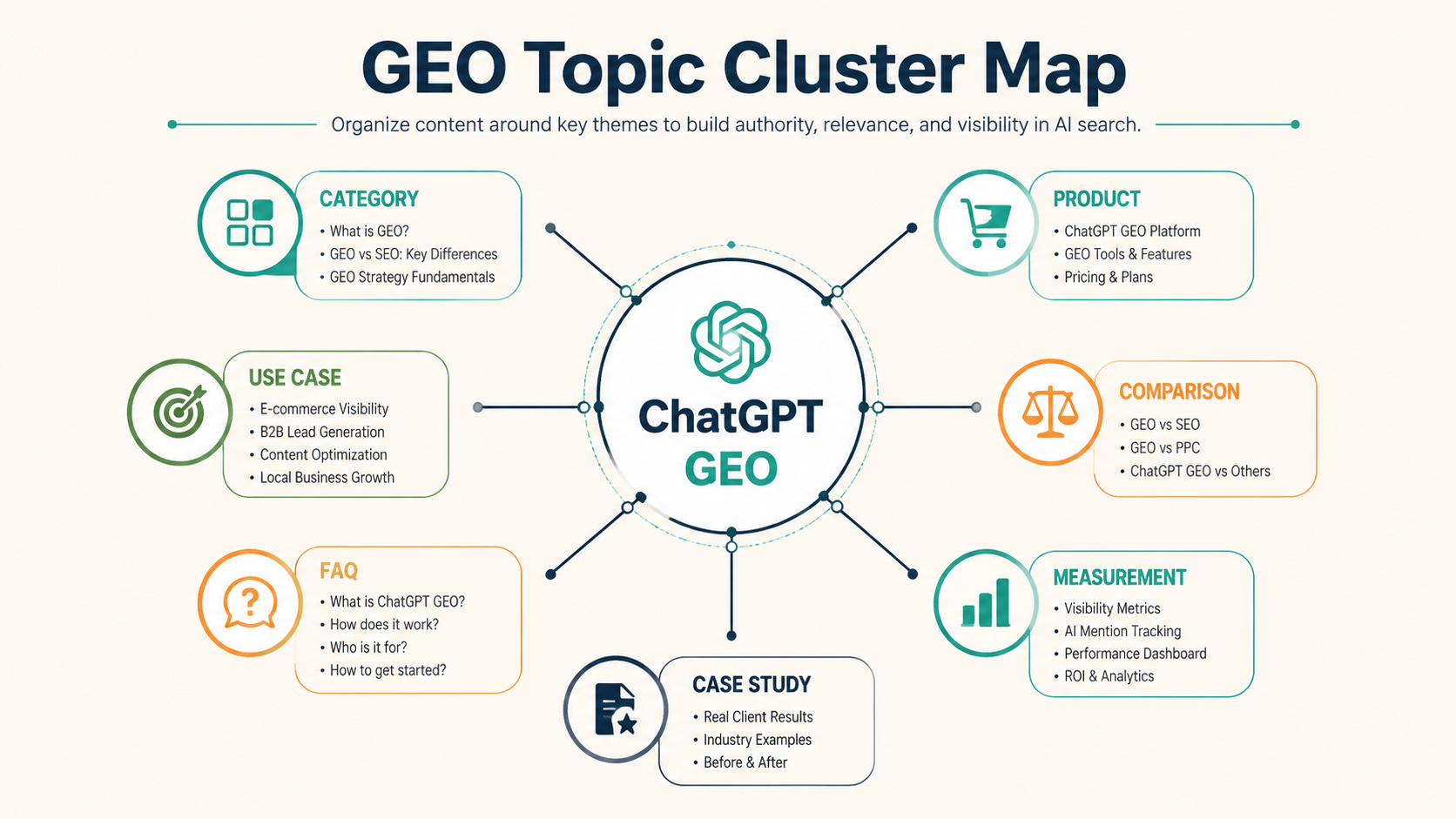
Why internal links matter for AI visibility
When a topic is spread across many pages, internal links act like a map.
They help answer questions such as:
- Which page defines the category?
- Which page explains the use case?
- Which page shows proof?
- Which page compares options?
- Which page measures visibility?
- Which page is the best next step for the reader?
If those relationships are not clear, AI systems may treat pages as separate, weaker sources.
A strong internal link system gives the site a clear hierarchy and helps authority flow to the pages you want considered most often.
The GEO cluster model
A practical GEO cluster often includes these pages:
Page type | Job in the cluster |
|---|---|
Category page | defines the market and language |
Product page | explains what the brand does |
Use-case page | maps the product to buyer prompts |
Comparison page | explains alternatives and fit |
FAQ page | answers real questions |
Case study | provides proof |
Measurement guide | explains how to test visibility |
Content brief | turns gaps into page updates |
Technical guide | explains crawlability and AI-readability |
The cluster should feel like a connected system, not a random blog archive.
Build links from the question to the answer
The simplest internal linking rule is this:
- link from broad to specific
- link from definition to workflow
- link from workflow to proof
- link from claim to evidence
- link from page to next step
For example:
- a category page should link to use-case pages and comparison pages
- a use-case page should link to product pages and proof
- a product page should link to docs, case studies, and comparisons
- a measurement guide should link to the audit template and report page
This helps readers move through the topic and helps AI systems see which page answers which prompt.
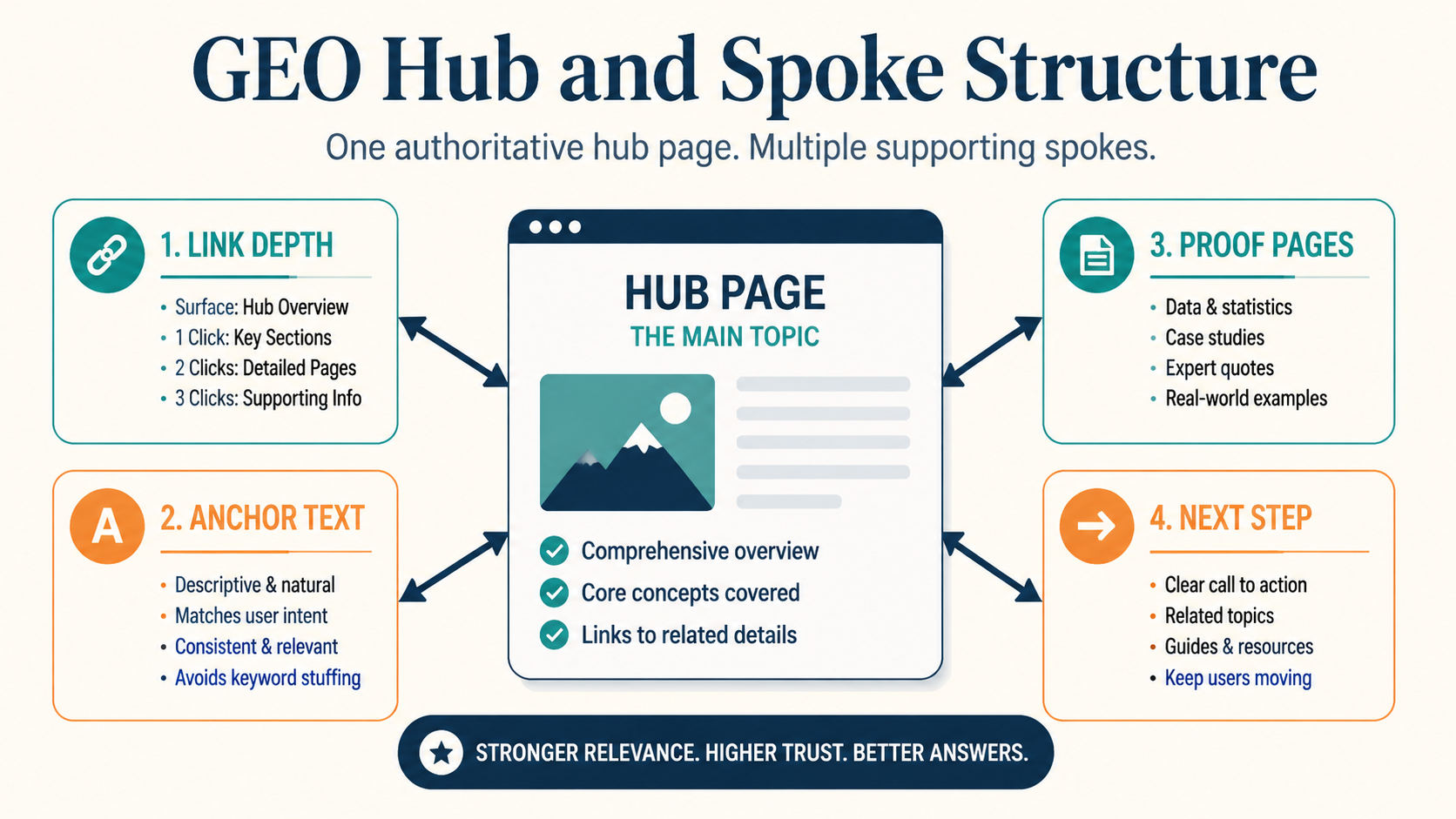
Decide the hub page
Every cluster needs a hub.
The hub is the page that defines the topic and points to the supporting assets.
Possible hubs:
- category page
- pillar guide
- measurement hub
- evidence hub
- FAQ hub
- product overview
The hub should have the strongest internal links in and out. It should also have the clearest summary of the cluster.
Use anchor text with intention
Anchor text should help the reader understand the destination.
Better anchor text examples:
- GEO content brief template
- how to measure ChatGPT visibility
- ChatGPT alternatives page
- AI search visibility checker
- 30-minute GEO audit
- third-party evidence for GEO
Weaker anchor text:
- click here
- read more
- this page
- learn more
- here
Descriptive anchors help search engines, but they also help AI systems understand the role of the linked page.
Avoid orphan pages
An orphan page has no meaningful internal links pointing to it.
That is a problem for GEO when the page is important because it may be harder for both humans and systems to discover.
Check for orphans among:
- case studies
- comparison pages
- measurement pages
- product updates
- technical guides
- category explainers
- FAQ hubs
- proof pages
If the page matters for AI visibility, it should live inside the cluster.
Connect internal links to entity strategy
Internal links are not only about navigation. They also help with entity clarity.
For example, if the category page links to the product page, use-case page, comparison page, and case study, the site is telling the system:
- what the category is
- how the product fits
- which problems matter
- what proof exists
- what the next step should be
That is useful entity information.
The site becomes less like a pile of pages and more like a defined market narrative.
Build a cluster from target prompts
Start with the prompts you want to win.
If buyers ask:
- what is GEO?
- how do I measure ChatGPT visibility?
- what tools help with AI search?
- what is the best alternative to [competitor]?
- how do I fix wrong brand descriptions?
...then build a cluster that answers those prompts across several pages.
A useful cluster might look like this:
- Category page: what is GEO?
- Measurement guide: how to measure ChatGPT visibility
- Comparison page: alternatives to [competitor]
- Use-case page: GEO for SaaS content teams
- Case study: proof of visibility improvement
- FAQ page: common GEO questions
- Technical guide: llms.txt and robots.txt for AI readability
This structure gives AI systems multiple sources with different jobs.
Use link depth carefully
Do not bury important pages too deep.
If a page is strategic, it should be reachable within a few clicks from the hub. Important GEO pages should usually have links from:
- homepage or nav when appropriate
- category or pillar page
- related use-case pages
- related comparison pages
- relevant case studies or evidence pages
The deeper the page, the less likely it is to become a central source unless it has strong external support.
A simple internal link map
Use this template before publishing a new cluster.
Page | Links out to | Links in from |
|---|---|---|
Category page | product, use-case, comparison, FAQ | homepage, product, blog |
Product page | docs, proof, comparison, use-case | category, homepage, case study |
Use-case page | product, proof, FAQ, measurement guide | category, product, blog |
Comparison page | product, alternatives, proof | category, use-case, FAQ |
Case study | product, use-case, evidence hub | product, use-case, comparison |
Measurement guide | template, report, audit, FAQ | category, use-case, dashboard |
A map like this makes publishing decisions easier.
Check the cluster after publishing
After you add links, test the cluster.
Ask:
- Can a reader move from problem to solution to proof?
- Can AI see which page is the hub?
- Are the most important pages linked from relevant pages?
- Do the anchors describe the destination accurately?
- Are there orphan pages that should be connected?
Then rerun prompt tests to see whether the right pages are more discoverable in answers.
Common mistakes
Mistake 1: linking everything to everything
That weakens the signal. Links should be intentional.
Mistake 2: using generic anchor text
The anchor should describe the destination.
Mistake 3: making the hub page too thin
The hub should explain the topic and direct readers to deeper assets.
Mistake 4: forgetting proof pages
Category and use-case pages need support from evidence pages.
Mistake 5: building clusters without prompt intent
The cluster should map to real prompts, not just site structure.
FAQ
Why do internal links matter for ChatGPT GEO?
Internal links help AI systems understand how your pages relate, which pages are authoritative, and where the best source material lives. They also help humans navigate the topic cluster.
What is a GEO cluster?
A GEO cluster is a connected set of pages around a topic such as category, product, use case, comparison, proof, measurement, or technical setup.
How many links should a page have?
Enough to connect it to the right hub and supporting pages, but not so many that the page becomes cluttered. Quality and relevance matter more than volume.
Should every page link to the category page?
If the category page is the hub for the topic, then most related pages should link to it or be reachable through it. The exact pattern depends on the site architecture.
What should I do first?
Start by defining the hub page and mapping the target prompts. Then link the supporting pages so they answer different parts of the same topic.
Author: David Sinclair, Topical Authority Strategist Across 500+ Topic Clusters at Auspia. David writes about topic clusters, authority building, coverage planning, and internal linking for AI visibility.