The short version
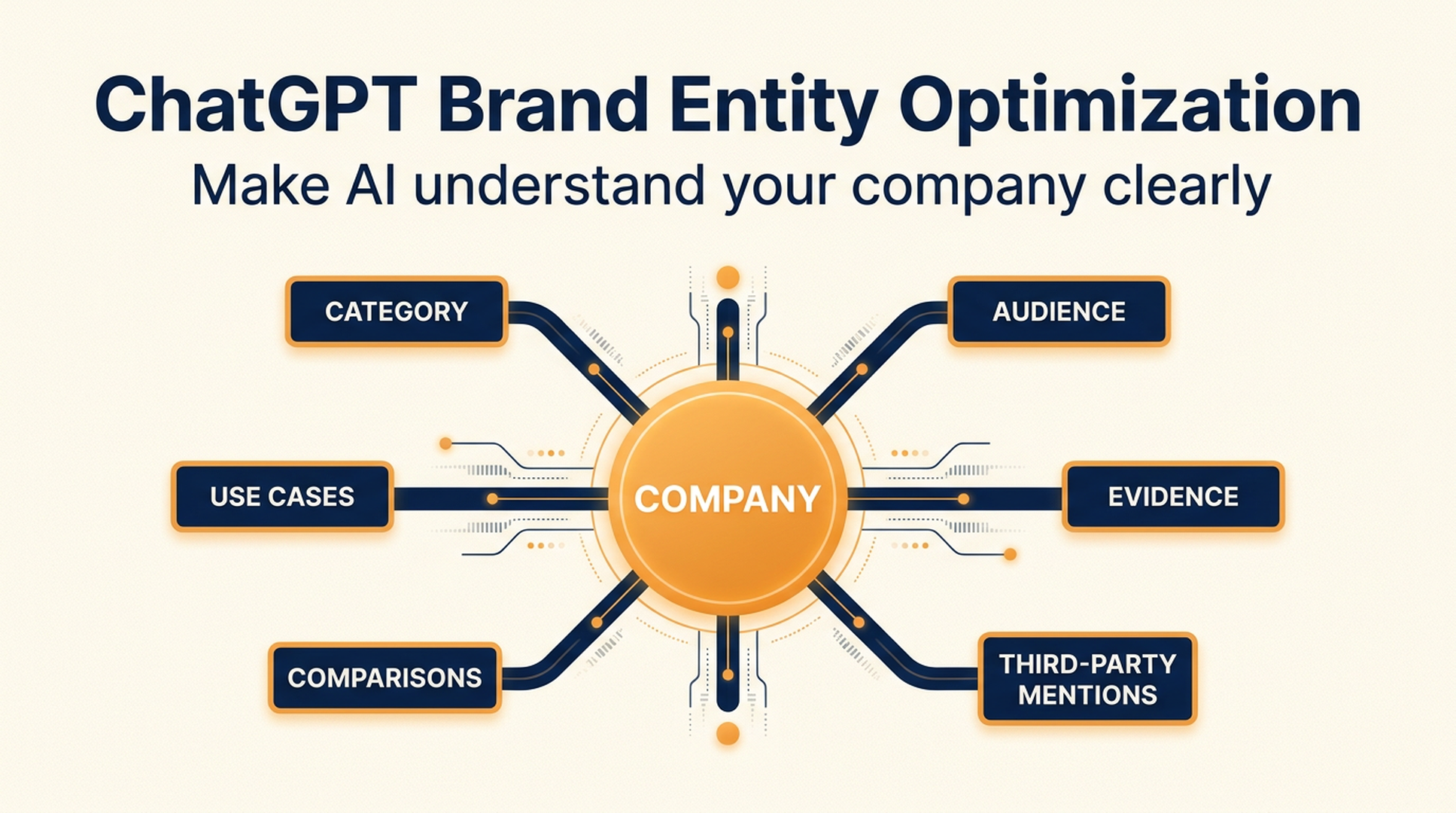
ChatGPT is more likely to describe or recommend a brand correctly when the brand has a clear entity trail: the same company facts, category language, product claims, proof points, and third-party references appearing across trustworthy pages. ChatGPT GEO is not only about writing better blog posts. It is also about making the brand itself easier for AI systems to identify, disambiguate, and compare.
If ChatGPT gives vague answers about your company, confuses you with another brand, or leaves you out of category recommendations, the issue is often not one missing keyword. It is an entity problem. Your website, profiles, comparison pages, reviews, case studies, and external mentions are not giving AI systems a stable enough picture of who you are and when you should be considered.
This article gives content and growth teams a practical brand entity optimization workflow for ChatGPT visibility.
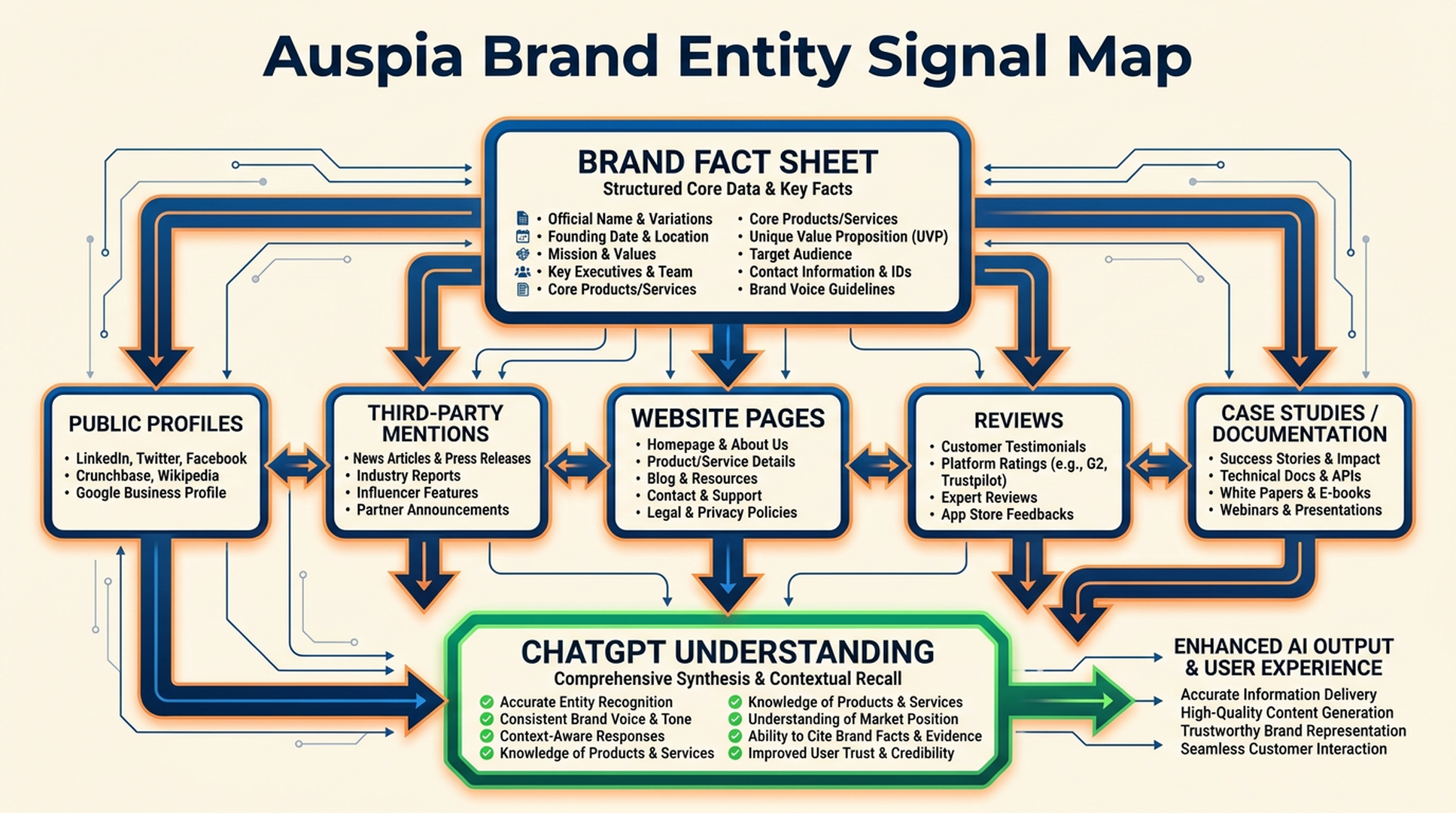
What brand entity optimization means for ChatGPT GEO
Brand entity optimization is the process of making your company easy to recognize as a distinct, consistent, well-evidenced entity across the web.
In traditional SEO, entity optimization often means helping search engines understand a brand, person, product, place, or organization. In ChatGPT GEO, the goal is similar, but the use case is different. You are not only trying to rank a page. You are trying to make sure an AI answer system can answer questions like:
- What does this company do?
- Which category does it belong to?
- Who is it for?
- What problems does it solve?
- How is it different from alternatives?
- What evidence supports those claims?
- When should it be mentioned in an answer?
A brand entity is weak when these answers change from page to page. It is strong when the same core facts appear repeatedly in trustworthy places.
The five facts ChatGPT needs before it can trust your brand
Before building more content, audit whether your brand has five stable facts. If these are fuzzy, AI visibility work becomes noisy.
Entity fact | What it answers | Weak version | Stronger version |
|---|---|---|---|
Category | What are you? | "AI platform" | "AI search visibility and GEO workflow platform" |
Audience | Who is it for? | "marketing teams" | "SEO, content, and growth teams measuring AI answer visibility" |
Use case | What job do you do? | "optimize content" | "audit whether a brand is mentioned, cited, and recommended in ChatGPT-style answers" |
Differentiator | Why choose you? | "fast and easy" | "combines prompt tracking, entity audit, and SEO/GEO content workflows" |
Evidence | Why believe it? | "trusted by teams" | case pages, public examples, comparison pages, documentation, reviews, and consistent third-party references |
This table is intentionally simple. Most ChatGPT visibility problems start because the brand has not made these facts easy enough to retrieve.
Step 1: Write a single brand fact sheet
Start with one internal document. Do not begin by rewriting 50 pages.
Your brand fact sheet should include:
- official brand name and common spelling variants
- one-sentence definition
- primary category and secondary categories
- target audiences
- main use cases
- products or services
- competitors and alternatives
- proof points you can support publicly
- claims you should avoid because they are vague or unsupported
- preferred descriptions for founders, product names, and core features
The goal is not to create a marketing manifesto. The goal is to create a canonical source that every public page can echo.
A good one-sentence brand definition looks like this:
Auspia helps SEO, content, and growth teams improve visibility across Google, ChatGPT, Perplexity, Gemini, and other AI search surfaces through GEO audits, prompt tracking, and content workflows.
That sentence works because it names the audience, the category, the surfaces, and the work being done. It is much easier for AI systems to reuse than a sentence like "Auspia is an AI-powered growth platform."
Step 2: Align the pages that define the brand
Once the fact sheet is clear, update the pages that AI systems and search engines are most likely to use as brand references.
Start with these pages:
- Homepage
- About page
- Product or service pages
- Pricing page, if public
- Documentation or help center
- Comparison pages
- Case studies
- Press or media page
- Author pages and company profiles
Each page does not need to repeat the exact same paragraph. But each page should reinforce the same entity facts.
For example, if the homepage says your company is an "AI search visibility platform," the about page should not call it a "content automation studio," while the product page calls it a "marketing assistant." Those may all be partially true, but they create category drift.
Category drift is expensive in ChatGPT GEO because AI systems often answer from compressed patterns. If your own site sends mixed signals, you reduce the chance that your brand appears in the right recommendation set.
Step 3: Build a brand evidence layer
ChatGPT-style systems do not only need a brand description. They need reasons to believe it.
A practical brand evidence layer includes:
- case studies that show who used the product and what changed
- comparison pages that explain when your product is and is not a fit
- documentation that proves the product actually does what the homepage claims
- templates, tools, or examples that demonstrate domain expertise
- review profiles with consistent category language
- third-party mentions from relevant industry pages
- founder or team profiles that connect people, product, and category
Do not confuse evidence with slogans. "Built for modern teams" is not evidence. A public workflow, benchmark, template, integration page, or customer story is evidence.
For AI answers, evidence also needs to be easy to summarize. If every proof point is hidden in a PDF, video, gated deck, or sales call, it is less useful for AI search visibility.
Step 4: Make comparison language explicit
Many AI recommendation prompts are comparative. Users ask things like:
- What are the best tools for improving ChatGPT visibility?
- What are alternatives to [competitor]?
- Which platforms help with GEO measurement?
- What should a SaaS company use to track AI search mentions?
If your site never explains your category, alternatives, and fit, ChatGPT has to infer the comparison. That often favors better-documented competitors.
Create comparison assets that answer:
Comparison question | Page or section to create | GEO purpose |
|---|---|---|
What category are we in? | Category explainer | Places the brand in the right answer set |
Who are we not for? | Fit / not-fit section | Reduces vague recommendations |
What alternatives exist? | Alternatives page | Helps AI systems map the market |
What do we do differently? | Comparison matrix | Makes differentiators extractable |
What proof supports this? | Case study or examples | Adds evidence beyond positioning |
This is not about attacking competitors. It is about making the market map legible.
Step 5: Fix entity inconsistencies outside your own site
Your website is the center, but it is not the whole entity trail. ChatGPT can be influenced by repeated descriptions across external sources, especially when those sources are crawlable and semantically clear.
Audit the places where your brand is described publicly:
- LinkedIn company page
- X/Twitter bio and profile text
- YouTube channel description
- GitHub organization profile, if relevant
- product directories
- review platforms
- podcast bios
- conference pages
- marketplace listings
- partner pages
- author bios on guest posts
Look for mismatched categories, old product names, outdated taglines, and vague descriptions.
A common problem: the company changed positioning, but old profiles still describe the old category. AI systems may keep seeing both versions. That makes the brand harder to classify.
A simple entity audit scorecard
Use this scorecard before asking why ChatGPT does not mention your brand.
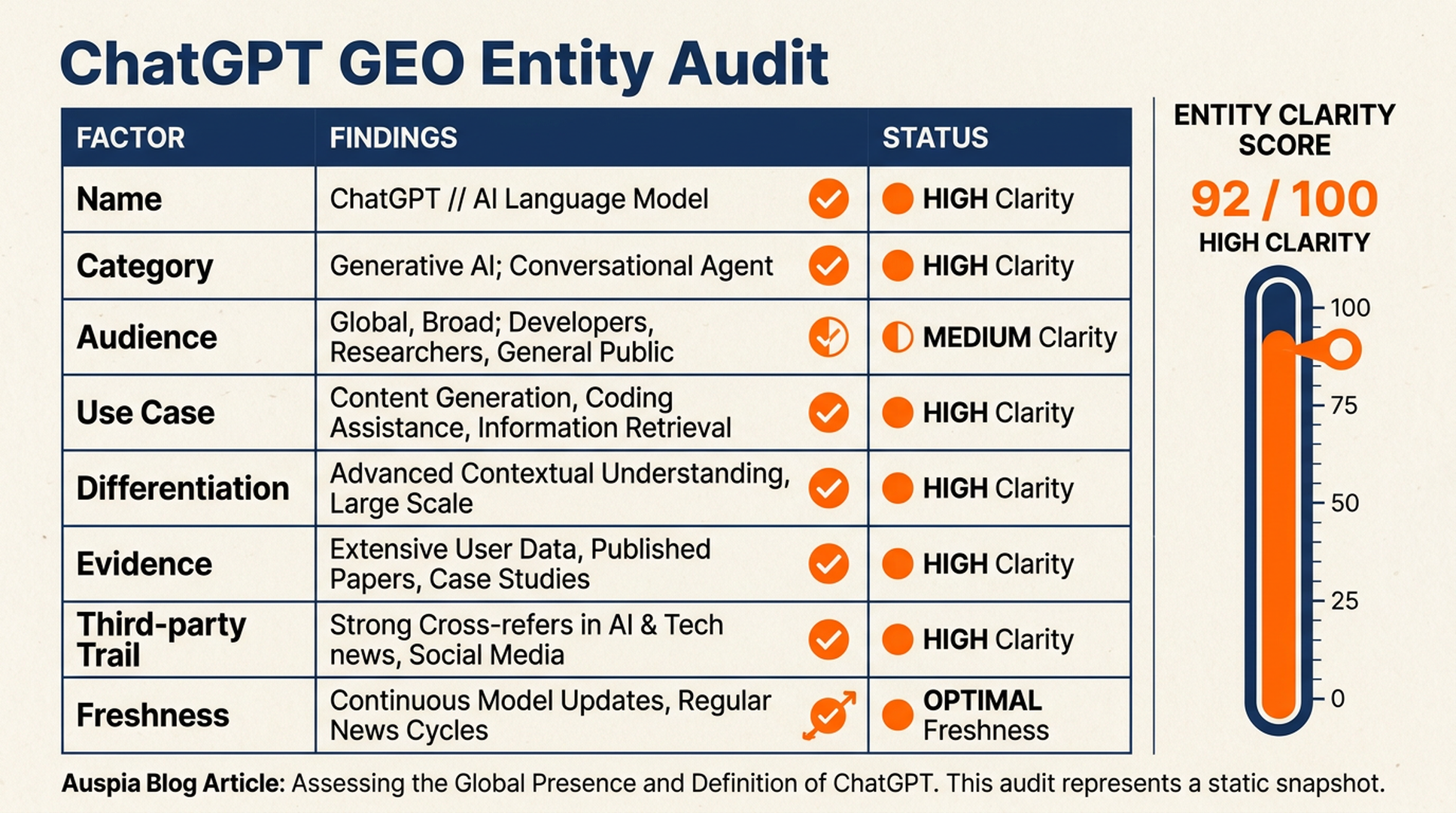
Area | Question | Score 0-2 |
|---|---|---|
Name consistency | Is the brand name written consistently across key pages? | |
Category clarity | Can a reader identify the category in one sentence? | |
Audience clarity | Is the target buyer named clearly? | |
Use case clarity | Are the main jobs-to-be-done explicit? | |
Differentiation | Are alternatives and differences explained without hype? | |
Evidence | Are claims supported by public examples or proof? | |
Third-party trail | Do external profiles repeat the same entity facts? | |
Structured pages | Do homepage, about, product, case, and comparison pages align? | |
Prompt fit | Does the brand naturally answer real category prompts? | |
Freshness | Are old descriptions and stale claims removed? |
Scoring guide:
- 0 = missing, outdated, or contradictory
- 1 = present but vague or inconsistent
- 2 = clear, current, and repeated across important sources
A score below 12 usually means the issue is not "ChatGPT ignored us." It means the brand has not given AI systems enough stable information to work with.
Common mistakes that weaken brand entity signals
Mistake 1: using a different category on every page
Brands often describe themselves differently depending on the page: platform, agency, assistant, automation tool, intelligence layer, growth engine. Variety feels creative to marketers, but it can confuse entity understanding.
Pick a primary category and use it consistently.
Mistake 2: hiding the plain-language answer
Some brands write beautiful homepage copy but never say what the company does. ChatGPT cannot reliably recommend a brand if the basic definition is buried behind metaphors.
Use plain language first. Add personality after clarity.
Mistake 3: publishing content that never connects back to the brand
A blog can rank for topics without strengthening the brand entity. Each strategic article should connect the topic to the company's category, use case, or point of view when relevant.
This does not mean forcing a sales pitch. It means making the relationship between expertise and brand clear.
Mistake 4: relying only on first-party claims
Your own site matters, but external validation helps. If only your homepage says you are in a category, the signal is weaker than if product pages, reviews, partner pages, templates, and third-party mentions say the same thing.
Mistake 5: changing positioning without cleaning old references
Repositioning creates a long tail of stale descriptions. Clean them deliberately. Old category labels can keep showing up in AI-generated summaries long after the team has moved on.
What to update in the next seven days
If you want the minimum viable version, do this in order:
- Write a one-page brand fact sheet.
- Rewrite the first 150 words of your homepage for category, audience, and use case clarity.
- Update your about page with the same entity facts.
- Add a short "who this is for" section to your main product page.
- Create or improve one comparison page.
- Refresh public profiles that still use old positioning.
- Run a 20-prompt ChatGPT GEO check to see how the brand is described.
For the prompt check, include brand prompts, category prompts, competitor prompts, and problem prompts. If the answers describe your company incorrectly, collect the errors and map them back to missing or conflicting public evidence.
If you need a quick diagnostic path, start with an AI search visibility check and compare what AI systems say with the brand fact sheet you want them to learn.
FAQ
What is a brand entity in ChatGPT GEO?
A brand entity is the recognizable identity of a company across public information: its name, category, audience, use cases, products, differentiators, and evidence. In ChatGPT GEO, a stronger entity makes it easier for AI systems to describe and recommend the brand accurately.
Can I improve ChatGPT visibility just by adding schema?
Schema can help clarify structured facts, but it is not enough by itself. You also need clear page copy, consistent category language, public evidence, and external references that reinforce the same brand meaning.
How long does brand entity optimization take?
The first cleanup can happen in a week. The stronger evidence layer usually takes longer because it involves case studies, comparison pages, documentation, third-party profiles, and repeated public references.
Should every page use the same brand description?
No. The wording can vary naturally. The core facts should stay consistent: what the brand is, who it serves, what it helps with, and what proof supports the claim.
Why does ChatGPT describe my company incorrectly?
Usually because public information is inconsistent, outdated, thin, or too vague. AI systems may combine old profiles, unclear pages, and third-party snippets into a summary that does not match your current positioning.
Author: Lydia Hart, Brand Entity Strategist for 200+ Entity Audits at Auspia. Lydia writes about brand facts, entity consistency, about pages, category language, and knowledge graph readiness.