The Badge Is Not The Strategy
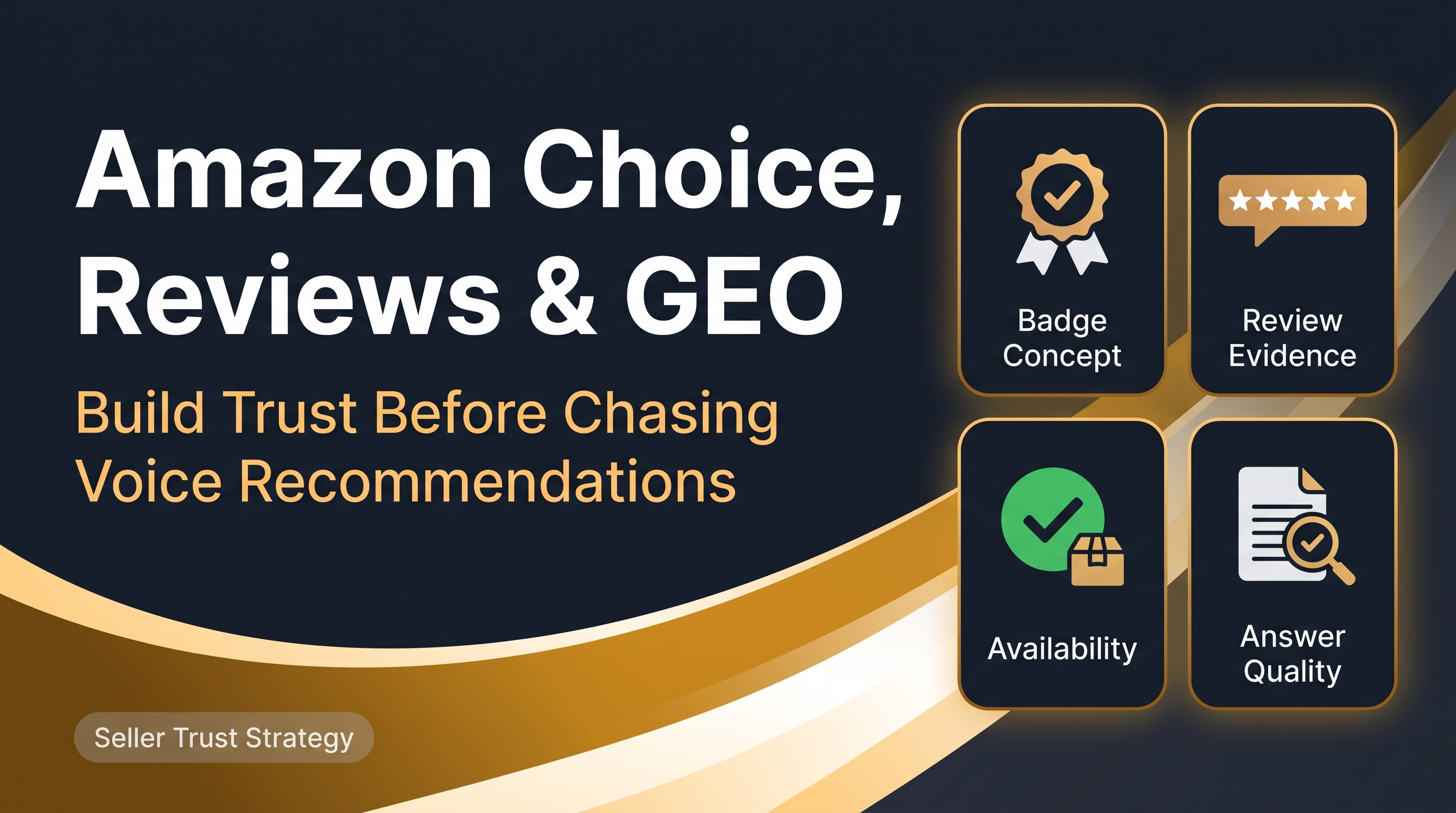
Amazon Choice, reviews, and GEO are connected, but sellers should be careful: the goal is not to "hack" a badge or guarantee voice recommendations. The practical goal is to build the trust signals that make a product safer to understand, recommend, compare, and buy.
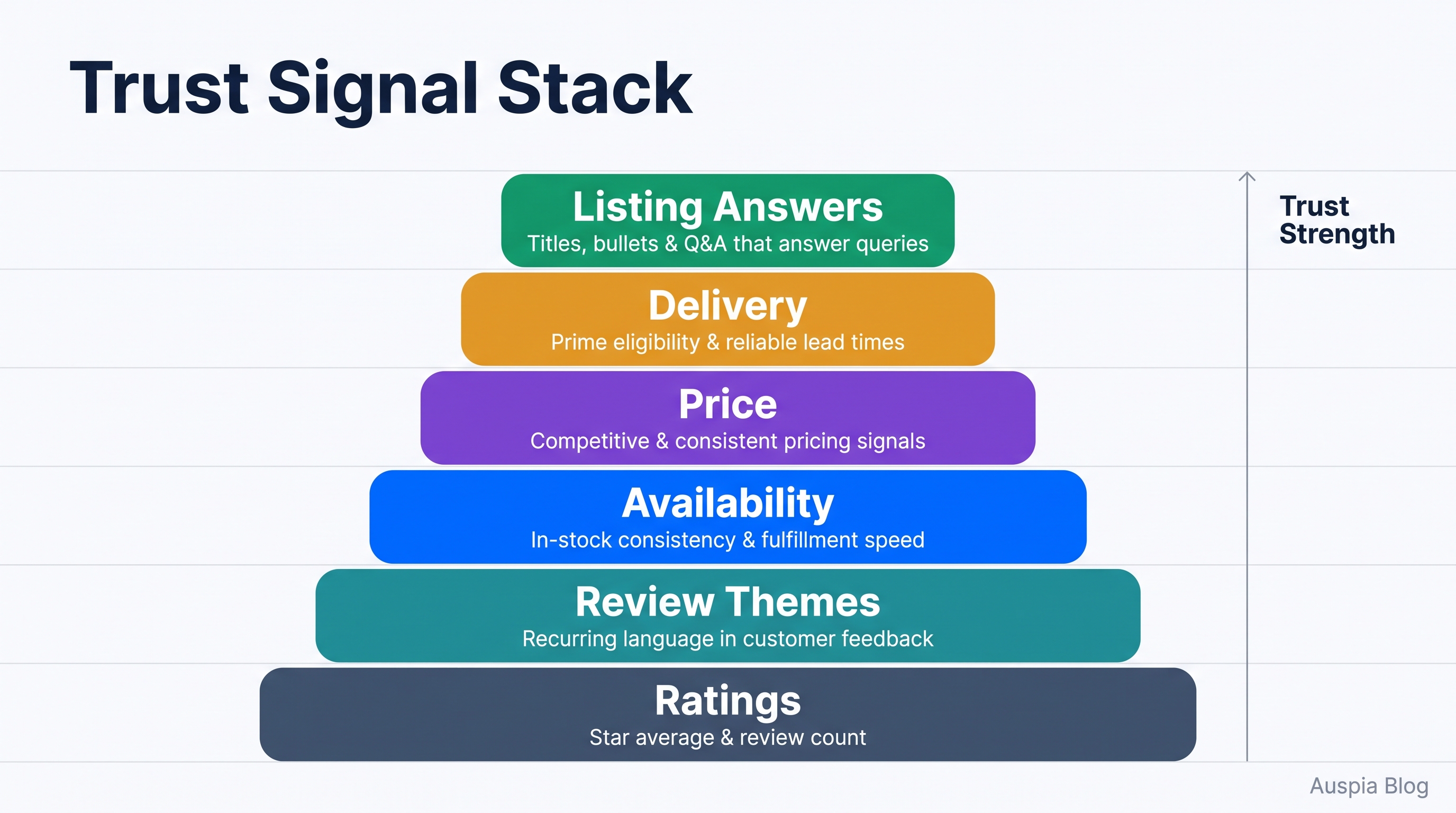
For Alexa and AI shopping, trust matters because the buyer often receives fewer visible options than on a traditional search results page. If an assistant-style experience compresses the decision, the product needs strong evidence: ratings, review themes, availability, price consistency, delivery reliability, and listing answers that remove uncertainty.
DataForSEO research for this Amazon Alexa GEO series showed amazon product reviews at about 2,400 monthly searches, amazon choice at about 1,000, amazon seo at about 1,000, and amazon product listing optimization with high CPC around $28.77. Sellers care about badges and reviews because they influence trust. But trust is not one badge. It is a stack.
What Sellers Should Understand First
Amazon Choice can be useful visibility, but sellers should not treat it as a controllable switch. Badge logic can vary by query, product, marketplace context, eligibility, availability, fulfillment, and customer experience signals. A seller who builds only for the badge may ignore the more durable work: making the product genuinely easier to trust.
For GEO, the better question is:
If an assistant had to summarize why this product is a safe choice, what evidence would it use?
That evidence usually comes from the product detail page, reviews, Q&A, pricing, availability, fulfillment, and the consistency of product claims.
The Trust Signal Stack For AI Shopping
A product that looks risky to a human shopper also looks risky in an assistant-style recommendation path. Use a stack rather than a single-score mindset.
Trust layer | What it tells a buyer | GEO role |
|---|---|---|
Ratings | The average satisfaction level | Baseline confidence |
Review count | Whether enough buyers have experience | Evidence depth |
Review themes | What buyers repeatedly confirm or complain about | Natural-language proof and objections |
Availability | Whether the product can actually be bought now | Recommendation practicality |
Price | Whether the offer feels stable and competitive | Purchase confidence |
Delivery | Whether fulfillment is fast and reliable | Reduced decision friction |
Listing answers | Whether the page resolves use-case questions | AI-readable answer quality |
Q&A | Whether specific risks are addressed | Objection removal |
Reviews matter because they supply real buyer language. Listing answers matter because they make that evidence easier to interpret.
The Dangerous Myths Around Amazon Choice And Reviews
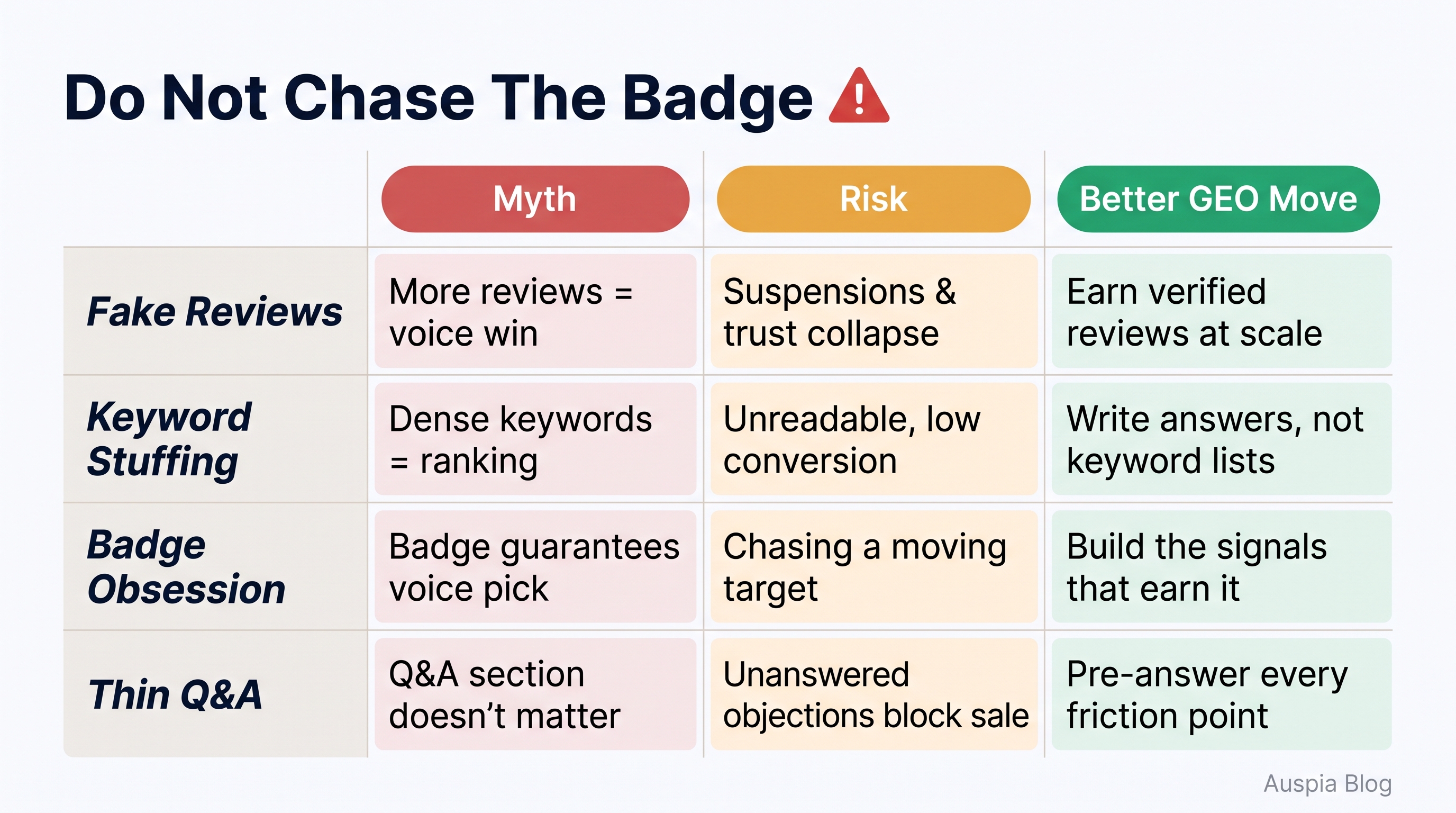
The wrong approach to Amazon Choice and reviews can create account risk, conversion problems, and weak GEO performance.
Myth | Risk | Better GEO move |
|---|---|---|
More reviews automatically means voice visibility | Review volume without relevance does not answer buyer questions | Earn specific, verified, policy-compliant reviews |
Keyword stuffing helps the badge | Dense copy can reduce readability and conversion | Write clear answers to real buyer questions |
Amazon Choice guarantees a voice recommendation | Badge presence can be query-dependent and not seller-controlled | Build durable trust signals across listing, reviews, Q&A, and fulfillment |
Q&A does not matter | Unanswered objections block purchase | Pre-answer compatibility, safety, fit, size, and use-case friction |
One badge is enough proof | Buyers still compare price, delivery, reviews, and fit | Treat trust as a system, not a label |
This is especially important for voice shopping. Sellers should avoid claims like "get Alexa to recommend your product." A safer and more accurate promise is: improve the evidence that makes the product easier to understand and trust.
Review Themes Are More Useful Than Review Count Alone
Review count is visible. Review themes are actionable.
A product with 2,000 vague reviews may be less useful for GEO than a product with fewer reviews that clearly answer the buyer's main concerns. For example:
Category | Useful review theme | Why it matters |
|---|---|---|
Pet food | "My senior dog digests it well" | Age and sensitivity evidence |
Dishwasher tablets | "Works in hard water" | Use-case proof |
Air filter | "Fits model 300 exactly" | Compatibility proof |
Shampoo | "No fragrance irritation" | Safety and sensitivity proof |
Coffee pods | "Same flavor every reorder" | Repeat-purchase confidence |
Trash bags | "Does not tear when full" | Durability evidence |
Sellers should mine reviews for repeated nouns, use cases, objections, and proof phrases. Then they should make sure the listing answers those same themes in compliant, factual language.
How To Turn Reviews Into Listing Improvements
Do not copy review text into the listing as if it were a claim you invented. Instead, translate review patterns into clearer product content.
Review pattern | Listing gap | Improvement |
|---|---|---|
Buyers mention wrong size | Size is unclear | Add dimensions, scale image, and pack-size wording |
Buyers ask if it fits a model | Compatibility is unclear | Add model list and Q&A answer |
Buyers praise a specific use case | Use case is under-emphasized | Add a bullet and image callout for that scenario |
Buyers complain about smell | Scent expectation is unclear | Clarify fragrance, ingredients, or unscented variant |
Buyers mention reorder consistency | Repeat confidence exists | Add variant naming and pack-size cues for reorders |
Buyers say setup was confusing | Instructions are weak | Add step-by-step image or A+ module |
This process improves human conversion and makes the listing easier for AI systems to summarize accurately.
Q&A Is A Trust Surface, Not An Afterthought
Q&A often contains the questions sellers failed to answer in the listing. For GEO, this is valuable because it shows the exact friction points buyers face.
High-value Q&A topics include:
- Compatibility with models, devices, accessories, or refills.
- Allergens, ingredients, scent, skin sensitivity, or pet age.
- Pack size, count, expiration date, and storage.
- Setup, cleaning, assembly, or replacement timing.
- Warranty, return, durability, leakage, breakage, or performance limits.
- Differences between variants.
A thin Q&A section does not necessarily hurt every product, but a thin Q&A section on a complex, safety-sensitive, or compatibility-heavy product is a missed trust signal.
Availability, Price, And Delivery Are Part Of GEO Trust
Content teams often forget the operational side of GEO. A product may have strong copy and great reviews, but if it is often out of stock, inconsistently priced, or slow to deliver, it becomes harder to recommend in a practical shopping path.
Operational signal | Why it matters for assistant-style shopping |
|---|---|
In-stock consistency | A recommendation is less useful if the product cannot be bought |
Fulfillment speed | Buyers often prefer reliable, fast delivery for routine purchases |
Price stability | Unstable pricing can reduce confidence and conversion |
Variant availability | Missing variants create wrong-purchase risk |
Return reasons | Repeated returns reveal trust gaps |
Customer service issues | Unresolved issues can weaken review sentiment |
GEO is not only a writing project. For Amazon sellers, it is a merchandising and operations project too.
What To Do Before Chasing Voice Recommendations
Use this sequence before worrying about whether a badge appears for a query.
1. Audit Review Quality
Look beyond the star average. Identify recurring praise, recurring complaints, missing proof, and repeated confusion.
2. Map Trust Gaps To Listing Assets
If reviews show confusion about fit, fix the title, image, bullets, and Q&A. If buyers praise a use case, make that use case easier to see.
3. Improve Q&A Coverage
Answer the questions that block purchase. Focus on safety, compatibility, size, ingredients, setup, variant differences, and routine use.
4. Stabilize Operational Signals
Check inventory, fulfillment, pricing, variant availability, and return reasons. These signals shape trust even when the content is strong.
5. Measure The Right Outcomes
Track conversion rate, review themes, Q&A volume, return reasons, branded search, ad search term quality, repeat purchase, and badge visibility where observable. Do not treat badge visibility as the only metric.
A Seller Scorecard For Trust-First GEO
Question | Weak | Strong |
|---|---|---|
Do reviews support the main claim? | Reviews are generic or mixed | Reviews repeatedly confirm the product's key use case |
Are objections answered? | Buyers ask the same questions repeatedly | Listing and Q&A resolve the main concerns |
Is the product available? | Frequent stockouts or missing variants | Stable in-stock status and clear variants |
Is pricing consistent? | Volatile or confusing pack economics | Price and pack size are easy to compare |
Does delivery support the use case? | Slow or unpredictable | Reliable fulfillment for the purchase context |
Are claims evidence-backed? | Vague superlatives | Specific facts, specifications, and review themes |
Is review generation compliant? | Incentive or manipulation risk | Policy-safe, verified customer experience focus |
Can AI summarize the product clearly? | Dense copy, thin Q&A, unclear variants | Clear answers, proof, and product fit |
A product that scores well here is stronger for humans, Amazon search, and assistant-style shopping.
Common Mistakes Sellers Should Avoid
Mistake 1: Treating reviews as a number only. The language inside reviews is often more useful than the count alone.
Mistake 2: Making unsupported claims from review themes. Use review themes to identify content gaps, but do not overstate claims that the product cannot support.
Mistake 3: Chasing Amazon Choice with shortcuts. Badge obsession can distract from durable trust signals and create compliance risk if sellers manipulate reviews.
Mistake 4: Ignoring out-of-stock patterns. A product that is unavailable at key moments loses practical recommendation value.
Mistake 5: Leaving Q&A thin on complex products. If buyers need compatibility, safety, or fit information, Q&A can be a valuable trust layer.
FAQ
Does Amazon Choice guarantee Alexa will recommend my product?
No. Sellers should not assume that Amazon Choice guarantees a voice recommendation. Badge visibility can depend on query context and marketplace factors. Focus on trust signals that improve product clarity and buyer confidence.
Are reviews important for Amazon Alexa GEO?
Yes. Reviews provide evidence, buyer language, objections, and proof themes. They help sellers understand what buyers trust, question, praise, and complain about.
Should sellers try to get more reviews for GEO?
Sellers should pursue legitimate, policy-compliant customer reviews, but quality and specificity matter. Reviews that clearly describe use cases, fit, durability, and objections are more useful than vague review volume.
Is Q&A useful for AI shopping visibility?
Yes. Q&A can answer specific buyer concerns that titles and bullets do not cover, especially around compatibility, safety, size, ingredients, setup, and variant differences.
What is the safest GEO strategy around Amazon Choice?
Build the signals that make a product easier to trust: clear listing answers, strong review themes, compliant review generation, stable availability, competitive pricing, reliable delivery, and answered objections.
Auspia Takeaway
Amazon Choice is a signal, not a strategy. Reviews are evidence, not just a count. GEO for Amazon sellers should focus on making products easier to understand, easier to trust, and easier to buy without overpromising voice recommendations.
Before chasing any badge, build the trust stack: ratings, review themes, availability, price, delivery, Q&A, and listing answers. That is the durable work.
Author: Ryan Chen, Senior Amazon Operations Expert with 10 Years in Marketplace Growth at Auspia. Ryan writes about Amazon GEO, marketplace search behavior, AI-assisted product discovery, listing optimization, and operational playbooks for Amazon sellers.