AI search is quietly redrawing the org chart. The teams that actually move GEO outcomes — brand, product, PR — aren't waiting for SEO to catch up.
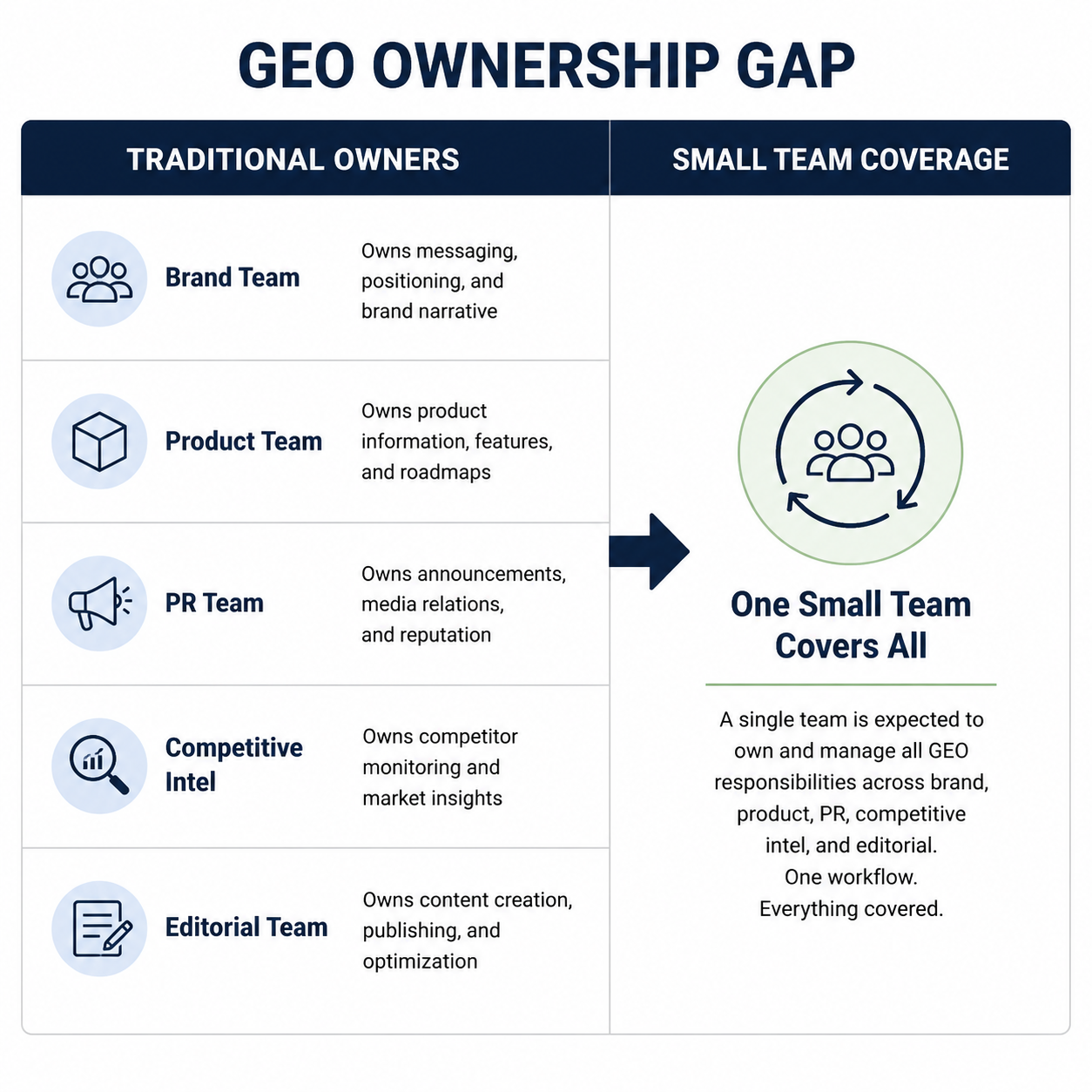
Tom Critchlow, a veteran search marketer, recently made a point that stuck with me: the people who drive real search outcomes aren't SEO professionals. They're the brand, product, PR, and editorial teams. SEO builds the technical foundation. Everything on top of it — brand familiarity, product positioning, third-party mentions, reputation signals — belongs to other functions.
That raises an uncomfortable question for small teams: if GEO success depends on capabilities you don't have a team for, what do you do?
Here's the breakdown: which outcomes actually matter in AI search, who traditionally owns them, and how small teams can cover the same ground without hiring a brand department, a PR agency, or a competitive intelligence unit.
The hidden ownership gap in GEO
Critchlow's argument is blunt: SEO has always claimed credit for outcomes it doesn't fully control. Rankings improve because of branded search, brand mentions, product quality, and reputation. SEO teams flag the need for these things. They rarely produce them.
In classic search, this gap was tolerable. Google rewarded technical optimization, content volume, and link signals — things SEO could own end to end. But AI search surfaces like ChatGPT, Perplexity, and Google AI Overviews don't just rank pages. They pull answers from brand mentions, product descriptions, reviews, editorial coverage, and entity facts scattered across the web.
So the work that matters most — building brand familiarity, keeping product information accurate everywhere, earning citations from credible sources, monitoring what AI says about you — is exactly the work SEO teams have never actually owned.
GEO outcome that matters | Traditional owner | What it requires |
|---|---|---|
Brand appears in AI answers | Brand team | Entity clarity, consistent brand facts, branded search volume |
Product details cited correctly | Product team | Structured product data, review signals, comparison-page presence |
Third-party mentions and citations | PR team | Media coverage, expert quotes, industry presence |
Competitor positioning tracked | Competitive intel | SERP analysis, share-of-answer monitoring, gap detection |
Trend-aware content production | Editorial team | Topic research, freshness signals, intent-aligned publishing |
Five outcomes. Five different teams. If you're a company of 200 people, maybe you have all five. If you're a team of 5, you have none of them - and you've been told SEO alone will carry you through the AI search transition.
Why the old workaround stops working
The standard SEO playbook — publish content, build links, fix technical issues — still matters. Nobody is arguing you should stop doing SEO. Critchlow himself says the technical foundation remains "equally important before and after."
But the foundation is no longer the building. In classic search, a well-optimized page could rank even if nobody had heard of your brand. In AI search, the model needs to have seen your brand name, your product attributes, and your reputation signals across multiple sources before it will recommend you in an answer.
Think about what happens when a user asks ChatGPT, "What's a good tool for checking AI search visibility?" The model doesn't read your meta tags. It recalls brand names it has encountered in reviews, comparison articles, forum discussions, and product documentation. If your brand doesn't show up in those places, no amount of on-page SEO will get you cited.
That's the ownership gap: the work that moves AI search outcomes happens outside your website, and SEO has no direct control over external surfaces.
What small teams actually need
If GEO success requires brand, product, PR, and competitive intelligence capabilities, a small team doesn't need to hire four new departments. They need to compress those functions into a single workflow they can actually run.
Here's what that looks like:
1. Brand visibility monitoring (the brand team function)
You need to know whether AI search models recognize your brand at all. That means running prompts across ChatGPT, Perplexity, Gemini, and Google AI Overviews to see if you appear, how you're described, and whether competitors show up instead.
Without a brand team, this becomes a recurring prompt-check routine: pick 10-15 buyer-intent prompts, run them weekly, log whether your brand appears, and track changes over time. The goal is to catch visibility gaps early — before they compound.
2. Product information consistency (the product team function)
AI models pull product facts from whatever they find online — your site, review platforms, app stores, comparison sites. If your pricing is wrong on one site, your features are described differently on another, and your latest update isn't mentioned anywhere, the AI will synthesize a version of your product that doesn't match reality.
The fix is an entity consistency audit: check what each major AI surface says about your product, compare it to what's actually true, and close the gaps by updating the sources the models read from.
3. Citation earning (the PR team function)
AI models trust brands that appear in credible third-party sources. This doesn't require a PR agency retainer. It requires identifying where your competitors are mentioned, finding equivalent publications or platforms, and creating the kind of content those sources want to reference — data, original analysis, tool comparisons, practical guides.
The workflow is: find where competitors are cited → identify the source type → create something more useful → get it in front of the same channels.
4. Competitor positioning (the competitive intelligence function)
You need to know which brands AI search recommends for your category, how often, and what it says about them. This is share-of-answer tracking — the AI equivalent of SERP position tracking.
Run the same set of prompts, but instead of checking your own visibility, map every brand the AI mentions. Count mentions, categorize sentiment, and track who's gaining or losing share over time. A simple spreadsheet updated monthly gives you the same signal a dedicated analyst would produce.
5. Trend-aware content (the editorial team function)
AI search rewards fresh content that addresses current questions. Instead of a content calendar driven by keyword volume alone, small teams need to track what questions buyers are actually asking AI platforms and create content that answers those questions better than existing sources.
The loop: monitor AI search results for your category → identify questions where no good answer exists → publish content that fills the gap → check whether AI models pick it up.
How Auspia compresses five teams into one workflow
This is where it gets practical. Auspia was built specifically for the gap Critchlow describes — the reality that small teams need brand, product, PR, and competitive intelligence capabilities but can't staff them individually.
Team function | What it does | How Auspia covers it |
|---|---|---|
Brand team | Brand visibility, entity consistency | AI Search Visibility Checker + GEO Score Checker audit brand presence across AI surfaces |
Product team | Product data accuracy | Website SEO Score Checker verifies crawlability and structured data for AI readability |
PR team | Citation earning | Keyword gap analysis identifies where competitors are cited and where you're missing |
Competitive intelligence | Share-of-answer tracking | Competitor visibility monitoring across AI search prompts |
Editorial team | Trend-aware content | Trend and keyword research tools identify content gaps AI search exposes |
The point isn't that Auspia replaces human judgment. It's that a three-person team using Auspia can run a weekly workflow that covers the same ground a brand team, a PR agency, and a competitive intelligence analyst would cover - at a fraction of the cost and time.
A typical week looks like this:
- Monday: Run 15 buyer prompts across ChatGPT, Perplexity, and Google AI Overviews. Log brand visibility and competitor mentions.
- Tuesday: Check AI Search Visibility Checker results for gaps. Identify which prompts you're missing from.
- Wednesday: Run the GEO Score Checker to audit entity clarity and product data consistency.
- Thursday: Review competitor positioning. Note which brands are gaining share-of-answer.
- Friday: Identify one content gap from the week's findings and publish or update a page to address it.
Five days. One person. Five team functions covered.
The real risk isn't to SEO — it's to teams that don't adapt
Critchlow framed the ownership gap as a career risk for SEO professionals. Fair enough. But that's the narrower view. The broader risk is to any organization that assumes their current team structure will carry them through the AI search transition.
Large companies can reorganize. They can move GEO ownership to brand, create a cross-functional AI search team, or hire a dedicated GEO lead. Small companies don't have that luxury. They have to compress the work into fewer people and fewer tools.
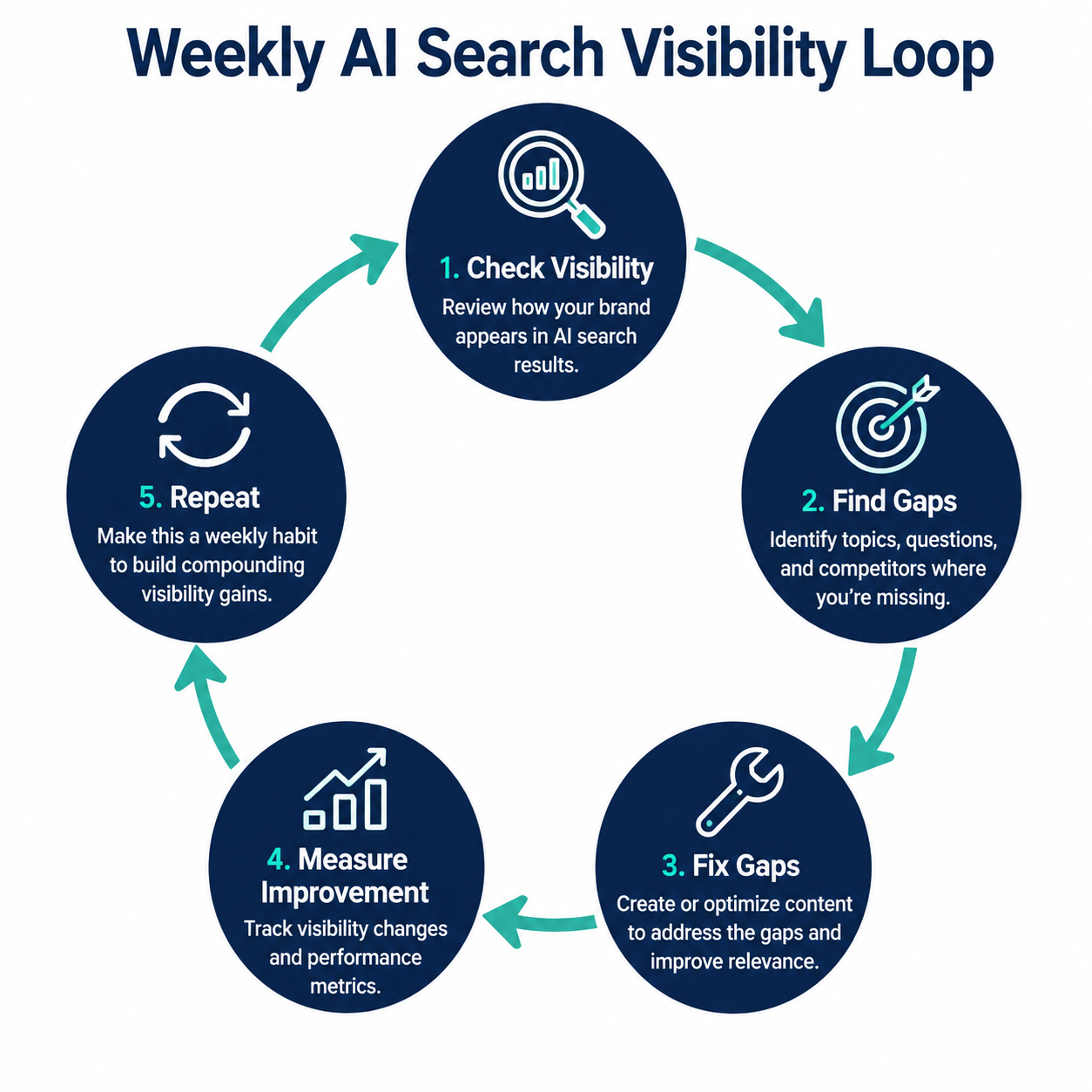
The teams that win in AI search won't be the ones with the biggest org charts. They'll be the ones that run the fastest loop: check visibility → find gaps → fix them → measure improvement → repeat. That loop doesn't require a brand department. It requires the right tools and a weekly cadence.
What to do this week
- Audit your AI search visibility. Run 10 prompts a buyer would use across ChatGPT, Perplexity, and Google AI Overviews. Note whether your brand appears, how it's described, and which competitors show up instead.
- Check your entity clarity. Run the GEO Score Checker to see whether AI models can correctly identify your brand, product, and category.
- Map your competitor's share-of-answer. For the same 10 prompts, track every brand mentioned. You now have a baseline.
- Find one gap and fix it. Pick the prompt where you're most absent and figure out why — missing product data, no third-party mentions, weak entity signals. Address one cause this week.
- Set a weekly cadence. Repeat steps 1-4 every week. Visibility compounds when you track it consistently.
The shift from SEO to GEO isn't about learning a new skill set. It's about accepting that the work that matters now spans brand, product, PR, and competitive intelligence — and finding a way to do all of it without hiring a single new person.
Author: Maya Ellison, 12-Year GEO Strategy Researcher at Auspia. Maya writes about AI search visibility, brand entity clarity, and practical GEO operating systems for growth teams.