The practical answer
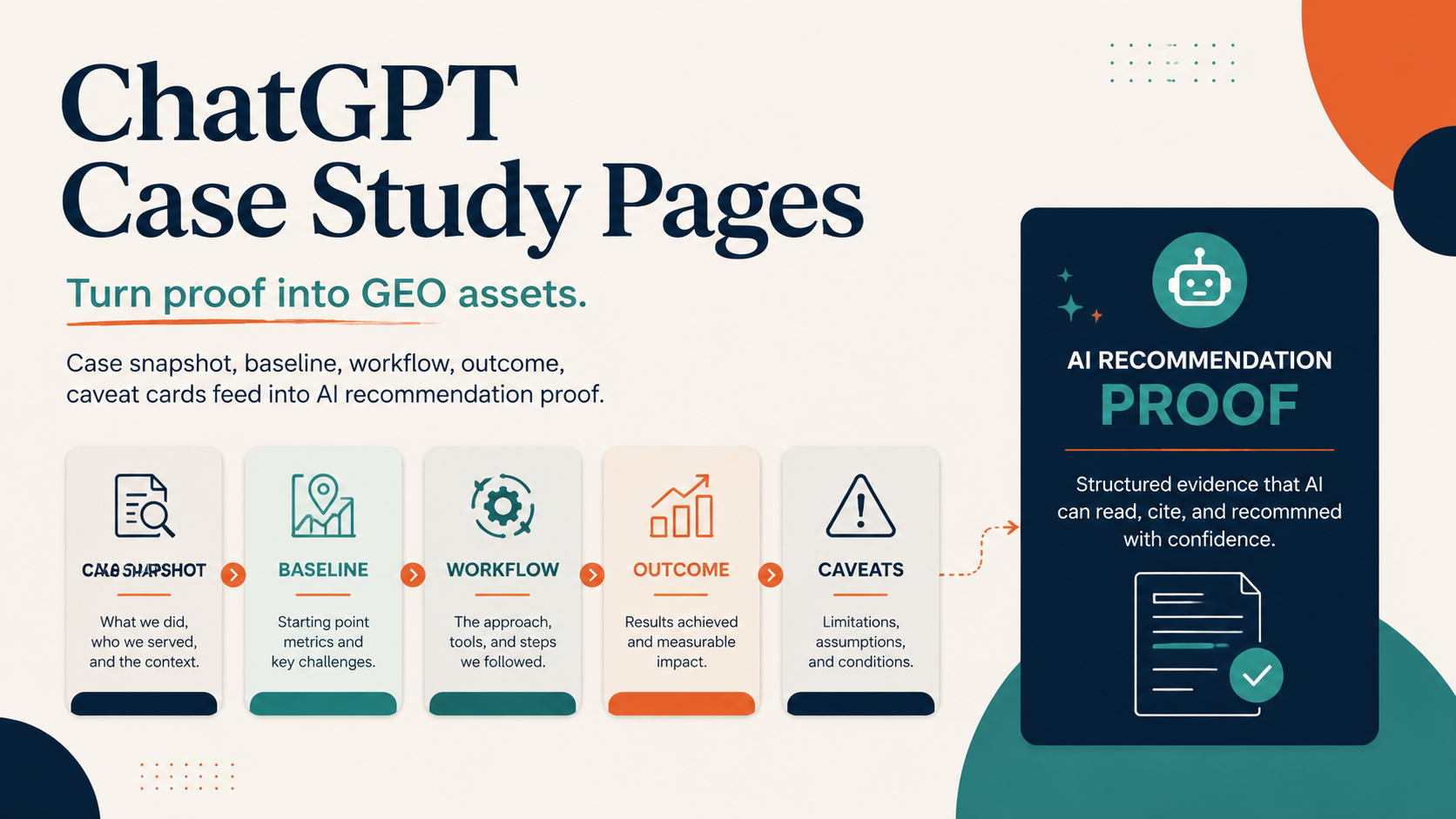
Case study pages help ChatGPT GEO because they turn claims into proof. AI answer systems can mention a brand more confidently when public pages show who used the product, what problem they had, what workflow was applied, what changed, and what limits or caveats exist. A homepage can explain positioning, but a case study can support belief.
For GEO, a case study should not only be a success story. It should be an evidence asset. That means it needs clear entities, problem context, measurable or observable outcomes, workflow detail, and reusable proof points that AI answers can summarize without exaggeration.
The best case study pages help both humans and AI systems answer: "Why should this brand be considered for this use case?"
Why case studies matter for ChatGPT GEO
Many ChatGPT prompts ask for recommendations or proof:
- Which tools are good for B2B SaaS content teams?
- Are there examples of brands improving AI search visibility?
- What evidence supports this product's claims?
- Which platform is best for measuring ChatGPT mentions?
- How do companies use GEO workflows in practice?
If your site only has claims and no proof, AI systems may rely on competitors or third-party sources with better evidence.
A case study gives AI systems source material for:
- audience fit
- use case fit
- workflow explanation
- before/after context
- outcome evidence
- implementation constraints
- product capability proof
That is why case studies are not just conversion assets. They are AI visibility assets.
What makes a case study GEO-ready
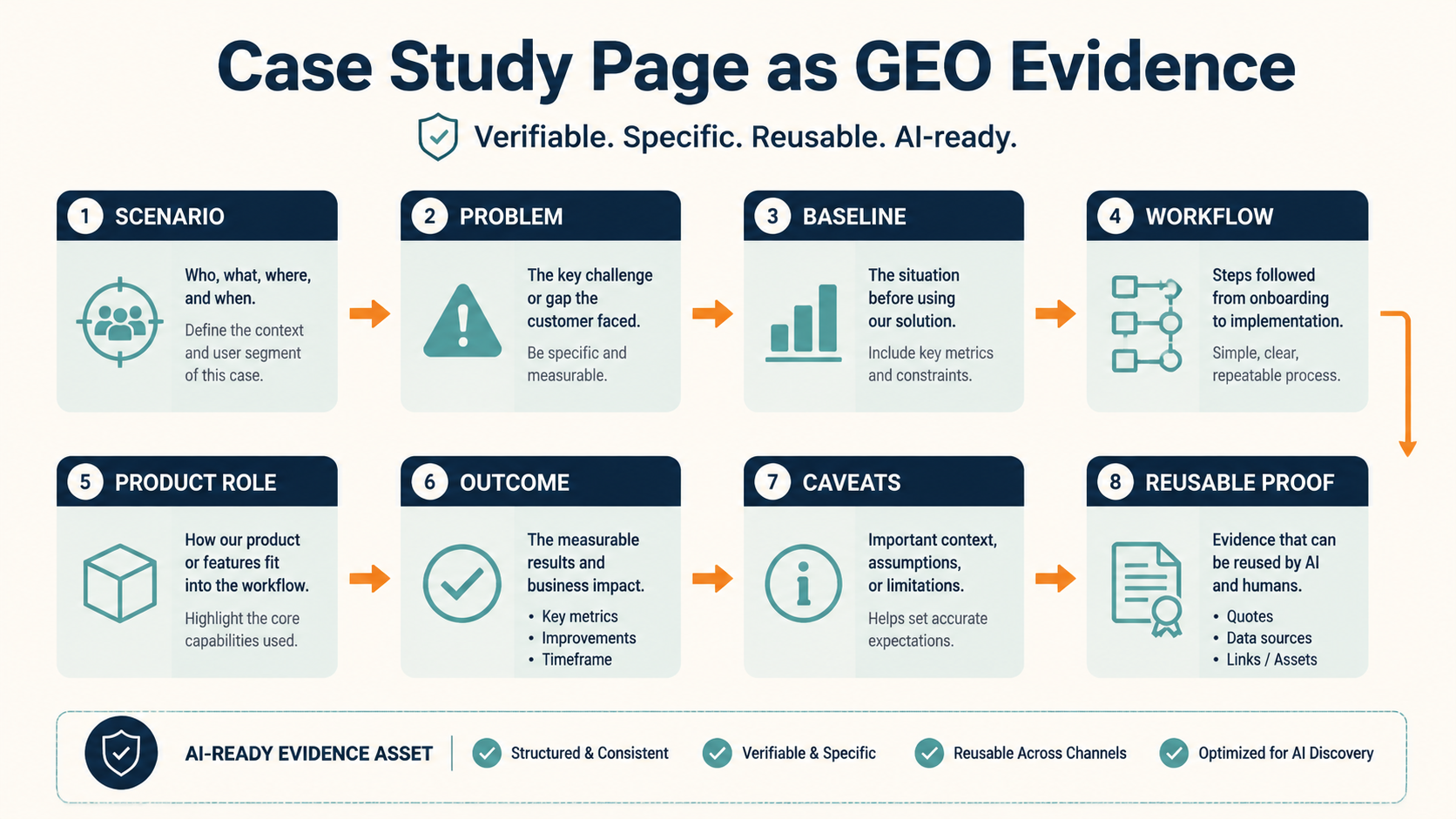
A GEO-ready case study should include these elements.
Element | Why it matters |
|---|---|
Clear customer or scenario entity | shows who the example applies to |
Problem context | connects the story to buyer prompts |
Starting state | gives before/after meaning |
Workflow steps | proves how the outcome was created |
Product role | connects features to use cases |
Outcome | supports claims with evidence |
Caveats | prevents overclaiming |
Reusable summary | gives AI answers a clean proof block |
If the page only says "customer achieved success," it is too vague for GEO.
Start with the proof question
Before writing, ask: what claim should this case study support?
Examples:
Claim | Case study should show |
|---|---|
The product helps measure ChatGPT visibility | prompt baseline, scoring method, recurring checks |
The product helps content teams prioritize GEO work | prompt gaps, brief creation, page updates |
The product helps fix wrong brand descriptions | issue log, source cleanup, answer improvement |
The product helps compare competitors | competitor overlap, alternatives prompts, market map |
The product helps technical teams improve AI readability | crawl/access audit, structured pages, docs updates |
This keeps the case study focused. One case study should not try to prove everything.
Use a case structure AI systems can summarize
A strong case study structure:
- Snapshot summary
- Customer or scenario context
- Problem
- Baseline
- Workflow
- Product role
- Outcome
- Caveats
- What other teams can apply
The snapshot summary is especially important. It should appear near the top and state the case in plain language.
Example:
A B2B SaaS content team used a 25-prompt GEO audit to find that its brand appeared in direct prompts but was missing from category and alternatives prompts. The team created a category page, two comparison sections, and a proof-backed use case page, then reran the same prompts to track description accuracy and competitor overlap.
This is much more useful than:
The customer transformed its AI visibility with a modern growth workflow.
Make the baseline visible
A case study needs a starting point.
For ChatGPT GEO, baseline examples include:
- brand absent from category prompts
- brand described with old positioning
- competitors appearing in alternatives prompts
- no citations or weak sources
- product page missing clear category language
- case studies not linked from key pages
- documentation blocked or hard to crawl
A visible baseline makes the improvement believable. Without it, outcomes feel like marketing claims.
Show the workflow, not just the result
AI answers and buyers both need to understand how the result happened.
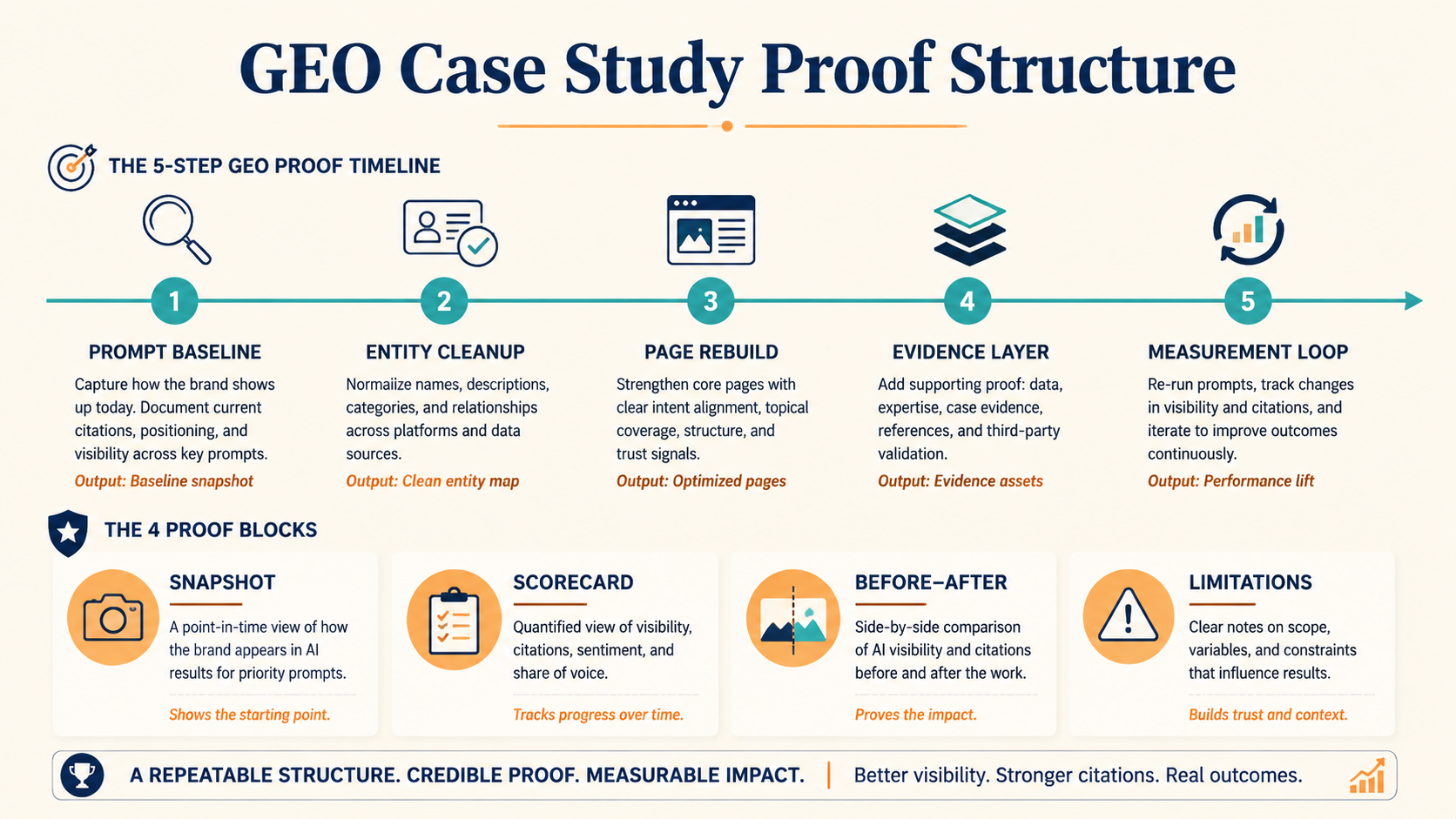
A GEO case study workflow might include:
Step | What happened | Why it mattered |
|---|---|---|
Prompt baseline | Tested 25 buyer prompts | identified visibility gaps |
Entity cleanup | Updated brand/category language | reduced wrong descriptions |
Page rebuild | Added category and use-case pages | improved prompt fit |
Evidence layer | Added proof, examples, and third-party links | supported recommendations |
Measurement loop | Reran prompts monthly | tracked answer quality |
This workflow gives the case study instructional value, not just proof value.
Connect outcomes to evidence carefully
Case studies should avoid overclaiming. Especially in GEO, many variables affect AI answers.
Use careful language:
- "After the update, the team's prompt checks showed..."
- "The brand description became more accurate in the tested prompts..."
- "The team observed fewer outdated descriptions across the baseline prompt set..."
- "This does not prove causation across all AI systems, but it shows a measurable improvement in the monitored prompt library."
Avoid:
- "Guaranteed ChatGPT rankings"
- "100% AI visibility"
- "Instant AI citations"
- "The only reason the answer changed was our page update"
Credible caveats make the case study stronger.
Add reusable proof blocks
A case study page should include proof blocks that can be reused by humans and AI systems.
Useful blocks:
- case snapshot table
- before/after prompt examples
- workflow timeline
- scorecard
- evidence inventory
- quote or observation
- limitations note
- key takeaway list
For example:
Proof block | Purpose |
|---|---|
Snapshot table | gives quick context |
Prompt baseline | shows starting visibility |
Workflow timeline | explains actions taken |
Outcome scorecard | summarizes change |
Limitations note | prevents overclaiming |
These blocks make the page more citation-ready.
What if you cannot name the customer?
Many teams cannot publish customer names. You can still create useful case-style evidence if you label it honestly.
Options:
- anonymized case study
- scenario teardown
- internal workflow example
- public benchmark
- synthetic example clearly labeled as illustrative
- before/after page rewrite example
- product workflow walkthrough
Do not pretend an illustrative example is a real customer result. For GEO, trust matters more than dramatic claims.
How to link case studies into the GEO cluster
Case studies should support other pages.
Link them from:
- product pages
- use-case pages
- comparison pages
- category pages
- FAQ answers
- content brief templates
- audit guides
- evidence pages
A case study hidden in a customer archive may not help much. A case study linked from the pages that make related claims becomes a stronger evidence layer.
Case study page checklist
Before publishing, check:
Check | Pass? |
|---|---|
The case supports one clear claim | |
The audience or scenario is specific | |
The starting problem is visible | |
The baseline is described | |
The workflow is explained step by step | |
Product role is clear without hype | |
Outcomes are supported and caveated | |
Reusable proof blocks are included | |
The page links to related product/use-case pages | |
The page avoids unsupported guarantees |
How to measure case study impact
For SEO:
- organic traffic to case pages
- assisted conversions
- internal link clicks from product/use-case pages
- engagement with proof blocks
- branded and comparison query lift
For ChatGPT GEO:
- whether AI answers mention evidence or examples
- whether the brand appears in use-case prompts
- whether product claims become more specific
- whether wrong or vague descriptions decrease
- whether comparison prompts include the brand with better context
- whether visible citations point to the case or related proof pages
Case studies usually support visibility indirectly. Measure them as part of the evidence layer.
Common mistakes
Mistake 1: writing a case study with no baseline
Without a starting point, the outcome is hard to trust.
Mistake 2: making the story too polished
A case study that hides the workflow, caveats, and constraints can feel like advertising.
Mistake 3: overclaiming causation
GEO results are influenced by many sources and systems. Use careful measurement language.
Mistake 4: failing to link the case from claim pages
If product and use-case pages make claims, link to the case study that supports them.
Mistake 5: hiding useful details in PDFs
Publish a crawlable HTML version with summary, workflow, and proof blocks.
FAQ
Are case studies useful for ChatGPT GEO?
Yes. Case studies provide evidence that supports brand recommendations, product claims, use-case fit, and workflow explanations. They help AI systems understand why a brand should be considered.
Do case studies need exact numbers?
Exact numbers help when they are accurate and allowed, but they are not always required. A workflow case, anonymized example, or before/after prompt audit can still be useful if it is clearly labeled and specific.
Can anonymized case studies help AI visibility?
Yes, if they are honest, specific, and useful. They should clearly explain the scenario, problem, workflow, and observed outcome without pretending to name a real customer.
How should a case study avoid overclaiming?
Use careful language, include limitations, show the baseline, and avoid implying that one page or action guarantees AI recommendations across all systems.
Where should case studies link?
Link them from product pages, use-case pages, comparison pages, category guides, FAQ answers, audit guides, and evidence pages where the case supports a claim.
Author: Vivian Brooks, B2B Case Study Strategist, 300+ Evidence Narratives Reviewed at Auspia. Vivian writes about case-style posts, evidence narratives, outcome framing, and proof assets for AI search visibility.