The practical answer
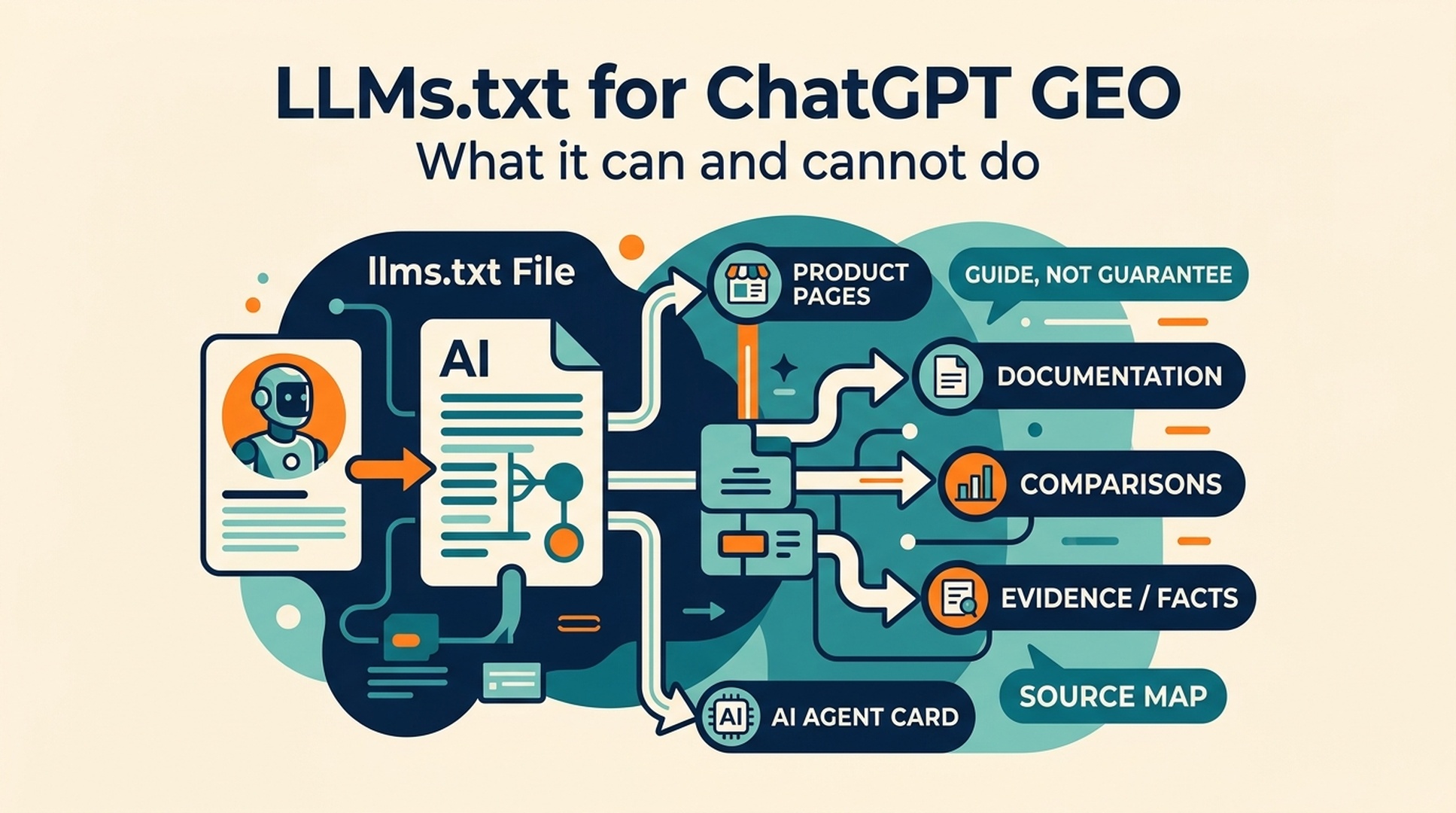
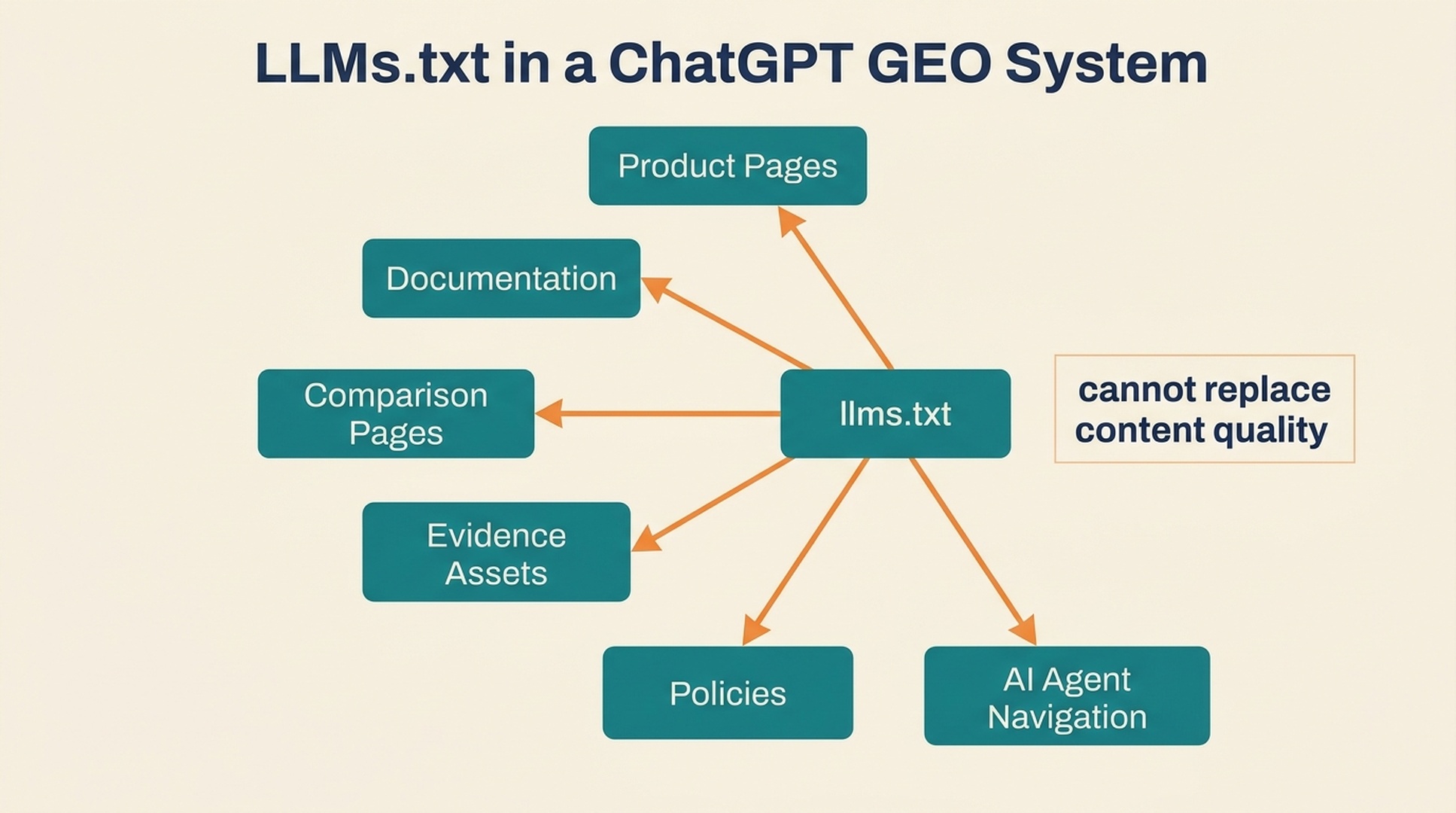
LLMs.txt can help AI systems and agents find the pages you want them to read, but it is not a magic switch for ChatGPT visibility. For ChatGPT GEO, treat LLMs.txt as a routing and documentation layer: it can point AI tools toward your best explanations, product pages, docs, comparison pages, policies, and evidence assets. It cannot replace clear content, public evidence, crawlability, entity consistency, or a real GEO strategy.
If your pages are vague, outdated, blocked, or unsupported, adding LLMs.txt will not make ChatGPT recommend your brand. If your site already has strong pages, LLMs.txt can make the important paths easier for AI agents and crawlers to understand.
Use it as part of a larger AI readability system, not as the whole system.
What is LLMs.txt?
LLMs.txt is a proposed text file that websites can publish to give large language models and AI agents a concise map of important site resources. It is usually placed at the root of a domain, such as:
https://example.com/llms.txt
The file can summarize what the site is, which pages matter, and where AI systems should look for documentation, product details, policies, examples, or other source material.
Think of it as a guide for AI readers. It is not the same as robots.txt. Robots.txt tells crawlers what they can or cannot access. LLMs.txt is more like a curated reading list and site guide.
What LLMs.txt can do for ChatGPT GEO
LLMs.txt is useful when it points to genuinely helpful pages.
It can help with:
Use | How it helps |
|---|---|
Source prioritization | Highlights the pages you consider authoritative |
Product clarity | Points to product, feature, docs, and use-case pages |
Entity consistency | Repeats the preferred brand/category description |
Agent navigation | Gives AI agents a simple path through the site |
Documentation discovery | Surfaces docs, policies, changelogs, and examples |
GEO workflow | Lists pages that answer important buyer prompts |
For example, a SaaS company can use LLMs.txt to point to its homepage, category page, product docs, comparison pages, customer stories, pricing, and support policy. That helps an AI agent understand where the best source material lives.
What LLMs.txt cannot do
LLMs.txt is often overhyped. It has limits.
It cannot:
- guarantee ChatGPT will crawl or use your pages
- guarantee citations
- override poor page quality
- fix wrong brand descriptions by itself
- replace schema, sitemaps, internal links, or technical SEO
- make unsupported claims trustworthy
- force AI systems to recommend your brand
- solve a weak third-party evidence trail
If a brand is invisible in ChatGPT because it lacks category pages, comparison context, and external proof, LLMs.txt alone will not solve that. It can only organize what exists.
The right pages to include
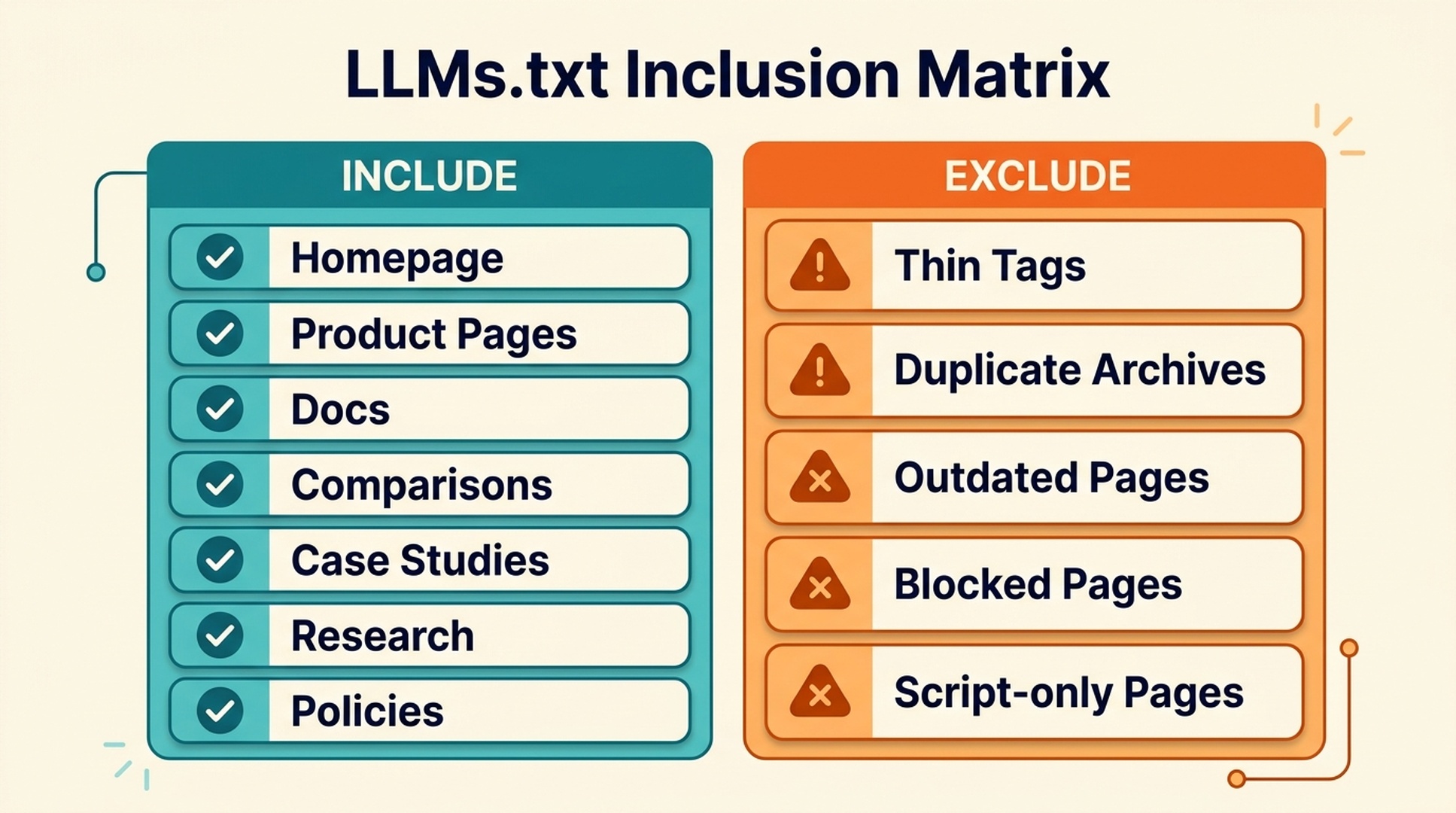
Do not treat LLMs.txt as a complete sitemap. Include pages that are useful source material.
Good candidates:
- homepage or overview page
- about page
- product pages
- documentation
- API docs
- pricing or plans page, if public
- comparison pages
- alternatives pages
- use-case pages
- category explainers
- case studies
- benchmark or research pages
- changelog
- support policy
- privacy/security pages
- glossary or FAQ hubs
Weak candidates:
- thin tag pages
- paginated archives
- duplicate posts
- low-value press releases
- outdated product pages
- pages blocked from crawling
- pages with only images or scripts
- promotional pages with no useful source content
The file should guide AI systems toward your strongest sources, not every URL you can find.
A simple LLMs.txt structure for GEO
Here is a practical structure for a brand that wants better AI readability.
# Example Company

> Example Company helps [audience] solve [problem] with [product/category].

## Core pages

- [Homepage](https://example.com/): Product overview and positioning
- [About](https://example.com/about): Company background and official description
- [Pricing](https://example.com/pricing): Plans and packaging

## Product and documentation

- [Product overview](https://example.com/product): What the product does
- [Documentation](https://example.com/docs): Setup guides and feature details
- [API docs](https://example.com/docs/api): Developer reference

## Use cases

- [Use case 1](https://example.com/use-cases/content-teams): Workflow for content teams
- [Use case 2](https://example.com/use-cases/seo-teams): Workflow for SEO teams

## Comparisons and alternatives

- [Alternatives page](https://example.com/alternatives): Comparison context
- [Example vs Competitor](https://example.com/compare/example-vs-competitor): Fit and tradeoffs

## Evidence

- [Case studies](https://example.com/customers): Customer stories and examples
- [Research](https://example.com/research): Benchmarks and original analysis
The descriptions matter. They should tell an AI reader why each page exists.
How to write the brand description
The opening description should be plain and specific.
Weak:
Example Company is an AI-powered growth platform for modern teams.
Stronger:
Example Company helps B2B SaaS content and SEO teams measure, improve, and report AI search visibility across ChatGPT, Google AI Overviews, Perplexity, and other answer surfaces.
The stronger version names the audience, category, job, and surfaces. It is more useful for AI systems and humans.
How LLMs.txt fits with robots.txt and sitemap.xml
These files do different jobs.
File | Main purpose | GEO role |
|---|---|---|
robots.txt | crawler access rules | avoid accidentally blocking important AI-readable pages |
sitemap.xml | URL discovery for search engines | helps indexing and coverage |
llms.txt | curated AI reading guide | points AI tools to your best source pages |
schema markup | structured page/entity data | clarifies page type, organization, product, article, FAQ, etc. |
Do not use LLMs.txt to compensate for a broken technical foundation. If important pages are blocked in robots.txt, missing from internal links, or impossible to render, fix that first.
A practical setup workflow
Step 1: Audit your source pages
List the pages you want AI systems to understand. Remove weak, outdated, or duplicate pages.
Step 2: Create the file
Write a short Markdown-style file with sections, links, and descriptions.
Step 3: Keep descriptions factual
Do not stuff keywords or make exaggerated claims. LLMs.txt should be useful, not promotional.
Step 4: Publish at the root
Place the file at:
https://yourdomain.com/llms.txt
Step 5: Link to it internally if useful
Some teams link to LLMs.txt from documentation, developer pages, or footer resources. This is optional, but it can help people and agents find it.
Step 6: maintain it
Update the file when product pages, docs, comparisons, or evidence pages change. A stale LLMs.txt file can send AI tools to old information.
How to measure whether it helps
You cannot isolate LLMs.txt impact perfectly, but you can monitor signals.
Track:
- whether AI agents request the file in server logs
- whether important pages receive AI crawler traffic
- whether brand descriptions become more accurate over time
- whether prompt answers cite or reference better pages, where citations are visible
- whether support/docs questions resolve to the right resources
- whether wrong or outdated pages stop appearing in answers
Use a stable prompt set before and after publishing. LLMs.txt should be measured as one component of a broader GEO update, not as a standalone ranking factor.
Common mistakes
Mistake 1: listing every URL
LLMs.txt should be curated. A huge dump of links is less useful than a clean map of authoritative pages.
Mistake 2: using marketing copy instead of descriptions
Write descriptions that explain what each page contains. Avoid hype.
Mistake 3: including weak pages
If the page is thin, outdated, or confusing, do not highlight it. Fix the page first.
Mistake 4: forgetting maintenance
A stale LLMs.txt file can reinforce outdated positioning. Review it after product launches, repositioning, documentation changes, or major content updates.
Mistake 5: treating it as a GEO shortcut
LLMs.txt is useful infrastructure, but it is not the strategy. The strategy is still clear pages, evidence, entity consistency, and measurement.
A quick LLMs.txt checklist
Before publishing, check:
Check | Pass? |
|---|---|
The brand description is plain and specific | |
The file is published at | |
Links point to crawlable public pages | |
Descriptions explain page purpose | |
Product, docs, comparisons, and evidence pages are included | |
Thin or outdated pages are excluded | |
Robots.txt does not block the important pages | |
The file has an owner and update cadence | |
The prompt baseline is recorded before launch |
FAQ
Does ChatGPT read LLMs.txt?
There is no guarantee that ChatGPT will read or use any specific site's LLMs.txt file in every situation. Treat it as an AI readability and agent-navigation aid, not a guaranteed ChatGPT ranking lever.
Is LLMs.txt the same as robots.txt?
No. Robots.txt controls crawler access instructions. LLMs.txt provides a curated guide to important content for AI systems and agents.
Should every website add LLMs.txt?
It is most useful for sites with documentation, products, tools, research, templates, policies, or content hubs that AI agents may need to navigate. Very small sites may benefit less until they have strong source pages.
Can LLMs.txt improve GEO visibility?
It can support GEO by pointing AI systems toward clear and authoritative pages, but it does not replace content quality, evidence, entity clarity, technical SEO, or third-party references.
What should I include first?
Start with your homepage, about page, product pages, documentation, comparison pages, use-case pages, case studies, and research or evidence assets. Exclude thin or outdated pages.
Author: Julian Mercer, 14-Year Technical SEO Practitioner at Auspia. Julian writes about crawlability, schema, rendering, site architecture, and technical foundations for AI-readable content.