


The practical answer
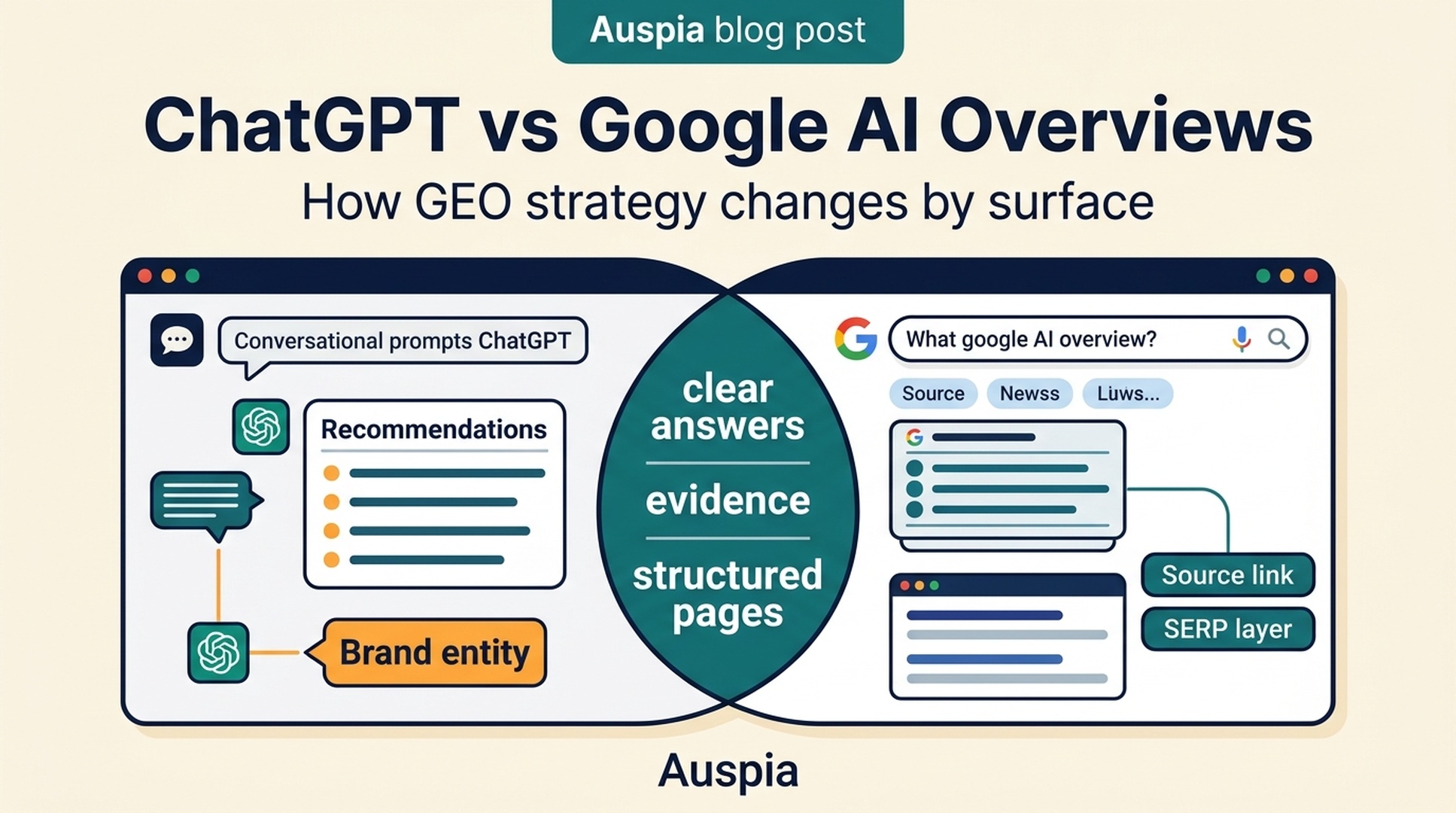
ChatGPT and Google AI Overviews both change how people discover information, but they do not reward exactly the same GEO strategy. ChatGPT often behaves like a conversational recommendation and synthesis system. Google AI Overviews sit closer to search results, where query intent, ranking signals, freshness, and source selection are more visible.
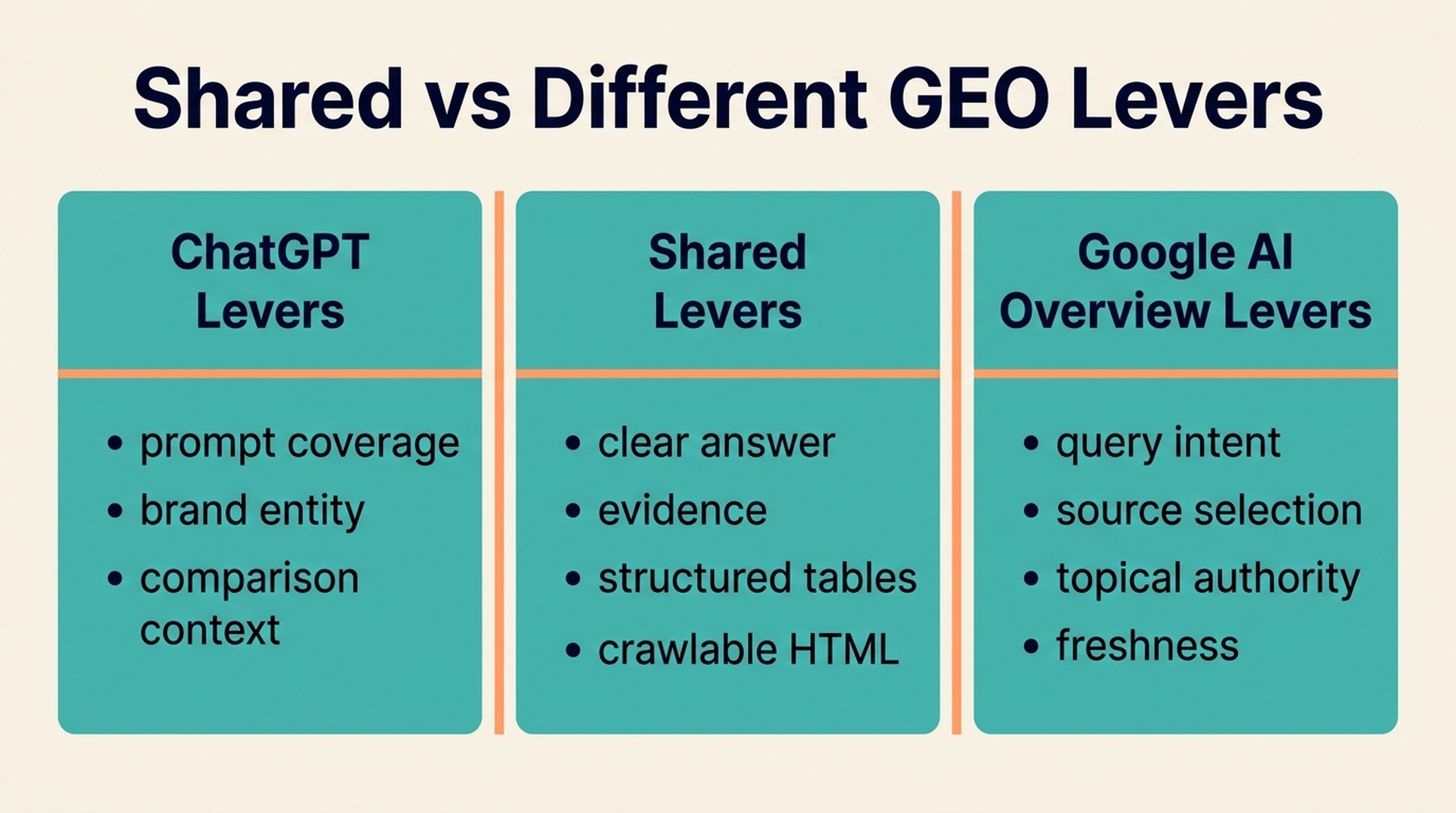
For growth teams, this means one content strategy should serve both, but measurement and page design need different emphasis. ChatGPT GEO needs brand entity clarity, comparison context, prompt coverage, and third-party evidence. Google AI Overview optimization needs extractable answers, topical authority, crawlability, freshness, and strong page-level relevance for search queries.
The overlap is large: clear answers, credible sources, structured pages, and useful examples help both. The mistake is assuming one AI visibility score explains every AI surface.
Where the two systems feel different to users
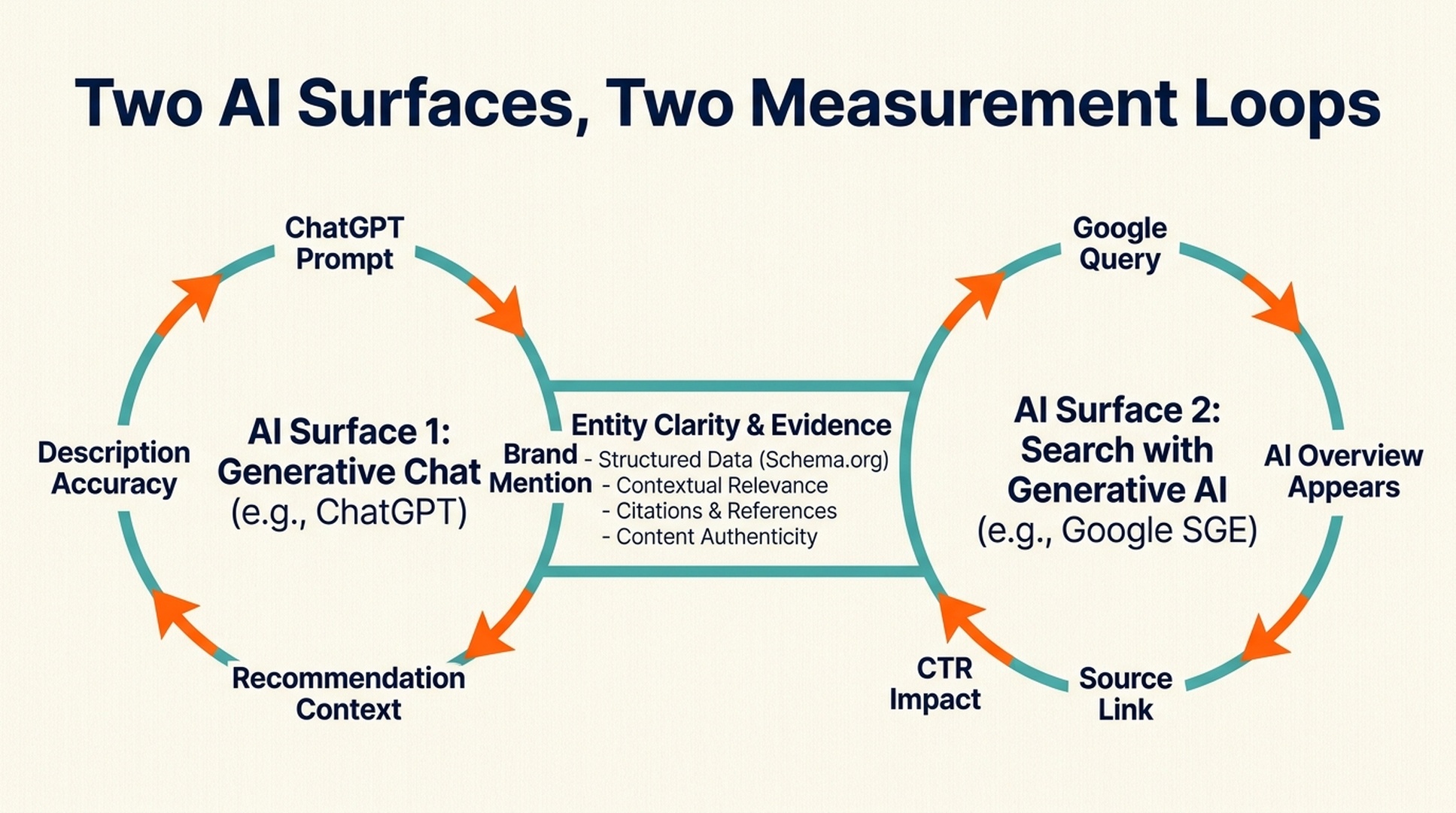
A user usually experiences ChatGPT as a conversation. They ask for advice, a shortlist, a plan, a comparison, or an explanation. The answer often synthesizes information into a single response.
A user experiences Google AI Overviews inside search. The AI answer appears above or within search results and is attached to a query. The surrounding page still includes links, organic results, shopping units, videos, forums, and other SERP features.
This difference changes the optimization lens.
Surface | User behavior | Optimization emphasis |
|---|---|---|
ChatGPT | asks conversational prompts and follow-ups | prompt coverage, entity clarity, recommendation context |
Google AI Overviews | searches a query and scans sources/results | query intent, extractable answer blocks, source relevance |
Both | wants a fast answer with confidence | clarity, evidence, examples, trustworthy pages |
If you only optimize for classic search queries, your brand may not appear in conversational recommendation prompts. If you only optimize for ChatGPT prompts, you may miss query-level opportunities in Google.
ChatGPT GEO: optimize for answer participation
For ChatGPT, the main question is: can the system understand when your brand, page, or idea belongs in an answer?
That requires more than one page. It requires a recognizable entity trail.
Important ChatGPT GEO signals include:
- clear brand category and audience
- product and use-case pages
- comparison pages and alternatives context
- third-party evidence and review profiles
- documentation or examples that prove the product exists
- prompt libraries that map buyer questions
- content that answers problem, category, and decision prompts
A common ChatGPT failure pattern is: the company has good SEO pages, but AI answers do not include the brand in recommendations because the market map is unclear.
For example, a SaaS company may rank for "AI content workflow" but still be absent when users ask, "What tools help content teams measure ChatGPT visibility?" The missing piece may be category positioning, comparison context, or public evidence.
Google AI Overviews: optimize for source selection
For Google AI Overviews, the question is more page-specific: is this page a good source for the query?
Important optimization areas include:
- direct answer near the top
- strong match to search intent
- crawlable content
- topical authority across related pages
- freshness for topics that change
- clear headings and structured sections
- examples, tables, and lists
- original evidence or useful synthesis
- technical SEO fundamentals
Google AI Overviews are still connected to the broader search ecosystem. Pages that are technically weak, unclear, thin, or mismatched to search intent are less likely to be useful sources.
This does not mean you should write for robots. It means your page should make the answer obvious.
The overlap: what helps both
The strongest AI visibility work improves both ChatGPT and Google AI Overviews.
Content quality | Why it helps ChatGPT | Why it helps AI Overviews |
|---|---|---|
Clear answer block | gives the model a reusable summary | helps match query intent quickly |
Entity clarity | reduces brand/category confusion | clarifies topical relevance |
Structured tables | supports comparison and synthesis | creates extractable source material |
Evidence and examples | strengthens recommendation confidence | increases source usefulness |
Internal topic cluster | builds semantic context | supports topical authority |
Fresh updates | reduces outdated answers | helps with changing queries |
Crawlable HTML | makes source content accessible | supports indexing and extraction |
If a page is clear, specific, and supported by evidence, it is usually better for both surfaces.
The difference: what to measure separately
Do not use one metric for all AI visibility.
For ChatGPT, track prompt outcomes:
- brand mentioned or absent
- brand description accuracy
- recommendation position in answer
- competitor overlap
- source/citation visibility where available
- whether the answer uses your category language
- whether the answer supports the right use case
For Google AI Overviews, track search-query outcomes:
- whether an AI Overview appears for the query
- whether your page is cited or linked
- which competitors are cited
- what paragraph or section appears to be used
- organic rank around the query
- freshness and update timing
- CTR changes when AI Overview appears
These metrics may move differently. A brand can improve ChatGPT recommendation visibility while not yet appearing in AI Overviews. A page can appear in AI Overviews while the brand remains weak in conversational recommendations.
Page types that serve each surface
Different page types carry different jobs.
Page type | Strong for ChatGPT | Strong for AI Overviews | Notes |
|---|---|---|---|
Definition guide | medium | high | best for "what is" queries |
Workflow playbook | high | high | useful for both prompts and how-to queries |
Comparison page | high | medium-high | critical for recommendation prompts |
Case study | medium-high | medium | supports proof and credibility |
Category page | high | high | helps market map and query relevance |
Product documentation | medium | medium-high | proves features and details |
Template/checklist | high | high | creates reusable answer material |
Opinion piece | low-medium | low-medium | useful only with strong evidence or POV |
For a GEO content cluster, mix page types. Do not build only blog explainers.
A dual-surface workflow
Use this workflow when planning a new article or page.
Step 1: Identify the search query
What would someone type into Google?
Example:
- how to measure ChatGPT visibility
- GEO content brief template
- ChatGPT SEO for SaaS
Step 2: Identify the conversational prompt
What would someone ask ChatGPT?
Example:
- how can my team track whether our brand appears in ChatGPT?
- what should a GEO content brief include?
- what tools help SaaS companies get recommended in AI answers?
Step 3: Decide the page job
Is the page a definition, workflow, comparison, evidence asset, template, or product page?
Step 4: Add the source block
Write a short section that directly answers the query/prompt. Include entities, proof, examples, and next actions.
Step 5: Add surface-specific improvements
For ChatGPT:
- include comparison context
- clarify when the brand or method is a fit
- name alternatives or adjacent methods
- connect the page to public evidence
For AI Overviews:
- strengthen heading-query match
- add concise answer blocks
- keep content crawlable
- update dates and examples
- support claims with visible sources or proof
Step 6: measure both separately
Run prompt checks for ChatGPT and query checks for Google. Do not collapse them into one generic "AI visibility" number.
Common mistakes
Mistake 1: assuming ChatGPT visibility equals AI Overview visibility
They overlap, but they are not the same surface. Track both.
Mistake 2: writing only definition content
Definitions are useful, but AI recommendations often need comparisons, evidence, templates, and use-case pages.
Mistake 3: ignoring brand entity work
A page can be well-written and still fail ChatGPT recommendation prompts if the brand is not clearly connected to the category.
Mistake 4: chasing citations without improving the page
AI Overview source selection is more likely when the page is genuinely useful for the query. Thin pages rarely become strong sources.
Mistake 5: measuring too broadly
"Do we show up in AI?" is not a measurement plan. Use prompt groups for ChatGPT and query groups for Google.
A simple planning template
Use this when creating a page that should support both surfaces.
Field | Fill this in |
|---|---|
Primary Google query | |
Primary ChatGPT prompt | |
Page job | definition / workflow / comparison / evidence / template |
Main entity | |
Related entities | |
Direct answer block | 3-5 sentences |
Required evidence | |
Comparison context | |
Structured asset | table / checklist / rubric / workflow |
Internal link target | |
ChatGPT metric | prompt score |
AI Overview metric | query/source visibility |
This template prevents a page from being optimized for only one discovery mode.
FAQ
Is ChatGPT GEO the same as Google AI Overview optimization?
No. They overlap, but ChatGPT GEO focuses more on prompt coverage, entity clarity, and recommendation context. Google AI Overview optimization is closer to search-query source selection, extractable answers, and page relevance.
Should I create separate pages for ChatGPT and AI Overviews?
Usually no. Start with one strong page that serves both humans and AI systems, then add surface-specific improvements such as prompt coverage, comparison context, answer blocks, and query-aligned headings.
What content works best for both surfaces?
Workflow guides, templates, comparison pages, category explainers, and evidence-backed articles usually work better than vague thought leadership because they provide clear source material.
How do I measure ChatGPT visibility?
Use a stable prompt library. Track whether your brand is absent, mentioned incorrectly, described accurately, recommended with context, or recommended with evidence.
How do I measure Google AI Overview visibility?
Track target queries, whether an AI Overview appears, whether your page is cited or linked, which competitors appear, and how organic CTR changes when the AI Overview is present.
Author: Owen Hartwell, Google AI Overview Tracker Across 40+ Verticals at Auspia. Owen writes about Google AI Overviews, search AI features, SERP shifts, and how AI answers change SEO strategy.


