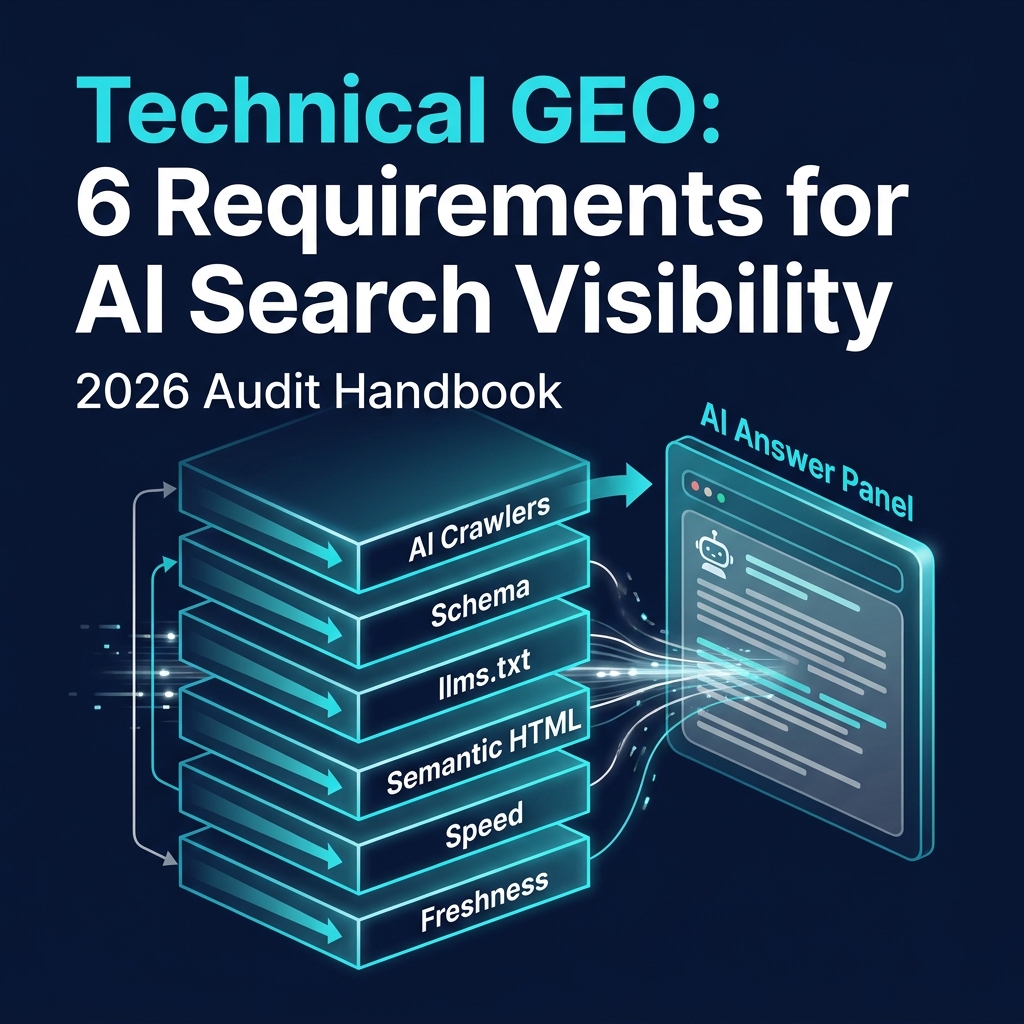
Technical GEO is the layer of work that determines whether AI search engines can crawl, parse, trust, and cite your content. Most teams treat it as an afterthought—something to handle "after the content is good." That sequence is backwards. In 2026, the sites getting cited by ChatGPT, Perplexity, and Google AI Overviews are the ones whose technical foundation was built for retrieval-first consumption, not just for ranking in blue-link results.
This guide breaks down the six technical GEO requirements, gives you an audit checklist for each, and shows where technical GEO diverges from technical SEO so you can prioritize the work that actually moves AI citation rates.
What Technical GEO Actually Means
Technical GEO is the practice of configuring your site's infrastructure, markup, and content structure so that generative engines—ChatGPT, Perplexity, Google AI Overviews, Microsoft Copilot—can retrieve, understand, and trust your content enough to cite it in generated answers.
It sits alongside content GEO (answer structure, citation-worthiness) and authority GEO (third-party mentions, entity consistency) as one of three GEO pillars. But it is the gatekeeper: if a retrieval system cannot access or parse your page, no amount of content quality will earn you a citation.
The core mechanism behind every generative engine is retrieval-augmented generation (RAG). When a user asks a question, the engine retrieves semantically relevant passages from indexed content, then synthesizes an answer. The unit of optimization therefore shifts from the entire page to the individual passage. Your technical job is to make those passages findable, extractable, and trustworthy.
The 6 Technical GEO Requirements
1. AI Crawler Accessibility (robots.txt)
Traditional SEO ensures Googlebot can crawl your site. Technical GEO extends that to the AI crawlers that feed retrieval systems: GPTBot, ClaudeBot, PerplexityBot, Google-Extended, and CCBot.
The decision is not binary. You need to distinguish between training crawlers (which collect data for model training) and retrieval crawlers (which fetch content for real-time answer generation). Blocking GPTBot prevents OpenAI from using your content for training, but ChatGPT Search can still access your pages through its web search layer. Blocking PerplexityBot, however, directly removes you from Perplexity's answer pipeline.
Audit checklist:
- Identify every AI crawler in your robots.txt and classify it as training-only or retrieval-serving
- Verify that retrieval crawlers (PerplexityBot, Google-Extended) are allowed on pages you want cited
- Confirm training crawlers (GPTBot, ClaudeBot, CCBot) are deliberately allowed or blocked based on your monetization stance
- Check server access logs for actual crawler visits—don't rely on robots.txt alone
- Validate with a robots.txt AI crawler checker to catch misconfigurations
A common mistake: teams block all AI crawlers to "protect content," then wonder why their AI search visibility drops to zero. If citation visibility matters to your business, retrieval crawlers must be allowed.
2. Structured Data and Schema Markup
Schema markup is no longer optional for GEO. It provides a machine-readable vocabulary that tells AI systems exactly what your content is about—entities, relationships, facts, and context. When an AI engine retrieves a passage, schema helps it confirm that the passage is about a specific product, person, organization, or event, which increases citation confidence.
The schema types that matter most for GEO:
Schema Type | GEO Role | Example |
|---|---|---|
Organization | Entity identity, brand facts | Company name, logo, founders |
Article | Content type, authorship, dates | Publishing date, author byline |
FAQPage | Question-answer extraction | Direct Q&A blocks AI can lift |
HowTo | Step-by-step retrieval | Process instructions |
Product | Feature/spec extraction | Pricing, dimensions, availability |
Person | Author authority signals | Credentials, role, expertise |
Review | Rating and sentiment data | Star ratings, review counts |
Audit checklist:
- Run Google's Rich Results Test on your top 20 pages
- Verify Organization schema is present site-wide and matches your knowledge panel
- Ensure every article has Article schema with author, datePublished, and dateModified
- Add FAQPage schema to pages with Q&A sections
- Validate schema with Schema.org validator—not just Google's tool, since AI engines may parse schema Google ignores
- Remove deprecated or incorrect schema that creates entity confusion
3. llms.txt and Content Discovery Signals
llms.txt is a plain-text file placed at your site root (e.g., yourdomain.com/llms.txt) that gives AI systems a structured summary of your business. The specification, currently at version 1.7.0 as of May 2026, requires an H1 heading matching your canonical business name, a blockquote summary, and H2-organized links to key resources.
Here is the honest picture: a recent study found that of roughly 38,000 domains with a valid llms.txt file, 97% received zero requests for it in May 2026. Adoption is early, and no major AI engine has confirmed it reads llms.txt as a ranking or retrieval signal. But the file is cheap to create, and it consolidates brand facts in one authoritative location—which has indirect value for entity consistency.
Do not confuse llms.txt with AGENTS.md. AGENTS.md is a file for software projects that guides AI coding agents on build steps, testing commands, and code conventions. It has nothing to do with website GEO. Over 60,000 repositories now contain an AGENTS.md file, but that is a developer tool, not a search optimization asset.
Audit checklist:
- Create a minimal llms.txt with your canonical business name, a 2-3 sentence summary, and links to your top 5-10 pages
- Verify the file is accessible at
/llms.txtwith a 200 status code - Do not expect immediate traffic—treat it as a low-cost entity consolidation step
- Skip AGENTS.md entirely unless you are managing a code repository for AI coding agents
4. Semantic HTML and Content Structure for Extraction
AI retrieval systems parse HTML structure to identify the most relevant passages. Semantic HTML—using <article>, <section>, <header>, <nav>, <main>, and <footer> instead of generic <div> tags—helps these systems distinguish content from navigation, ads, and boilerplate.
The structural patterns that improve extractability:
- Front-load the answer. Put the core conclusion within the first 200 words. AI engines retrieve passages, not full pages, and they weight early content more heavily.
- Use descriptive headings. Every
<h2>and<h3>should describe the section's content in plain language. AI systems use headings as retrieval anchors. - Keep paragraphs short. 2-4 sentences per paragraph. Long blocks are harder for retrieval systems to chunk and match to queries.
- Use lists and tables. These are inherently machine-readable and frequently extracted verbatim by AI engines.
- Add explicit Q&A blocks. Question headings followed by concise answers are the single most extractable content format for generative engines.
Audit checklist:
- Inspect your top pages with browser dev tools—verify
<main>and<article>tags are present - Check that headings follow a logical hierarchy (h1 → h2 → h3) with no skipped levels
- Ensure the first paragraph of each section directly answers the heading's implied question
- Replace long paragraph blocks with lists or tables where the content is enumerative
5. Crawl Performance and Site Speed
Generative engines rely on the indexes of major search engines like Google and Bing to discover content. If your site is slow, if Core Web Vitals are poor, or if crawl budget is wasted on low-value pages, AI engines will struggle to retrieve your content in real time.
This is where technical SEO and technical GEO overlap most heavily. The fundamentals—fast server response times, optimized images, minimal render-blocking JavaScript, clean XML sitemaps, and logical internal linking—are prerequisites for both.
The GEO-specific nuance is that AI engines often fetch pages in real time during answer generation. A page that loads in 4 seconds may be fine for Google's indexing crawler (which revisits on its own schedule) but too slow for a real-time retrieval fetch, causing the AI engine to skip your content and cite a faster competitor.
Audit checklist:
- Run Lighthouse on your top 20 pages—target a performance score of 90+
- Verify server response time (TTFB) is under 800ms
- Check that XML sitemaps are clean, submitted to Google Search Console, and contain only canonical URLs
- Ensure internal links point to the canonical version of each page
- Audit crawl budget: block low-value parameter URLs in robots.txt and use
noindexon thin pages
6. Content Freshness and Recency Signals
AI engines have a documented recency bias. Data shows that when content becomes more than three months old, AI citation rates drop sharply. Generative engines favor fresh content because it is more likely to reflect current reality—a priority that matters especially for topics where facts change quickly.
Technical GEO addresses this through a structured content refresh cycle. This is not about rewriting articles from scratch. It is about updating dates, statistics, examples, and schema fields at predictable intervals so AI systems see the content as current.
Audit checklist:
- Identify your top 20 AI-citation-eligible pages (use Auspia's GEO Checker to find which pages currently get cited)
- Set a quarterly refresh calendar for each page
- Update
dateModifiedin Article schema every time you revise content - Add visible "Last updated" dates to article pages—AI engines parse these
- Refresh statistics and examples with current data sources each cycle
Technical GEO vs Technical SEO: What Changes
Technical SEO and technical GEO share a foundation, but the optimization targets diverge in important ways:
Dimension | Technical SEO | Technical GEO |
|---|---|---|
Optimization unit | Page | Passage |
Target system | Search engine crawler | RAG retrieval pipeline |
Success metric | Rankings, clicks | Citations, mentions |
Crawler focus | Googlebot, Bingbot | GPTBot, PerplexityBot, Google-Extended |
Markup priority | Rich results eligibility | Entity clarity, fact extraction |
Content structure | Heading hierarchy for ranking | Passage extractability for synthesis |
Freshness signal | Update frequency for crawl priority | Recency bias in citation selection |
Speed threshold | Core Web Vitals thresholds | Real-time retrieval fetch speed |
The practical implication: you cannot abandon technical SEO and focus only on GEO. The two are additive. A site with strong technical SEO has a better foundation for GEO because AI engines use the same crawl infrastructure. But a site that stops at traditional SEO will miss the GEO-specific layers—AI crawler access, passage-level structure, entity schema, and freshness cycles—that determine whether you get cited.
5-Step Technical GEO Audit Workflow
Run this workflow on your site to identify and fix technical GEO gaps:
Step 1: Crawler Access Audit. Pull your robots.txt and classify every AI crawler directive. Verify retrieval crawlers are allowed on citation-worthy pages. Use Auspia's robots.txt AI crawler checker for automated validation.
Step 2: Schema Coverage Audit. Test your top 20 pages with the Rich Results Test and Schema.org validator. Ensure Organization, Article, and FAQPage schema are present and correct. Fix any schema errors or deprecated types.
Step 3: Content Structure Audit. Open each top page in browser dev tools. Verify semantic HTML tags are present, headings follow a logical hierarchy, and the first paragraph of each section answers the heading's question. Rewrite long paragraph blocks into lists or tables.
Step 4: Performance Audit. Run Lighthouse on every top page. Fix any score below 90. Prioritize server response time, image optimization, and render-blocking resources.
Step 5: Freshness Audit. Check the dateModified field in Article schema for every top page. If any page hasn't been updated in 90+ days, schedule a content refresh. Update statistics, examples, and the visible "Last updated" date.
After completing the audit, use Auspia's GEO Checker to measure your citation rate before and after the fixes. The goal is not a single audit—it is a recurring cycle that keeps your technical foundation aligned with how generative engines evolve.
Common Technical GEO Gaps
Three gaps appear most frequently in audits:
Gap 1: Blocking retrieval crawlers. Teams block GPTBot to prevent training use, but also block PerplexityBot or Google-Extended, which removes them from real-time answer generation. The fix: allow retrieval crawlers on public content, block only training crawlers if your monetization model requires it.
Gap 2: Missing or incorrect Organization schema. Without Organization schema, AI engines cannot confidently connect your content to your brand entity. This reduces citation trust and causes brand fact errors in generated answers. The fix: implement Organization schema site-wide with accurate name, logo, sameAs links, and founder information.
Gap 3: No freshness cycle. Content that was well-structured at publication decays in citation value after three months. Teams that don't refresh lose citations to competitors who update more frequently. The fix: build a quarterly refresh calendar and treat dateModified updates as a technical GEO task, not just an editorial one.
Frequently Asked Questions
Is technical GEO separate from technical SEO?
No—it is an extension. Technical SEO provides the crawlability and performance foundation. Technical GEO adds AI-specific layers: AI crawler access, passage-level content structure, entity schema, and freshness cycles. You need both.
Do I need llms.txt for GEO?
It helps with entity consolidation but is not yet a confirmed retrieval signal. Create a minimal file for low cost, but do not expect immediate citation impact. Prioritize schema markup and AI crawler access first.
Should I block GPTBot?
It depends on your goals. Blocking GPTBot prevents OpenAI from training on your content but does not remove you from ChatGPT Search results (which use web search). If citation visibility matters, allow retrieval-serving crawlers and block only training crawlers if needed.
How often should I refresh content for GEO?
Every 90 days for high-priority pages. AI citation rates drop sharply after three months. Update statistics, examples, and the dateModified schema field each cycle.
What schema types matter most for AI citations?
Organization, Article, FAQPage, and HowTo. Organization establishes entity identity. Article signals authorship and freshness. FAQPage and HowTo provide directly extractable Q&A and process content.
Author: Julian Mercer, 14-Year Technical SEO Practitioner at Auspia. Julian writes about crawlability, structured data, and the technical infrastructure that makes content visible to both search engines and AI answer systems.