Short answer: Perplexity SEO is source optimization
Perplexity SEO is the work of making your brand, pages, and evidence easier for Perplexity to find, understand, cite, and recommend in AI-generated answers.
It overlaps with Google SEO, but the job is different. You are not only trying to rank in a list of links. You are trying to become a source inside the answer itself.
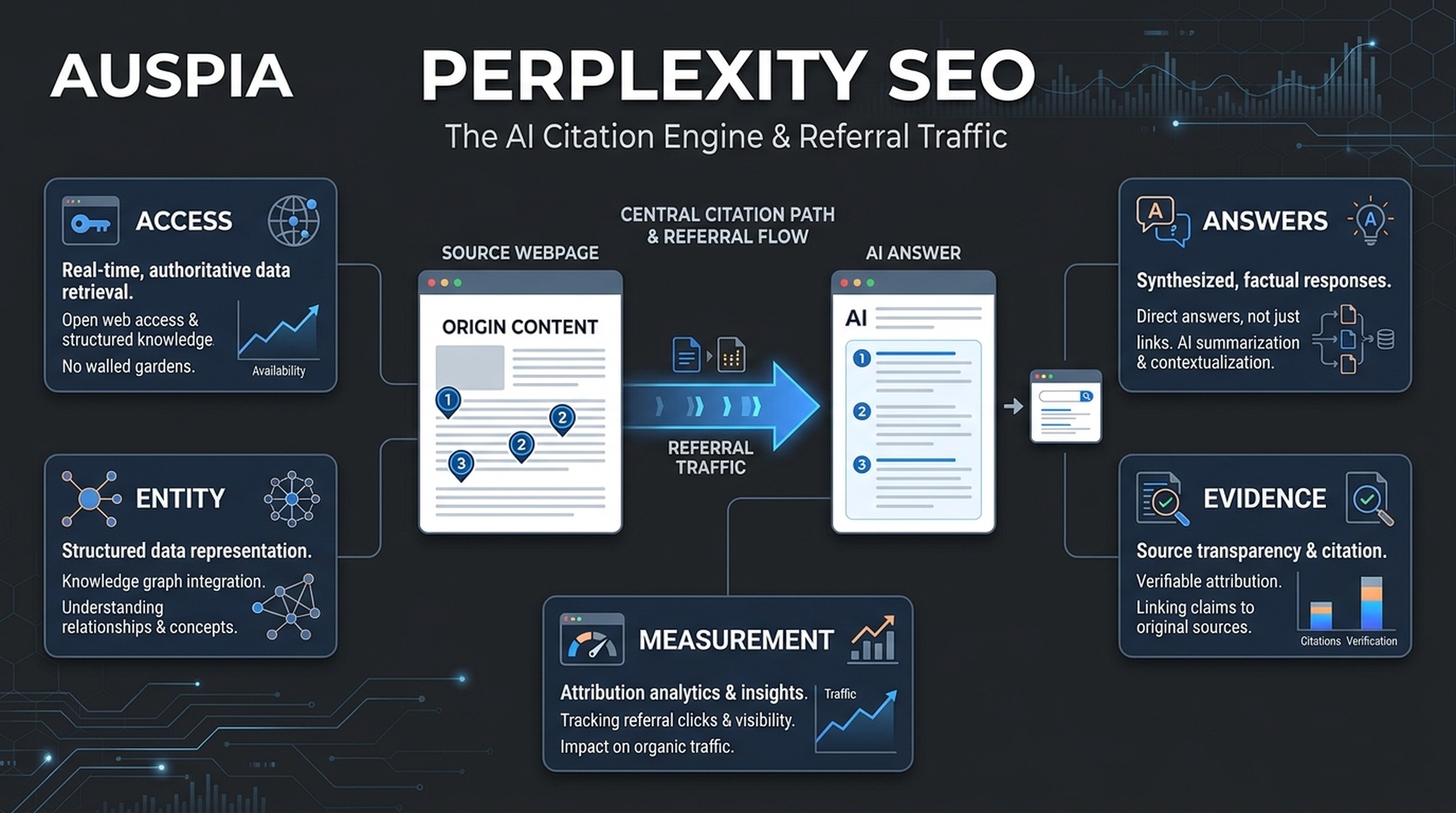
That changes the work. A page that performs well for Perplexity usually has five things: crawl access, answer-ready structure, clear brand facts, external evidence, and a way to measure citations and referral traffic. Miss one of those, and the page may still be indexed by search engines while staying invisible in AI answers.
A practical Perplexity SEO program should answer three questions every week:
Question | What to check |
|---|---|
Can Perplexity access our pages? | Robots.txt, WAF, CDN rules, server logs, PerplexityBot visibility |
Can it use our pages as sources? | Direct answers, dated facts, tables, definitions, citations, original evidence |
Are we earning business value? | Brand mentions, cited URLs, answer position, referral sessions, assisted conversions |
That is the frame for this guide.
Why Perplexity SEO matters
Perplexity is not a normal search results page. Users ask full questions, get a synthesized answer, and see numbered citations attached to the answer. Perplexity describes its product as a system that searches the internet in real time, pulls from sources such as articles and websites, and gives citations so users can verify the information.
That citation layer matters for brands.
A user might search Google, scan ten blue links, and click the result that looks most relevant. In Perplexity, the user may read the answer first and only click a source when they want to verify, compare, or go deeper. The source still gets value before the click because the brand name, page title, and claim can appear directly inside the research flow.
The traffic volume may be smaller than Google. The intent can be stronger. Someone asking "best customer support platforms for a 50-person SaaS team" or "which payroll tools support contractors in multiple countries" is not browsing casually. They are often building a shortlist.
For growth teams, the goal is not to chase every Perplexity mention. The goal is to appear when the answer affects evaluation, trust, and purchase intent.
Perplexity SEO vs Google SEO vs GEO
The easiest mistake is treating Perplexity like another Google ranking surface. It is closer to a cited answer system.
Area | Google SEO | Perplexity SEO | Broader GEO |
|---|---|---|---|
Main surface | Search results | AI answer with citations | AI answers across platforms |
Visibility unit | Ranking URL | Cited source, brand mention, answer inclusion | Share of answer, source presence, recommendation quality |
User behavior | Search, click, compare pages | Ask, read synthesis, inspect sources | Ask across ChatGPT, Perplexity, Gemini, Google AI Overviews, Claude, and others |
Content goal | Rank and earn clicks | Be useful enough to cite | Be retrievable, trusted, and recommended |
Measurement | Rankings, CTR, organic sessions | Mentions, cited URLs, referral traffic, answer position | Prompt visibility, sentiment, citation share, competitive presence |
Perplexity SEO sits inside GEO, but it deserves its own plan because Perplexity is citation-heavy and web-retrieval-heavy. If your pages are blocked, vague, stale, or unsupported by external evidence, a general "AI visibility" strategy will not save them.
How Perplexity discovers and cites sources
Perplexity uses web search and citations as part of the product experience. Its Help Center says each answer includes citations that link back to original sources, so users can verify information or explore further.
For site owners, two crawler identities matter:
Crawler | What it means for SEO teams |
|---|---|
| Perplexity's crawler for discovering and indexing web content so pages can appear in Perplexity search results. |
| A user-triggered agent that may fetch pages in response to a real query. |
The practical lesson is simple: do not optimize a page for Perplexity before you know whether Perplexity can reach it.
Check:
robots.txtrules- CDN and WAF rules
- bot protection settings
- server logs
- blocked user agents
- excessive JavaScript rendering requirements
- pages hidden behind forms, scripts, or gated experiences
This is where old-school technical SEO becomes useful again. If your infrastructure blocks AI crawlers or user-triggered fetches, your content may never enter the answer set.
Auspia note: crawler access is not the same as citation eligibility. Allowing a crawler only opens the door. The page still needs to be a useful source.
Related Perplexity SEO guides
Use this page as the hub for the Perplexity SEO cluster. If you need a specific next step, start here:
Need | Recommended guide |
|---|---|
Earn citations | |
Compare search systems | |
Check crawler access | |
Rewrite source pages | |
Measure visibility | |
Run an audit | |
Clean brand facts | |
Fix blockers | |
Turn citations into visits |
The five pillars of Perplexity SEO
Perplexity SEO works best when it is treated as a system, not a checklist of hacks.
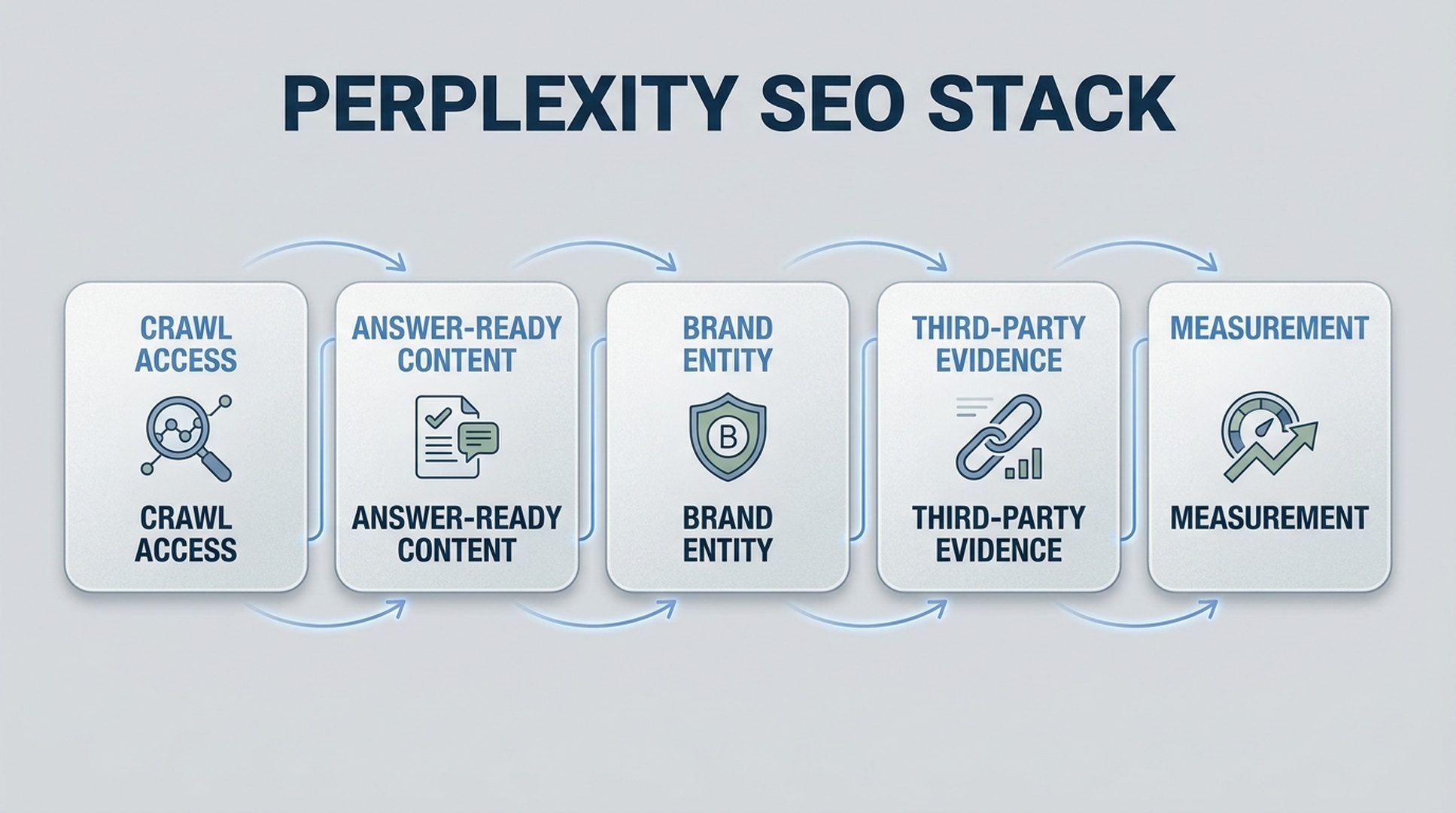
Pillar | What it improves | Example action |
|---|---|---|
Crawl access | Discoverability | Allow relevant Perplexity crawlers, inspect logs, remove accidental WAF blocks |
Answer-ready content | Citation fit | Add direct answers, tables, definitions, dated facts, and concise summaries |
Brand entity clarity | Mention accuracy | Make brand name, category, product, locations, and claims consistent across the web |
Third-party evidence | Trust and retrieval depth | Earn mentions on review sites, partner pages, directories, research pages, and industry sources |
Measurement | Learning loop | Track prompts, mentions, cited URLs, referral sessions, and conversions |
Most teams over-invest in the second pillar and under-invest in the other four. They rewrite content, add FAQs, and hope citations appear. Sometimes they do. More often, the page is technically hard to fetch, the brand entity is fuzzy, or the claim has no external support.
Pillar 1: make your site accessible
Start here because access failures are boring, common, and expensive.
Open your robots.txt file and check whether AI crawlers are blocked by broad rules. Then look at your CDN, WAF, and bot protection settings. Many sites do not intentionally block Perplexity. They block unfamiliar crawlers by default.
A minimum technical check should include:
Check | Why it matters |
|---|---|
| Perplexity cannot use what it is not allowed to access |
Important pages return | Redirect chains and errors reduce source reliability |
Page content is visible without login | AI answer systems need accessible source text |
Core answer content exists in HTML | Heavy client-side rendering can make extraction harder |
WAF rules do not block Perplexity user agents | Bot protection can stop real-time answer fetches |
Server logs show successful crawler access | Logs confirm what tools can only estimate |
If this feels too technical, use it as a division of labor. SEO owns the page list. Engineering owns access checks. Analytics owns the log and referral review. No one should rewrite 40 pages before the crawl path is verified.
Relevant Auspia tool: Robots.txt AI Crawler Checker.
Pillar 2: write pages that can be cited
A Perplexity-ready page does not need to be short. It does need to be easy to quote, summarize, and verify.
Good source pages usually include:
- a direct answer near the top
- clear definitions
- dated information when freshness matters
- comparison tables
- original examples
- source links for external claims
- author or organization context
- product/category facts written consistently
- FAQ only when the questions are real
Here is the difference in practice.
Weak page section | Stronger Perplexity-ready section |
|---|---|
"Our platform helps teams improve productivity with AI." | "AcmeFlow is an AI workflow tool for B2B support teams. It routes tickets, summarizes customer history, and drafts replies inside Zendesk and Intercom." |
"We support global businesses." | "AcmeFlow supports English, Spanish, German, and French workspaces. It is used by support teams with 20-500 agents." |
"We are better than traditional tools." | "Compared with rule-based ticket routing, AI routing can classify tickets by intent, urgency, account tier, and sentiment." |
The stronger version gives Perplexity something concrete to use. It names the category, audience, integrations, languages, and comparison basis. It also reduces the chance that the answer invents a vague or wrong brand description.
Pillar 3: clarify your brand entity
Perplexity cannot recommend your brand accurately if the web cannot agree on what your brand is.
Entity work sounds abstract, but the basics are practical:
Brand fact | Where it should be consistent |
|---|---|
Official name | Homepage, About page, schema, social profiles, directories |
Category | Title tags, H1s, product pages, comparison pages, review profiles |
Primary audience | Homepage copy, case studies, landing pages, help docs |
Product claims | Product pages, docs, FAQs, third-party listings |
Locations and markets | Contact page, local profiles, company profiles |
Founding or company facts | About page, press page, structured data, public profiles |
This is especially important for B2B and SaaS brands with generic names. If one page calls you an "AI assistant," another calls you a "workflow platform," and third-party listings call you a "chatbot," Perplexity has to choose which description to trust.
Auspia perspective: brand entity cleanup is often the fastest way to improve AI answer accuracy. It may not create citations by itself, but it reduces confusion when citations happen.
Pillar 4: earn external evidence
Owned content is necessary. It is rarely enough.
Perplexity can retrieve and cite pages from many parts of the web. If every strong claim about your brand lives only on your own site, you are asking the answer system to trust you without corroboration.
Useful external evidence includes:
Evidence type | Example |
|---|---|
Review profiles | G2, Capterra, Trustpilot, marketplace reviews |
Partner pages | Integration partners, agencies, technology alliances |
Directories | SaaS directories, local directories, vertical databases |
Data assets | Benchmarks, surveys, calculators, industry reports |
Documentation | Public docs, API pages, changelogs, GitHub repositories |
Editorial mentions | Newsletters, industry blogs, podcast notes, conference pages |
This does not mean buying low-quality links. It means creating enough public evidence that your brand is not a single self-authored claim.
For Perplexity SEO, third-party pages serve two roles. They can be cited directly, and they can help the system understand your brand context.
Pillar 5: measure beyond rankings
If your Perplexity SEO report only tracks Google rankings, it is the wrong report.
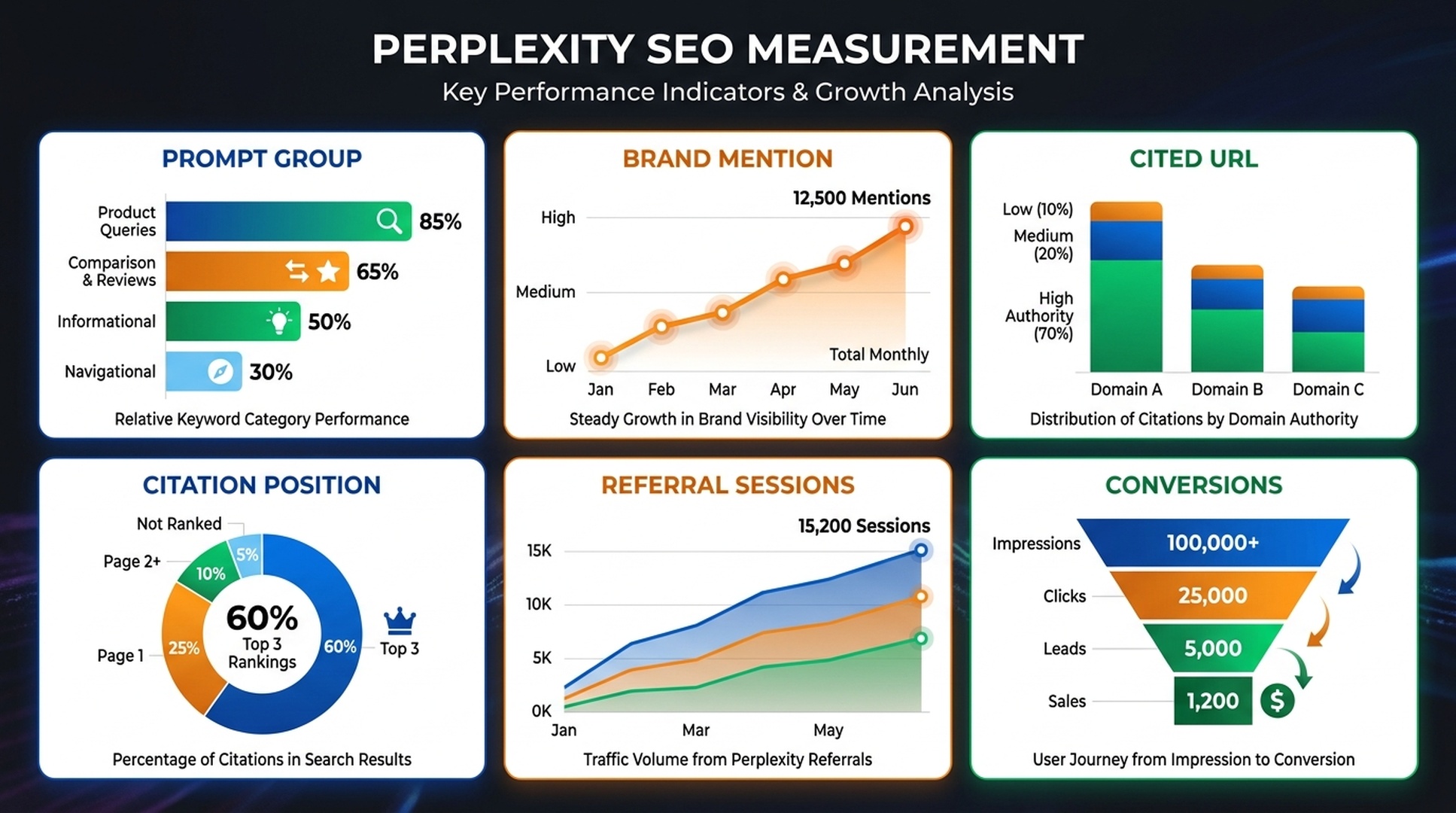
Build a small prompt library first. Use prompts that match real buyer and research behavior, not vanity prompts that force your brand name.
Examples:
Prompt type | Example |
|---|---|
Category discovery | "What are the best AI visibility tools for SaaS companies?" |
Problem-solving | "How can a B2B company track mentions in AI search results?" |
Comparison | "Auspia vs other AI visibility tools for content teams" |
Use-case | "Tools to check whether AI crawlers can access my website" |
Buyer shortlist | "Which tools help marketers measure Perplexity citations?" |
Then track:
- whether your brand is mentioned
- whether your URL is cited
- which page is cited
- where the citation appears
- what claim is attached to your brand
- which competitors appear nearby
- whether the answer sentiment is accurate
- whether Perplexity referral traffic appears in analytics
- whether those sessions convert, assist, or return later
Do not expect clean attribution. AI-search journeys are messy. A user may discover you in Perplexity, search your brand on Google, visit a comparison page, and convert days later. That does not make Perplexity unmeasurable. It means the report needs prompts, citations, referral data, and assisted journey notes.
Relevant Auspia tool: AI Search Visibility Checker.
A 30-day Perplexity SEO plan
This is a practical starting sprint for a small team.
Week | Focus | Output |
|---|---|---|
Week 1 | Access audit | List of priority pages, robots.txt review, WAF/CDN check, log sample, blocked crawler issues |
Week 2 | Source-page rewrite | 5-10 pages updated with direct answers, tables, definitions, dates, and stronger product facts |
Week 3 | Entity and evidence cleanup | Updated About page, Organization schema review, profile consistency check, third-party mention list |
Week 4 | Measurement loop | Prompt library, first citation baseline, referral review, competitor visibility notes |
Do not start with 100 pages. Pick a small set:
- homepage
- About page
- top product page
- top comparison page
- one data or benchmark page
- one practical guide
- one tool page
- one high-intent FAQ or help page
The goal of the first month is not to dominate Perplexity. It is to build a baseline and remove obvious blockers.
Perplexity SEO checklist
Use this before publishing or refreshing a page.
Area | Check |
|---|---|
Access | The page is indexable, returns |
Fetchability | Main content is visible in HTML and not hidden behind login or scripts |
Answer fit | The page gives a direct answer within the first few paragraphs |
Specificity | Claims include facts, dates, numbers, categories, or examples |
Brand clarity | The page names the brand, category, audience, and use case consistently |
Evidence | External claims link to credible sources |
Original value | The page contains something worth citing: data, framework, example, checklist, comparison, or tool |
Freshness | The page shows recent updates when the topic changes often |
Internal path | Readers can move from the cited page to a relevant product, tool, demo, or deeper guide |
Measurement | The target prompt group and success metric are defined before publishing |
A useful rule: if a human researcher would not cite the page, Perplexity probably has little reason to cite it either.
Common mistakes
The most common Perplexity SEO mistakes are not exotic.
Mistake | Why it hurts |
|---|---|
Treating Perplexity like Google rankings | You optimize for position, not citation usefulness |
Blocking AI crawlers by accident | Your pages may be invisible to retrieval |
Writing vague brand claims | AI answers need concrete facts, not slogans |
Publishing pages with no direct answer | The system has to work harder to extract a usable source |
Relying only on owned content | Third-party evidence helps validate your brand context |
Measuring only organic sessions | Mentions and citations may happen before clicks |
Overusing llms.txt as a silver bullet | Access hints cannot replace useful, trusted pages |
Ignoring conversion paths | A cited page can earn attention and still waste the visit |
FAQ
What is Perplexity SEO?
Perplexity SEO is the process of optimizing your website, brand facts, and external evidence so Perplexity can discover, cite, and mention you in AI-generated answers. It includes technical access, answer-ready content, brand entity clarity, third-party signals, and citation measurement.
How is Perplexity SEO different from Google SEO?
Google SEO usually focuses on ranking pages in search results and earning clicks. Perplexity SEO focuses on being selected as a cited source inside an AI-generated answer. Rankings still matter because Perplexity uses web retrieval, but the final visibility surface is different.
How do I get cited by Perplexity?
Start by making sure Perplexity can access your site. Then create pages with direct answers, clear facts, comparison tables, source links, and original value. Strengthen your brand entity across your site and third-party profiles. Finally, track prompts to see which pages are cited and which competitors appear.
Should I allow PerplexityBot?
If you want your content to appear in Perplexity search experiences, review Perplexity's crawler documentation and make an informed access decision. Many growth teams allow relevant AI crawlers for public marketing, product, and educational pages while keeping private or sensitive areas blocked.
Does schema help with Perplexity SEO?
Schema can help clarify entities, organizations, products, FAQs, breadcrumbs, and article metadata. It is not a guaranteed citation trigger. Treat schema as supporting infrastructure, not a replacement for useful content and external evidence.
Is llms.txt required for Perplexity SEO?
No public evidence shows that llms.txt alone guarantees Perplexity citations. It can be a useful machine-readable guide for AI systems, but it should not replace crawlable pages, clear content structure, brand consistency, and real evidence.
How do I measure Perplexity referral traffic?
Check analytics for referrals from Perplexity domains, but do not rely only on referral sessions. Also track prompt visibility, brand mentions, cited URLs, citation position, answer accuracy, and later branded-search or direct-traffic movement.
Sources
- Perplexity Help Center: How does Perplexity work?
- Perplexity Docs: Perplexity crawlers
- Perplexity Docs: API overview
Auspia takeaway
Perplexity SEO is not a trick for forcing citations. It is source readiness.
Make your pages accessible. Make your answers specific. Make your brand facts consistent. Build evidence outside your own site. Then measure what Perplexity actually says, cites, and sends back to your website.
The teams that win will not be the ones that publish the most AI search content. They will be the ones whose pages are easiest to retrieve, easiest to trust, and easiest to use as sources.
Author: Adrian Cole, Analyst of 1,000+ AI Search Results at Auspia. Adrian writes about how brands appear in ChatGPT, Perplexity, Gemini, Google AI Overviews, and other answer surfaces.